On a summer morning in 1954, a young American actress drove an open car along a narrow Mediterranean road called the D37. Cary Grant sat in the front passenger seat. A film crew documented the descent through La Turbie, the hilltop village overlooking the principality of Monaco. The actress was twenty-four years old, an Oscar nominee, a favorite of Alfred Hitchcock, and her photograph had graced the covers of magazines across the Western world.
Grant, seated beside her, was more nervous about refusing to wear his glasses than about the hairpin turns. Twenty-eight years later, in September 1982, the same woman drove the same winding road through the same village, accompanied by her seventeen-year-old daughter, with a back seat full of dresses destined for a boarding school in Paris. The car missed a sharp curve and fell roughly one hundred feet down the roadside embankment. The woman was Grace Patricia Kelly, the daughter of a Philadelphia contracting magnate, a Hollywood career built in five years, a marriage contract worth two million dollars, twenty-six years of confinement she could not leave, and a death on the very road where she had once filmed a movie with Cary Grant.
Kelly was born in Philadelphia on November 12, 1929, the third of four children. Her father, Jack Kelly, was the son of Irish immigrants. He had started as a bricklayer and, with a seven-thousand-dollar loan from his brothers, built Kelly for Brickwork into one of the largest contracting firms on the East Coast. He was also one of the great amateur athletes of his generation.
At the 1920 Antwerp Olympics, he won the single sculls, beating the British oarsman Jack Beresford by a second, and then, about half an hour later, won the double sculls with his cousin Paul Costello. At the 1924 Paris Games, he and Costello won the double sculls again, making Kelly the first rower in Olympic history to collect three gold medals. He ran for mayor of Philadelphia in 1935, losing narrowly in a city that usually buried Democrats by three hundred thousand votes. During the war, Franklin Roosevelt appointed him to a senior post in the national physical fitness body.
His brother George won the Pulitzer Prize for drama, and his brother Walter worked in Hollywood vaudeville. Jack Kelly ran his household the way he ran his contracting business. He believed firmly that Grace’s older sister Peggy would be the family star. Grace, by the family’s repeated judgment, came second.
Anything Grace could do, Peggy could do better. Grace was a quiet child, asthmatic, frequently barred from the athletic events that were the center of family life. She spent hours at home with books and dolls and small plays she staged for herself in the upstairs rooms. Her father considered acting, as he later made plain, little better than prostitution.
Yet she went ahead anyway, and the path she took intersected exactly with her family’s own contradictions. To enter the American Academy of Dramatic Arts in New York, she auditioned with a scene from her uncle George Kelly’s play The Torch-Bearers. She was accepted after an interview, accepted on the strength of George’s influence, which her father openly resented, the Pulitzer-winning uncle opening the door the gold-medal father wanted shut. She left Philadelphia and her father’s refusal, and settled into the Barbizon Hotel for Women on East 63rd Street in Manhattan, a building designed to reassure anxious parents.
Men were barred from the upper floors. Guards and elevator operators enforced the rule. Room inspections confirmed every resident was in place before curfew, and a late arrival was questioned at a desk that watched the door. She staged a career as a model to pay her way, appeared in live television during the era of live broadcasts, and by the time she graduated she had television work, a portfolio of fashion photographs, and a face the camera caught in a way that came along maybe once in a generation.
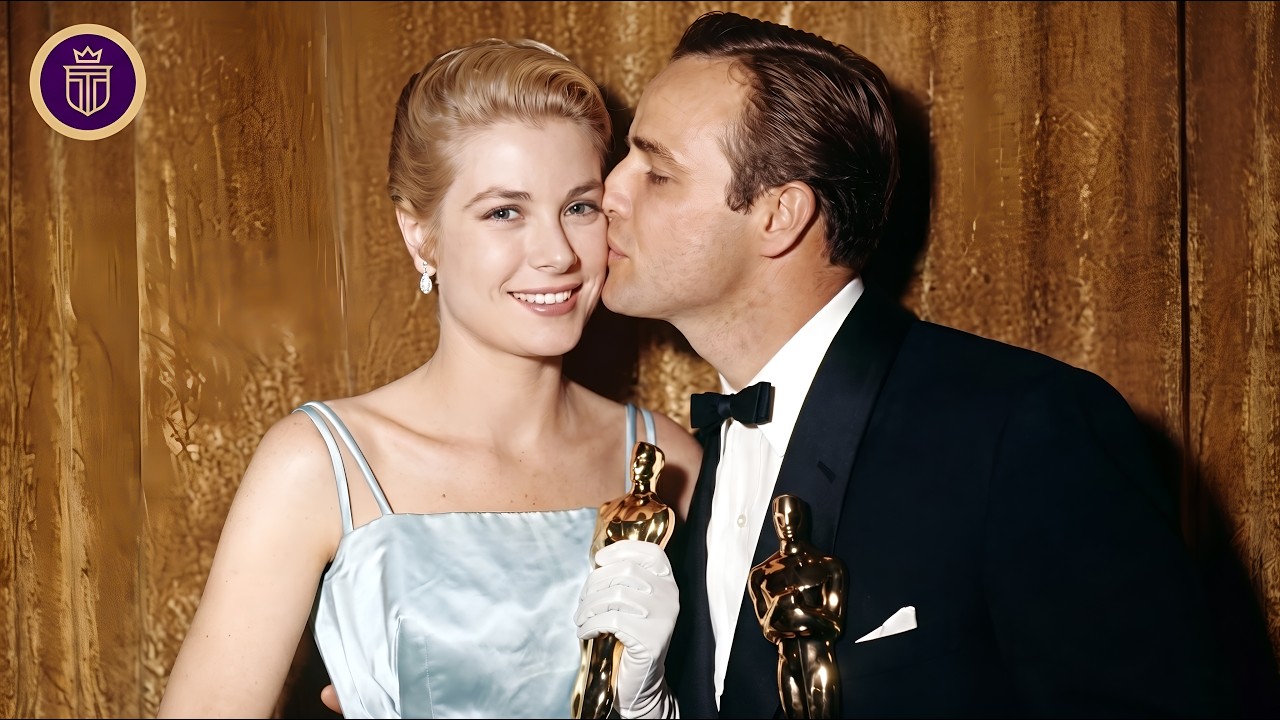
Between 1951 and 1956, the Barbizon curfew translated into eleven feature films, an Oscar, and three collaborations with the most famous director in the English-speaking world. She won the Oscar for Best Actress for The Country Girl at the twenty-seventh Academy Awards ceremony on March 30, 1955, beating Judy Garland, the heavy favorite, by only six votes. Hitchcock built his films around her distinctive qualities, that calm exterior suggesting latent warmth, the aristocratic blonde who seemed untouchable, photographed so that her appearance became the subject of the film. The image was deliberate, carefully designed, and immensely valuable.
It stuck to her so completely that it accompanied her to the cathedral and to the throne. Her reputation, built by the studio system around her, came to the surface in 1954. Her costar in Dial M for Murder was Ray Milland, a married man nearing fifty. This time the affair was confirmed rather than rumored.
Grace and Milland made little effort to hide it. Her sister Lizanne called the relationship very serious. The studio learned how serious when a public relations staffer sent to Milland’s apartment on business found Grace answering the door. Milland’s wife Muriel, told by her sister who followed the pair to the airport, separated from him.
The columnist Hedda Hopper, one of the two most feared gossip journalists in America, denounced Kelly as a man-chaser, a term designed to end women’s careers while leaving the men beside them untouched. The label stuck. Milland calculated, decided his wife owned the property in her name and divorce would be financially ruinous, reconciled with Muriel, and remained married until his death in 1986. Grace gained a reputation that overshadowed the rest of her career.
In The Country Girl, she shed her glamour to play the exhausted, bitter wife of an alcoholic singer. That performance was what the Academy rewarded. The most striking thing about the win was the silence from Philadelphia. She had won the Oscar to be seen, and the man against whom she had built everything looked, as always, somewhere else.
Oleg Cassini, the fashion designer who sought her hand, was refused by Jack Kelly on the grounds that he was twice divorced, foreign-born, and in the women’s clothing trade. Grace could not ultimately oppose her father. She ended the relationship. On May 6, 1955, an electrical strike delayed preparations, and Grace Kelly met Prince Rainier III of Monaco at a photo session arranged by Paris Match.
Rainier had been looking for a wife for several years. By 1955, the number of acceptable European Catholic brides had shrunk to a small group, each name carrying unwelcome political meanings. The American actress, in her own way, was a suitable political choice. She belonged to no European royal family and brought no inherited grudges to the alliance, only a film career, wealth, and a face that could solve Monaco’s image problem at once.
Rainier also had a constitutional need for a wife, written into the Franco-Monégasque Treaty of July 17, 1918, which had tied the principality’s future to France in a way that made producing an heir a matter of state survival. Without a successor acceptable to the French government, Monaco risked becoming a protectorate under French sovereignty. He had been seeking a bride for years, and his earlier serious relationship with French actress Gisèle Pascal had reportedly ended partly due to doubts about her fertility. Grace had to undergo a medical examination to confirm her fertility before the engagement was completed.
What Rainier could not provide was the money to make the marriage commercially viable on his court’s terms. He needed a wealthy father. The price was two million dollars, roughly a million drawn from Grace’s Hollywood earnings. Jack Kelly grumbled that his daughter should not have to pay anyone to marry her, but the arrangement went through.
A civil ceremony was held on April 18, 1956 in the palace throne room, and the following day the religious ceremony took place at Saint Nicholas Cathedral before six hundred guests. The dress took twelve hundred hours to embroider. About thirty million people watched on black-and-white television across Europe through Eurovision. The New York Herald Tribune counted eighteen hundred journalists.
Rainier struggled to place the ring on her finger, a moment Grace later explained had been staged in advance, an intentional gesture to show her readiness. Even that single spontaneous moment of the day turned out to be part of the design. In the end, she had organized her entire life to be seen by a man who refused to look at her. On April 19, 1956, she built a colossal stage on which thirty million people watched her.
Her father had no choice but to sit in the front row of the cathedral and watch his daughter become a princess. She paid part of the money she had earned herself to secure his seat from her film earnings in exchange for her passage to the throne. Grace was required to give up acting, move permanently to Monaco, and renounce her American citizenship. Rainier announced shortly after the wedding that she had agreed to end her Hollywood career, and her films were banned from the principality.
The boundaries of the estate her father had begun in Philadelphia and the Barbizon had simply moved to another jurisdiction. In 1962, when an attempt to return to the screen for a Hitchcock film was announced, the palace was met with resistance from the principality, from MGM, and ultimately Rainier decided the timing was wrong. She withdrew. She never acted in a commercial feature again, though she made a short film titled Rearrangement years later.
According to accounts from those close to her, Rainier’s infidelities reportedly began during her honeymoon pregnancy period, and she told her hairdresser she knew of his betrayals and was deeply unhappy about them. In later years married life was conducted as two parallel lives in two cities, with Grace living in Paris. By the late 1970s, the route out of the principality for the last time was the road she had once descended with Cary Grant twenty-eight years earlier. On the morning of September 13, 1982, Grace set out from the family country home at Roc-Agel returning to the palace with her seventeen-year-old daughter Stéphanie, the back seats filled with Stéphanie’s dresses for her return to school in Paris.
Grace drove herself instead of the chauffeur. She had complained of a headache that morning. The road was the D37, the narrow, winding route descending through La Turbie, one of the places where she had filmed scenes for To Catch a Thief in 1954. Whether it was the exact same stretch of road remains disputed, but she had passed through the village before, driving with the camera rolling and Cary Grant beside her, more nervous about refusing to wear his glasses than about the curves.
At about 9:45 that morning, she was recognized by a policeman when she stopped to let his car pass. Minutes later, at a sharp curve, the car failed to slow, lost control, left the road, fell about thirty meters down the slope, and came to rest on its roof. Stéphanie climbed out from the wreckage, begging the people who rushed over to call the palace. Grace was unconscious, head wound and twisted leg, and never regained consciousness.
Doctors found she had suffered a stroke before the accident through the fall, and a second hemorrhage in the hospital was the immediate cause of death. On the night of September 14, 1982, after consulting Caroline and Albert, Rainier removed life support, and Grace died at 10:55 that evening, aged fifty-two, at the age of fifty-two, and was buried in the same cathedral where she had been married twenty-six years before, in the same cathedral where she married twenty-six years before, in the same cathedral she was married in twenty-six years earlier, attended by all who had known her, Cary Grant and Nancy Reagan among them, while Stéphanie lay in the hospital, spinal fractures keeping her away. Rainier never remarried. When he died on April 6, 2005, he was buried beside her in the cathedral.
More than four decades after her death, the principality continues to organize much of its public identity around her memory. Her image appears on the coinage of Monaco, in tourist materials, on commemorative stamps, and on the foundation bearing her name that still funds the arts. For the twenty-six years she spent inside a principality she could not leave, the calm she carried with her to a film set and, in the end, to a mountain road, was the one place Grace Kelly ever truly had to herself. The calm was hers to the very end.
As for the road, it took what remained, the calm she carried with her down the cliff.