George Brinton McClellan arrived in Washington in the summer of 1861 like a man who had been cast for the role in advance. He was thirty-four years old, a West Point graduate who had finished second in his class, a veteran of the Mexican-American War, and an official observer of European armies in Crimea. When the Union suffered its humiliation at Bull Run, where picnicking spectators ended up tangled in the same panicked retreat as the soldiers, Abraham Lincoln called him to Washington and handed him command of what would become the Army of the Potomac. The newspapers named him the Young Napoleon almost immediately, and a public hungry for a hero was eager to believe it.
McClellan embraced the role. He wrote to his wife that July that the president, the cabinet, and General Scott all deferred to him. “By some strange operation of magic,” he told her, “I seem to have become the power of the land. ” He was not wrong about the deference.
What he was catastrophically wrong about would take another year to reveal itself. When McClellan took command, the Army of the Potomac was not really an army. It was a disorganized collection of ninety-day volunteers who had just watched their comrades break and run at Manassas. Morale was shattered, supply lines were a mess, and the chain of command was a tangle of political appointments and bruised egos.
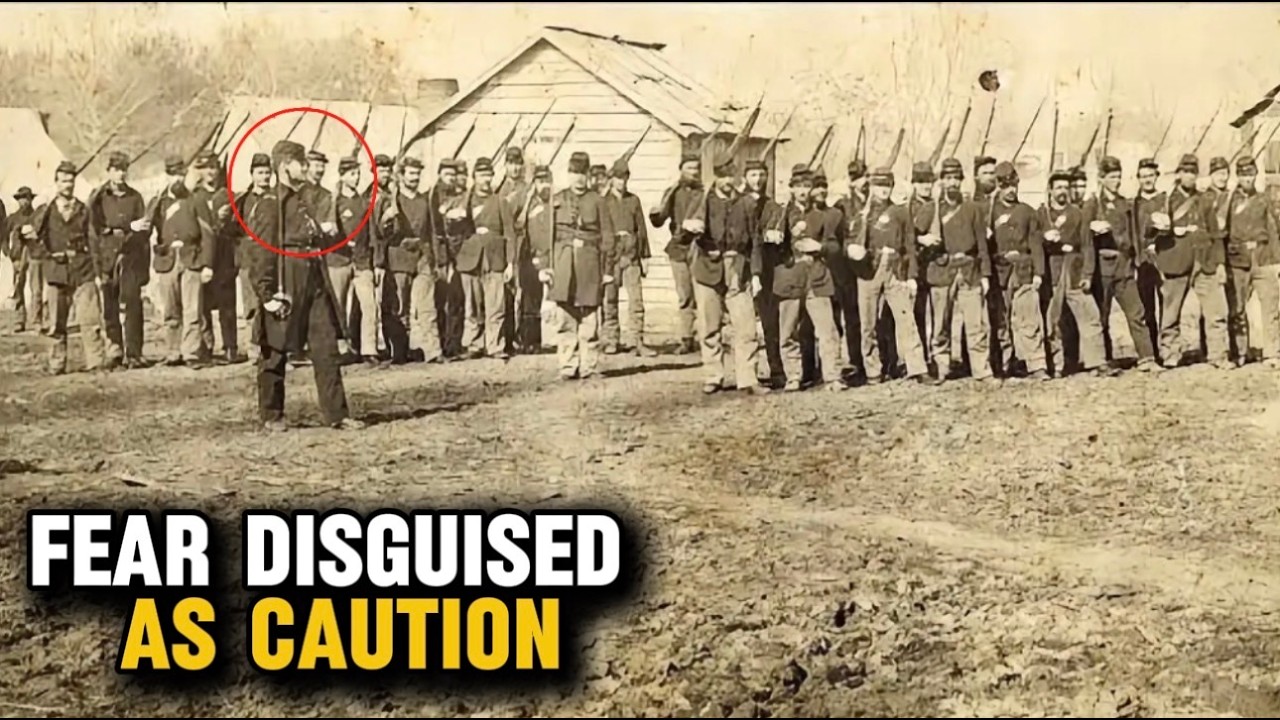
McClellan looked at this problem and genuinely solved it. Within months the army was a functioning military force. Drilling was relentless, supplies were organized, the sick were treated, and artillery was formed into defined batteries. McClellan moved through the camps personally and frequently, and the soldiers responded to him with something close to worship.
They called him Little Mac and threw their hats in the air when he rode by. Whatever else he was, McClellan could make men want to fight for him. The tragedy is that he was far less willing to ask them to. The winter of 1861 into 1862 stretched on, and the Army of the Potomac did not move.
Lincoln asked. The cabinet asked. Newspaper editors who had celebrated McClellan’s arrival grew frustrated. McClellan, reorganizing, inspecting, planning, requesting more men and more equipment, insisted his army was not ready.
He claimed the Confederate forces at Manassas under Beauregard and Johnston numbered 150,000 or more. In reality, the Confederate force in northern Virginia was somewhere around 45,000. His intelligence officer, Allan Pinkerton, fed him inflated numbers, but McClellan was not a passive recipient of these estimates. He embraced them with a consistency that suggested something beyond gullibility.
He needed the enemy to be larger than it was, because a massive Confederate force justified not moving, and not moving was what he intended to do until he was certain he could not fail. He was not a coward in any conventional sense. He had demonstrated real courage under fire in Mexico. What he could not tolerate was the possibility of defeat, not the wounds or death battle involved, but the humiliation of a campaign that went wrong.
He had built an identity on being the exceptional man who succeeded where others failed, and he could not subject that identity to the risk that serious military operations require. Every offensive he planned was postponed because the conditions for guaranteed success were never present. Guaranteed success in war is a mirage. Waiting for it is another name for paralysis.
Lincoln was patient with McClellan in a way that defied expectations. He endured the delays and absorbed the condescension, and McClellan was openly condescending, referring to Lincoln in private correspondence as the “original gorilla” and a “well-meaning baboon. ” Lincoln understood that McClellan had built something real, and that replacing him carelessly carried its own risks. But the turning point came in March of 1862.
Confederate General Johnston decided his position at Centreville and Manassas was untenable and withdrew southward. When Union cavalry probed the abandoned lines, they found that several of the fearsome Confederate artillery positions were occupied by logs painted black to resemble cannon barrels, positioned to make the lines appear fortified. These were what soldiers called Quaker guns. Johnston had fooled the most decorated general in the Union Army with painted wood.
This was the context for the Peninsula Campaign of spring 1862. McClellan’s plan was genuinely ambitious. Instead of marching overland toward Richmond, he would move the army by water down the Chesapeake Bay to Fort Monroe at the tip of the Virginia Peninsula, then advance toward Richmond from the southeast. It was a sensible concept.
What he encountered in early April was a Confederate defensive line at Yorktown, where Washington and Rochambeau had besieged Cornwallis eighty years earlier. The line was commanded by John Bankhead Magruder, a theatrical general with roughly 13,000 men. McClellan had about 70,000 available, with more arriving. He could have forced the line, and several of his core commanders believed he could have.
Instead he halted, declared it too strong for direct assault, and began siege preparations. Magruder helped the illusion along magnificently. He marched his men in circuits through visible gaps in the tree line so that the same regiments appeared to be multiple units. Union observers consistently overestimated the Confederate strength.
After a month, Johnston simply withdrew again, this time toward Richmond. McClellan reported this as a success, but the reality was that roughly 13,000 men had held up the advance of 70,000 for a month through nothing more aggressive than a bluff. The campaign moved forward through May. When Johnston attacked McClellan at Seven Pines in late May, the assault was poorly coordinated and Johnston himself was badly wounded.
The opening this created for Robert E. Lee made Johnston’s wounding one of the most consequential events of the war for the Confederacy. Lee saw that the Confederate strategic situation was not sustainable. The Confederacy was smaller, less industrialized, and less populous.
The way to reverse that arithmetic was to fight offensively, to threaten the North’s will to continue the conflict, and in his operational instincts Lee was one of the most aggressive commanders either side produced. In late June 1862, Lee launched a series of attacks against McClellan’s army in what became known as the Seven Days Battles. The Confederate attacks were often poorly coordinated and took punishing casualties, especially at Malvern Hill, where Union artillery on high ground disassembled Confederate formations before they could close to rifle range. McClellan’s army was not defeated in any strict tactical sense.
But his response was to retreat, a full retreat to a new base at Harrison’s Landing, abandoning the offensive entirely and leaving the initiative wholly to Lee. During those days McClellan sent a telegram to Secretary of War Edwin Stanton blaming the government for the situation and telling him plainly, “If I save this army now, I tell you plainly that I owe no thanks to you or any other persons in Washington. You have done your best to sacrifice this army. ” The officer who received the message in Washington deleted those paragraphs before letting Stanton see it, apparently deciding that the full version would be professionally catastrophic for the general who sent it.
When Lincoln visited Harrison’s Landing in early July, McClellan handed him an unsolicited letter arguing against the confiscation of Confederate property, against measures targeting slavery, and for a war conducted without disturbing the existing social order of the South. Lincoln read it, thanked him, and left. The Army of the Potomac was eventually withdrawn from the peninsula and placed under John Pope. When Pope was crushed at Second Bull Run in late August, leaving the road to Washington dangerously exposed, Lincoln reinstated McClellan to command the combined forces defending the capital.
His cabinet was enraged. Lincoln, understanding their anger, said that McClellan had a particular gift for taking a demoralized army and making it ready to fight. But he also gave the famous assessment: “He has the slows. ”
September brought McClellan the greatest gift any commander receives.
Lee had crossed the Potomac into Maryland with roughly 40,000 men, intending to take the war north. On September 13th, Union soldiers near Frederick discovered a packet of papers wrapped around three cigars. It was Special Orders No. 191, Lee’s operational order detailing the positions and routes of every Confederate force in Maryland.
It reached McClellan that afternoon. He reportedly told a visiting friend, “Here is a paper with which, if I cannot whip Bobby Lee, I will be willing to go home. ” He knew Lee’s entire plan. His own army outnumbered Lee’s significantly.
McClellan waited sixteen hours before moving. During that time a Confederate sympathizer may have warned Lee that the order had been found, and the Confederate army began a frantic consolidation. When the armies finally met at Antietam Creek on September 17th, Lee had concentrated a sufficient portion of his army. Antietam was the bloodiest single day in American military history.
Roughly 23,000 men were killed, wounded, or missing between sunrise and sunset. McClellan’s plan was straightforward, but the execution was sequential rather than simultaneous, allowing Lee to shift his limited reserves to each threatened point. Late in the afternoon, A. P.
Hill’s division arrived from Harpers Ferry after a forced march of seventeen miles and stopped the moment when a final push might have broken Lee’s exhausted right flank. But there was also something present on McClellan’s side that did not enter the fight: Fitz-John Porter’s Fifth Corps, roughly 20,000 men held in reserve who never fired a shot. Lee’s army never broke through his lines. It never came close.
Lee crossed back into Virginia on the night of September 18th. McClellan reported a victory, and in the narrow sense it was true. The invasion had ended, and Lincoln used the moment to issue the preliminary Emancipation Proclamation. But McClellan did not pursue.
Lincoln, visiting the army in early October and seeing a fit, well-supplied force sitting still, reportedly said it was McClellan’s bodyguard. The pursuit that finally began in late October moved so slowly that Lee had time to interpose his army between McClellan and Richmond. On November 5th, 1862, Lincoln relieved McClellan of command for the last time. Soldiers wept at his farewell.
At least one general urged him to march on Washington. McClellan declined, and whatever his failures, he was not willing to add military coup to the list. He went to Trenton, where he waited for a political opportunity. The Democratic Party nominated him against Lincoln in 1864.
He lost badly, partly because Sherman’s capture of Atlanta transformed the political landscape and partly because the Democratic platform calling for a negotiated peace was repudiated by most of the soldiers whose votes he had expected to win. The army voted overwhelmingly for Lincoln. Afterward McClellan served one term as governor of New Jersey and wrote his memoirs, a defensive document published posthumously under the title McClellan’s Own Story. He died in 1885 at fifty-eight.
The case against McClellan is not a collection of isolated mistakes. It is one recurring failure dressed in different clothes across two years of command. He was outbluffed by painted logs at Centreville, outbluffed by a theatrical general with a fraction of his numbers at Yorktown, and handed the rarest intelligence windfall in the war’s eastern theater only to spend sixteen hours standing still while its value drained away. At Antietam he held 20,000 men off the field with Lee’s back to the Potomac.
His arrogance and his timidity were not contradictions. They were the same thing operating at different registers. He was brilliant at building armies and congenitally unable to use them. The more complicated question is whether some criticism reflects not just his actual failures but the frustration of a Union that expected easy victory.
The Confederate Army in 1861 and 1862 was a formidable opponent. The disasters that followed his dismissal, Fredericksburg under Burnside and Chancellorsville under Hooker, show that McClellan was not uniquely bad among the Army of the Potomac’s commanders, and the army did not find a commander fully equal to the task until Grant arrived in March of 1864. That does not rehabilitate McClellan. It contextualizes him.
He was not a fraud, not a coward, and not a traitor, though some opponents suggested it. He was something perhaps more damaging than any of those. He was a man skilled enough to be given everything and cautious enough never to spend it. The men who served under him never stopped loving him, and their affection does not change the operational record.
What he gave the Union was real, and what he withheld from it was catastrophic. The tragedy is precisely that those two things lived inside the same man.