The farmers who worked the fields outside Gettysburg, Pennsylvania, had no idea what was about to happen to their land. In late June 1863, the most powerful Confederate army ever assembled was marching north through the Cumberland Valley, stripping the countryside of cattle and grain, and nobody on either side had yet decided that this crossroads town would be the place where anything important occurred. The collision that followed was not planned. It grew out of bad timing, bad intelligence, wounded pride, and a commanding general who had begun to believe he could not lose.
By the time it was over, more than 50,000 men had been killed, wounded, captured, or gone missing. No single engagement in American history has ever matched those numbers. Robert E. Lee crossed the Potomac in June 1863 carried by a wave of momentum that had begun to look almost supernatural.
In thirteen months, he had taken command of a Confederate army nearly pushed out of Richmond and turned it into a force that had defeated every Union general sent against it. He had smashed John Pope at Second Bull Run. He had humiliated Ambrose Burnside at Fredericksburg so badly that Union bodies piled up along a stone wall like cordwood. He had outmaneuvered Joseph Hooker at Chancellorsville with an army half the size of his opponent and sent the entire Union force fleeing back across the Rappahannock.
His subordinates were devoted to him. His soldiers believed they were invincible. And Lee himself had come to trust his own instincts with a certainty that was beginning to shade into something more dangerous than confidence. The march north had a logic.
Virginia’s farmland had been picked over by two years of war and could barely sustain the army. Pennsylvania was untouched, rich with livestock and stored grain. A Confederate army operating deep in Union territory would force Washington to respond. It might also do something Lee had been trying to achieve for more than a year: compel the Lincoln administration to negotiate, or push the northern public to demand an end to the war.
Confederate commissioners were already in Canada. Peace Democrats in the north were exhausted by the casualty lists. One crushing defeat on northern soil, Lee believed, might be enough to break the political will to continue fighting. What he did not have, riding into Pennsylvania, was his eyes.
J. E. B. Stuart and the Confederate cavalry had ridden off on a raid around the Union army and vanished, leaving Lee without reliable intelligence about where the Army of the Potomac actually was or how fast it was moving.
Lee was operating in enemy territory through unfamiliar roads and terrain with no real sense of where his opponent was. He knew Hooker had been replaced by George Gordon Meade, a steady, unspectacular Pennsylvanian who had commanded a corps at Fredericksburg and Chancellorsville without particular distinction but without catastrophic failure either. Meade had been in command for three days when the fighting started. He had not wanted the job.
The opening contact on July 1 was an accident of logistics. Henry Heth, a division commander in A. P. Hill’s corps, sent his men toward Gettysburg because he had heard there were shoes stored in the town warehouses, and his men needed shoes.
What he found instead was John Buford’s Union cavalry division, which had arrived the previous evening and spread out along McPherson’s Ridge west of town. Buford recognized immediately that whoever held the ridges south and east of Gettysburg controlled every road feeding into the town. He posted his troopers to delay the Confederate advance and sent word for Union infantry to come fast. Heth’s men pushed forward expecting little resistance and ran into a fight neither side had authorized.
The cavalry held longer than anyone expected. When the First Corps arrived under John Reynolds, one of the finest officers in the federal service, the battle locked in with a fury that announced this would be no minor skirmish. Reynolds was killed within the first hour, shot from his horse while directing troops into McPherson’s Woods. The Union line bent and broke and was driven through the streets of Gettysburg by the end of the afternoon, survivors streaming south to the high ground at Cemetery Hill.
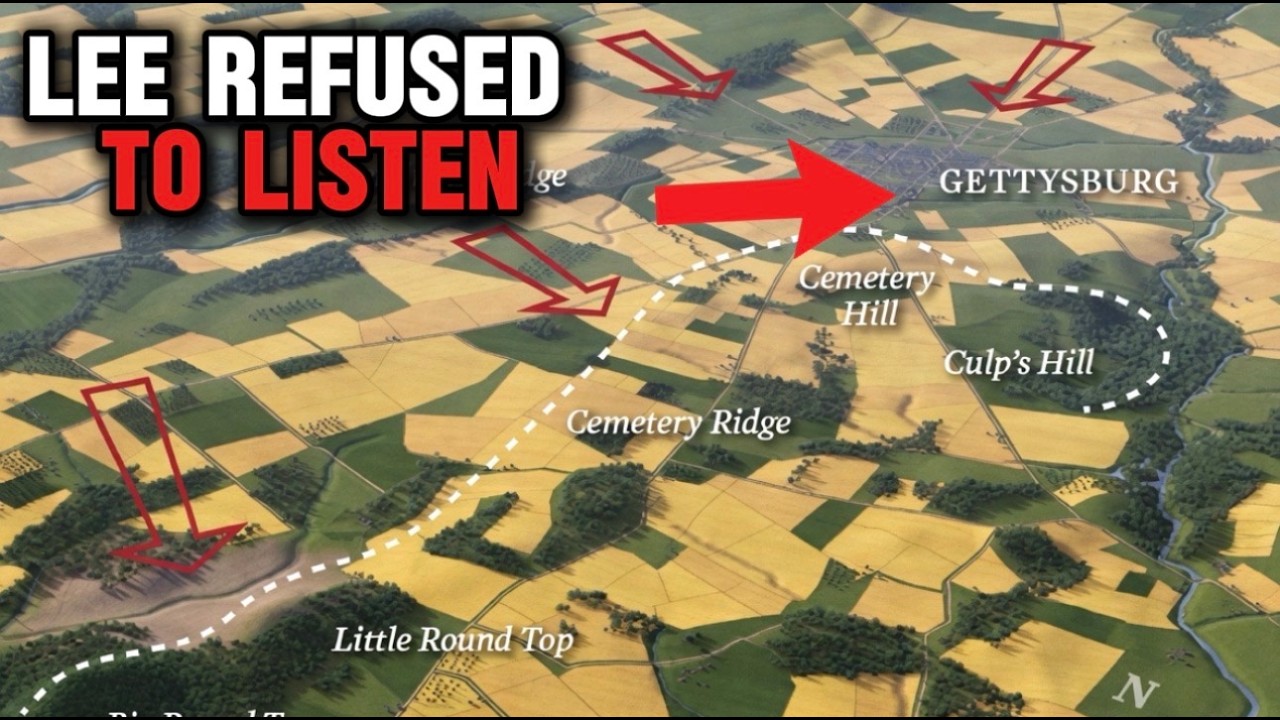
What the broken Union troops found when they reached Cemetery Hill was more ground a good soldier could love. Cemetery Ridge ran south from the hill like a long low spine, ending at two rocky eminences called Little Round Top and Big Round Top. To the west, across roughly a mile of open fields, lay Seminary Ridge, where the Confederates were consolidating. The valley between them was farm country: wheat fields, orchards, a peach orchard, and a jumble of boulders locals called Devil’s Den.
On the night of July 1, as both armies fed more troops into the area, the stage was set for something enormous. The argument that has never fully resolved itself in Civil War scholarship is what Lee should have done next. James Longstreet, his most experienced corps commander and the man Lee called his warhorse, looked at the Union position on Cemetery Ridge and told Lee plainly that it was too strong to attack frontally. Longstreet wanted to swing the army south, get between Meade and Washington, force the Union army to come off the high ground, and attack on ground of their own choosing.
Lee dismissed it. The Union army was right there, he said. He would attack it. On the afternoon of July 2, Longstreet’s assault against the Union left began, and it came close to success.
The attack swept through the Peach Orchard, where Dan Sickles had advanced his Third Corps without orders into an exposed salient that left both flanks hanging in the air. Confederate troops pushed through the wheat field in waves of brutal close-range fighting. The ownership of that ground changed hands six times in a single afternoon. Hood’s division crashed into Devil’s Den and tried to climb Little Round Top, the southern anchor of the entire Union line, which had been left almost completely undefended because the officer responsible for it had ridden forward with a telescope to watch the fighting and forgotten to post troops on the hill.
The man who saved Little Round Top was a former college professor from Maine named Joshua Chamberlain, commanding the 20th Maine Volunteer Infantry Regiment. He was ordered to hold the far left of the Union line at all costs. His men were exhausted, outnumbered, and running out of ammunition. The 15th Alabama under William Oates came up the slope again and again, and each time Chamberlain’s men threw them back.
When the ammunition was nearly gone and another assault was coming, Chamberlain ordered his regiment to fix bayonets and charge downhill into the attacking Confederates. The shock broke the Alabama assault entirely. Little Round Top held. Elsewhere on July 2, Confederate troops came within yards of breaking through.
Louisiana Tigers nearly seized East Cemetery Hill after dark, fighting their way through Union artillery before being driven back with rifles used as clubs. Richard Ewell’s assault on Culp’s Hill gained a foothold in the outer Union trenches before being contained. The day’s fighting had pushed the Army of the Potomac to the edge of its endurance. Meade called his corps commanders together that night in a farmhouse near the cemetery and asked them directly whether to stay or retreat.
They voted to stay. What drove July 3’s casualty numbers to staggering heights was a decision Longstreet considered so mistaken that he later wrote he had never wanted to give the order and had waited, hoping Lee would change his mind. Lee had decided to send a massive infantry assault directly at the center of the Union line on Cemetery Ridge. The objective was a small grove of trees that became known afterwards simply as the Angle.
Meade had predicted the night before, almost exactly, that Lee would strike his center the next day. The Union artillery chief, Henry Hunt, had quietly reserved ammunition and positioned his guns with care. Winfield Scott Hancock’s Second Corps had spent the night digging in along the ridge. The assault force numbered roughly 12,500 men organized around three divisions: George Pickett’s fresh Virginians, Johnston Pettigrew’s division, and Isaac Trimble’s two brigades.
Before they moved, Lee ordered a massed artillery bombardment of the Union center, the largest cannonade ever assembled on the North American continent, nearly 170 Confederate guns opening simultaneously. The noise was heard in Pittsburgh. The smoke was so dense that Confederate gunners could not see where their rounds were landing, and most were overshooting the ridge and exploding harmlessly behind Union lines. When Hunt ordered his own guns to go silent to conserve ammunition, the Confederate artillery chief interpreted the silence as evidence the Union guns had been destroyed and sent word for the infantry to advance.
George Pickett asked Longstreet for the order to go. Longstreet, unable to bring himself to speak it, simply lowered his head. Pickett took that as a yes, rode to his division, and sent them forward. What followed was the most famous infantry assault in American military history, and it was catastrophic from the first step.
The men stepped out from the tree line on Seminary Ridge in parade-ground formations and began walking across nearly a mile of open ground toward a position they could see waiting for them. There was nowhere to shelter. Union artillery opened immediately, not with drained guns, but with full batteries that had been waiting. Shellfire tore gaps in the Confederate lines that closed and closed again as the men kept moving forward with a discipline Union soldiers watching from the ridge acknowledged was unlike anything they had ever seen.
Union infantry along the stone wall at the Angle began volley fire at four hundred yards, then three hundred, then closer. Regiments on Pickett’s flanks were hit by enfilading fire from Union troops positioned at angles to the advance. Pettigrew’s division on the left was shredded. Trimble’s brigades tried to fill the gaps and were destroyed in the attempt.
A small Confederate force actually broke through the stone wall at the Angle, roughly two hundred men under Lewis Armistead, who put his hat on his sword and led them over the wall in a moment artists have been painting ever since. Armistead fell mortally wounded within minutes, shot down among the Union artillery he had reached. His men were surrounded and killed or captured almost immediately. The entire assault lasted less than an hour.
Of the 12,500 men who stepped out of the trees, more than half were casualties. Some units lost three-quarters of their strength. Pickett’s three brigade commanders were all casualties. Every regimental commander in his division was killed or wounded.
When Lee rode out to meet the survivors streaming back, he told them the failure was entirely his fault, that it had been his plan and his mistake. The dead and wounded covered a mile of Pennsylvania farmland. In the wheat field alone, bodies lay so thickly that a person could walk across the ground without stepping on grass. The 1st Minnesota Infantry Regiment had charged a Confederate brigade on the evening of July 2 to buy Hancock time to bring up reinforcements and suffered 82 percent casualties in roughly five minutes, the highest loss rate of any Union regiment in a single engagement during the entire war.
Why did the killing reach such extraordinary levels at Gettysburg specifically? Part of the answer is the nature of Civil War tactics meeting Civil War weapons. The standard infantry rifle by 1863 was the Springfield or Enfield muzzleloader firing a minie ball, accurate to several hundred yards and inflicting wounds so severe that a man hit in an arm or leg usually lost it, and a man hit in the abdomen or chest usually died. These rifles had an effective range three to four times longer than the smoothbore muskets of the Napoleonic era, but infantry commanders were still using assault tactics that worked when muskets could barely hit a man at a hundred yards.
The result was formations of men walking upright into accurate fire at ranges where the shooter had time to aim, fire, and reload. The ground at Gettysburg made this worse. Cemetery Ridge, Little Round Top, and Culp’s Hill were exactly the kind of elevated defensible terrain that allowed a smaller force to multiply its effective firepower. An attacker climbing a slope is slower, more exposed, and more winded than a defender crouching behind a stone wall at the top.
The open fields between the ridges offered attacking infantry almost nothing: no cover, no concealment, no avenue of approach that wasn’t fully visible to the defenders. The Union artillery deserves particular attention because its role is often underestimated relative to the dramatic imagery of massed infantry. Hunt’s batteries on Cemetery Ridge fired canister shot at the Confederate infantry as they closed, tin canisters packed with iron balls that turned each artillery piece into an enormous shotgun capable of cutting down entire files of men with a single discharge. The combination of rifle fire and canister at close range was what finally disintegrated the Confederate assault.
Lee retreated on July 4, the same day Vicksburg fell to Ulysses Grant nearly a thousand miles to the southwest. His army was battered but intact, and it would fight on for nearly two more years. Meade pursued too cautiously and failed to cut off the Confederate retreat at the Potomac, a hesitation that enraged Lincoln. But the Army of Northern Virginia that crossed back into Virginia was not the same army that had crossed north.
It had left roughly 28,000 casualties in Pennsylvania. It would never again operate offensively outside Confederate territory. The ground at Gettysburg became a national cemetery before the year was out. Lincoln came in November to speak at its dedication and produced in a few minutes a statement about what the war meant and what the dead had died for that has outlasted every speech made by every general or politician of that era.
The soldiers buried there, he said, had consecrated the ground far beyond anything the living had power to add or detract. Gettysburg was not the war’s most strategically significant battle. Vicksburg arguably had a larger effect on the Confederacy’s long-term survival. But it was the moment when both sides were forced to look at what this war actually was, what it cost, and where it was going.
The Army of the Potomac had held. The Army of Northern Virginia had broken itself against that ridge and would spend the rest of the war fighting on its back foot. The summer of 1863 was the hinge on which the whole thing turned, and the Pennsylvania crossroads town where a Confederate infantry general went looking for shoes is where the hinge cracked open.