In the early 1950s, Frank Sinatra sat at a table in a photograph that captured a man falling apart. A cigarette burned between his fingers, but his eyes were somewhere else entirely, fixed on a memory he could not escape. By then, he had lost nearly everything. His voice had failed him.
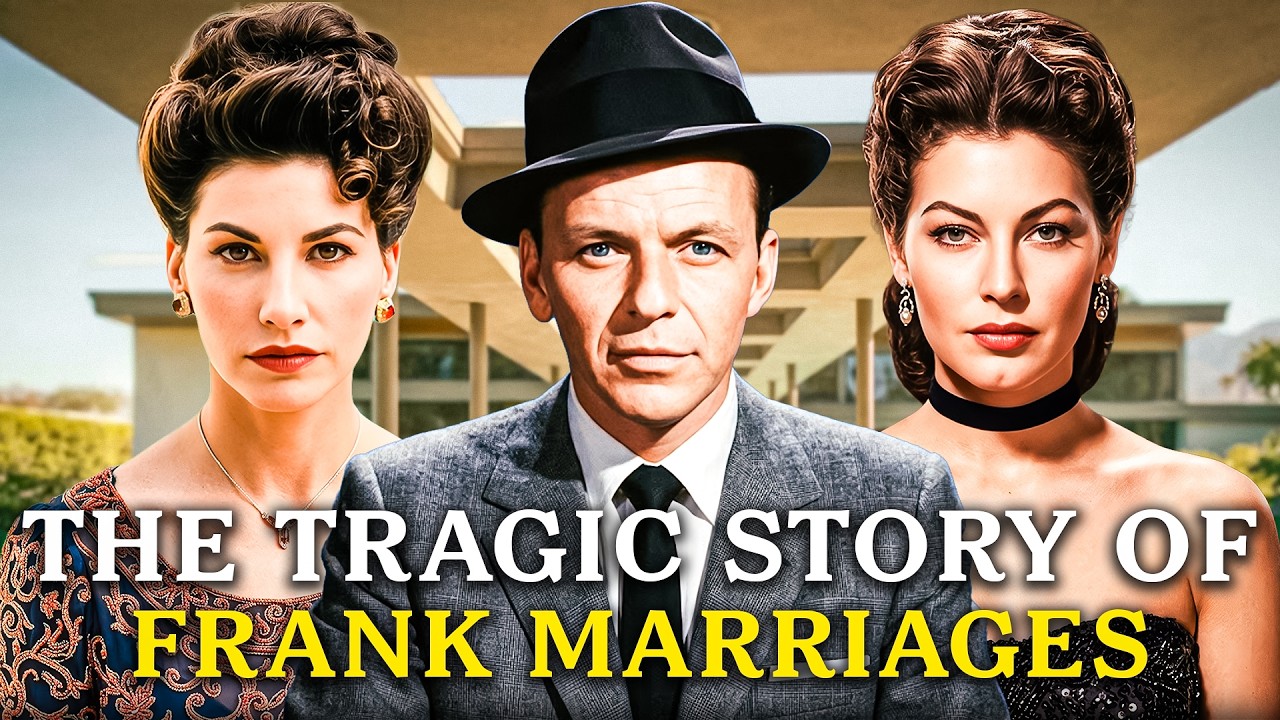
His record label had dropped him. Hollywood, which had once built him into a god, now treated him as a has-been. The teenage girls who had screamed his name in theaters in 1942 no longer noticed him. And the woman he loved more than any stage, the one who made him feel alive in a way fame never had, was tearing him apart from the inside.
To understand what Frank Sinatra became, you have to understand where he started. He was born on December 12, 1915, in Hoboken, New Jersey, to Sicilian immigrants Antonino Martino Sinatra and Natalie Garaventa. The birth was brutal. He came into the world weighing over thirteen pounds, and the forceps used during delivery left permanent scarring on his left cheek, ear, and neck.
His grandmother held him under cold water to revive him, and he was laid on a kitchen table, presumed dead for a moment before he cried. His mother, Dolly, was a fierce, politically connected woman who ran the neighborhood with an iron will. His father, Marty, was a quiet former boxer turned firefighter. Frank absorbed both of them, his mother’s ambition and his father’s silence, and grew up skinny, small, and often alone, bullied by neighborhood kids for the nice clothes his mother bought him.
He dropped out of high school after forty-seven days and decided he was going to sing. In the mid-1930s, he worked as a singing waiter at the Rustic Cabin Roadhouse in Englewood Cliffs, New Jersey, earning fifteen dollars a week but getting his voice heard over the venue’s radio wire. Bandleader Harry James signed him in 1939, and then Tommy Dorsey came calling. From Dorsey, Sinatra learned to sustain notes by breathing through the side of his mouth, training his lungs the way the trombonist trained his, so that a musical phrase never broke.
By 1942, he had become something no one had quite seen before. He was not a movie star or a comedian. He was a singer who made young women feel he was singing directly to them, alone in a room. The screaming started in October 1942 at the Paramount Theater in New York, where he appeared as an extra attraction with Benny Goodman’s band.
Teenage girls, many with brothers and boyfriends shipped off to war, lost complete control. They screamed through entire songs and fainted. Police were called, and the press called it mass hysteria. Columbia Records signed him, radio spots multiplied, and the boy from Hoboken began to believe he was exactly as important as everyone said he was.
That belief would cost him more than he ever expected. He had married Nancy Barbato on February 4, 1939, in a modest Catholic ceremony in Jersey City. She was steady and loyal, believing in him when no one else did. She organized her life around his schedule and his needs, managed his household, and remained composed as the rumors began.
Fame had arrived with access to film sets and dazzling women, and Frank did not say no. In the 1940s, especially in Catholic Italian-American communities, a wife stayed and managed. Then Ava Gardner walked into his life, and what Nancy had managed carefully for nearly a decade became impossible to contain. Ava Lavinia Gardner was born on December 24, 1922, in Grabtown, North Carolina, the youngest of seven children.
Her father was a struggling tobacco farmer, and her mother ran a boarding house. She was raising herself toward a secretarial career when a photographer took her portrait and displayed it in the window of his New York studio. Someone from MGM’s legal department saw it, and at eighteen, Ava Gardner was on a train to Hollywood for a screen test. Her first test was so awkward that the studio nearly passed, but Louis B.
Mayer reportedly said the camera loved her face, and that was enough. She was signed, groomed, and transformed. By the time she appeared in The Killers in 1946, she was not just beautiful. She was magnetic in a way that made audiences lean forward.
Off screen, she was funny, profane, and unpredictable. She had already been married twice, first to Mickey Rooney, who was serially unfaithful, then to Artie Shaw, who told her she was not smart enough and that she embarrassed him. Both marriages collapsed within a year. By the time she met Frank Sinatra properly, she was twenty-six, twice divorced, and completely unimpressed by celebrity.
Frank was thirty-three, married, famous, and in the early stages of professional collapse. She did not fall for his reputation. She fell for something more dangerous. What drew them together was recognition.
She had been handled, shaped, and presented. He had been managed, packaged, and sold. When they were alone, something in each of them relaxed. They argued constantly, sometimes in public, but the arguing was honest in a way their polished social performances were not.
Frank made little attempt to conceal the affair. He brought Ava to events and was photographed with her. The columnists took immediate notice, and the public reaction was swift and ugly. His fan base, built on the devotion of women who saw him as a romantic ideal, felt betrayed.
His radio show lost sponsors. Theaters struggled. Nancy filed for legal separation in 1950, and the divorce was finalized in 1951. Frank and Ava married on November 7, 1951, in a small ceremony in Philadelphia.
By the time they married, Frank’s world was already coming apart. In early 1950, during a performance at the Copa in New York, he had opened his mouth and almost nothing came out. A vocal hemorrhage had damaged his vocal cords. Columbia Records dropped him in 1952.
His manager left. His television show was canceled. MGM let his contract expire. He was in debt, borrowing from friends and from men connected to organized crime, figures he had cultivated for years in the club world where they simply ran things.
The F. B. I. kept a file on him.
The press, which had elevated him, enjoyed the reversal. He was thirty-five years old, called washed up, and watching himself disappear in real time. Ava watched it too. She did not leave, and she did not pretend it was not happening.
She was honest with him, sometimes painfully so. Their fights were legendary. Things were thrown, doors slammed, and they separated and reconciled so many times that people stopped counting. In 1951, Frank fell into such profound despair that Ava called friends in a panic over pills he had taken.
The episode was managed quietly, as such things were managed in Hollywood then, and kept out of the papers. Frank would later describe the early 1950s as the worst period of his life. Then something changed everything. He wanted the role of Maggio in From Here to Eternity, a scrappy, doomed private in James Jones’s novel about soldiers in Hawaii on the eve of Pearl Harbor.
Columbia Pictures was not interested. Sinatra was damaged goods. Ava went directly to Harry Cohn’s wife and made a case for him. Whatever the combination of factors, Cohn eventually agreed to test him.
Sinatra flew to Africa, where Ava was filming Mogambo, and waited. He was paid eight thousand dollars, a fraction of what he had once commanded. He got the part. When the film opened in August 1953, his performance stopped people cold.
Every frame looked like lived experience rather than acting. The film won eight Academy Awards, and Sinatra took Best Supporting Actor. He gave his acceptance speech and then stood in the wings and wept. The record deal that followed was with Capitol Records.
Working with arranger Nelson Riddle, he created a series of albums that redefined American popular music, sustained emotional experiences built around a mood and a feeling everyone recognized. The critics who had written him off now called him the finest interpreter of popular song alive. The club dates filled up again, and better film roles returned. He was more respected in the mid-1950s than he had been at the height of the bobby soxer years, because now the fame carried gravity.
But the marriage to Ava was already over. They separated legally in October 1953, and the divorce was finalized in 1957. The relationship never fully ended. They separated and reunited, called each other from opposite sides of the world, and held on to something neither could name or release.
There were other people on both sides, but of all the women in his life, Ava was the one who held on. Frank reportedly called her the great love of his life, at parties, in interviews, in private, sometimes in front of other women he was involved with. Even after the divorce, he would call her at hours that made no sense across time zones. She would pick up or not, and the conversations could go anywhere, tender, then furious, then tender again.
Frank married three more times. Ava never remarried. She moved to Madrid in the late 1950s and later to London, where she kept dogs, avoided the press, and gave occasional interviews more candid than her publicists preferred. She said in one that she had loved Frank completely, and that was the problem.
There was no halfway with Frank. Her health declined in the 1980s, and a stroke in 1986 left her partially paralyzed. Frank, on hearing about it, quietly sent money for the rest of her life. Ava Gardner died on January 25, 1990, in London, from pneumonia.
She was sixty-seven. Frank was playing a concert in Atlantic City when he received the news. He finished the show, because the show always finished, and then went to his dressing room and did not come out for a long time. He kept a photograph of her for the rest of his life.
Frank Sinatra performed for the last time in February 1995 in Palm Desert, California. He died on May 14, 1998, in Los Angeles, at eighty-two. His last reported words asked his wife Barbara not to leave him alone. In the enormous tributes that followed, Ava Gardner’s name appeared again and again.
She had been dead for eight years, and it was still impossible to discuss Frank without her. They had everything, physical intensity, intellectual recognition, a shared understanding of what it meant to be watched and wanted and never fully seen. And they could not make it work. One was always reaching while the other pulled away.
Frank’s best music was made in the years immediately after her. Only the Lonely, released in 1958, is an album about grief, not the loud kind, but the settled, permanent kind you learn to carry. When he sings on that album, he is not performing emotion. He is reporting it.
He kept that photograph of Ava Gardner for thirty-eight years after their divorce, until the day he died. That is not a footnote. That is the whole story.