Every brick begins as mud. A wet handful of clay pressed into a form, left in the sun, and then stacked. That simple sequence, first carried out roughly eleven thousand years ago in the ancient Levant, produced what remains the most manufactured object in human history. People produce about 1.
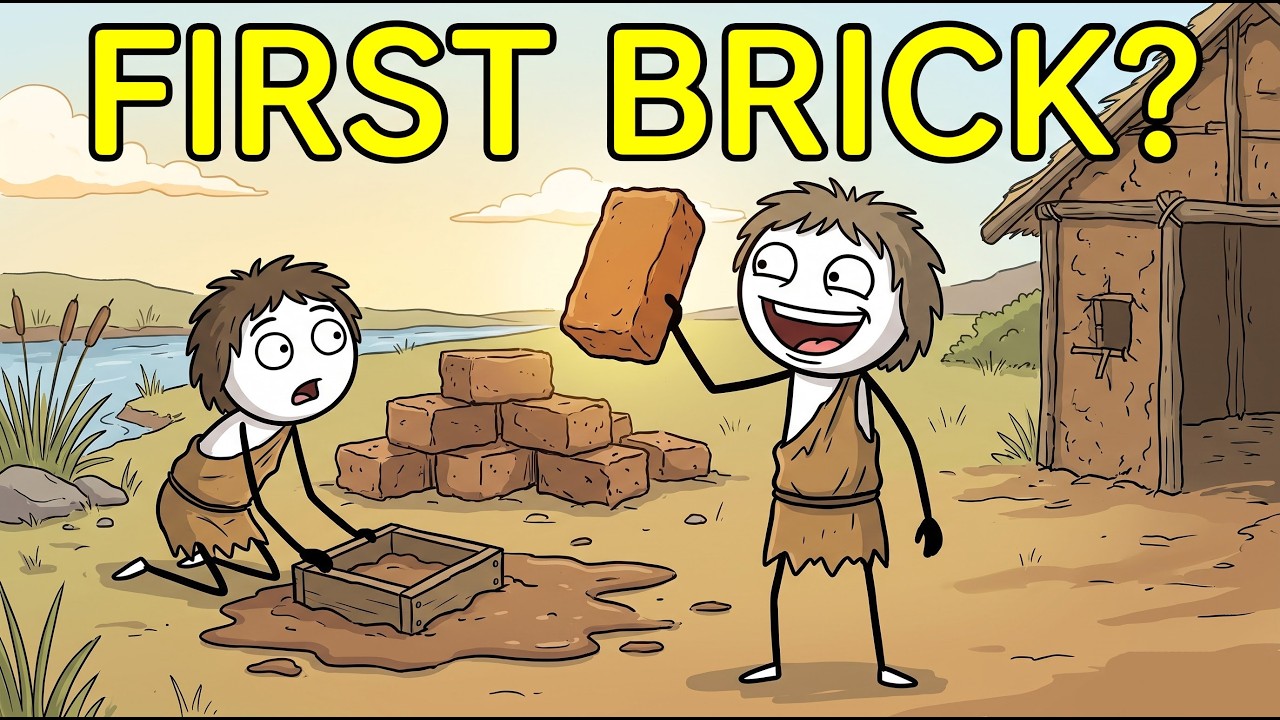
5 trillion bricks every year, more than every bullet, nail, screw, bolt, and coin manufactured annually combined. Every one of those bricks traces back to a quiet moment of observation: wet clay holds its shape, dry clay keeps it. Clay itself is everywhere. It forms over millions of years as water, carbon dioxide, and organic acids slowly break down feldspar-rich rock like granite, leaving behind fine particles of minerals such as kaolinite, illite, and montmorillonite.
These minerals are flat, plate-like grains. When water is added, the plates slide over one another, making the clay soft and pliable. When the water evaporates, the plates lock together through surface tension and electrostatic forces. No kiln, no chemistry, no technology beyond sunlight and patience is needed to make a mud brick.
The oldest known mud bricks come from Jericho, at a site called Tell es-Sultan in the Jordan Valley. Archaeologist Kathleen Kenyon excavated there between 1952 and 1958, and in the pre-pottery Neolithic layers dating to roughly 9000 to 8500 BCE, her team found the earliest mud bricks. They were not neat rectangles. They were flat on one side and rounded on top, shaped like fat loaves of bread, sometimes marked with thumbprints so mud mortar would grip better.
Archaeologists call them plano-convex bricks. People used them to build houses, walls, and the famous Tower of Jericho, a structure of stone and mud brick almost 8. 5 meters tall, built around 8300 BCE, before pottery, before metal tools, before writing, before the wheel. Around the same time, at Tell Aswad near Damascus in modern Syria, people were making bricks of a different shape: long, narrow, cigar-shaped forms molded by hand.
The bricks there date to roughly 8700 to 8000 BCE. Neither community copied the other. Two separate groups, about a hundred kilometers apart, arrived at the same idea independently. Wet clay, shaped, dried, stacked.
The concept was so intuitive that it appeared spontaneously wherever people settled down and started building. At Çayönü in southeastern Turkey, excavated by Robert Braidwood from the University of Chicago beginning in 1964, mud brick construction appeared between roughly 8600 and 7000 BCE. At Jarmo in the Zagros foothills of northern Iraq, Braidwood found mud brick village structures dating to around 7000 to 6000 BCE. At Çatalhöyük in south-central Anatolia, excavated by James Mellaart from 1961 to 1965 and later by Ian Hodder from 1990 to 2018, entire homes were made of mud brick, packed together without streets, entered only through roof openings.
Thousands of people lived in a continuous mass of mud brick rooms there for roughly two thousand years, rebuilding over the old ruins whenever walls collapsed. None of these early builders used molds. Each brick was shaped by hand and differed slightly from every other. Irregular bricks produced irregular walls, wasted mortar, and limited how high and how fast people could build.
The mold changed everything. It appeared in the Levant and Mesopotamia during the late pre-pottery Neolithic and pottery Neolithic periods, roughly between 7500 and 6000 BCE. A simple wooden frame, open at top and bottom, produces bricks of identical size every time. That allowed walls to rise faster, buildings to be planned in advance, and brickmaking to move from handcraft to industry.
Sun-dried mud brick works remarkably well in dry climates. Egyptian storage walls of mud brick still stand at the Ramesseum, the mortuary temple of Ramesses II, after 3,200 years. A tomb painting in the burial chamber of Rekhmire, a vizier who served Pharaoh Thutmose III around 1450 BCE, shows every stage of the ancient process: men digging clay from the riverbank, mixing it with water and chopped straw in pits, pressing it into wooden molds, flipping bricks to dry in neat rows under the sun, and carrying finished bricks on their shoulders to the building site. The process is nearly identical to what is still used in parts of West Asia and North Africa today.
Straw is not filler. As mud brick dries, it shrinks, and uneven shrinkage causes cracks. Chopped straw spread through the clay absorbs some of that stress and distributes it across thousands of tiny fibers, while also adding tensile strength. The Book of Exodus describes the Pharaoh punishing the Israelites by demanding bricks without straw.
The chemistry is accurate: brick without straw is measurably weaker and more prone to cracking. But mud brick has a fatal weakness: water. Get it wet enough and the brick dissolves back into mud. In Egypt that hardly mattered.
In Mesopotamia, where winters brought rain, it was a problem. In the Indus Valley, where monsoons lasted for months, it was a disaster. The solution, discovered by accident somewhere along the way, was fire. Heat clay enough and something permanent happens.
At about 200 degrees Celsius, free water evaporates. Between 200 and 600 degrees, chemically bound water is driven out of the clay minerals themselves. That is the point of no return. The clay can never become plastic again.
Between 300 and 900 degrees, organic material burns away, and iron compounds oxidize into the same chemical that makes rust red, which is why most bricks are red. Between roughly 900 and 1150 degrees, sintering begins. Silica and alumina form glassy phases at the contact points between particles, fusing them into a dense, hard, waterproof mass. The people who first achieved this had no idea what was happening at the molecular level.
They only knew that brick pulled from a hot fire lasted longer than brick from a gentle one. The earliest evidence of fired brick in Mesopotamia dates to the Uruk period, roughly 4000 to 3100 BCE. Fired brick was expensive, requiring vast quantities of wood, animal dung, or reeds in a treeless floodplain. Mesopotamian builders used a hybrid system: cheap sun-dried mud brick for the core, fired brick for the outer facing where rain and running water did their damage.
The Great Ziggurat of Ur, built by King Ur-Nammu around 2112 to 2095 BCE and completed by his son Shulgi, sits at Tell Muqayyar in southern Iraq. Excavated by Sir Leonard Woolley between 1922 and 1934, its base measured roughly 62. 5 by 43 meters and rose about 30 meters in three stepped tiers. The core was millions of mud bricks; the outer shell was fired brick about 2.
4 meters thick, bonded with bitumen, the natural asphalt that seeped from the ground across Mesopotamia. Woolley discovered that the builders inserted horizontal layers of woven reed matting every five to eight courses. The mats created flexible joints that let the massive structure settle without cracking, drew moisture away from the mud brick core, and distributed loads evenly. That is reinforced masonry, four thousand years before the term existed.
Some of the fired facing bricks were stamped with Ur-Nammu’s name. The first branded building product in history. The Book of Genesis remembers Mesopotamian brickwork, describing the builders of the Tower of Babel telling one another to make bricks and bake them thoroughly, using bitumen for mortar. The text notes that they used brick instead of stone because Mesopotamia had no building stone.
The ziggurat that likely inspired the story was Etemenanki in Babylon, the ziggurat of the god Marduk, rebuilt by Nebuchadnezzar II in the sixth century BCE. According to the Esagila tablet, a clay document from 229 BCE recording the building’s dimensions, its base measured about 91 by 91 meters and rose roughly 91 meters high. Nebuchadnezzar also built one of the most visually stunning brick structures of the ancient world: the Ishtar Gate, constructed around 575 BCE as the main ceremonial entrance to Babylon’s inner city. It was made of fired brick, but not ordinary brick.
Each brick was individually molded with raised decoration, coated in colored glass made of ground quartz mixed with metallic pigments and alkaline flux, then refired at 900 to 1000 degrees to fuse the glaze to the surface. Blue came from copper compounds. The result was a double-arched gate covered in brilliant blue tile showing rows of wild bulls, sacred to the weather god Adad, and dragon-like mušḫuššu creatures sacred to Marduk. Lions lined the processional way leading to the gate.
German archaeologist Robert Koldewey excavated the gate between 1899 and 1917 and shipped thousands of glazed brick fragments to Berlin, where a reconstruction about 14 meters tall stands today in the Pergamon Museum. While Mesopotamia was building ziggurats with expensive fired brick facings over cheap mud brick cores, another civilization on the other side of West Asia was doing something entirely different. The Indus Valley civilization, also called the Harappan culture, flourished from roughly 2600 to 1900 BCE across about 1. 5 million square kilometers, from the Himalayas to the Arabian Sea.
Every Harappan brick followed a single ratio of 4:2:1, length to width to height, with a standard size of about 28 by 14 by 7 centimeters. Sir John Marshall first documented this systematically during excavations at Mohenjo-Daro in the 1920s, publishing the results in 1931. The ratio is structurally ideal: a brick with these proportions can be laid lengthwise, crosswise, or standing on end, and in any position it locks cleanly with its neighbors. The same brick, the same ratio, the same standard appeared across the entire civilization.
We do not know what the Harappans called themselves, and we know the name of not one of their rulers. But the standard suggests an effective central authority or a remarkably consistent collective agreement. Modern standard bricks around the world still approximate the 4:2:1 ratio. The Harappans used that brick to build one of the earliest known urban sanitation systems.
Houses had indoor bathing areas and toilets connected to covered brick drains running beneath the streets, sloped to maintain flow and maintained by a municipal sanitation authority. The Great Bath at Mohenjo-Daro, about 12 meters long, 7 meters wide, and 2. 4 meters deep, was waterproofed with tightly fitted fired brick sealed with bitumen. Europe would not match that level of urban sanitation until the nineteenth century.
The Harappans fired almost all their brick, not just facings but entire buildings, at 800 to 1000 degrees Celsius, which is why the ruins of Mohenjo-Daro are still recognizable after 4,500 Pakistani monsoons. The Romans took brickmaking and transformed it. Roman bricks were thin and flat, more like large tiles than modern blocks. Standard types included the bessalis of about 20 by 20 centimeters, the pedalis of about 30 by 30 centimeters, and the bipedalis of about 60 by 60 centimeters.
Builders cut square bricks diagonally into triangles, laid them with points facing inward to create a smooth outer face, and filled the space behind with Roman concrete. The brick was not the structure; it was the formwork for the concrete core. That technique built the Markets of Trajan around 110 CE, the Baths of Caracalla around 216 CE, and an empire of aqueducts, warehouses, apartment blocks, and military fortifications. Roman bricks were stamped with the factory, the owner, and sometimes the year of production.
Brick was a brandable, traceable product in the first century CE. China had its own parallel brick history. Mud brick construction appeared by the Western Zhou period, roughly 1046 to 771 BCE. Hollow brick tombs, sometimes decorated with carved relief designs, became common during the Han dynasty.
The most famous Chinese brick project came under the Ming dynasty, from 1368 to 1644 CE, when the Great Wall was covered with millions of gray fired bricks. Some bricks were stamped with the name of the responsible kiln, the production batch, and the individual workers who made them, allowing accountability and punishment if a brick failed. The mortar that held those bricks together was also unique. In 2010, researchers at Zhejiang University published a study analyzing Ming-era mortar, including sections of the Great Wall.
They found that builders mixed slaked lime with sticky rice starch. The amylopectin in the rice acted as an organic additive that improved compressive strength and water resistance. The same grain that fed the workers chemically bound the wall they built. In medieval Europe, brickmaking nearly vanished.
After the fall of Rome, the knowledge faded across western Europe for centuries, surviving in the Byzantine Empire and the Islamic world. Brick returned to northern Europe around the twelfth century, especially in regions like northern Germany, Poland, and the Baltic, where natural stone was scarce. Malbork Castle in Poland, the seat of the Teutonic Knights, is the largest brick castle in the world by surface area. In England, the Great Fire of London broke out in September 1666 and burned for four days, destroying nearly 13,200 houses, 87 churches, and most of the city.
Before the fire, London was a wooden city of timber frames and thatched roofs packed into narrow streets. Within a year, Parliament passed the London Building Act of 1667, requiring all new buildings to be of brick or stone. Wooden facades and thatched roofs were banned. London transformed from a medieval timber city into a brick city, and the characteristic London house, built of yellow London brick made from Thames Valley clay rich in calcium carbonate, became the dominant building style for the next 250 years.
For ten thousand years, brickmaking was manual labor. In 1858, German engineer Friedrich Hoffmann patented the Hoffmann kiln, an annular continuous kiln in which a fire moves around a circular or oval tunnel divided into chambers. While one chamber burns, others are being loaded, preheated, cooled, or emptied. The kiln never goes cold.
Fuel efficiency improved dramatically. At about the same time, mechanical extrusion machines replaced hand molding, pushing clay through a rectangular die to produce a continuous column that wires cut into individual bricks. The entire process became mechanized. In the Americas, an independent tradition developed.
The word adobe derives from the Arabic al-tub, which entered Spanish during centuries of Islamic rule in Iberia. Taos Pueblo in New Mexico, continuously inhabited since roughly 1000 to 1450 CE, is one of the oldest continuously occupied communities in North America, built of mud brick. In South America, the Huaca del Sol near Trujillo, Peru, built by the Moche civilization between about 100 and 700 CE, contains an estimated 140 million hand-formed mud bricks stacked into pyramid form by people who never saw a kiln. The brick was not invented once.
It was invented again and again over thousands of years on every inhabited continent, because the problem was universal and the material was everywhere. Wet clay holds its shape. Dry clay keeps it. That observation, reached independently by people at Jericho eleven thousand years ago, at Tell Aswad 10,700 years ago, at Çayönü 10,600 years ago, at Çatalhöyük 9,500 years ago, in the Indus Valley 4,600 years ago, in China 3,000 years ago, and in the Americas long before any European set foot on the continent, is the simplest and most influential building insight in human history.
It required no genius, only clay, sunlight, and the desire to sleep inside something that would not collapse. Fired brick came later, when someone in Mesopotamia during the fourth millennium BCE noticed that mud brick left too close to a fire became harder, denser, and waterproof. From that observation came the kilns that fired the facings of the Ziggurat of Ur, the glazed brick of the Ishtar Gate, the standardized perfection of Harappan cities, the thin bricks of Roman aqueducts, the gray brick of the Great Wall, and the yellow brick of rebuilt London.
One material, one chemical reaction, and ten thousand years of human construction.