In February 1961, a woman in her late forties stood in the wings of a Las Vegas showroom, waiting to learn whether the world still wanted her. She had been, by the sworn testimony of Fred Astaire, conductor Arturo Toscanini, and nearly every critic who ever watched her work, the greatest tap dancer who had ever lived. At the summit of that gift, Eleanor Powell had walked off the screen and vanished into a private life that would cost her far more than anyone in the audience could have guessed. Why the finest dancer in America disappeared, and what had been done to her behind closed doors, were questions the film industry preferred not to ask.
She said the small private prayer she always said before she danced, and the curtain went up. She was back. Eleanor was born in Springfield, Massachusetts, on November 21, 1912, so frail that her family feared she would not survive her first winter. Her parents’ marriage had collapsed by the time she was eleven months old, and her mother, Blanche, took the child home to her own parents, where she put together a convenient fiction: Eleanor’s father was dead.
He was not dead. He would resurface, alive and reportedly contrite, when his daughter was twenty-three and already a movie star. A girl raised inside a lie that size grows up suspicious, and Eleanor grew up suspicious to the point of affliction, so painfully shy that she hid from visitors rather than say hello. It was to cure the shyness, not to create a prodigy, that Blanche signed her up for dancing school at age eleven.
The cure worked, and then some. By her early teens the shy child had become a working performer, studying ballet and acrobatics and appearing in the summer clubs of Atlantic City, where the impresario Gus Edwards spotted her. Edwards, a one-man star factory whose juvenile reviews had launched a row of marquee names, hired her for his act. Eddie Cantor and Jack Benny watched her work and told her the thing that was becoming obvious to everyone but herself: she belonged in New York.
She and Blanche moved to Manhattan toward the end of the 1920s, where Eleanor collided with an inconvenient truth. The New York stage did not want acrobats. It wanted tap dancers, and she could not tap a step. She bought a package of ten lessons, loathed the first one, and had to be coaxed back for the second.
Somewhere around the seventh lesson, it all came together. Those ten lessons were the only formal tap instruction Eleanor Powell would ever receive. She made her Broadway debut in 1929, worked steadily through the lean early years of the Depression, and climbed season by season from a standout in the chorus line to a featured attraction with her own name on the bill. A tap dancer, she liked to say, was really a frustrated drummer, and she happened to be a drummer who had taken up the feet in place of the sticks, working in a percussive off-beat style that had not quite existed before she arrived at it.
Hollywood came for her in a fit of misjudgment. Fox cast her in a 1935 adaptation of George White’s Scandals, then concluded she had no future in pictures: too tall, too toothy, too plainly a hoofer. MGM, screening the same footage, came to the opposite conclusion, signed her, and set about the customary renovation—dental work, voice lessons, a softer face for the cameras, and a softer biography for the publicity department. Broadway Melody of 1936 turned her, overnight, into a sensation.
The New York Times called her “a rangy and likable girl with the most eloquent feet in show business. ” Louis B. Mayer handed her a seven-year contract, built her a private rehearsal hall on the lot, and presented her with a portrait of himself inscribed “You Are My Lucky Star. ”
What followed was a run of vehicles assembled at considerable expense.
She choreographed her own numbers, which scarcely any woman in Hollywood was permitted to do, working out the routines herself and drilling them past the point at which most bodies would have quit. She trained like a serious athlete on a regimen that would have flattened most of her leading men. And she understood exactly what the apparatus had turned her into, fretting aloud that audiences no longer saw a person but “a tireless, automatic Amazon, a singing, tapping top. ”
Her numbers were spectacles of mounting ambition.
In Born to Dance she detonated across the deck of a battleship in an Art Deco finale of frankly deranged ambition. In Broadway Melody of 1938 she shared the bill with a teenage Judy Garland, who stopped the film cold by crooning to a framed photograph of Clark Gable. In Rosalie the studio stranded her atop a battery of enormous drums. By Honolulu in 1939, in which she contrived to tap a hula and to tap while skipping a rope, she was drawing $125,000 a picture.
The praise had climbed past the ordinary vocabulary of show business. Toscanini is said to have remarked that he would carry three things through life: the glorious sunset, the splendor of the Grand Canyon, and the dancing of Eleanor Powell. Fayard Nicholas, as qualified a judge as any man living, said she was “one of the very greatest, period, bar none. Not one of the greatest women, one of the greatest, period.
A musician. ”
Yet the very completeness of the gift was quietly curdling into a liability in the time-honored way that conspicuous excellence in a woman has always been a liability. There were almost no male dancers who could partner her on level terms. When MGM at last teamed her with the single dancer on the planet possibly her match, the result was sublime and, in a sense, quietly fatal.
In Broadway Melody of 1940, Eleanor Powell danced with Fred Astaire, and for the length of the “Begin the Beguine” finale—two minutes and fifty-one seconds in black marble—the American film musical reached an altitude it would never again improve upon. They rehearsed for two solid weeks on nothing but arm movements. The number was perfect, and being perfect, it strangled the partnership in its cradle. Astaire admired her without reservation as a technician and could not abide what dancing beside her did to him on screen.
“She dances like a man,” he complained. “She had a very mannish style. She was a little big for me. ” There would be no second Astaire and Powell picture.
Years later, a candid Astaire would tell Powell’s own son, “Your mother is a much better dancer than me. ”
She was at the very top of all of it when she met the man who would, in effect, retire her on her behalf. Glenn Ford, a Columbia contract player, was still waiting on the part that would make him. They began keeping company around 1942, by which Powell had already half decided to get out.
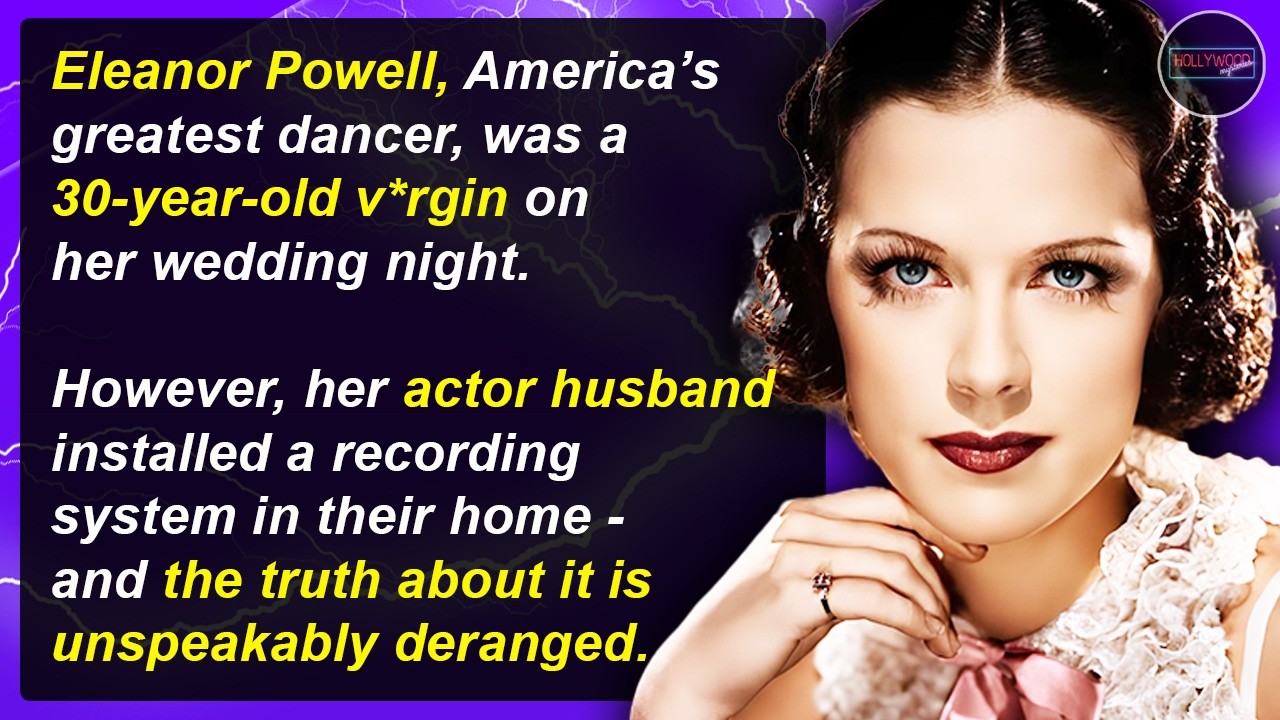
Blanche had raised her daughter to regard sex before marriage as a private catastrophe, and Eleanor went to her wedding bed a virgin at thirty. They married in October 1943, and she retired more or less where she stood. In hindsight, the timing looks less like a sacrifice than like a woman stepping off a train she had correctly sensed was losing speed. Tap was sliding out of fashion, and MGM was visibly cooling on the whole enterprise.
She would grace a feature film exactly once more, in 1950, and after that, the most eloquent feet in show business deliberately went still. What she received in exchange was her son, Peter, born in 1945, and she threw herself into motherhood with the same totalizing intensity she had once aimed at a sound stage. The difficulty was the actual husband. Ford’s career abruptly caught fire on his return from the war, and in 1946 he took the role of his life opposite Rita Hayworth in Gilda.
Sparks went up between them on the set, and the rumors made their way home to his wife. Hayworth, the reigning love goddess of the age, proved to be merely the first of them. The fuller accounting was owed to the biography Peter Ford would eventually write of his own father, drawing on records the man had apparently been at pains to keep. By that account, Ford was a compulsive documentarian of his own sexual appetites.
He had a secret telephone system wired into the Beverly Hills house, at first to keep track of everything Eleanor said, but he found another use for it: capturing his private calls to his various lovers. The romantic ledger ran to 143 women, including Hayworth, Joan Crawford, Judy Garland, and Marilyn Monroe. He was jealous even of the attention his wife gave their own son, whom he also secretly taped. Eleanor’s verdict was delivered with the flatness of a person who had long since finished crying about it: “He had such an inferiority complex.
It was sheer hell. ”
What is hardest to understand is how completely she kept it all off her face. The public Eleanor of those years was the model studio wife, gracious and uncomplaining. What brought her through was a private faith of genuine depth.
She had believed in God since she was a small girl, and she had always danced for God. Through the long retirement she taught Sunday school, and in the early 1950s she created a children’s religious television program, Faith of Our Children, which won five Emmy Awards. When she sat a racially mixed classroom of children in front of the cameras—an act of quiet defiance in the television of the early 1950s—and was reprimanded by nervous executives, she came back the very next week with a class made up entirely of black children. And when the studio wanted to take the program national on terms she judged unacceptable, she declined rather than see it compromised.
The marriage ended in 1959, and it did not end kindly. She filed on grounds of mental cruelty, saying, “I filed on the grounds of mental cruelty, and that’s exactly what he gave me. ” She walked away with a conspicuously small settlement, a woman on the wrong side of forty-five who had handed away for love the only skill anyone had ever paid her to perform. So she went back down onto the floor.
Dieted back to what she called dancing weight, she rebuilt an act out of nothing, and in February 1961 walked in front of a paying crowd at the Sahara in Las Vegas. The body answered, and the public cared. She carried the act east to the Latin Quarter in Manhattan, where the New York Times announced that Eleanor Powell had Broadway at her feet all over again. She stepped into the lead of a Los Angeles revival of Annie Get Your Gun, and appeared on the Ed Sullivan, Perry Como, and Hollywood Palace shows at an age when the town has, as a rule, no further use for a woman.
By the middle of the 1960s she had largely set the dancing down again, this time in favor of the church. She was ordained a minister. “I was married to Glenn Ford,” she said, “but now I feel as though I’m married to God. ” Her final public appearance was a leave-taking of the very man with whom she had made her most perfect two minutes and fifty-one seconds.
In the spring of 1981, already gravely ill, she attended the American Film Institute’s televised tribute to Fred Astaire, rose to speak, and was met with a standing ovation. She had been diagnosed with ovarian cancer. Surgery and chemotherapy had not stopped it. She told a friend near the end, “I trust the Lord.
I know he’s holding my hand through this. ”
Eleanor Powell died at home in Beverly Hills on February 11, 1982, at the age of sixty-nine. Glenn Ford was knocked flat by the news. “I fell in love with Ellie, and I still love her very much.
There is nothing more I can say. ” She was cremated and laid to rest at Hollywood Forever. The truer monument is the footage: the battleship, the giant drums, the little dog, and above all, those black marble minutes beside a stair where the camera records, plainly and for keeps, a woman doing something better than the most celebrated dancer alive, and being repaid for it with polite oblivion.
On the evidence, the industry did not deserve her then, and was only beginning to catch up.