In January 1945, near the Colmar Pocket in eastern France, a nineteen-year-old American infantryman from Texas found himself alone, wounded, and nearly out of ammunition in the middle of a German attack. For roughly an hour, Audie Murphy held off an entire company of enemy soldiers, then led a counterattack while still under fire. That action would earn him the Medal of Honor and cement his place as the most decorated American combat soldier of World War II. Murphy had already established a remarkable record by that point.
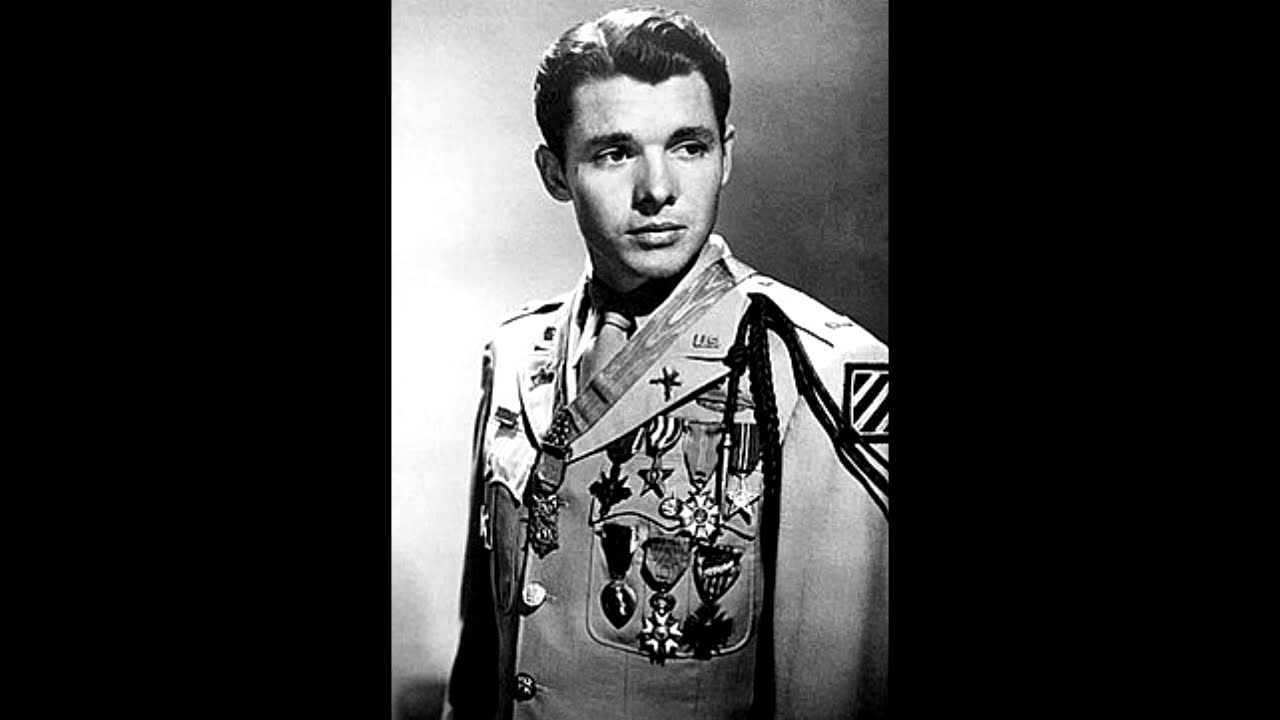
He was born in 1925 into a poor sharecropping family in Hunt County, Texas, one of twelve children. His father abandoned the family, and his mother died when he was a teenager. In 1942, shortly after his mother’s death, he attempted to enlist in the Marines but was rejected for being too small and underweight. The Army accepted him after he turned eighteen, and he was sent to North Africa and then to Europe with the 3rd Infantry Division.
His combat career was defined by aggressive action and heavy fighting. Murphy fought in Sicily, at the Volturno River, at Anzio, and in the campaigns through France. By the winter of 1944 and 1945, the Allied advance had stalled against German resistance in the Vosges Mountains and the Rhineland. The Colmar Pocket was the last major German foothold west of the Rhine, a defensive pocket holding several divisions that threatened the Allied flank.
Breaking it required brutal close-quarters fighting. On January 26, 1945, near the village of Holtzwihr, Murphy was serving as a lieutenant in Company B of the 15th Infantry Regiment, 3rd Infantry Division. German infantry and armor pushed forward against the company’s position. Murphy ordered his men to withdraw to cover, but he stayed at the forward position to direct artillery fire.
His command post was a disabled tank destroyer that was burning and at risk of exploding. From that exposed spot, he used a field telephone to guide artillery onto the advancing Germans while enemy fire struck all around. The attack pressed on. With his men pulled back and his own ammunition nearly exhausted, Murphy climbed onto the burning tank destroyer and opened fire with its .
50 caliber machine gun. From that exposed position, he held the German company in place for about an hour, inflicting heavy casualties and preventing the enemy from overrunning his company’s position. The tank destroyer was in danger of exploding at any moment, and he was wounded in the leg during the fight. He continued firing until the German attack broke apart.
When the German force faltered, Murphy led his company forward in a counterattack. Still wounded and essentially out of the ammunition he had carried into the fight, he drove the enemy back and retook the ground that had nearly been lost. For that action, he received the Medal of Honor, presented to him in 1945. The official citation recorded that he had held his position single-handedly, killed or wounded a large number of the enemy, and prevented his company from being surrounded or destroyed.
The account of that day became central to his postwar identity. Murphy received every combat award the United States Army could offer for valor, including the Distinguished Service Cross, the Silver Star, the Bronze Star, and three Purple Hearts. He was also decorated by France and Belgium for heroism in action. Those awards made him the most decorated American combat soldier of the war, a distinction he carried with him for the rest of his life.
After the war, Murphy returned to a country that was eager to honor its veterans, and he found a public role in Hollywood. He moved into acting and built a career that lasted roughly twenty-one years. Most of his films were westerns, a genre that suited his quiet, measured screen presence. He appeared in films with actors such as James Stewart and John Huston’s productions, and his name became familiar to a generation of American moviegoers.
His most significant film role came when he played himself in the 1955 movie To Hell and Back, a dramatization of his 1949 memoir of the same title. The film was a major commercial success, becoming Universal Pictures’ biggest box office hit up to that time, until the release of Jaws in 1975. For Murphy, the movie was both a personal achievement and a kind of repeated confrontation with his own war experience. Playing himself meant reliving the events that had defined him in front of the camera.
The war followed him in other ways. For years after returning home, Murphy struggled with insomnia and recurring nightmares, symptoms that would today be recognized as post-traumatic stress disorder. He spoke openly about his difficulties sleeping, and he admitted that he could only rest with a loaded pistol under his pillow. That detail became part of his public story, a reminder that the celebrated soldier carried the psychological cost of his service long after the fighting ended.
His public reputation was complicated by financial problems in the final years of his life. Murphy made money in acting and also in other ventures, but a series of bad investments and obligations left him struggling. Despite the money trouble, he refused offers to appear in alcohol and cigarette commercials. He was still a familiar public figure, particularly to young audiences, and he did not want to set a bad example.
Murphy died on May 28, 1971, in a plane crash near Roanoke, Virginia, when the small aircraft he was traveling in went down in poor weather. He was just short of his forty-sixth birthday. At the time of his death, he remained what his wartime record had made him: the most decorated American combat soldier of World War II, a man whose name was tied to both the war he had fought and the unresolved aftermath he carried with him.
His Medal of Honor action at the Colmar Pocket remained the defining moment of his public life, and the memoir and film that grew from it kept that story before the American public for years after his death.