At 3:00 on the afternoon of July 3, 1863, the Confederate artillery fell silent. For two hours, more than 150 guns had hammered the Union line on Cemetery Ridge. Now the smoke began to drift, and in the quiet that followed, roughly 12,500 Confederate infantrymen rose from the tree line along Seminary Ridge, formed their ranks, and prepared to cross a mile of open ground toward a stone wall defended by about 5,000 Union soldiers and 100 cannons. Within half an hour, more than 6,000 of them would be dead, wounded, or captured.
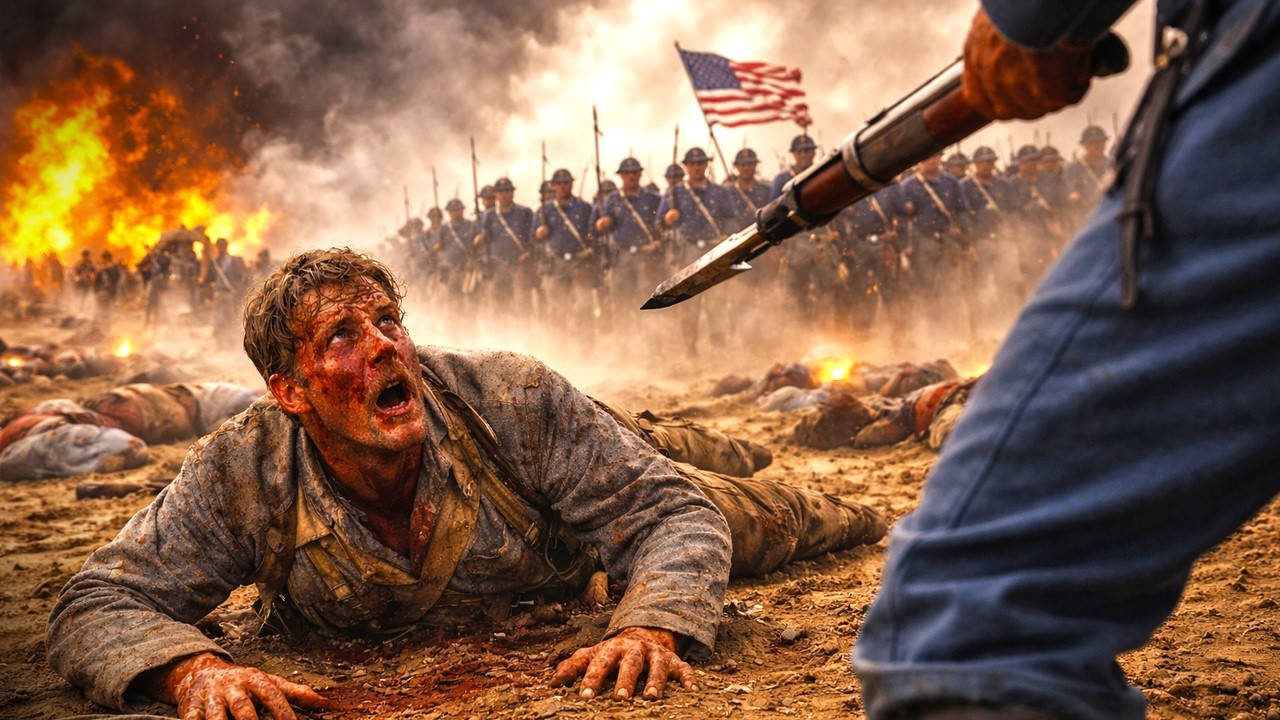
The man who did not want this attack to happen was Confederate General James Longstreet. That morning, he had argued directly with Robert E. Lee, insisting that no force he had ever seen could take the position. After two days of brutal fighting at Gettysburg, Lee believed the Union center had been weakened, that a massive bombardment could soften it, and that a concentrated infantry assault could break it.
Longstreet disagreed and said so plainly. Lee overruled him and gave the order. The division chosen to lead the assault bore the name of George Pickett, a 38-year-old Virginian who had graduated last in his West Point class of 1846. Pickett had begged for the assignment.
More than half the assault force, however, came from Pettigrew’s and Trimble’s divisions, made up largely of North Carolinians, Mississippians, and Alabamians. Many of these men had already been shattered in the fighting on July 1 and were being asked to do it again. Pettigrew’s troops were tired, hungry, low on ammunition, and filled with walking wounded. The bombardment began at 1:07 PM.
Veterans later compared the sound to a continuous roll of thunder that shook the ground. The plan was simple: two hours of concentrated fire would destroy the Union artillery, break the infantry behind it, and open a gap for the assault force. The Confederates planned a line nearly a mile wide. Pickett’s Virginians were fresh, cleaner than the rest, and eager.
The other divisions were anything but. Between the two ridges lay gently sloping farmland, wheat fields, no cover, and a shallow depression at the Emmitsburg Road. At the far end stood the stone wall, four feet high. Behind it waited the Union Second Corps under General Winfield Scott Hancock, a cool and fearless commander who had placed his infantry and more than 100 cannons to cover every yard of the approach.
Among the officers preparing to advance, Richard Garnett, commanding one of Pickett’s brigades, could barely walk. He had spent the war under a shadow of accusation from Stonewall Jackson, who had wrongly blamed him for a retreat at Kernstown. Garnett had demanded a court-martial to clear his name, but it never came. Now, unable to walk, he chose to ride his horse, making himself the most visible man on the field.
His men cheered when they saw him. Behind Garnett, Lewis Armistead prepared his own brigade. Armistead’s closest friend in the world was Hancock, the man commanding the Union position he was about to attack. Both men knew exactly where the other stood.
Just after 3:00, Pickett rode to Longstreet and asked whether he should advance. Longstreet, who had spent the morning predicting disaster, could not bring himself to speak. He lowered his chin and nodded. Neither Longstreet nor Pickett knew that the two-hour bombardment had largely missed.
Overshooting the Union line, most of the Confederate rounds had exploded behind the crest, destroying wagons and terrifying the rear area but leaving the stone wall and its defenders mostly intact. The infantry was about to walk into an undamaged defensive position without the support they expected. They stepped off in parade ground order, flags flying, bayonets fixed, a formation nearly a mile wide that even Union defenders later admitted was breathtaking. For the first 400 yards, the Union guns stayed silent.
At roughly 600 yards, the Confederates reached the Emmitsburg Road, and the Union artillery opened fire with canister, tin cans packed with iron balls that turned each cannon into a giant shotgun. Entire files collapsed. The neat formation turned to shreds, thousands of men dropping into the shallow depression and refusing to go on. Officers screamed, threatened, and pleaded, but more than two-thirds of some units never left that road.
George Pickett directed his division from about 200 yards behind the line, unable to see the full scale of the disaster taking shape ahead of him. All three of his brigade commanders were about to become casualties within the next quarter of an hour. The men who did push past the Emmitsburg Road, perhaps half the original force, reformed into a compressed mass and continued toward the wall. At 200 yards, the Union infantry behind the stone wall opened fire with their rifles.
The first volley did not sound like a volley, it hit like a physical force, and men fell in rows. Smoke grew so thick that neither side could see fifty yards. Veterans on both sides later described choking sulfur and darkness lit only by muzzle flashes. Officers fell fastest, drawing fire by the simple act of standing upright.
Garnett, still mounted, rode forward through the heaviest fire on the field, his men following until a bullet found him roughly a hundred yards from the wall. His body was so badly mangled in the ensuing fighting that his own men could not identify him for days. The vindication he had sought all his life died with him in the wheat. Inside fifty yards, the world reduced itself to noise, smoke, and the men directly ahead.
At about 3:25, the first Confederates reached the stone wall at a bend known as the Angle, near a small copse of trees. Perhaps two hundred or three hundred men climbed over it, the first and only Confederates to penetrate the Union line during the charge. Armistead, his hat balanced on the tip of his raised sword so his men could see him through the smoke, crossed the wall and shouted, “Come on, boys. Give them the cold steel.
Who will follow me? ” Roughly 150 men followed. For a few minutes, they fought hand-to-hand among the Union guns. Twenty yards away, Captain Alonzo Cushing, a 26-year-old artillerist already wounded twice and bleeding heavily, ordered his last round of canister loaded and screamed his final words: “Fire!
Quick, boys, fire! ” His guns discharged, and the Confederates were on him. Armistead made it roughly fifty yards past the wall, the deepest penetration of the entire assault. He reached a Union cannon and put his hand on it.
Then he was hit and fell beside the gun. The Confederates who had crossed the wall had no reinforcements. No one else was coming. Hancock, Armistead’s closest friend, had already been wounded himself, struck in the groin by a cannonball fragment, but before he collapsed he issued the order that sealed the battle: “Pour everything into the breach.
” Union reinforcements converged on the Angle from three directions, firing at twenty yards, ten yards, five yards. It was over in ten minutes. The men inside the line were killed, captured, or cut down trying to scramble back over the wall. The high-water mark of the Confederacy lasted less time than it takes to eat a meal.
The survivors turned and stumbled back across the same field they had just crossed, but there was no formation now, no order, few flags. Union artillery kept firing into their backs. Robert E. Lee rode out to meet the broken men as they staggered back to Seminary Ridge.
Calm and composed, he told them, “It is all my fault. ” He said it more than once. The assault lasted less than an hour. In that time, 6,555 Confederate soldiers were killed, wounded, or captured.
Roughly one man fell every half second. Pickett’s division, the spearhead, lost 2,600 men, 58 percent of its strength. All three of his brigade commanders were gone, Garnett dead, Kemper shot through the body, Armistead dying. But the majority of the casualties had come from Pettigrew’s and Trimble’s divisions, which lost more than 3,900 men, a sacrifice largely forgotten because the charge bears Pickett’s name.
The Union lost approximately 1,500 defenders. The assault should properly be called the Pickett-Pettigrew-Trimble Charge. It never is. Armistead was carried to a Union field hospital.
He asked the men who captured him to send his personal effects to Hancock, his watch, his prayer book, his spurs. He asked whether Hancock was alive. They told him the general was wounded but would recover. Armistead died on July 5, having refused Hancock’s offer of personal medical care.
The two friends never saw each other again. On July 4, it rained. Union burial details crossed the field and began burying the Confederate dead in shallow trenches. Many bodies were so damaged by artillery that they could not be identified.
That same day, word reached Washington of the victory at Gettysburg and the fall of Vicksburg. The war had turned. Lee retreated across the Potomac and fought for two more years, but the offensive power that had carried the Confederacy into Pennsylvania was gone forever. George Pickett was shattered.
When Lee asked him to rally his division for a possible counterattack, he replied, “General Lee, I have no division. ” After the war, he lived quietly in Virginia, sold insurance, and refused to discuss the charge publicly. His wife later wrote that he wept every year on the anniversary of July 3. In a private letter, he wrote of Lee: “That old man had my trust and my love, and he blundered then and there, and he will forever regret it.
”
In the years that followed, Southern writers transformed the slaughter into a noble sacrifice, the high-water mark of the Confederacy, stripping away the terror and the futility and the smoke. Armistead, Garnett, and the dead of the wheat field were drafted into service a second time, this time as symbols of a romanticized rebellion. Pickett wanted no part of it. He died in 1875, having never forgiven Lee.
Captain Alonzo Cushing, who fired his last round of canister into Armistead’s men at twenty yards and was held upright by a sergeant as he died, received the Medal of Honor in 2014. It took the United States government 151 years to honor the man who helped hold the line at the most famous moment of the most famous battle of the Civil War. The mile of ground between the ridges is still there. It can be walked today at Gettysburg National Military Park, about fifteen minutes at a steady pace, with no one shooting, the wheat quiet, the stone wall still standing.
The men who crossed it knew what they were walking into. Garnett knew when he swung into the saddle. Armistead knew when he put his hat on his sword. Longstreet knew when he nodded instead of speaking.
They went anyway, and the ground never stopped remembering what happened there.