On November 16, 1881, Wyatt Earp stood before a judge in Tombstone, Arizona, and gave his sworn account of the events that had led to the most infamous gunfight in Western history. The shooting at the O. K. Corral had happened three weeks earlier, and now the man at the center of it all was finally telling his side of the story, under oath, in open court.
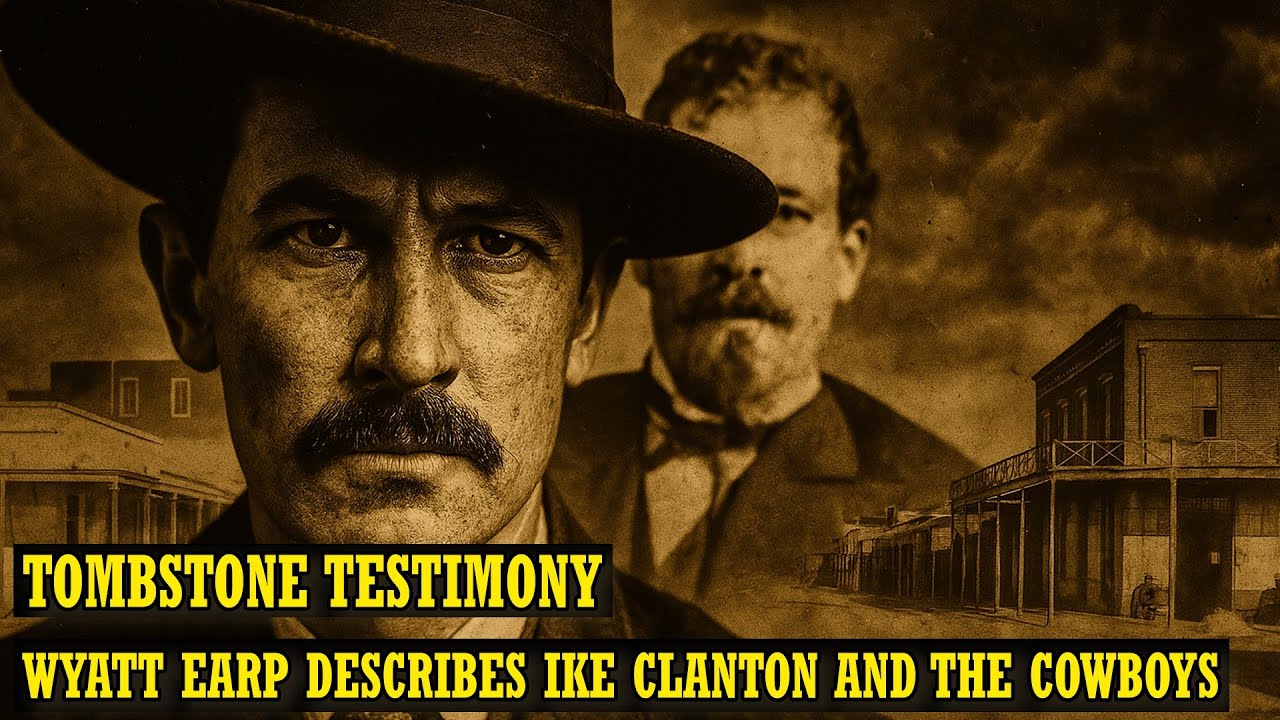
Earp was thirty-two years old, a saloon keeper by trade, and a former deputy sheriff who had also worked as a detective. He had lived in Tombstone since December 1879, having come west from Dodge City, Kansas, where he had served as city marshal. Now he stood accused alongside John H. Holliday, and both men had been informed of their right to make a formal statement under a section of Arizona law approved in February 1881.
Earp chose to speak. He began not with the gunfight itself but with the long chain of events that had brought him to that courtroom. In the spring of the previous year, Earp and his brothers Virgil and Morgan, along with Marshall Williams, Captain Joseph H. Hurst, and four soldiers, had followed the trail of six government mules missing from Camp Rucker.
Their search led them to a ranch owned by Tom and Frank McLaury near Charleston, where they found the animals and the branding iron used to disguise them. A man named Frank Patterson negotiated a compromise with Captain Hurst, who persuaded the Earp party to return to Tombstone, insisting the matter was resolved. Weeks later, Hurst admitted the agreement had been a lie, a ploy to get the Earps to leave. He warned them that certain people had made troubling statements about them.
Not long afterward, Earp encountered Frank and Tom McLaury in Charleston. The meeting was tense. They warned him that if he ever pursued them that closely again, there would be serious consequences. Around the time of the Benson stagecoach robbery, in which Bud Philpot was killed, Earp was assisting Wells Fargo in a detective capacity.
He became convinced that Billy Leonard, Harry Head, and James Crane had committed the robbery. These men had strong ties to the Clantons and McLaurys, whose ranches were rumored to be havens for outlaws. Earp had ambitions to run for sheriff of Cochise County, and capturing the men responsible for the stagecoach robbery would earn the respect of the public and business leaders. A reward of roughly twelve hundred dollars per man, about thirty-six hundred dollars total, had been offered, and Earp believed it might persuade others to help him.
He arranged a private meeting behind the Oriental Saloon with Ike Clanton, Frank McLaury, and Joe Hill. He explained that he wanted to apprehend Leonard, Head, and Crane, and that doing so would support his campaign for sheriff. He promised them the full reward and complete confidentiality in exchange for reliable information. Ike Clanton showed interest, noting he had a personal dispute with Leonard over a property claim.
But he asked what would happen if the men could not be taken alive. Earp reached out to Marshall Williams, the Wells Fargo agent, who telegraphed company leadership in San Francisco. In June 1881, a reply confirmed the reward would be paid regardless of whether the suspects were brought in alive. Earp shared the telegram with Clanton, Hill, and later Frank McLaury.
The agreement was set. Joe Hill would travel to New Mexico, where Leonard, Head, and Crane were believed to be hiding, and lure them back toward the McLaury ranch. Earp would then arrive with a posse to make the arrests. Joe Hill left personal items with Virgil Earp for safekeeping and was gone about ten days.
When he returned, he said he had arrived too late. Leonard and Head had already been killed, reportedly by horse thieves. Earp later learned those horse thieves may have been associated with the Clanton and McLaury crowd, suggesting internal conflicts or secret reprisals. After this, the relationship between the Earps and the Clantons and McLaurys deteriorated.
Ike Clanton and Frank McLaury began accusing Earp of sharing the plan with Marshall Williams and Doc Holliday, which Earp insisted was not true. They started avoiding the Earps around town, and tensions rose. From that point on, the Earps and Holliday began hearing troubling remarks suggesting threats were being made behind the scenes. Earp explained his friendship with Holliday by recalling that when he was city marshal of Dodge City, Holliday had come to his aid during a dangerous moment when Earp was surrounded and outnumbered, and may well have saved his life.
About a month before the gunfight, Earp and his brother Morgan had assisted in the arrest of Pete Spence and Frank Stilwell for the Bisbee stagecoach robbery. Though they acted as part of a legal posse organized by the sheriff, the Clantons and McLaurys blamed them personally. After the arrests, Frank McLaury pulled Morgan aside in front of the Alhambra Saloon. He harshly criticized Morgan and warned him not to attempt to arrest him.
Morgan replied that if there was legal cause, he would do his duty. Frank said that although he had previously retracted past threats, those retractions no longer stood. Both before and after that incident, several townspeople told the Earps they had heard troubling remarks about possible harm being directed toward them. The people reportedly making these statements included Ike Clanton, Frank and Tom McLaury, Joe Hill, and John Ringo.
On the night of October 25, 1881, Earp was eating at the lunch counter in the Alhambra Saloon when he overheard Holliday and Ike Clanton arguing. Morgan Earp led Holliday outside. Virgil Earp arrived and told them firmly that if they did not stop, he would have to arrest them. The crowd dispersed.
Later, Earp encountered Ike Clanton on Fifth Street. Clanton said that when Holliday had approached him earlier that night, he felt unprepared to respond, but that by morning things would be different. Earp told him plainly that he had no interest in conflict and would avoid it if he could, because, as he put it, there was no money in it. Clanton left him, saying, “I’ll be ready for you in the morning.
”
At the Oriental Saloon, Clanton followed Earp inside and displayed his revolver openly, repeating that he intended to confront them the next morning. Earp secured the money from his faro game and headed home. He did not get up until around noon on October 26. He was still in bed when Ned Boyle came by and said he had just spoken with Ike Clanton, who was armed and making threats, claiming that as soon as any of the Earps showed themselves in the street, something serious would begin.
Later, Harry Jones came to Earp concerned, saying Clanton was walking around with both a rifle and a revolver, searching for them. Earp went to find him. At the corner of Fifth and Allen, he ran into Virgil, who was acting marshal. They split up.
Virgil found Ike Clanton on Fourth Street near Fremont, and as Earp came down the street, he saw Virgil confronting him. Clanton shifted his rifle as if to raise it, and Virgil quickly grabbed it and used his revolver to subdue him. By the time Earp arrived, Virgil and Morgan had taken Clanton’s weapons and escorted him to the Grand Hotel, then to Justice Wallace. In the courtroom, Ike looked at Earp and said something like, “I’ll get back at all of you for this.
” He added that if he had a weapon at that moment, he would settle it right then. Morgan replied calmly that if Ike was so eager, he would hand him his own revolver. As Morgan offered it, Ike began to rise, but Deputy Sheriff Campbell intervened, telling him to stay seated. Earp was growing increasingly concerned.
He had heard numerous threats from Ike and his associates, and their behavior that day made it feel like something serious was being planned. He turned to Ike, sitting about eight feet away, and said, “You’ve been making these threats for some time now. If you really want to settle this, I’ll face you anytime, any place, even if it means riding over to San Simon into your own territory. ” Ike replied calmly, “I’ll see you after I’m done here.
All I need is four feet of ground. ”
Outside the courtroom, Earp encountered Tom McLaury, who said he was willing to meet Earp anywhere. Earp struck him lightly with his left hand, drew his pistol as a warning, and told him plainly that if he intended to act, now was the time. Tom did nothing, and Earp tapped him on the head with the barrel of his revolver and walked away.
Shortly after, Earp saw Tom McLaury, Frank McLaury, and Billy Clanton walking down Fourth Street toward a gunsmith shop. He followed. Frank McLaury’s horse was standing on the sidewalk with its head in the doorway. Earp, acting as a deputy city marshal, took the horse by the bridle and backed it off the walkway.
Frank tried to take the reins, but Earp told him to move it, and he complied. Ike Clanton arrived, and all four went inside the shop, where Earp could see them rearranging the ammunition in their belts. They exited and walked toward Dunbar’s Corral. Earp explained that Virgil was the city marshal, Morgan had been working as a special officer for about six weeks, and Earp himself had been deputized to serve while Virgil was in Tucson for the Spence and Stilwell trial.
He believed Virgil would soon have to disarm the group based on their behavior and ongoing threats, so he followed to be nearby in case help was needed. About ten minutes later, as Virgil, Morgan, Doc Holliday, and Earp stood on the corner of Fourth and Allen, a man named Coleman warned Virgil directly, “They mean trouble. They’ve just left Dunbar’s corral and gone into the O. K.
Corral, all carrying weapons. You’d better go disarm them. ” Virgil turned to the others and asked them to come with him. Morgan suggested they might need horses in case of a pursuit, but Earp told him that would not be necessary.
If they tried to escape, he said, they could stop their horses and detain them. The four of them walked through Fourth Street toward Fremont. As they rounded the corner, they saw Frank and Tom McLaury, Billy Clanton, and Sheriff Johnny Behan near the vacant lot between Fly’s photography studio and the adjacent building. Sheriff Behan separated from the group and walked toward them, looking over his shoulder, clearly uneasy.
Earp heard him say to Virgil, “For God’s sake, don’t go down there. You’ll be killed. ” Virgil responded calmly, “I’m going to disarm them. ” When Morgan and Earp reached Behan, he told them, “I have already disarmed them.
” Hearing this, Earp lowered his pistol and placed it in his overcoat pocket. They continued toward the group. Frank McLaury, Tom McLaury, and Billy Clanton were lined up against the eastern side of the building just west of Fly’s Gallery. Ike Clanton, Billy Claiborne, and another man stood in the middle of the vacant lot.
The revolvers belonging to Frank McLaury and Billy Clanton were clearly visible. Virgil stepped forward and instructed them, “Raise your hands. I’ve come to disarm you. ” Instead of complying, Billy and Frank placed their hands on their revolvers.
Virgil quickly clarified, “Wait, I don’t mean to start anything. We’re only here to disarm you. ” Despite the warning, Billy and Frank began drawing their weapons. At the same time, Tom McLaury opened his coat, revealing what appeared to be a firearm, and stepped behind a horse.
Earp’s own revolver was still in his overcoat pocket, where he had placed it after Sheriff Behan claimed to have disarmed the group. But when he saw Billy Clanton and Frank McLaury reach for their weapons, he immediately retrieved his. Billy aimed in Earp’s direction, though Earp did not return fire at him. He had heard that Frank McLaury was particularly skilled with firearms and dangerous, so his attention was focused on him.
Billy and Earp fired at nearly the same moment. It was unclear who shot first, but the exchange happened almost simultaneously. Within moments, Ike Clanton rushed toward Earp and grabbed his left arm. He did not appear to be armed.
Earp told him plainly, “The fight’s already begun. Either get involved or step aside,” and pushed him away. Ike ran off and disappeared between the lodging house and the photo studio. Earp’s first shot struck Frank McLaury in the abdomen.
Though he staggered, he managed to fire back. Earp stated that he never drew his firearm until after Billy Clanton and Frank McLaury had already drawn theirs. He never aimed or fired at Ike Clanton, because he believed Ike was unarmed. That decision, he said, was intentional.
He believed strongly that Ike, Tom, and Frank had planned a coordinated attack against his brothers, Doc Holliday, and himself. The threats, the behavior, and the gathering of armed men all suggested something serious was underway. Even so, he did not take preemptive action. Despite believing he would have been justified in defending himself before any shots were fired, he chose to act only when it became clear there was no other option.
They were there to fulfill their duties as lawmen, acting under Virgil’s command as city marshal. Once Billy Clanton and Frank McLaury pulled their weapons, Earp knew there was no turning back. It became a matter of survival for himself, his brothers, and Doc Holliday. He also addressed claims made against him.
He denied any involvement in stagecoach robbery or any criminal activity, calling Ike Clanton’s account a fabrication from beginning to end. He described a private proposal from Sheriff Behan, who had offered to split the earnings of the sheriff’s office if Earp would step aside from seeking the appointment. Earp agreed, but after that meeting, Behan never brought the subject up again, and the reasons he later gave for backing out were, in Earp’s view, untrue. Earp also recounted an incident involving a horse stolen from him after he arrived in Tombstone.
He had traveled to Charleston with Doc Holliday to recover it, and Billy Clanton tried to take the horse from a corral before Earp stopped him and told him it belonged to him. Once official paperwork arrived, Billy surrendered the animal willingly. Before leaving, he sarcastically asked if Earp had any more horses to lose. Earp replied that he planned to keep them in the stable from now on.
His testimony drew to a close with a reminder of how much effort had gone into the pursuit of the stagecoach robbers. Earp had been out on the trail for ten days, Virgil and Morgan for over two weeks. They had followed the trail from the site of the robbery through the Dragoon Mountains, across the Catalina Mountains, and into New Mexico, committing every resource they had to the chase. He stated with confidence that if it had not been for Morgan and himself, they would not have caught the man named King, who attempted to flee toward a dense patch of brush along the river.
Wyatt Earp’s sworn statement was not just a legal defense. It was a window into the deep mistrust, tangled alliances, and explosive tensions that defined Tombstone in the early 1880s. The names Clanton, McLaury, and Ringo did not just represent individuals.
They symbolized the blurred line between outlaw and rancher, lawman and vigilante, in a town where the threat of violence was never far away.