In November 1944, in a headquarters building behind the front line in the Rhineland, a German staff officer sat late at night reviewing a stack of papers under a desk lamp. His task was intelligence, specifically understanding the enemy’s supply situation: how much ammunition the Americans had, how much fuel, how fast it could be moved, and therefore how long they could keep attacking before they had to stop. The German army had always taken this task seriously because it understood that wars are decided by supplies. That autumn, the Germans had particular reason to think carefully about fuel because their own army did not have enough of it.
Allied bombers had spent months systematically destroying German synthetic fuel plants. Divisions were ordered to ration every liter. Vehicles were being pulled by horses. Units that had been fully motorized in 1940 were now marching.
Commanders planned operations around the fuel they could find, not around the requirements of the battle. So the German officer knew exactly how valuable fuel was and how difficult it was to transport. That was why the American numbers did not make sense. Prisoner interrogations showed that the Americans had abundant fuel.
Aerial reconnaissance showed huge fuel dumps and endless convoys. American tanks and trucks moved freely by day and night, and American aircraft flew from bases in France in numbers that indicated enormous quantities of aviation fuel. Yet the American armies were hundreds of miles from the ports where this fuel arrived, at the end of destroyed railroads in a country crowded with military traffic. The staff officer knew what it took to move fuel long distances by truck.
He had made those calculations for his own army many times. At that distance, trucks consumed too much of their cargo just reaching the front, making the whole operation nearly impossible. What he missed, and what almost no one on the German side understood, was that a large part of American fuel was not being moved by truck at all. It was being moved through pipelines.
To understand the pipelines, it helps to start with how much fuel a modern army needed in 1944. An American armored division could burn tens of thousands of gallons of gasoline in a single day of heavy maneuvering. A field army of several divisions, with all its trucks, tanks, and support vehicles, consumed hundreds of thousands. In addition, the air forces flying from bases on the European continent required enormous amounts of aviation fuel.
Every drop of it came from overseas, most of it from American refineries, shipped across the Atlantic by tankers. When the Allies landed in Normandy in June 1944, the first fuel reached the beach in a laborious way, in cans. Millions of five-gallon cans were stacked on landing craft and trucks and manhandled onto the beaches. This worked in the first weeks, but it could never sustain a campaign.
Here at the very beginning of the story lies a notable irony: the can itself was German-made. In the 1930s, German engineers designed a high-quality steel fuel container for the Wehrmacht, with flat, stackable sides, three handles for carrying, an internal air pocket that made it float if dropped in water, and a spout that needed no funnel. It was among the best pieces of military equipment of the war. The British captured examples early in the conflict and copied them.
The Americans copied it too, producing millions. Allied soldiers called it the jerrycan, the German can. At the start of the campaign, Allied fuel supplies were carried in containers of German design. The Americans also discovered, through bitter experience, the importance of can quality.
Old American fuel cans leaked and were difficult to pour. The German design, with its tight seal and well-designed spout, was far more effective, so Allied production shifted to copies of it. During the war, millions of cans were produced, and a great many were lost, either on roadsides, in ditches, used for water, or taken by civilians. Can loss became a supply problem in itself, and units were sometimes ordered to recover empty cans as quickly as full ones.
But even millions of cans were not enough. The campaign across France needed something else. The most famous part of the Allied plan was a British project called PLUTO, short for Pipe Line Under The Ocean. The idea was strikingly ambitious: lay fuel pipelines across the bottom of the English Channel itself, from the English coast to France, so fuel could be pumped directly from England’s storage to the continent without tankers.
Engineers developed special pipes for the task, one built around a flexible lead core like an underwater telephone cable, and another made of welded steel in long lengths. The steel pipe was wound onto huge floating drums that were towed across the Channel by tugs, paying out the pipe onto the sea floor as they went. It was a remarkable engineering achievement and deserves its fame. It is fair to say, however, that PLUTO’s early performance was disappointing.
The first lines, laid to Cherbourg, suffered technical problems and delays. Later lines laid across the narrowest part of the Channel to Boulogne worked far better. Over the course of the campaign, PLUTO delivered a large volume of fuel, but it covered only a modest share of total Allied consumption. The greater part of the fuel arrived another way.
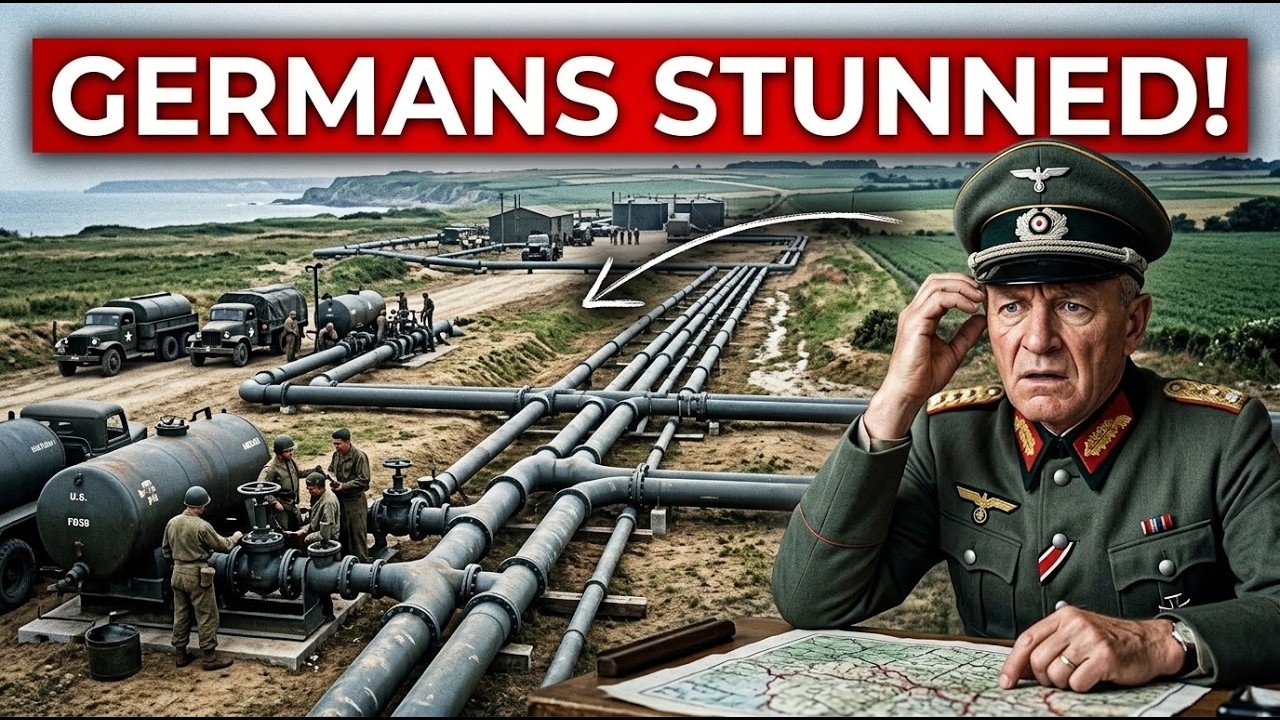
Tankers crossed the Channel and anchored offshore at special piers, where flexible hoses connected them to pipelines running to the shore. Ports were captured and reopened, and tankers discharged into storage tanks on land. From those tanks, a new network of pipelines began spreading inland, and this network stretching across France toward the front was the part of the story the German staff officer could not see. The inland pipelines were built mostly by US Army engineers, specialized petroleum distribution units whose entire job was laying pipe, building pumping stations, and moving fuel.
Their equipment was designed for speed. The pipe was lightweight steel in lengths that a small crew of soldiers could carry and handle without heavy machinery. The sections were not welded, a slow process requiring skilled welders, but joined with quick mechanical couplings, clamps that could be fastened in moments. The pipe did not need to be buried across open ground; it could simply be laid alongside a road or across a field.
Every few miles along the line stood a pumping station, a group of engine-driven pumps often mounted on trailers, pushing fuel to the next station. Storage tanks were set up along the route. At the forward end, the pipeline fed tank farms and discharge points where fuel was pumped into trucks and cans for the final leg to the units. Laying the line was a race.
On level ground, with experienced crews and ready pipe, engineers could lay miles in a day, pushing the line forward behind the advancing armies. Pumping crews followed to bring each new section online. The life of a pipeline unit was hard and unglamorous. Crews unloaded pipe from trucks and rail cars, carried it by hand along the planned route, laid it length after length, and joined the couplings.
Behind them, other crews tested the line under pressure, hunting for leaks, then brought it into operation. Pump station crews lived beside their pumps, often in tents or requisitioned farm buildings, running the engines around the clock, watching the gauges, keeping the fuel moving to the next station. Along the entire line, patrols walked or drove searching for damage: a coupling knocked loose by a passing truck, a section crushed by a tank, a length deliberately cut. When a break was found, repair crews went out, shut down the section, fixed it, and restored flow.
The pipeline network did not carry only one type of fuel. The armies needed gasoline for vehicles, and the air forces needed high-octane aviation fuel for aircraft operating from airfields across France. Pipelines were used to move different products in sequence, and some lines were built specifically to feed forward airfields, so fighter-bombers flying close support missions could refuel at bases near the front instead of relying entirely on trucks. By the end of the war, American engineers alone had laid thousands of miles of pipeline through France and Belgium into Germany, including lines that crossed the Rhine itself in the spring of 1945.
Consider the effect on the calculations that puzzled the German officer. A truck carrying fuel from the coast to the front burns part of its load on the way out and part on the way back. The farther the front advances, the more of each load is consumed in delivering the rest. A pipeline does not have that problem.
The pumps need fuel to run, but a pipeline moves enormous volumes of fuel continuously, day and night, in all weather, without drivers, without truck wear, without traffic congestion, without burning a large share of its cargo. Every mile the pipeline advances is a mile the trucks no longer have to cover. Trucks can focus on the last leg, from the end of the pipeline to the fighting units, a short distance. The men who laid those pipelines and kept the pumps running along hundreds of miles of isolated line were among the most invisible soldiers of the war.
Why was it so hard for the German staff officer to see it? Part of the answer is that a pipeline is not a dramatic target. It is just a pipe running along a roadside, with an occasional pumping station and a few storage tanks. From the air, it was easy to miss.
Because of Allied air superiority, German reconnaissance aircraft rarely flew over Allied rear areas looking for pipelines. Another part of the answer is that the pipelines were vulnerable, something the Allies worked hard to manage. Anyone with a cutting tool could damage a pipe running across open ground, whether saboteur, thief, or careless driver. Fuel was a valuable commodity, and in the broken economy of liberated France, people tapped the pipelines to steal fuel for the black market.
Guard units patrolled the lines, and maintenance crews constantly repaired leaks and breaks. But the system kept working because any damaged section could be bypassed or repaired quickly, and no single pipeline break stopped the whole network. Another part of the answer is that the German staff officer was thinking about supply the way his own army thought about it, through trucks, trains, and horses, all under constant air attack. His army had no comparable pipeline network accompanying it on the battlefield.
The German officer could not grasp that the enemy was pumping fuel toward the front across hundreds of miles of French countryside without any obstacle. And there was another reason, the grimmest from the German perspective. By late 1944, Germany did not have the fuel to supply a pipeline even if it had built one. The synthetic fuel plants had been bombed, and the Romanian oil fields were lost when Romania left the Axis in August 1944.
Whatever fuel Germany had left was directed first to aircraft, then to submarines, then to the most important armored units. Much of the remaining German army moved on foot and by horse. In the autumn of 1944, the two supply systems could not have been more different. On the German side of the line, a fuel column might be a few trucks, some of them captured, moving only at night to avoid aircraft, carrying fuel assembled from depots whose stocks were running out.
Behind them, the railroads that were supposed to feed those depots were being bombed. Behind the railroads, the synthetic fuel plants that were supposed to produce that fuel were also being bombed. At every stage, the system was shrinking. On the American side, a pipeline ran along a French road in broad daylight, fed by tankers arriving at the coast from an ocean the German submarines no longer controlled, pumping fuel steadily toward storage that grew larger week by week.
The German officer was comparing these two images, whether he realized it or not, and the gap between them was the difference between an army that could move and one that could not. It is worth being precise about what fuel supplies meant on the battlefield, because they formed the basis of nearly every American advantage in the west. Fuel let tanks maneuver instead of crawling from fuel depot to fuel depot. It let trucks carry ammunition, food, and supplies.
It let artillery be moved and refueled. It kept ambulances running. It let fighter-bombers fly from forward airfields all day, every day, refueling between missions. It let the American army use motor vehicles for everything, moving infantry, towing guns, moving headquarters, delivering messages, in a way the German army could not.
Every American unit was equipped with vehicles, while German units marched. It is also important to be honest about the limits. Pipelines did not solve every problem. In late summer 1944, the armies outran the entire supply system, pipelines, trucks, and railroads combined.
Patton’s Third Army and others ground to a halt for lack of fuel. The pipelines lagged behind throughout the pursuit across France. It took months for the network to reach full reach and capacity. Even then, the last miles to the front still depended on trucks and cans.
The pipeline was not magic; it was infrastructure built patiently, maintained constantly, and expanded gradually, until the fuel crisis that paralyzed the armies in September was largely overcome by spring 1945. So why could German staff officers not explain how the Americans got fuel to the front? Because they were looking for trucks and trains, and a large part of the solution lay in pipes. The German army understood logistics as well as any army in the world.
What it lacked in 1944 was not intelligence or skill but fuel. It lacked air cover for its supply lines. It lacked the industrial capacity to build and supply a network like the one the Allies built. The Allied answer was fundamentally industrial.
Fuel was moved across the ocean by fleets of tankers, pumped under the Channel through pipes wound onto giant drums, discharged into pipelines on the coast, and driven hundreds of miles inland using lightweight pipe and quick couplings, assembled by specialized engineering units. Fuel was pumped forward station by station, day and night, and carried the final kilometers in cans copied from German design. Every piece on its own was ordinary. Together, they formed a chain that ran from an American oil field to a tank on the German border.
It was not glamorous. It rarely appears in films. But it was, in a very real sense, the lifeline of the Allied armies.
The German army, for all its fighting skill, was fighting an enemy whose lifeline it could not see and could not cut.