William Tecumseh Sherman understood the American South from the inside. He had lived there before the war, walked its roads, sat at its tables, and observed the quiet certainty with which plantation owners regarded the enslaved people they commanded. That understanding shaped everything that followed. When he warned in 1861 that the war would be long, brutal, and enormous, with hundreds of thousands of men and years of savage fighting, the comfortable world of the time refused to hear it.
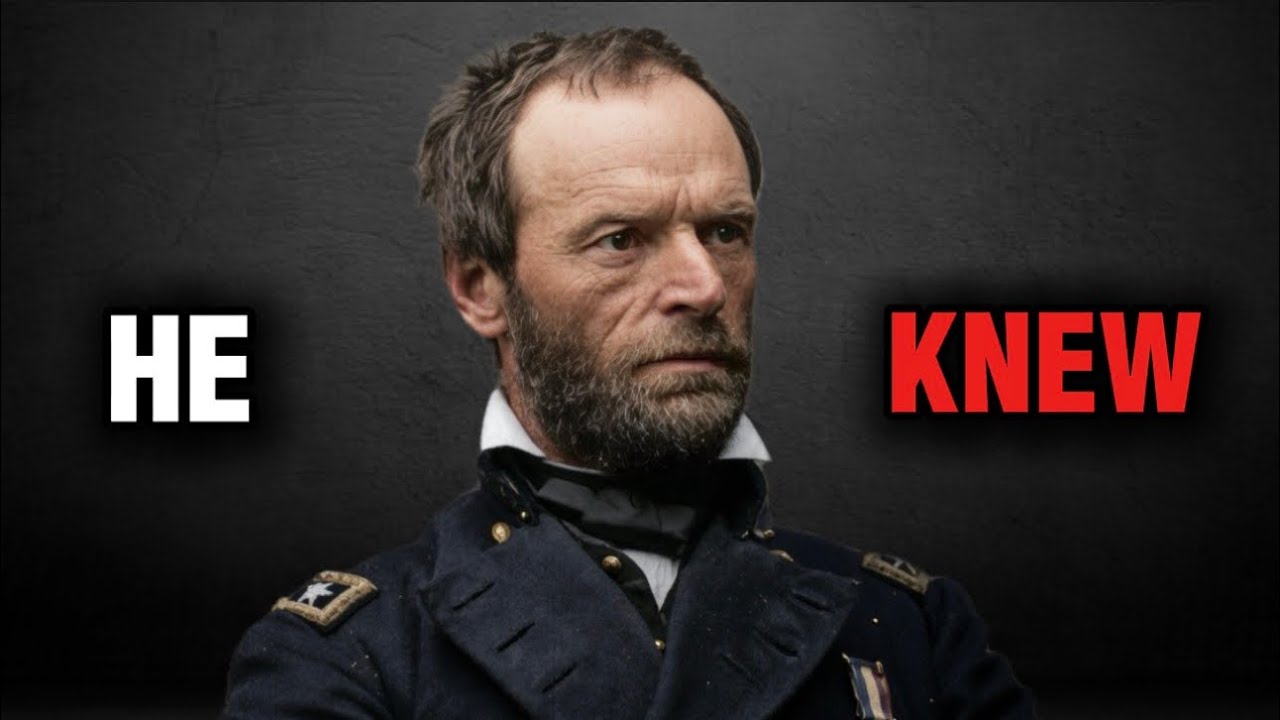
Newspapers called him mad. The Cincinnati Commercial declared him mentally unfit. His own wife wrote letters full of concern. He was relieved from command and sent home in what amounted to a soft dismissal.
The war he predicted lasted four years and killed more than six hundred thousand people. But being right before the facts arrived to confirm it is a lonely position, and Sherman’s early predictions were only the beginning of what no one wanted to hear. Sherman’s diagnosis of the Confederacy went deeper than troop counts and campaign durations. He saw a society organized around a single institution so deeply woven into the psychology of its white population that winning battles would never end the war.
The Confederacy was not just a government or an army. It was an entire civilian population fused to a cause, a population that would remain dangerous long after the last gun fired unless the war was taken to them directly. This was the framework from which the march to the sea emerged, not as savagery or revenge, but as a theory of war he called hard war. The newspapers called it barbarism.
Historians would argue about it for a century and a half. But the second half of Sherman’s argument, the part about what had to happen after the fighting stopped, is where he was most right, and where being ignored cost the country the most. Sherman believed the Confederate defeat on the battlefield would be interpreted by much of the South as a temporary interruption rather than a permanent verdict. He said with blunt clarity in letters, conversations, and memoirs that the white southern ruling class would never genuinely accept the outcome of the war without a sustained, serious, and lengthy occupation and restructuring of southern civil society.
He did not believe in the good faith of the planter class. Surrender at Appomattox represented exhaustion, not conviction, and he knew exhaustion eventually lifts. His commanding general shared that suspicion. Ulysses Grant watched the situation during Reconstruction with mounting alarm and spent most of his two terms as president deploying federal troops to suppress Ku Klux Klan violence, writing increasingly desperate dispatches about organized terrorism against black voters and officeholders.
He asked Congress for more enforcement power, got it, used it, and then watched as northern political will evaporated. The most radical Republicans, men like Thaddeus Stevens and Charles Sumner, had pushed for the hardest possible version of Reconstruction, including land redistribution, military governance, and a genuine dismantling of the old power structure. They were blocked at nearly every turn by Andrew Johnson’s vetoes, a weary northern public, and eventually a Supreme Court that methodically hollowed out the Reconstruction amendments. The particular cruelty of Reconstruction’s failure is that it was not tried and found impossible.
It was abandoned before it could be completed. The troops came home, the federal presence evaporated, and the planters and their allies reconstituted themselves under new names. Black men who had voted, held office, served in legislatures, built schools, and negotiated labor contracts were driven back into a condition that borrowed every practice of slavery except the legal name. Sharecropping tied workers to the land through debt instead of chains.
Black codes restricted movement, criminalized unemployment, and funneled black men into convict leasing operations where they were effectively worked to death on behalf of the same plantation economy that had preceded the war. Sherman had not predicted the precise details, but he had predicted the essential shape of it, that without a thoroughgoing transformation, the South would reconstitute itself in recognizable form. What he perhaps could not have fully anticipated was how successfully the reconstituted South would win the propaganda war that followed. The Lost Cause mythology did not emerge organically.
It was constructed systematically and deliberately by former Confederate officers, politicians, and their intellectual allies. The Southern Historical Society, founded in 1869, became the institutional engine of the rewriting project, with Jubal Early, one of Lee’s core commanders, as its central figure. Under his influence, Robert E. Lee was transformed from a man who had taken up arms against his country into a secular saint.
The war was recast as a constitutional struggle over states’ rights, not a defense of slavery, despite the fact that the Confederate Constitution explicitly protected slavery, and despite the fact that Confederate Vice President Alexander Stephens had said plainly in his cornerstone speech in 1861 that slavery and the natural inferiority of Black people was the cornerstone of the Confederate Republic. Those words, spoken openly and on the record, were quietly disappeared from the standard telling. A different story was told loudly, repeatedly, in textbooks, monuments, novels, and films. D.
W. Griffith’s Birth of a Nation, released in 1915, represented the Lost Cause mythology’s most complete cultural conquest. It portrayed Reconstruction as a period of Black incompetence and menace, northern cynicism, and honorable southern suffering. The Ku Klux Klan appeared as heroes on horseback.
Woodrow Wilson watched it in the White House and called it history written in lightning. It was nothing of the kind. It was propaganda assembled from decades of carefully tended lies, but it worked so completely that its version of events became the popular understanding of the Civil War and its aftermath for generations. The monuments followed the same logic.
Most Confederate monuments were not built in the immediate aftermath of the war. They were built in two distinct spikes, one in the early twentieth century as Jim Crow laws were codified, and another in the 1950s and 1960s as the civil rights movement challenged that codified racial hierarchy. They were not memorials. They were statements of ongoing defiance, markers of contested territory placed on courthouse lawns and before state capitol buildings, not in cemeteries where grief lives, but in the civic spaces where power is exercised.
The political failure had specific mechanics. The Compromise of 1877, the deal that resolved the disputed presidential election between Rutherford Hayes and Samuel Tilden, is usually taught as a dry procedural matter, but its consequences were catastrophic. In exchange for putting Hayes in the White House, federal troops were withdrawn from the South. The last meaningful federal enforcement presence evaporated.
Reconstruction’s institutional architecture fell almost immediately. Men who had been elected to Congress and served in state legislatures were driven out by campaigns of terror barely concealed and entirely unpunished. The Red Shirts in South Carolina and the White League in Louisiana were paramilitary organizations whose purpose was the violent destruction of Black political participation, and they operated in plain sight because no federal authority remained to stop them. Grant, by then out of office, wrote about it with fury, saying the country had abandoned the freedmen to their enemies and that the consequences would echo through generations.
He was right. The system of racial subjugation constructed in the South after Reconstruction’s collapse lasted nearly a century, enforced by law, economic coercion, psychological terror, and outbursts of spectacular violence. The Wilmington massacre of 1898, the Atlanta race riots of 1906, the Tulsa massacre of 1921, and hundreds of documented lynchings, ritualized public murders photographed for souvenir postcards and described in local newspapers with the calm detachment of sports reporting. This was the South Sherman had been afraid the war would leave intact if Reconstruction was not finished.
And Reconstruction was not finished. What makes this history difficult to sit with is not just the suffering it produced, but the way it was continuously normalized. The violence, the disenfranchisement, the poverty. And the Lost Cause was so successfully installed in the cultural operating system that it was not really contested at the national level until the civil rights movement forced the confrontation in the middle of the twentieth century.
Even then, the confrontation was only partial. The Civil Rights Act of 1964 and the Voting Rights Act of 1965 were extraordinary achievements, but they were legal and political achievements. They changed what was permissible, not what was believed. The monuments were still standing.
South Carolina flew the Confederate flag over its state house until 2015. The psychological architecture Sherman identified remained largely intact. Sherman was also, it must be said directly, a man of his time. He had deep contempt for the planter class, but his concern for Black Americans was not driven by any belief in their full equality.
He resisted arming Black soldiers for much of the war. His views on race were the views of a white nineteenth-century man shaped by the assumptions of his world. But the essential dynamic he saw, that the Confederate project would reconstitute itself if not genuinely dismantled, that former Confederates would never simply accept defeat in the deep sense, that the civilian population’s commitment to racial hierarchy ran too deep to dissolve on its own, he saw it, said it, and wrote it. The country, exhausted and distracted, moved on.
The echoes are long. The Voting Rights Act of 1965 was gutted by the Supreme Court in Shelby County v. Holder in 2013, on the reasoning that the conditions requiring federal oversight no longer existed. Within hours, several states moved to implement voting restrictions that federal preclearance had previously blocked.
The debate over Confederate monuments accelerated after the Charleston church shooting in 2015, when Dylann Roof murdered nine Black parishioners in part because he had absorbed Confederate mythology. The monuments began coming down, and the intensity of the resistance to their removal illustrated with some precision that Sherman had been right about the depth and durability of the attachment. Enormous things have changed. The legal structure of American apartheid was dismantled, and Black Americans have exercised political power at every level of American government.
But Sherman’s argument was not simply about policy outcomes. It was about how deep the roots went. On that question, the evidence of the intervening century and a half suggests he was not wrong. He wrote in his memoirs with the bitterness of a man who had watched his correct predictions go unheeded, that the war had solved secession and the legal question of slavery, but that the deeper habits of mind, the assumptions, the hierarchies, the determination to maintain power by whatever means available, had not been reached by cannon and fire.
They were going to have to be addressed by the much slower and less dramatic work of law, politics, and culture. He was not optimistic. He should not have been. The habits he identified proved more durable than almost anyone who did not want to believe it was willing to accept, and the cost, paid most heavily by the people whose freedom and safety depended on whether the country was willing to finish what it had started, stretched across generations and is still being counted.
When the people around you are determined not to listen, the truth does not go away. It just waits, accumulating interest until the reckoning arrives in a form that is harder to look away from.