Jim Sullivan was not a star when he disappeared, and he never got the chance to become one. A gifted guitarist and songwriter from Nebraska, born in 1940 and raised partly in California, he spent years playing in Los Angeles clubs, earning respect from industry insiders but never breaking through to mainstream success. His sound, a smooth folk rock blend, fit naturally into the late 1960s and early 1970s, yet the recognition he craved stayed just out of reach. In 1969, Sullivan released his debut album, UFO.
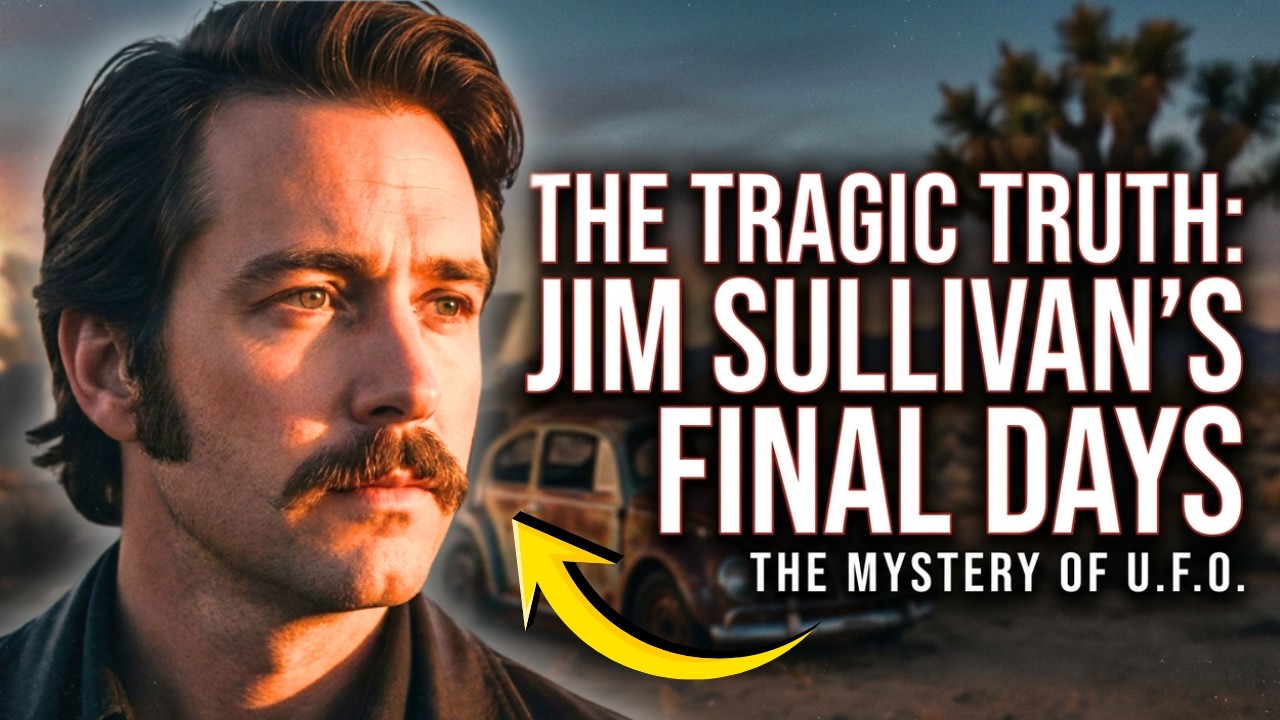
It did not sell well, and it did not make him famous. But the album carried something strange beneath its surface. Songs like Jerome and the title track UFO were steeped in haunting atmosphere and lyrics that circled around mystery, space, and disappearance. Listeners who encountered the record often felt uneasy without quite knowing why.
Over the years, that eerie quality turned UFO from a commercial failure into a cult artifact, treasured by collectors and deep-cut rock fans, though Sullivan himself never saw that appreciation in his lifetime. By the mid 1970s, he was frustrated with the music business. Wanting a fresh start, he packed his car and headed for Nashville, hoping for another chance. He never arrived.
In March 1975, Sullivan checked into a motel in Santa Rosa, New Mexico. The next morning, he was gone. His car was later found abandoned on a remote ranch road. Inside were his belongings: his wallet, his money, his guitar.
Everything a person would take if they were deliberately starting over in a new city. But Sullivan was not there. There were no confirmed sightings, no body, no explanation. The abandoned car changed everything about how the disappearance was understood.
A man who leaves voluntarily does not usually leave behind his wallet, his guitar, and his cash. That single detail turned a sad story into a deeply unsettling one and opened the door to decades of questions. Did he walk away on purpose? Was he harmed?
Did he lose his bearings in the desert, suffer a breakdown, or meet with something no one ever uncovered? With his music so heavily tied to alien imagery, speculation ran wild. Extraterrestrial theories made for fascinating headlines and gave the story a strange symmetry: an artist who made an album about being taken by aliens had vanished without a trace. For many, the connection felt too perfect to ignore.
But the most likely explanation remains far more heartbreaking. Investigators and researchers have long believed Sullivan wandered into the harsh New Mexico desert and died from exposure, disorientation, or injury. The terrain there is unforgiving, and a man on foot, unprepared and alone, would have had little chance of survival. Yet because no confirmed remains were ever recovered, that conclusion has never been definitively proven.
The uncertainty has never fully receded. The result is an open case with no final chapter. There is no closure, no clean answer, just an artist who made unsettling, beautiful music and then disappeared in a way that mirrored the themes he had sung about years earlier. The lack of resolution is precisely what has kept his story alive.
Without a body, without a confirmed fate, the mystery refuses to close. In the years since, Jim Sullivan’s music has found a second life. The record that failed on release was eventually reissued for modern listeners and celebrated precisely as the hidden gem it had always been. Younger audiences rediscovered his songs, and the attention he spent his life chasing finally came, just decades too late.
That may be the cruelest part of the story. Sullivan spent years trying to be heard, working in obscurity, building his craft in clubs and studios while the industry barely noticed him. The recognition he wanted never arrived while he was alive to enjoy it. Only after he vanished did the world truly start listening.
His story raises an uncomfortable question that has no real answer. Some artists become legends only after they are gone, and it is impossible to know how many brilliant voices are being ignored in the present, the way Sullivan was ignored. But the man himself left no answer behind.
Only the music, the mystery, and the silence of a desert that never gave up its secret.