In June 1862, the United States Army gave one of its most seasoned cavalry officers an impossible mission. Confederate horsemen had slipped behind Union lines outside Richmond, Virginia, and Brigadier General Philip St. George Cooke was expected to chase them down. Cooke was a Virginian who had stayed loyal to the Union.
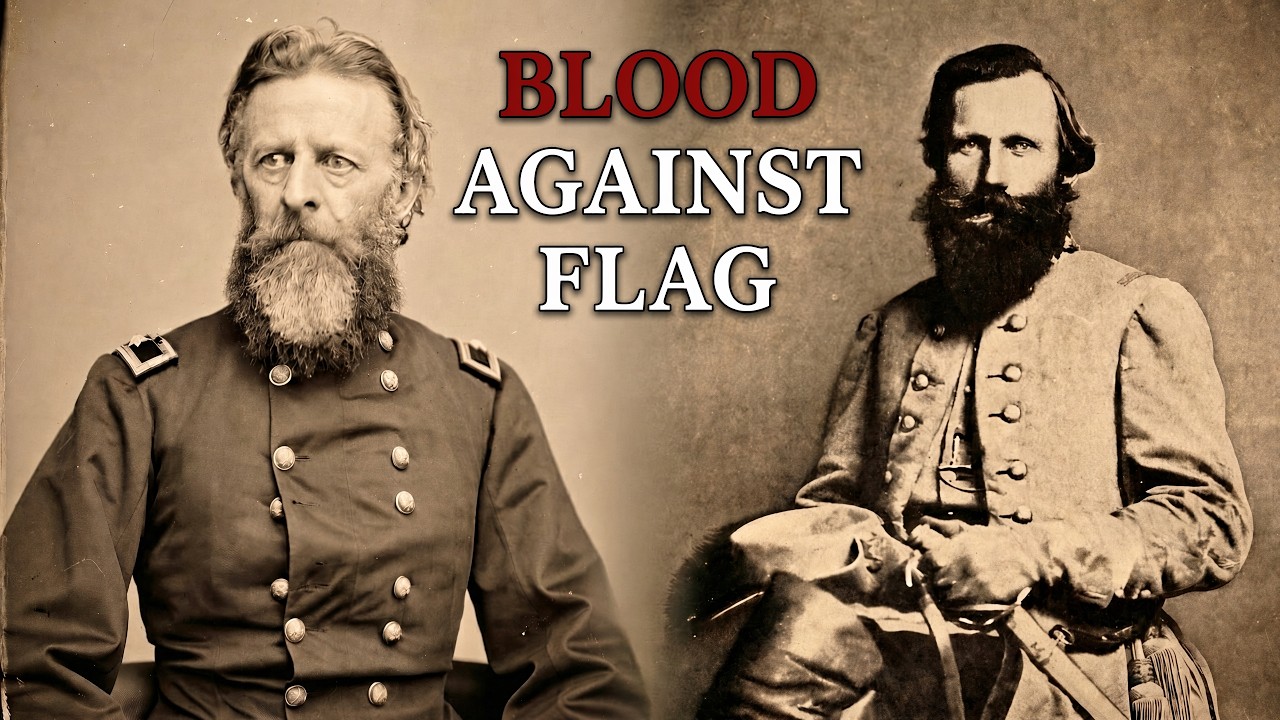
He had spent thirty-five years in military service, most of it on the American frontier. He had literally written the army’s cavalry manual. The man he was pursuing was Jeb Stuart, the Confederacy’s most famous cavalryman, and also the husband of Cooke’s daughter Flora and the father of his grandchildren. For three days, Philip St.
George Cooke’s command tried to catch his son-in-law in a sweep around one of the largest armies ever assembled in the Western Hemisphere. They never caught him. And that failure was not confined to the battlefield. It followed Cooke in the newspapers, in the criticism of other Union officers, and into the deepest privacy of his own family.
Two years earlier, Stuart and Flora had honored the old general by naming their only son Philip St. George Cooke Stuart. By the end of 1861, that name had disappeared. The boy’s parents changed it after Stuart objected to the grandfather’s loyalty to the Union.
By the end of the war, the general once called the father of the United States cavalry was far from the front lines, supervising army recruiting in New York, while other men led the mounted troops he had spent his life training. This is the question at the heart of the story: What is the real cost of a man’s oath when keeping it places him against his own blood and kin? When the Union began to break apart in the winter of 1860 and 1861, Philip St. George Cooke was as far from the crisis as an American soldier could be.
He commanded the Department of Utah from a remote post called Fort Crittenden, more than two thousand miles from Washington. News of secession reached him in fragments through mail and letters that were weeks old by the time they arrived. State after state left the Union. Then in April 1861 came the most important report.
Virginia’s secession convention voted to leave. Cooke was fifty-one years old, a colonel of cavalry, and one of the most experienced mounted officers in the United States Army. His family and the Confederate cause had every reason to value that experience. His relatives urged him to come home, stand with Virginia, and place his long military service under the new Confederacy.
Hundreds of officers around him were making the same decision. Virginians among them resigned in wave after wave. Robert E. Lee went south, and so did many other Virginians Cooke had served with over his long career.
At Fort Crittenden, with only dispatches, Cooke had no crowd to follow and no one to persuade him. He had the question itself, stripped of everything else. He had sworn an oath to the United States at eighteen, and the United States had given him every mile of his life since then. Virginia had given him only his birthplace.
He refused the South, and he did not refuse quietly. On June 6, 1861, Cooke wrote a public letter to a Washington newspaper denouncing Virginia’s secession. His words left no room for doubt. “I owe Virginia little, my country much.
I have been given a distant command, and I will remain under her flag as long as it flies. ” It was a clear declaration of loyalty, printed where the whole country could read it. It was also a catastrophe inside his own house. The Cooke family in the summer of 1861 was torn apart.
His only son, John Rogers Cooke, resigned his commission in the United States Army and went south, eventually rising to Confederate brigadier general commanding infantry in the Army of Northern Virginia. One of Cooke’s daughters was married to Dr. Charles Brewer, who became a Confederate surgeon. Another daughter, Julia, was married to a Union officer who would command a New York regiment.
The family split in four directions, brother against father, sister against sister. Then there was Flora. Flora Cooke had married a young lieutenant named James Ewell Brown Stuart in November 1855 at Fort Riley in Kansas Territory, where her father was post commander. Stuart had served under Cooke on the frontier.
When Virginia seceded, Stuart resigned from the United States Army within weeks and accepted a Confederate commission. He expected Philip St. George Cooke to do the same. When Stuart learned his father-in-law would remain under the old flag, his reaction was anger, not grief.
“He will regret it but once, and that will be continuously,” Stuart wrote. The two men never spoke again. There was no reconciliation, and nothing changed that for the rest of Stuart’s life. Stuart did not stop at silence.
In 1860, he and Flora had named their infant son Philip St. George Cooke Stuart in proud honor of the grandfather. Now that the name seemed a stigma, Stuart wrote to Flora that keeping it would cause irreparable harm to their only son. Before the end of 1861, the couple renamed the boy, making him James Ewell Brown Stuart Jr.
so that he would carry his father’s name instead. Flora was caught in the middle of all of this, a Union general’s daughter raising her children in the heart of the Confederacy. In a letter from camp in November 1861, Stuart urged her to bear the faults of others with the patience of silence, promising that her husband and brothers would atone for her father’s conduct. “Atonement,” the son-in-law now said about Philip St.
George Cooke. By the spring of 1862, both men were generals and heading toward the same patch of Virginia. McClellan had landed his massive army on the Peninsula east of Richmond and was pushing slowly toward the Confederate capital. Cooke commanded the army’s cavalry reserve, a division-sized force of regulars and volunteers.
Across the lines, Stuart commanded the cavalry of the army defending Richmond. The father-in-law and son-in-law now held mirror positions in hostile armies close enough to hear the same church bells. The Union advance stalled only a few miles from the city. On June 1, 1862, command of the Confederate army passed to Robert E.
Lee. Lee wanted to attack, but he needed to know whether McClellan’s right wing north of the Chickahominy River lay exposed. To find out, he turned to Stuart. Before dawn on June 12, 1862, Stuart led twelve hundred carefully chosen men quietly north out of Richmond.
The column pretended to be heading toward the Shenandoah Valley, then turned east directly into the rear of the Union army. By the afternoon of June 13, Stuart had his answer. The Federal flank was open, unfortified, and vulnerable. His reconnaissance objective was essentially complete.
He had to decide how to return. Going back meant retracing a route the enemy now knew straight toward whatever force was gathering behind him. Going forward meant riding a complete circle around an army of more than one hundred thousand men. At the small crossroads of Old Church, Stuart made the decision that made him famous.
He would ride completely around them. Stuart later wrote that he saw an opportunity to strike a heavy blow at a boastful and insolent foe. Every soldier in the column understood who commanded the army’s cavalry. The Confederate horsemen logically assumed that an old and famous commander like Cooke would be waiting for them somewhere with everything he had.
The pursuit they feared came too late. At a crossroads called Lynn’s Corner, the raiders collided with a detachment of the 5th U. S. Cavalry.
Sabers flashed in a sharp, short clash. A Confederate captain named William Latane was killed, the only Confederate killed in the entire expedition. The Federals fell back, and at Old Church the raiders overran and burned the 5th Cavalry’s camp. That regiment would return to this story in its darkest moment.
The brief fight became memorable not only for Latane’s death but because it put Stuart’s raiders in direct contact with the cavalry commanded by Cooke. Then the raid struck Union communications and supplies. At Tunstall’s Station, Stuart’s men cut the telegraph and closed the York River Railroad, McClellan’s own supply line. All night the column pushed south through New Kent County, dragging prisoners and captured mules behind them while the Union reaction behind them stumbled and stalled.
And where was Cooke? Word of the raid reached him on the afternoon of June 13. What followed became one of the most criticized episodes of his career. Conflicting reports made it difficult to know whether Stuart was alone or supported by Confederate infantry.
Cooke chose a cautious pursuit and kept his horsemen near supporting infantry, giving up the only advantage a pursuit possesses, speed. A chase meant to catch cavalry moved at the pace of foot soldiers. Orders and reports contradicted each other. Hours were wasted.
By the time Union forces reached Tunstall’s Station, Stuart’s men were gone. Stuart then faced the one enemy that nearly destroyed him, the rain-swollen Chickahominy River. His exhausted men repaired a broken bridge using timbers from a nearby building and crossed barely ahead of their pursuers. Union cavalry arriving at the crossing found the rear guard burning it.
Three days, roughly one hundred miles, 165 prisoners, 260 horses and mules captured, and valuable military intelligence. Confederate losses: one man. Richmond erupted. Newspapers praised the raid as a brilliant maneuver, and the story lost nothing in the telling because the South noticed exactly what made it entertaining.
The son-in-law had completely outgeneraled the father-in-law. Stuart became a national hero overnight and was promoted to major general within weeks. In the North, the humiliation produced sharp criticism, and Cooke became the scapegoat. His name, his slowness in pursuit, his Virginia birth, and his family connections merged in the criticism, and the calculations readers were asked to make were cruel.
Some critics wondered whether the old Virginian’s heart was truly in the war. Those whispers were poisonous, and they were entirely wrong. Twelve days later, Cooke led a cavalry charge at Gaines’ Mill that further stained his reputation. It was June 27, 1862, two weeks after the raid.
Armed with Stuart’s information, Lee pushed most of his army across the Chickahominy to crush the exposed Union flank. Fitz John Porter’s Fifth Corps was fighting for survival on a plateau behind a muddy swamp called Boatswain’s Swamp near a mill owned by the Gaines family. Cooke and his cavalry were on that plateau, posted on the Union left near the river, guarding the very guns the Confederate army had come to capture. Somewhere across the field, Jeb Stuart rode with two thousand horsemen covering the far end of the Confederate line.
The father-in-law and son-in-law were on the same battlefield in the fading evening light. They would never be closer than that in this life. All that hot afternoon, Porter’s men repelled one Confederate attack after another. Then, near sunset, Lee finally moved his entire force at once.
More than thirty thousand men attacked together, the largest single assault the Confederacy would ever make. Led by John Bell Hood’s Texas brigade, the gray line broke the center of the Union position. Porter’s front did not bend. It shattered.
From his position near the left flank, Cooke watched the disaster unfold. Union soldiers streamed back past the guns in the evening dusk. The gun crews were suddenly exposed after their protection had withdrawn, and Confederate infantry were rushing up toward them through the smoke and fading light. Within minutes, the guns would be lost.
Cooke had only one card to play, the one his entire life had prepared him for. Near him stood five companies of the 5th U. S. Cavalry, the same regiment whose camp had been burned at Old Church two weeks before.
Now it numbered barely 250 officers and men. They were professional regulars, the kind Cooke had spent four decades preparing. He looked at the collapsing line and at the guns, and he gave the order his own manual said a cavalryman must give. Charge.
The bugles sounded. The line surged forward amid cheers from the soldiers. Almost immediately, the formation was torn apart as the horsemen swerved around their own retreating guns. Then Hood’s infantry turned and leveled their rifles.
The volley came like a wall. Witnesses said many of the regiment fell in the first rank, horses and men together. Riderless animals, maddened by the noise, wheeled and galloped back through the Union batteries, and the gunners who saw horsemen bursting from the smoke thought they were Confederates. A handful of troopers actually reached the enemy line and were killed near the guns.
The regiment’s commander, Captain Charles Whiting, was captured. The regiment suffered heavy losses, officers and men killed, wounded, and missing in an attack that lasted only minutes. At least nineteen Union guns fell to the Confederates that evening, and darkness more than anything else ended the battle. Porter’s exhausted corps limped across the Chickahominy that night and burned the bridges behind it.
It was a slaughter, and it was also, according to many accounts, not in vain. The desperate charge gave the Union artillery precious minutes to limber the caissons and escape, and most of the guns were saved. Cooke himself described it simply as a hard duty assigned to that half of the 5th Cavalry. A French officer on McClellan’s staff later told him the truth as he saw it, that Cooke, with his cavalry, had done all that cavalry could do to impede the defeat.
One survivor of the charge put it more simply. We saved some of the guns and tried to save them all. Fitz John Porter saw it differently, and Porter’s version reached the official record. In his report, the corps commander blamed the cavalry charge for throwing his artillery into confusion at the critical moment, writing that Cooke, certainly ill-informed, had ordered it against instructions.
The wording was polite. The implied accusation was devastating to his career. Porter had lost the battle and at least nineteen guns, and the written explanation was that a Virginian with a Confederate family had been responsible. Now the pieces were all in place.
A famous failure against his son-in-law in June. A disaster blamed on him in the same month. Newspapers questioning his loyalty. A corps commander pointing at him in an official report.
Every road Philip St. George Cooke had traveled, forty years of frontier, war, and doctrine, had shrunk to a single question in Washington. What do we do with this man? The answer came quickly and quietly, which in some ways made it worse.
There was no court-martial for Philip St. George Cooke, no formal charge, no hearing where he could call witnesses and defend himself. It was simply an ending. In July 1862, days after the Battle of Gaines’ Mill, Cooke left the Army of the Potomac and active field service.
He would later say his superiors were incompetent, and after the criticism that followed the campaign, he had his reasons. But he never returned to field command, and rumors about his loyalty followed him. The Union’s senior cavalryman, the author of the army’s own tactics, became subject to political suspicion with a Confederate son, two Confederate sons-in-law, and a new disaster attached to his name. What the War Department did with him afterward tells the whole story.
For about thirteen months, the father of the U. S. cavalry sat on courts-martial, a cavalry general judging other men’s cases while the war went on without him. In the fall of 1863, new orders sent him south to command the District of Baton Rouge in occupied Louisiana, a garrison post far from the decisive fronts.
In May 1864 came the final unambiguous message. Cooke was assigned to New York City as superintendent of the recruiting service for the regular army. An office, forms, rations, and depot inspections. Far from the clash of sabers for the rest of the war.
The orders carried no formal accusation. Together, they amounted to a sentence. There was one final, quieter blow. Several editions of Cooke’s cavalry manual were published and continued to be printed and circulated.
His book, the system Cooke had spent a lifetime drafting, stayed in print and in use while its author counted recruits. The army decided it could use the manual and sideline the man. And while Cooke processed recruits, he had to watch his son-in-law become immortal. Stuart raided the headquarters of the Union army and escaped with the general’s dress uniform.
In October 1862, he rode completely around McClellan’s army a second time through Pennsylvania, as if proving the first ride had not been luck. He screened Lee’s army through the great campaigns of 1862 and 1863, briefly commanded Stonewall Jackson’s corps in the crisis at Chancellorsville, and became in the Southern imagination the crowned cavalier of the Confederacy. There was also a private record, harsher than the public one. In November 1862, little Flora, Stuart and Flora’s eldest daughter, died of typhoid fever at age five.
She was Philip St. George Cooke’s granddaughter. He learned of her death across enemy lines without any chance to stand at her grave. The war had not only taken his commands and his reputation.
It had made him a stranger at his own family’s funerals. Then, on one day in May 1864, the record changed forever. On May 11, 1864, at a crossroads called Yellow Tavern just north of Richmond, Stuart’s outnumbered forces collided with a massive column of Union cavalry under Philip Sheridan. Late in the battle, as a Michigan regiment fell back before him, a dismounted Union trooper turned and fired his pistol.
The bullet struck Stuart in the side. He was thirty-one years old. They carried him into Richmond, to the home of Dr. Charles Brewer, his brother-in-law, the Confederate army surgeon who had married Flora’s sister Maria.
Stuart died there the following evening. Flora, who hurried toward the city, arrived too late. The house where Jeb Stuart died belonged to the family of Philip St. George Cooke.
Nearly everyone gathered around the deathbed was someone the old general loved. He was hundreds of miles away in a recruiting office in New York on the other side of the war. Stuart had written that his father-in-law would regret his choice but once, and that he would regret it continuously. He went to his grave in Hollywood Cemetery, having maintained his own private code of silence to the end.
The two men never exchanged another word. Flora wore black in mourning for her husband and never took it off. She was twenty-eight years old and wore mourning clothes for the remaining fifty-nine years of her life, through decades of work as a teacher and eventually as principal of a girls’ school in Staunton, Virginia, an institution later renamed Stuart Hall in her honor. She preferred to be called Mrs.
General Stuart. The daughter of one of the Union’s great cavalrymen became the Confederacy’s permanent widow. The boy who had been named Philip St. George Cooke Stuart grew up, as his father insisted, as James Ewell Brown Stuart Jr.
, and his original name was never restored. Cooke’s own war ended without compensation. The army gave him a brevet major general’s rank in 1866, a thank-you honor for his long service, and sent him west again. As commander of the Department of the Platte, he oversaw the opening months of Red Cloud’s War.
He kept working in quiet administrative commands until 1873, then retired after nearly fifty years of service and settled in Detroit. In his final decades, he wrote and waited. He published memoirs of his years on the southwestern frontier. In 1885, he used the pages of a national magazine to defend the Gaines’ Mill charge one last time, still answering Fitz John Porter’s report more than twenty years after the guns fell silent.
Slowly, intermittently, some of his family returned. Family accounts say Flora visited her parents after the war, a Confederate general’s widow in black mourning clothes sitting at the table of a Union general. In the late 1880s, more than twenty-five years after the estrangement, his son John Rogers Cooke, the former Confederate general, finally reconciled with his father. Some of what was broken was repaired.
Not all of it. Not ever all of it. Philip St. George Cooke died at his home in Detroit on March 20, 1895, at age eighty-five.
They buried him in Elmwood Cemetery in Michigan soil beneath a modest stone, while the family he had lost lay hundreds of miles away in Hollywood Cemetery in Richmond, gathered around the imposing monument to the son-in-law with whom he never reconciled. Stand at those two graves and the entire story is there. In Richmond, the legend, the crowned cavalier who chose Virginia and died young enough to become a myth. In Detroit, the old man who chose his oath and lived long enough to count everything it cost.
Cooke was never accused of disloyalty, never stripped of his rank, never formally tried. He was quietly marginalized by his country and quietly cast out by his family. And he endured both without retreating from a single word of that letter he wrote in 1861. I owe Virginia little, my country much.
He kept the promise. He remained under the flag as long as it flew. The deepest measure of the price is not in any battle report. It is in the name of a child given in his honor in 1860 and withdrawn within eighteen months, so thoroughly that history still remembers the boy today as Jeb Stuart Jr.
The armies took Cooke’s orders. The newspapers took his reputation. But his family took his name.
And that was the one loss the old soldier could never face, never overcome, never recover.