The official engagement photograph was taken on a cool May afternoon in 1973 at Buckingham Palace and released to the world the next day. Captain Mark Phillips of the Queen’s Dragoon Guards stands beside Princess Anne, he in dress uniform, she in a simple blue suit. They look happy, as one might expect. But the story is in their hands.
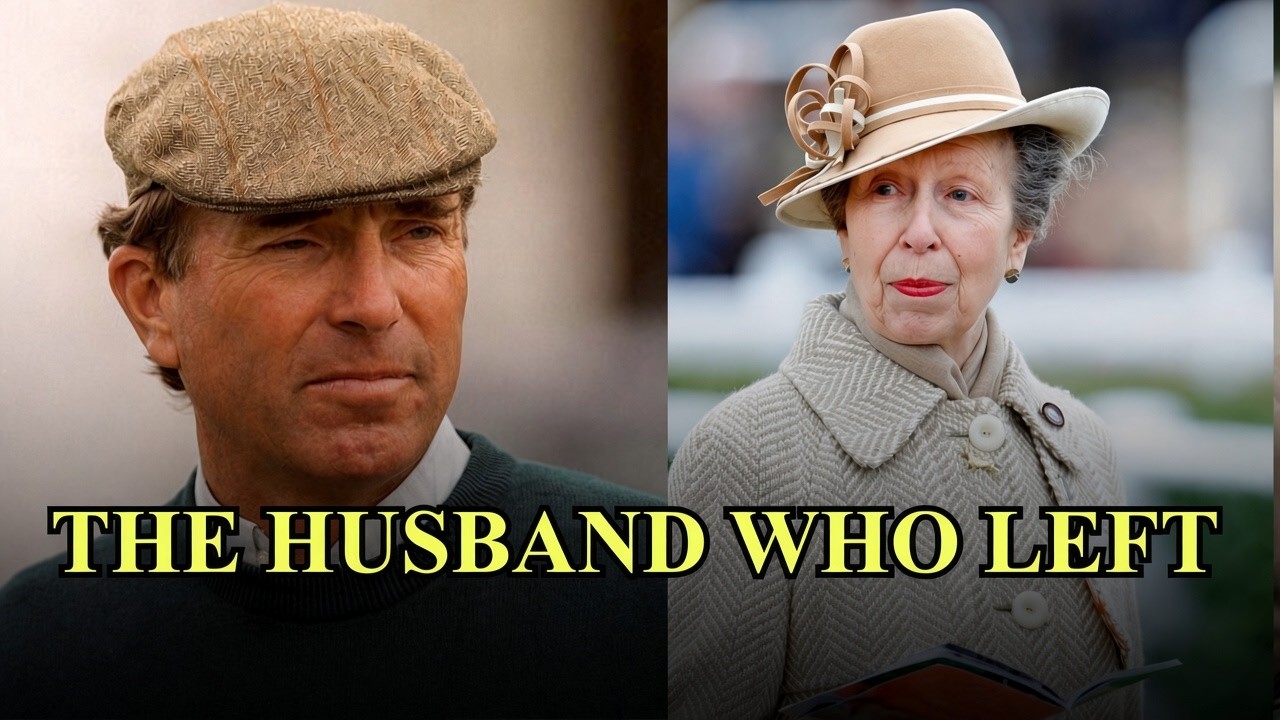
Anne’s left hand rests lightly on his forearm, the engagement ring a modest diamond flanked by two smaller stones. His left arm is held stiffly at his side, his hand not relaxed but a tight, white-knuckled fist. The photographer, Lord Snowdon, Princess Margaret’s former husband, captured it rather than staged it. The portrait was meant to signal a beginning.
It instead suggested a man bracing for what was coming. Mark Phillips was not born into palaces and press lines. He was the son of a major, raised in the Wiltshire countryside, a world of horses, mud, and army camaraderie. He was a gifted equestrian, quiet, intensely private, and by many accounts shy.
The cavalry officer’s uniform fit him perfectly. The role of royal consort would not. The palace announcement of the engagement was rushed and clinical, stating only that the Queen had given her consent. There was no mention of courtship or love.
In the weeks that followed, Phillips was reportedly dispatched to the palace for briefings—not on statecraft, but on cutlery. A senior courtier tutored him on the bewildering array of forks and knives at a formal banquet. For a man accustomed to army mess halls, this was an alien ritual. The press constructed its narrative: the dashing officer who won the princess.
But candid photographs often betrayed the fiction. Mark’s smile frequently looked strained, and he stood a half step behind Anne, unsure of his footing on this new polished stage. Anne herself was no typical fairy-tale princess. She was sharp-witted, direct, and famously impatient with what she called tomfoolery.
She respected Mark’s skill in the saddle and his quiet competence. Whether she understood the cost he would pay to enter her world was less clear. She was a born royal. He was a conscript.
The wedding was set for November, only six months after the announcement. The schedule was relentless: official portraits, public appearances, planning sessions. Mark’s army duties became secondary. His primary job was to be seen, to be photographed, to play his part.
He was leaving the known world of regiments and rankings for the opaque, unwritten rules of the royal family. There were no manuals for this, only corrections. To understand the man in that portrait, you must leave the palace and travel west to the Cotswolds, to a world of damp wool and saddle leather, of regimented order and the solitary focus of the cross-country course. This was the world that made Mark Phillips, a world defined not by bloodlines but by discipline, not by inheritance but by merit—the height of a jump, the time on a clock, the rank on a shoulder.
His father, Major Peter Phillips, had served with distinction. The family home was a modest Georgian house near Tetbury, a comfortable, unpretentious life of service and sport. The atmosphere was one of bluff, no-nonsense values. Emotion was a private matter, a potential weakness to be managed.
Success came from control—control of your horse, your body, your expression. His path seemed preordained. He followed his father into the army, receiving a commission in the First Queen’s Dragoon Guards. But the stable, not the barracks, was his true sanctuary.
His mother had been a champion showjumper, and young Mark possessed an almost preternatural connection with horses. In the saddle, he was not the son of a major or a junior officer. He was simply a rider, and his skill was undeniable. The pinnacle of this world was the Olympics.
In 1972, at age twenty-three, Lieutenant Mark Phillips arrived in Munich as part of the British three-day eventing team. Eventing is the triathlon of equestrian sport, a brutal test of dressage, cross-country, and showjumping across three days. The pressure is immense. Competing on a horse named Great Ovation, Phillips was part of a British team that performed with flawless cohesion.
When the final scores were tallied, they stood atop the podium. Mark Phillips had won an Olympic team gold medal. On the podium, he allowed himself a broad, unguarded smile—a moment of pure, uncomplicated joy. Here, the world acknowledged him for what he could do, not for who he might one day marry.
He returned to England a national sports hero, yet his life remained remarkably consistent. He went back to his regiment and trained his horses. Even after his Olympic win, while serving as a young officer, he would sometimes be found late at night in the stable block, alone, quietly polishing his own saddle and boots. It was a private ritual, a reconnection with the tangible tools of his trade.
This was control. This was peace. This was the man, fully formed, who would soon be introduced to Princess Anne. Their courtship unfolded not in drawing rooms but outdoors, in the mud and morning light of the training grounds.
Both in their early twenties, they found common ground on the cross-country course. They began seeing each other regularly while he was stationed at Sandhurst and she was training at the nearby Pirbright ranges. Their world was one of shared purpose. Here, titles mattered less than timing, bloodlines less than balance.
He was simply Mark, a talented horseman and respected soldier. She was Anne, a fiercely determined equestrian. The fact that one of them was the Queen’s daughter was in those early days almost incidental. One small physical truth spoke volumes: Anne’s hands were calloused and weathered, her fingernails kept brutally short.
They were not the soft, manicured hands of a fairy-tale princess. They were the practical tools of her trade. The press was initially charmed. Here was a love story the public could understand, the handsome army officer and the spirited princess united by a passion for horses.
Photographs from 1972 showed them side by side on horseback, relaxed in each other’s company. The Queen and Prince Philip were reportedly pleased. The young man was solid, stable, and shared their daughter’s deepest passion. He appeared an ideal consort.
But this courtship on horseback created a powerful illusion of privacy. Galloping across open country, they could briefly outrun the press. The very nature of their shared passion built a wall around them. This created a dangerous assumption: that their life together could continue in much the same way, that their equestrian partnership would be insulated from the demands of the monarchy.
It was a fundamental miscalculation. The privacy they enjoyed was borrowed, contingent entirely on their status as courting individuals. The moment they became engaged, that bubble was destined to pop. The proposal, when it came in the spring of 1973, was a quiet affair.
He simply asked, and she simply said yes. The announcement on May 29, 1973, was met with widespread public delight. Commentators painted a picture of a modern, down-to-earth royal marriage, a partnership of equals bound by sport. Yet even in the official engagement photographs, a subtle dissonance is visible.
The casual intimacy of the training ground was gone, replaced by the formality of the palace. The wedding on November 14, 1973, was a spectacle of state broadcast to two hundred million people. Westminster Abbey was filled with crowns and coronets. Princess Anne, in a Tudor-style dress with a high collar, walked up the aisle with her father.
Captain Mark Phillips waited at the altar in his dress uniform. The vows were exchanged, the bells pealed, the crowds cheered. By every outward measure, it was a fairy-tale conclusion. Yet fairy tales, as biographer Brian Hoey notes, tend to end at the wedding.
The first act of their married life, the honeymoon, would quietly illuminate a fundamental mismatch of expectation and reality. They departed for a multi-stage tour that was less a retreat than a continuation of public duties. After a brief interlude at Broadlands, they traveled to the Caribbean aboard the royal yacht Britannia. The ship was a floating palace, but it was also a government asset.
As Anne would later reflect, the honeymoon on Britannia was not a private vacation but an official tour with a marital pretext. The vessel’s log outlines a schedule of port calls, receptions, and tours. In Antigua, they inspected a sugar mill. In the Galápagos, they observed giant tortoises.
They hosted diplomatic dinners in the yacht’s ornate state rooms. The world’s press followed in chartered boats. The formality was unrelenting. Even in the middle of the Pacific Ocean, dinner required black tie.
According to royal correspondent James Whitaker, Mark found the ship’s rigid hierarchy stifling. He was used to the earthy, informal camaraderie of the regiment and the stable yard. Here, he was a passenger, a figurehead, a consort. One telling detail: the ship’s meteorological officer reportedly took daily barometric readings not just for navigation, but to ensure the captain’s dinner wine was served at the perfect atmospheric pressure for taste.
This was the rarified, micromanaged world Mark had married into. Anne, however, was in her element. She had known Britannia since childhood. She understood its rhythms and its unspoken rules.
The official engagements were not an imposition but the very point of the trip. She threw herself into the tours with characteristic briskness, asking sharp questions of sugar mill managers, showing genuine interest in ecological work. The contrast was palpable. He was a tourist in his own marriage.
She was a working royal on a business trip that happened to include her new husband. A long-serving officer later told biographer Brian Hoey that the princess was often seen on deck with a stack of official correspondence, while the captain was more frequently found with a novel or a camera, seeking moments of solitary respite. From the Galápagos they flew to Quito, Ecuador, for more formal engagements, then on to the Falkland Islands for a review of troops and local ceremonies. The message was unmistakable: this marriage was an extension of crown service.
They returned to Britain shortly before Christmas. The public saw a tanned, smiling couple. The reality within their first home, a suite of rooms at Buckingham Palace while their country house, Gatcombe Park, was being prepared, was more complex. They had endured weeks of constant company with little authentic privacy.
There was no space for the ordinary, foundational talk that builds a marriage. Their partnership had been cemented before the eyes of the world, but the intimate bond had been crowded out. Anne retreated into the familiar patterns of royal work. Mark returned to army duties, a sphere where he had autonomy and respect.
They were together, yet they began living parallel lives almost immediately. According to friends quoted in later biographies, Mark largely stopped trying to reshape the dynamic. He accepted the periphery. He would focus on his horses.
As the new year of 1974 dawned, they settled into a rhythm of coexistence, not fusion. In 1974, as documented by biographer Anne de Courcy, Princess Anne undertook over 220 public engagements. The following year, the number was similar. Duty was the engine of her life.
Mark had no formal title. The palace, in a break with tradition, had announced that Captain Phillips would not receive a peerage. He would remain a commoner. As the Daily Mail noted in a 1974 profile, this left him uniquely undefined.
He was the princess’s husband, but he was not Prince Mark or the Earl of anything. In the rigid taxonomy of the monarchy, he was an appendage. Their home, Gatcombe Park, became both a practical solution and a potent symbol. The Gloucestershire estate, purchased for them by the Queen, was a working farm.
It provided Mark a realm where he could manage the land, train his horses, and build his equestrian career on his own terms. But it also meant that when Anne was in London or touring overseas, he was often in the country. Their lives ran on parallel tracks. According to a staff member quoted in Brian Hoey’s biography, the couple maintained separate bedrooms from the very beginning, connected by a private dressing room.
The layout underscored a certain formality, a distinct separation of their private spheres. The press, initially charmed by the sporting couple, began to note the distance. Columns pointed out his frequent absence from her side. They questioned what Captain Phillips actually did.
The narrative shifted from dashing army captain to the man left behind. He was, according to a 1975 piece in the Observer, often seen as a solitary figure at Gatcombe, more at home with his grooms than with courtiers. His military career offered some structure, but it was secondary to his wife’s obligations. He stood politely for photographs and mastered the art of walking three paces behind.
Anne’s dedication was absolute. She once told a television documentary: “I don’t think it’s necessary for a member of the royal family to set out to be popular. You set out to do a job and if people don’t like the way you do it, then hard luck. ” This was the ethos Mark now lived alongside.
The passion he had witnessed on the cross-country course was the same force that propelled her through twelve-hour days of ribbon cuttings and speeches. There was no off switch. Their shared language remained horses, but the context had diverged. For her, riding was a cherished escape squeezed between engagements.
For him, it was his profession and identity. At Gatcombe, he established a commercial farm, oversaw a pedigree cattle herd, and built an internationally renowned equestrian center. The estate gave him a reason to get up in the morning that was entirely his own. A visitor would have seen a man in muddy boots, a clipboard in hand, discussing drainage with his farm manager.
He was building something concrete. She was upholding something immense. The arrival of their children, Peter in 1977 and Zara in 1981, brought a new gravity to Gatcombe. Biographer Brian Hoey reported a telling divergence in parenting philosophy.
Mark favored a far less formal upbringing than palace tradition dictated. He wanted his children to have the run of the estate, to get muddy, to be ordinary. Anne was determined her children would have a childhood more normal than her own, but her version of normal was filtered through her duty and disciplined upbringing. The goal was shared; the method was not.
One strange, verified detail underscored their separateness: for years, a rumor circulated that Mark kept a pet jackdaw that flew freely through their home. The story was confirmed by Princess Anne herself in a television interview. A wild, chattering bird unconcerned with protocol, belonging ultimately to Mark, given the freedom of a royal residence. The facade of the equestrian power couple began to show deep cracks in the mid-1980s.
In 1985, The Sun published details of passionate letters sent to Mark Phillips by a woman named Janet Keelley, a former airline stewardess. The correspondence reportedly spanned several years. One letter allegedly stated, “I want you more than anyone else. I am so proud of you, my darling.
” Palace courtiers moved quickly to dismiss the letters, with one unnamed aide famously labeling them the ravings of a lovesick teenager. Yet the letters existed, and their publication transformed Mark Phillips in the public eye. Anne’s reported response was characteristically brisk. According to Brian Hoey, she was furious but not heartbroken.
Her anger was directed less at the emotional betrayal than at the catastrophic failure of operational security. The private agreement had been to maintain a united front. This exposure was a profound professional embarrassment. The most persistent name linked to Anne was that of Timothy Lawrence, a Royal Navy officer and equerry to the Queen.
He first appeared quietly in her life in 1986. The press began counting sightings, noting the easy familiarity. It was a slow-burning story built on glances and proximity rather than stolen letters. Photographs of Mark and Anne together in the late 1980s show a studied distance.
They stand beside each other at events, their bodies angled away, their eyes rarely meeting. They performed their joint duties with flawless, icy precision. The peace of the border agreement was gone, replaced by a cold war conducted in the flash of paparazzi cameras. The official statement released on August 28, 1989, was a model of clinical detachment.
It comprised just thirty-eight words: “With regret, the Princess Royal and Captain Mark Phillips have decided to separate. Their decision has been reached amicably, and they will continue to share the upbringing of their children. ” There was no mention of divorce, conflict, or cause. The Independent noted the chilling neutrality, observing that not a breath of criticism was leveled by one at the other.
The separation was not a rupture but a public confirmation of a long-established private reality. The work of estrangement had been completed years before. This was merely the filing of the paperwork. The formal end came in the spring of 1992.
On April 23, the Princess Royal was granted a decree absolute, dissolving her marriage after nearly nineteen years. There was no fanfare. The divorce was, in many ways, the least dramatic event of that year. 1992 would be christened the annus horribilis by the Queen herself.
The Duke and Duchess of York formally separated in March. In June, Diana: Her True Story was serialized. In August, the so-called Squidgygate tapes were published. In November, a catastrophic fire engulfed Windsor Castle.
Against this backdrop, Anne’s divorce was a quiet, personal fracture amidst a very public conflagration. Her approach remained brisk. The work schedule published in the court circular scarcely flickered. She attended a service for the Order of St John, visited a community center in Islington, presented prizes at the Badminton horse trials.
The rhythm of duty did not change. This was her answer to the chaos: relentless, disciplined forward motion. The financial and practical settlements were handled with notable lack of acrimony. Mark retained the lease on Gatcombe’s surrounding farm, keeping him near his children.
He reportedly received no lump-sum payment. The decree absolute was granted on a Thursday. By the following Monday, Anne was on an official visit to Norway. The children, now teenagers, divided their time between their parents.
The couple’s mutual love for their children and the rural life they had built provided a neutral territory where polite civility could reign. Mark Phillips departed the stage of public life with quiet finality. He returned to the landscape that had always defined him. He became Captain Mark Phillips, formidable horseman, meticulous course designer, fair judge.
He granted almost no interviews about his former life. He never wrote a memoir. The silence was comprehensive. In 1997, five years after the divorce, he married Sandy Pflueger, an American Olympic equestrian.
The ceremony was private and subdued in Vermont, a world away from Westminster Abbey. It was a union of two professionals. His professional reputation only grew. He became a senior international judge and course designer at World Championships and Olympic Games.
When he did appear in the news, it was often in the equestrian press, discussing a new fence design. One peculiar detail from this period: in the early 2000s, Mark and Sandy Phillips became embroiled in a mundane dispute with their local council over the construction of a new stable block and indoor riding arena. There were objections about size, materials, and planning permission. For a man once scrutinized for the cut of his wedding suit, it was a wonderfully trivial kind of notoriety.
Their children became the most striking testament to the union. Peter and Zara were not raised as royals. They were raised as riders. In a 2020 interview with the Sunday Times, Peter put it plainly: his parents were determined to give them as normal an upbringing as possible.
Zara, who would go on to win a world championship and an Olympic silver medal, credited both parents for her horsemanship, describing her father’s coaching as technical and detailed, a complement to her mother’s more instinctive approach. They carried no royal titles, a decision made by their mother that now seems prescient. It granted them a layer of anonymity and the freedom to succeed on their own terms. There is one strange, verified detail that lingers from the later years of their shared life at Gatcombe.
While the princess had her own dedicated police protection, Mark Phillips did not. This led to a peculiar domestic arrangement. If Mark returned home late from an eventing clinic, he would sometimes find himself locked out. The security officers, following protocol for the princess’s residence, would have secured the gates for the night.
The co-owner of the property would be left outside his own home, unable to gain entry until a protection officer was alerted. It is a small anecdote, yet it encapsulates his position perfectly. The gate was literally closed to him. It was a physical manifestation of a barrier he could not cross.
Mark Phillips receded into the background of the royal story, but he did not vanish. He built a successful, respected career shaping the very sport that had been his first love. He remarried and had another daughter. He found the quiet, productive life he had always sought.
Anne, meanwhile, forged ahead on her singular, relentless path of duty, eventually finding a more compatible partnership with Timothy Lawrence. Both found a version of contentment, but on opposite sides of a great divide. Peter and Zara Phillips stand as living proof that the greatest act of loyalty to a family can be to build a shelter from its storm. Their stability is his vindication.
In that silence, the echo of the collision finally faded, leaving only the landscape of what remained: a family, a career, a peace.