Mary Todd Lincoln had already buried her husband and three of her sons when she walked into the studio of William H. Mumler, a photographer known for claiming he could capture images of the dead. She kept her identity hidden, but when the photograph was developed, a ghostly figure appeared beside her. Mumler’s wife pressed her to admit who she was, and the truth came out: the shadowy presence beside her was Abraham Lincoln.
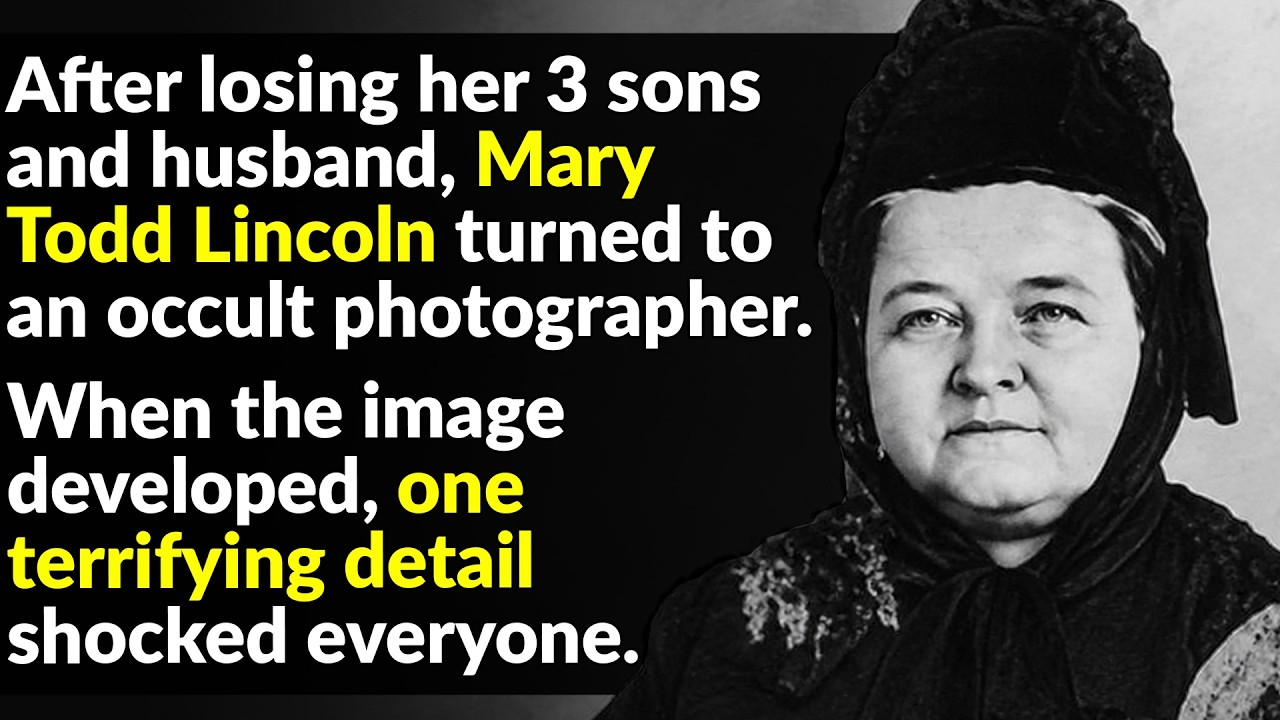
The image stunned those who saw it, and for many it became fresh evidence in a long and bitter argument over whether Mary Todd Lincoln was one of the worst first ladies in American history, or a woman broken by losses no one should have to bear. She was born in Lexington, Kentucky, in 1818, the fourth of seven children. Her father, Robert Todd, was a wealthy banker and slaveholder, and Mary grew up in a fourteen-room mansion with every advantage. But tragedy struck early.
When she was six, her mother Elizabeth died in childbirth. Her father remarried the following year to another Elizabeth, called Betsy, who would go on to have nine more children. Mary’s education was elite. At Madame Mentelle’s finishing school she studied French, dance, drama, music, and etiquette, and those who knew her described her as sociable and intelligent.
At twenty-one she moved to Springfield, Illinois, to live with her sister Elizabeth, the wife of Congressman Ninian W. Edwards. She quickly became popular with the local young men, and one of her most promising suitors was Stephen A. Douglas, a lawyer and rising Democratic politician.
But then Abraham Lincoln came to the house. Mary was drawn to him partly because of politics. Both were Whigs, and their courtship led to an engagement. The problem was that Lincoln did not come from her social class.
Her sister and her guardian disapproved, and the engagement was broken off on January 1, 1841, a day Lincoln later called his fatal first of January. Eighteen months passed, but Mary had not changed her mind. They found each other again and renewed the relationship in secret, planning a quick wedding without telling her family. On the day they intended to elope, November 4, 1842, Lincoln ran into Edwards on the street.
Lincoln was an honest man and could not lie to him. He admitted that he and Mary planned to marry that very day. Edwards was not pleased, but instead of calling off the wedding, he offered his own house as the venue. Mary Todd became Mary Todd Lincoln and left the fourteen-room mansion for a single room above a boarding house.
Soon she gave birth to their first son, Robert. After a year in the small flat, the family of three moved to a small cottage. Lincoln was building a successful law practice, and Mary was raising a growing family. A second son, Edward Baker Lincoln, was born in 1848, and William arrived in 1850.
That same year, little Eddie died of tuberculosis at the age of four. The loss devastated both parents. A fourth son, Thomas, called Tad, was born in 1853. Lincoln’s work often kept him away from home for months at a time, leaving Mary alone with the boys.
In 1860, everything changed. Lincoln went from being an Illinois lawyer to president of the United States. He won no votes from the southern states, which understood his antislavery position and rejected it. Mary came from a slaveholding family, and her husband’s stance placed her in an awkward position, but she chose to stand beside him, even if it meant being cut off from her own relatives.
As first lady, Mary was responsible for the social life of the White House, and she struggled with the job while facing journalists, lawyers, and political rivals. The Civil War began just one month after Lincoln took office. Mary spent the period trying to keep up morale, visiting hospitals and giving fruit and flowers to wounded soldiers. She was the first first lady from the West, and most of the people she encountered in Washington were easterners.
They found her rude and called her a pretender, and in some ways she brought it on herself. She spent freely, especially on jewelry, buying on credit at the exclusive store Galt and Brothers. She redecorated the White House and decided the dining room needed an expensive new set of china. Lincoln grew angry at her extravagance, especially when he had to ask Congress to appropriate money to cover the bills.
Mary was suffering emotionally throughout this period. She had suffered severe headaches for most of her adult life, and they grew worse after she struck her head in a carriage accident. She also struggled with depression. In 1862, her sons Willie and Tad both fell ill with typhoid fever after drinking contaminated water in the White House.
Willie died. Mary’s grief turned frightening. She stayed shut in her room for three weeks and could not bring herself to attend her son’s funeral. It was during this period that she turned to spiritualists and mediums, seeking contact with her dead child.
One spiritualist told her that the entire cabinet was against the president and that Lincoln should dismiss all of them. On April 14, 1865, it was clear the North had defeated the South. The news also reported that the president and first lady would attend a play at Ford’s Theatre. Mary was suffering from a headache and said she would not go.
Lincoln insisted, and the two went together. They sat side by side in their box, holding hands. During the third act, a scene always drew loud laughter from the audience. As the spectators laughed, John Wilkes Booth entered the presidential box and fired.
Lincoln was laughing when the bullet struck his head. Distraught, Mary held her husband up in his chair to keep him from falling. Lincoln was carried across the street to a house where doctors could treat him. He had slipped into a coma.
Mary was not allowed to be with him until the next morning, and roughly nine hours after being shot, Lincoln died. A funeral train carried his body around the country so that the nation could mourn. Back at the White House, spiritualists crowded around Mary, filling her head with messages they claimed came from her dead husband. Her son drove them all out.
As a widow, Mary understood she needed to be near family. She had only two living sons left, so she moved to Chicago. Money also worried her. Lincoln had left her an estate worth eighty thousand dollars, well over a million by modern standards, but she had never learned to manage money.
She decided Europe would be better for her and Tad. She arranged for a wealthy American family living in Germany to pay for the trip and help support them. While abroad, she lobbied Congress for more money, arguing that if the wives of wounded soldiers received pensions, she should too. She had few supporters in Congress, but the bill passed, granting her three thousand dollars a year.
After Europe no longer suited her, she and Tad returned to America. Tad fell ill and died on July 15, 1871. Sources differ on the cause, with pneumonia, heart failure, and tuberculosis all suggested. Whatever the exact reason, Mary had now lost her husband and three of her four sons.
Only Robert remained. Her relationship with money spun out of control. She spent recklessly on unnecessary things, yet could not shake the fear of becoming poor. Then came the notorious photograph.
In 1872, Mary went to see William H. Mumler, the spiritualist photographer, and asked him to take her picture without revealing who she was. When Mumler showed her the photograph, a ghostly figure appeared beside her. His wife pressed her to admit her identity, and the figure was identified as Abraham Lincoln.
This belief in spirit photographs, combined with her growing paranoia and strange behavior around money, pushed Robert to an extreme decision. He wanted to commit her to an asylum for her own safety, but he knew a judge would have to approve it because Mary would not go voluntarily. So Robert arranged a trial in secret. On May 19, 1875, Leonard Swett, a lawyer who knew both Mary and her husband, brought her to court.
She had no idea why. Once there, it became clear she was at the center of a hearing to determine her sanity. Seventeen witnesses testified about her behavior, and an all-male jury declared her insane. She was supposed to be sent to an asylum, but before she went, she visited several pharmacies, trying to gather enough medicine to kill herself.
A pharmacist caught on and gave her a placebo instead. Mary was committed to Bellevue Place Asylum but soon began planning her escape. She secretly wrote letters to her lawyer and his wife, who were also her friends, and to the editor of the Chicago Times. Suddenly Robert became the villain.
Many criticized his decision to confine his mother, especially since he now controlled her finances. The unwanted publicity forced the asylum’s directors to make a surprising decision: they told Mary she was free. Without a moment’s delay, she moved to Springfield to live independently with her sister Elizabeth. Later she went to Europe and settled in France, where her health declined and her money ran low.
In 1881 she traveled to New York City and tried to increase her pension. President Garfield had suffered the same fate as Lincoln, and his family was receiving government support. Despite her reputation for wasting money, Congress raised her pension and gave her an advance. Mary decided to spend the rest of her life in Springfield with her sister.
Exactly eleven years after Tad’s death, she fell ill and sank into a coma. She died of a stroke the next morning at sixty-three years old. Long after her death, the question of what was truly wrong with Mary Lincoln remained unsettled. In her book The Emancipator’s Wife, Barbara Hambly claimed Mary used opium throughout her life.
In 2007, Jason Emerson published The Madness of Mary Lincoln, arguing she suffered from bipolar disorder. Most historians have viewed her as an interfering and disruptive first lady, and many have pointed to the loss of her husband and sons as the source of her troubles. The famous ghost photograph, whether a trick of light or a genuine glimpse of the dead, only deepened the mystery that followed her to the grave.