The most famous outlaw of the American Old West may not even have had the name history gave him. Billy the Kid, the man who supposedly killed twenty-one men in twenty-one years of life, left behind no birth certificate, and the records that do survive list at least four different possible names: Henry McCarty, William H. Bonney, William Antrim, and Kid Antrim. His birthplace is disputed among New York, Indiana, and Kansas, and even his birth year shifts between 1859 and 1861 depending on the source.
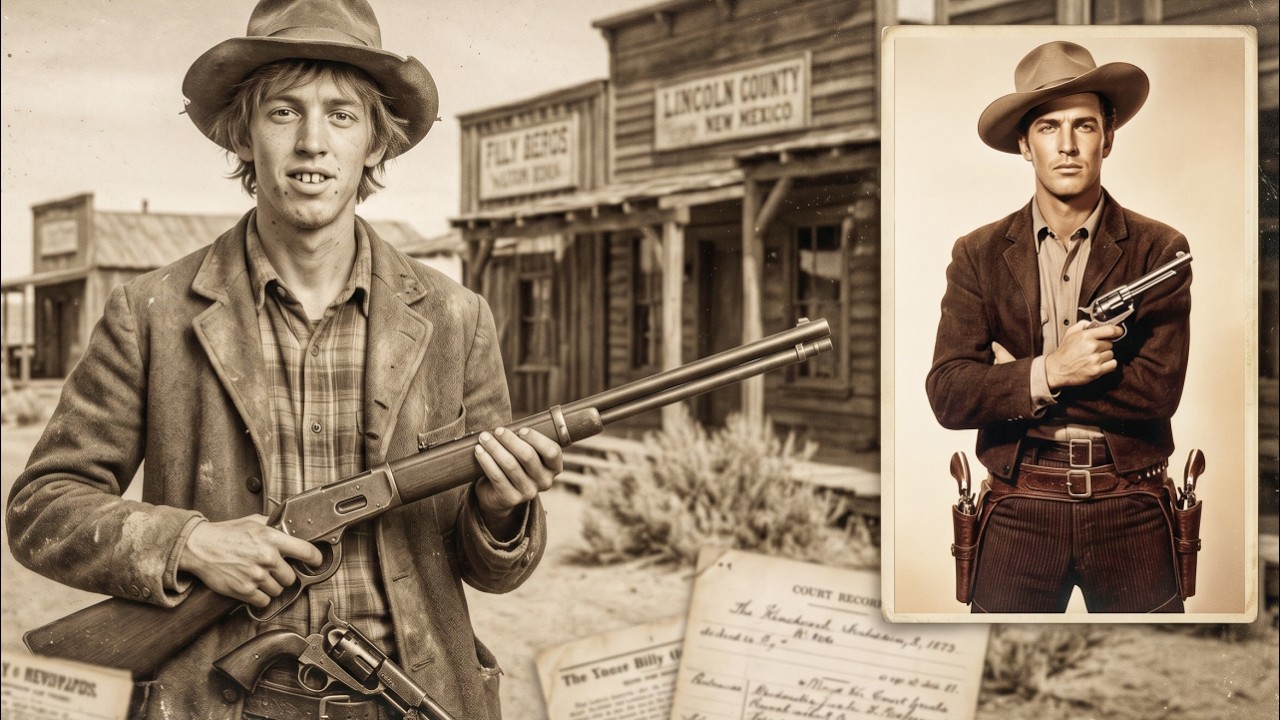
The nickname Billy the Kid never appeared on any official document while he was alive. A man who became a national legend through books, films, and television remains a mystery at the most basic level. The story of how he became an outlaw begins not with rebellion but with abandonment. When his mother Katherine died of tuberculosis around 1874, Billy was roughly fourteen or fifteen years old.
His stepfather, William Antrim, wanted nothing to do with the boys and handed Billy and his brother Joseph over to neighbors. A teenager who had just lost his mother was suddenly left alone in the world. Billy went to work washing dishes in hotels and restaurants just to survive. Less than a year later, he was arrested for the first time, and the details of that arrest reveal how little chance he ever had.
An older man named George Schaefer had stolen clothes and cheese from a Chinese laundry in Silver City, New Mexico, and hid the goods in the place where Billy was living. The boy did not even know where the items had come from, but Sheriff Harvey Whitehill arrested him by association. Years later, Whitehill himself admitted he never believed the boy was the real thief, but someone had to answer for the crime. Billy did not stay in jail long.
He escaped through a chimney in the jail building, his first recorded breakout, all because of stolen cheese he never took. Before he became a legend, Billy was a skinny teenager who kept getting beaten by the same man. Francis Cahill, an army blacksmith at Camp Grant, Arizona, was bigger and older, and he enjoyed humiliating the boy in front of everyone, shoving him to the ground and calling him kid as if he were talking to a dog. On August 17, 1877, inside a saloon, Cahill threw Billy to the floor one more time and landed on top of him.
This time Billy pulled a pistol and shot Cahill in the stomach. The man died the next day. Witnesses said Cahill had started the fight, but the local jury called the shooting criminal and unjustified. Billy ran before he could be arrested.
By modern standards, many would call it self-defense, but in 1877 that shot turned an intimidated boy into a fugitive. The Lincoln County War, which would define his life, was not a battle between heroes and villains. In 1878 in New Mexico, two groups of merchants were fighting over a lucrative contract to supply goods to the army at Fort Stanton and the Apache reservation. On one side were Murphy and Dolan, who already controlled the market.
On the other were Tunstall and McSween, who wanted a share. Billy fit into the conflict because John Tunstall was the only man who gave him work and respect when no one else would. When Tunstall was murdered, Billy did not take up a gun for ideology or justice. He wanted revenge for the only person who had treated him like a human being.
The Regulators he joined were not heroes. They were pawns in a money war between men in suits who never got their own hands dirty. The war made Billy an outlaw in the records, but at the time he was legally the system itself. The Regulators were officially appointed as deputies by Sheriff Dick Brewer, with the approval of Justice of the Peace John Wilson.
They had badges and legal authority. When they went out hunting members of the rival faction, they were technically carrying out orders within a recognized law enforcement structure. The problem was that the other side also claimed legal authority. It was lawman against lawman, each group holding its own paperwork and justification.
No one was clearly the good guy. Billy became a criminal not because he acted differently from the others, but because his side lost. The famous claim that he killed twenty-one men, one for each year of his life, was invented by Pat Garrett and the ghostwriter Ash Upson for the biography published in 1882, right after Garrett killed Billy. They wanted to sell books, and a round number with that symbolism made a perfect headline.
Historians who examined court records, witness accounts, and military documents found the real count was far lower, somewhere between four and nine deaths that can be directly attributed to Billy. The number varies because in several shootouts during the Lincoln County War, multiple men were firing at once, making it impossible to know who hit whom. The confirmed minimum includes Francis Cahill and two law officers. Billy was also different from most Anglo outlaws of the Old West in one critical way.
He grew up around Mexican families in New Mexico and spoke Spanish fluently, which gave him a real survival advantage. The Hispanic families of Lincoln County hid him, fed him, and warned him when sheriffs were close. To them, he was not a criminal but an ally against the Anglo-Americans who controlled the territory’s politics and economy. They called him El Chavato, the little goat, and the name was used with affection.
This part of his story barely appears in any major American film. In 1879, Billy made a deal with Governor Lew Wallace, the same man who would later become famous for writing Ben-Hur. The terms were simple. Billy would testify against the killers from the Lincoln County War, and in return he would receive a full pardon.
Billy kept his end. He turned himself in, testified, and waited. The pardon never came. He wrote at least five letters to the governor asking him to honor the promise, and received silence.
In 1881, already under a death sentence, Billy sent one last message saying he was sitting in jail under a sentence of death despite the agreement they had made. Wallace did not answer. He was busy with his literary career. Billy’s fate was sealed not by a bullet but by a broken promise.
If the governor had kept his word, Billy would not have escaped, would not have been hunted down, and probably would not have died at twenty-one. For about three months after the deal, Billy actually tried to leave the outlaw life behind. He lived in Fort Sumner, working as a cowboy, playing cards at night, and attending dances in the local Mexican community. There were no robberies, no shootouts.
It was the longest stretch of his adult life without involvement in crime. But the pardon never came, and when Billy realized he had been used, he went back to the outlaw life, not by choice but because the doors that existed for him had closed. Before Pat Garrett became sheriff, he and Billy had been friends. They drank at the same saloons in Fort Sumner, played cards at the same tables, and shared the same circle of friends.
People who knew them described it as a real friendship. Then came the election of November 1880. Garrett won the job of Lincoln County Sheriff with a clear mission: capture or kill Billy the Kid. Eight months later, on the night of July 14, 1881, Garrett was hiding inside Pete Maxwell’s room in Fort Sumner, waiting in the dark.
Billy walked into the room, expecting only to speak with Maxwell. When he noticed a silhouette he did not recognize, he asked in Spanish, “Quién es, who’s there? ” Garrett fired twice. The first shot hit Billy in the chest and was fatal.
The second missed. Billy was twenty-one years old. He did not draw his gun. He did not get a chance to react.
He never saw who shot him. The most famous death in the Old West was not a noon duel on a dusty street. It was a quiet ambush in a dark room. The exploitation began almost immediately.
Less than six weeks after his death, New York publishers were selling cheap booklets about his life. Pat Garrett released his biography the following year, and the preface itself admitted the story had been dressed up by a ghostwriter. New Mexico was desperate to attract investors and settlers, and gunslinger stories sold newspapers back east and created curiosity about the territory. Billy became a product before he had been buried two months.
The people who actually knew him remembered someone different from the legend. Neighbors and acquaintances in Silver City described him as polite, helpful, and well-mannered. Susan McSween Barber, who knew him during the Lincoln County War, said he was a good-hearted young man who did not look for trouble but did not run from it either. Sheriff Harvey Whitehill, the first man to arrest him in 1875, admitted years later that he never believed that boy was truly bad.
To him, it was the system that shaped what Billy became. Garrett pocketed five hundred dollars for the killing, but the shot came with a price. Much of New Mexico, especially the Hispanic community that admired Billy, saw Garrett as a coward who shot a friend in the dark. In 1882 he lost reelection as sheriff.
He tried cattle ranching, worked as a customs inspector, and organized horse races. Nothing worked out. In 1908, Pat Garrett was shot in an isolated field in New Mexico during a land dispute. He was fifty-seven years old and broke.
The man who killed Billy the Kid died poor and forgotten. Billy the Kid had two protruding teeth that no Hollywood actor has ever portrayed. He lost his mother at fifteen, was arrested for a crime he did not commit, killed a man in self-defense, was betrayed by a governor who promised him a pardon, and died in an ambush in a dark room at twenty-one. He was not a romantic rebel.
He was a teenager the system had no place for and did not know what to do with except destroy. The legend the system needed survived him. The real man remained buried in Fort Sumner.