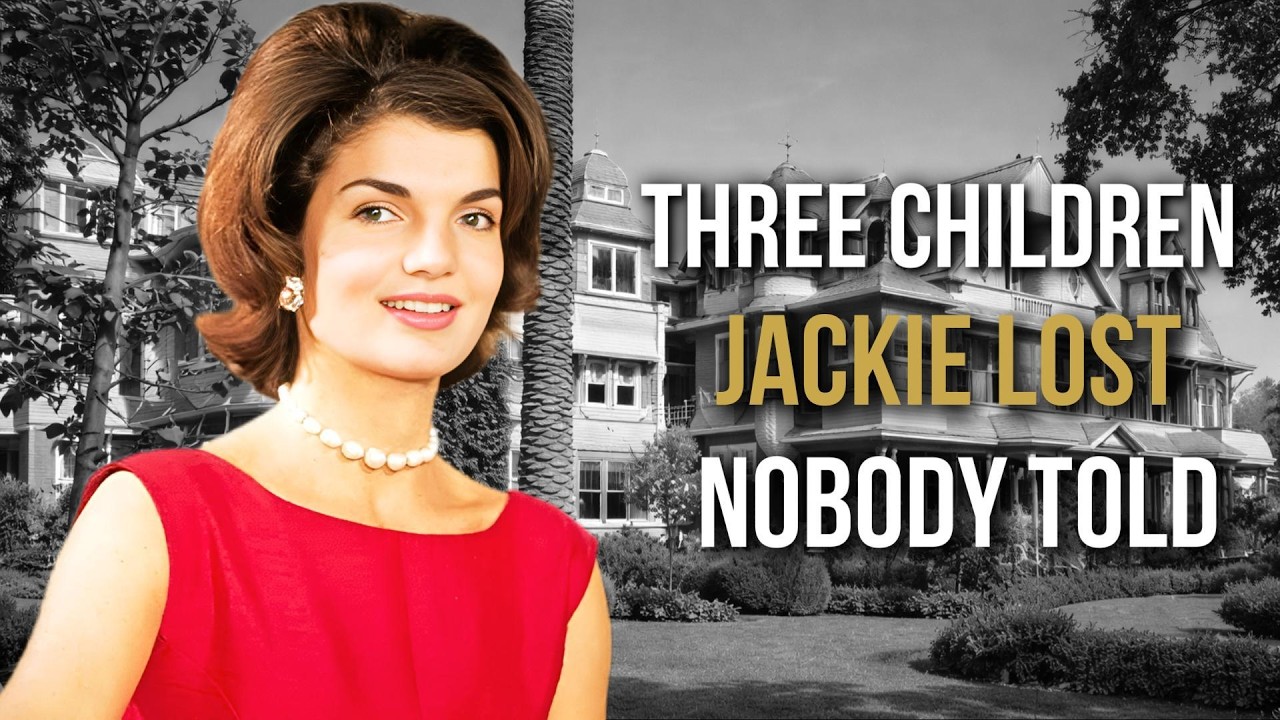
Jackie Kennedy’s life looked like a fairy tale to the world—the pink suit, the pearls, the composure that never cracked under the brightest lights in America. But behind that flawless image lay a private history of loss so profound that most of it remained hidden even from those closest to her. Before she became the most photographed woman in the country, before the White House, before Camelot, Jacqueline Bouvier had already learned that the world would not allow her to grieve publicly. She would bury three children in her lifetime, and she would do nearly all of it in silence.
She was born on July 28, 1929, in Southampton, New York, to John “Blackjack” Bouvier, a charming, handsome man who was also an alcoholic and a womanizer. He called his eldest daughter the most beautiful daughter a man ever had—then disappeared when she needed him most. Her parents divorced when she was eleven, the first crack in a life that appeared flawless from the outside. Jackie was brilliant: she spoke French, Spanish, and Italian, studied at the Sorbonne in Paris, won a junior editorship at Vogue, wrote poetry, drew illustrations, and read constantly.
She was not merely a beautiful woman; she was a deeply thoughtful one who felt everything. She met John F. Kennedy in May 1952 at a dinner party. He was a congressman, thirty-six years old, already legendary for his charm and careless with women.
She was twenty-two and fully aware of his reputation. She accepted his proposal anyway. Their wedding on September 12, 1953, was called the social event of the year: 700 guests at the ceremony, 1,200 at the reception. From the outside, a fairy tale.
From the inside, something far more complicated. JFK’s closest friend later admitted that Jackie knew exactly what she was marrying. She understood his nature and chose him anyway, because she loved him—not the senator, not the image, but him. Love, however, would not protect her from grief.
The first loss came quietly. In 1955, two years into the marriage, Jackie suffered a miscarriage. There was no public announcement, no statement. She was expected to recover and continue, and she did, because that was what was required of her.
On August 23, 1956, she gave birth to a stillborn daughter. The baby was full term, perfectly formed, and never took a single breath. Years later, the Kennedy family would give her the name Arabella. But when Arabella was born, John F.
Kennedy was not there. He was on a yacht in the Mediterranean, on vacation with friends, somewhere between Italy and Greece. His brother Robert was the one who came—Robert, who sat with Jackie, who made the arrangements, who buried the baby. JFK returned days later.
Three months after Arabella’s death, Jackie appeared on the cover of Life magazine, smiling, composed, holding baby Caroline. The stillborn daughter was never mentioned, nor was the miscarriage. Jackie Kennedy learned very early that her grief was not permitted to be public. By the time JFK became president in January 1960, she had already buried one child and lost another.
The world saw none of it. The White House years are remembered as Camelot—the gowns, the state dinners, the cultural events, the restoration of the residence into a showcase of American history. What is not remembered is what it cost her. Jackie privately described the White House as a glittering, cruel place.
She was thirty-one, mother to a toddler and a newborn, the most watched woman in America, and she carried her grief without ever being permitted to express it openly. There was one secret no camera ever captured. Jackie Kennedy smoked three packs of cigarettes a day. In public, nothing—not a single photograph exists of her smoking.
She would extinguish a cigarette the moment cameras appeared, and she trained her staff never to mention the habit. Behind closed doors, she smoked three packs daily, every single day. Medical research now confirms that heavy smoking during pregnancy significantly increases the risk of premature birth, stillbirth, and underdeveloped lungs in newborns. The evidence strongly suggests that this most carefully hidden habit may have contributed to the 1955 miscarriage, to Arabella’s stillbirth, and to the child who was still to come.
During those White House years, JFK continued his affairs—with Marilyn Monroe, with Mary Pinchot Meyer, with others whose names history has partially recorded and partially buried. Jackie knew. Multiple biographers confirm it. She once told a friend that she had made her peace with it, deciding to focus on what the marriage was rather than what it was not.
But making peace does not mean it does not hurt. In August 1963, something happened that changed their marriage completely. On August 7, five weeks before her due date, Jackie went into labor. Patrick Bouvier Kennedy was delivered by emergency cesarean section at Otis Air Force Base near Cape Cod, Massachusetts.
He weighed four pounds ten and a half ounces. He was alive. But Patrick had hyaline membrane disease; his lungs were not fully developed, and every breath required effort his tiny body could barely manage. For thirty-nine hours, he fought.
This time, JFK was there—not on a yacht, not campaigning. He was at the hospital, pressing his finger through the glass of the incubator to touch his son’s hand. Jackie was still recovering from the cesarean at a different hospital and could not be there. Patrick was transferred to Boston Children’s Hospital, the best facility available, and JFK followed him.
On August 9, 1963, thirty-nine hours after he was born, Patrick Bouvier Kennedy died. John F. Kennedy wept openly. It was only the second time in his public life that anyone had seen him cry, and he had to be escorted from the room.
Patrick’s death changed something between them. Friends who saw the couple in the weeks that followed described a closeness they had not shown in years—more tender, more openly affectionate. JFK told his friend, journalist Charles Bartlett, “I just wish I could help her more. ” Jackie was photographed holding his hand at public events, something that had been rare between them.
The grief of Patrick had brought them fully together in a way the happiness of the White House years never quite managed. Eleven weeks after Patrick died, John F. Kennedy was assassinated in Dallas, Texas, on November 22, 1963. After he was pronounced dead at Parkland Memorial Hospital, Lyndon B.
Johnson needed to be sworn in as president, and he wanted Jackie Kennedy present. Her aides urged her to change her clothes. The pink Chanel suit she had been wearing when her husband was shot was soaked in his blood. Jackie refused.
She stood beside Johnson as he took the oath of office still wearing the blood-soaked suit. When Lady Bird Johnson quietly suggested she might want to change first, Jackie replied, “Let them see what they have done to Jack. ” She was thirty-four years old, three months after burying Patrick, having just watched her husband die in her arms. In that moment, she made a deliberate decision: the world would not be permitted to look away.
Jackie planned JFK’s state funeral almost entirely herself. She modeled it on Abraham Lincoln’s. She requested the riderless horse, the eternal flame at the graveside, the horse-drawn caisson through the streets of Washington. She walked behind the casket on foot, in public, with world leaders walking beside her.
Every detail was her decision. A woman who had just lost her husband, who had buried two children before him, organized one of the most significant state funerals in American history—in seventy-two hours. Five years later, on October 20, 1968, Jackie Kennedy married Aristotle Onassis, a sixty-two-year-old Greek shipping billionaire. The world was horrified.
America’s widow, the keeper of the Camelot flame, had married a man who was already involved with opera singer Maria Callas. The headlines were savage. The public felt betrayed. But what everyone missed was what Jackie actually said.
After Robert Kennedy was assassinated in June 1968, she told a friend, “If they are killing Kennedys, my children are targets. I want to get out of this country. ” She was thirty-nine years old, with two living children, terrified. She had already buried three children, watched her husband die in her arms, and just watched her closest support shot dead in a hotel kitchen.
Onassis gave her what no amount of Kennedy money or Secret Service protection had ever provided: a private island, a yacht, the ability to disappear completely from the world that had consumed everything she loved. Jackie Kennedy died on May 19, 1994, at sixty-four, of non-Hodgkin’s lymphoma. She left quietly, the way grief had always moved through her life—without announcement, without performance. Her son, John F.
Kennedy Jr. , spoke to the press outside her apartment. She was surrounded by her friends, her family, her books, the people and things she loved. She did it in her own way and on her own terms.
She is buried at Arlington National Cemetery beside JFK, beside Patrick, beside Arabella. The family that was always too small, finally together. She lost three children, her husband to an assassin’s bullet, her brother-in-law to another. She lived for thirty years under a level of public scrutiny that would have destroyed most people.
She survived not by performing strength, but by making quiet, deliberate choices about what to show and what to protect. The pink suit was not vanity; it was witness. The Onassis marriage was not betrayal; it was survival. The composure was not coldness; it was the only armor she had.
Jackie Kennedy never asked the world to understand her. She simply continued—with grace, with grief, and with a privacy the world never quite forgave her for.