In late May of 1921, a 67-year-old woman was visiting a friend in Somerset when she fell down a staircase, breaking her left ankle. The injury seemed manageable, but gangrene set in, and on June 10th, surgeons amputated her leg above the knee. She appeared to recover, speaking to visitors and seeming to improve. Then, on June 29th, the femoral artery in the stump hemorrhaged, and she bled to death in her London home.
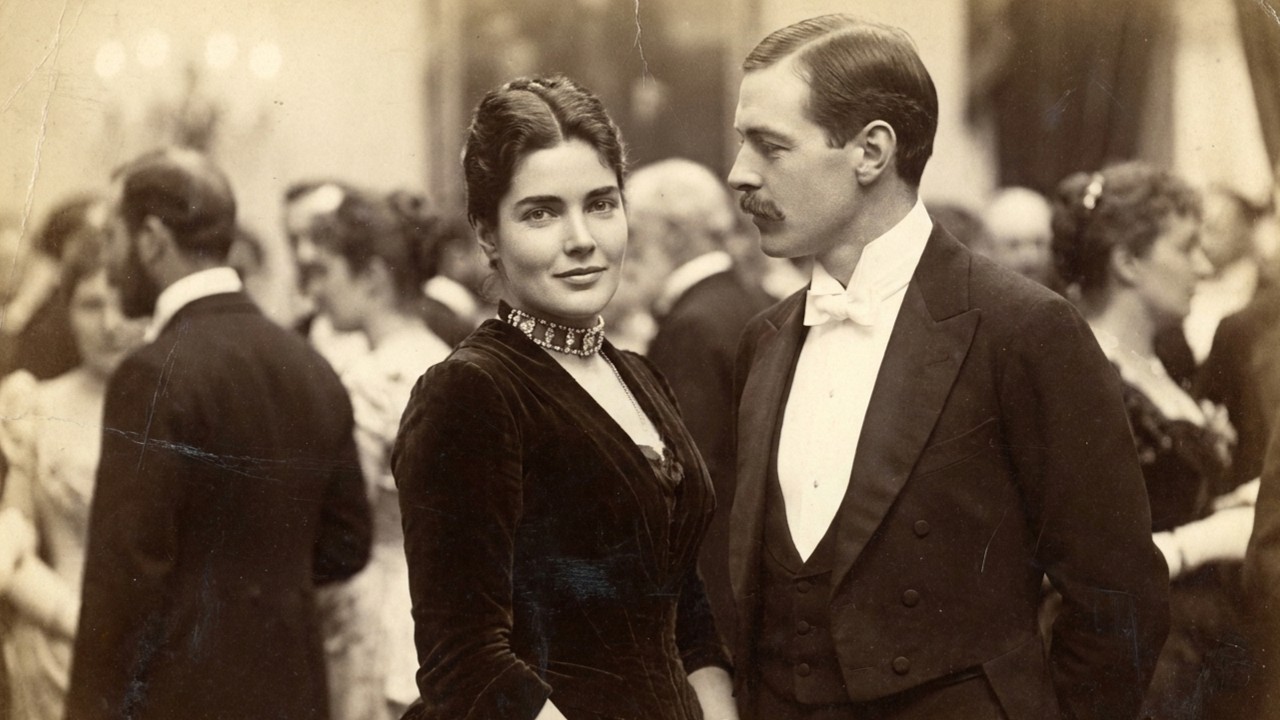
The world did not stop. Winston Churchill, her son, was Colonial Secretary, managing the aftermath of the First World War in the Middle East. Nineteen years would pass before he became Prime Minister of Great Britain on May 10th, 1940, and promised his people nothing but blood, toil, tears, and sweat. The woman who made that moment possible never lived to see it.
She was born Janette Jerome in Brooklyn, New York, in 1854, the daughter of Leonard Jerome, a Wall Street speculator who had turned nerve and timing into a fortune estimated at ten million dollars. The Jerome household was a laboratory in the mechanics of power. Leonard kept his mistress next door to his wife, threw parties for presidents and newspaper editors, and understood that a good dinner party and a well-told story could buy almost anything. His daughter, called Jenny, absorbed this lesson.
She was dark-haired and magnetic, but more importantly, she was watchful. She learned that the real exchanges of the world happened not in banks, but in drawing rooms, that charm was a weapon, and that the ability to command a room outlasted any fortune. Leonard’s fortune proved volatile, and by the early 1870s, his wife Clara had endured enough of his public infidelities. She took her daughters to Paris, a strategic withdrawal.
American money bought social access in Paris that New York’s old families would never grant. Jenny studied piano seriously, learned French fluently, and absorbed the codes of European aristocratic society. She was being polished for a purpose: European marriage, titled marriage, the kind that turned money into rank. In August 1873, at a regatta on the Isle of Wight, she met Lord Randolph Churchill, the younger son of the Duke of Marlborough.
He was 24, brilliant, impulsive, and immediately overwhelmed by her. They met on a Tuesday evening; by Thursday, he had proposed. The subsequent negotiation between Leonard Jerome and the Duke of Marlborough was brutal, conducted by letter across the Atlantic. The Duke considered the Jeromes vulgar and the match close to disgrace, but the Churchills needed money.
Leonard offered a dowry of £50,000, settled in a trust that paid Jenny about £2,000 a year. They married in Paris in April 1874, and Winston was born that November, seven and a half months later. The official story of a premature birth after a fall was whispered about for decades. What mattered more was the reality: Jenny had traded her father’s money for a title and her American identity for a seat at the table of the most powerful empire on Earth.
Within six years, the despised outsider had infiltrated the inner circle of the Prince of Wales, the future King Edward VII. Victorian aristocratic society was ruthlessly coded, and Jenny studied it like a diplomat. She mapped the networks, mastered the unwritten rules, and offered something no English woman could match: she was different, direct, worldly, and fearless. The Prince of Wales found her irresistible, and his favor made her socially untouchable.
She used it immediately. Her dinners became legendary, not for the food, but for the guest lists. She mixed politicians with generals, diplomats with editors, curating the conversation between men who had not previously spoken. She positioned herself inside the machine of English power.
Then she began operating it on behalf of her husband. Lord Randolph Churchill believed he was the most brilliant political mind in the Conservative Party, and Jenny let him believe it. He had genuine talent, a devastating debater who co-founded the Fourth Party and developed a populist political philosophy called Tory Democracy. By 1886, at 37, he was Chancellor of the Exchequer and Leader of the House of Commons, widely discussed as a future prime minister.
He was not self-made; Jenny was the engine. While political wives were expected to remain invisible, she canvassed voters door-to-door, wearing his racing colors, remembering names, shaking hands. She ran the social machinery that made his faction possible, managing the dinners that connected his allies, cultivating the wives of rival politicians, and managing his press relationships with the sophistication of a modern campaign director. The household was funded by her settlement, and the gap between income and expenditure was filled by borrowing.
Then Randolph destroyed it all. In December 1886, he resigned as Chancellor, expecting the Prime Minister, Lord Salisbury, to beg him to return. Salisbury simply accepted, and Randolph was politically finished at 37. Jenny tried to save it, mobilizing every ally she had spent years cultivating, but the damage was absolute.
He spent the remaining eight years of his life in a long decline, his mind disintegrating. His illness was diagnosed at the time as general paralysis of the insane, the tertiary stage of syphilis, though modern historians have suggested alternatives. The trajectory was undeniable. His speech grew slurred, his judgment bizarre, and by 1893 he could barely speak coherently in public.
Jenny managed the catastrophe with discipline. She maintained the public fiction of a devoted wife, controlled access to her husband, and accompanied him on a disastrous world tour in 1894. During this time, she was also building the most powerful private network in the British Empire. As a widow in 1895, deeply in debt, she had assembled an intelligence network that would have been the envy of any diplomatic service.
Through her relationships with men like Count Charles Kinsky, a diplomat and her great love, the Prince of Wales, and Lord Kitchener, she gained access to diplomatic, military, and political intelligence no woman of her era could have obtained formally. This was not promiscuity; this was architecture. Each relationship connected her to a different corridor of power. The human cost was real.
Her younger son Jack was born in 1880, and his paternity has been a matter of speculation for over a century. Both sons were raised largely through servants and boarding schools. Winston’s letters from school are agonizing in their repetition, begging her to visit and to write. He later described her as the evening star, loved at a distance but always too far away to touch.
This distance produced a wound that never fully healed, a desperate need for approval that would define him. Within months of burying her husband, Jenny lost Kinsky, who married another woman under pressure from his family. She was 41, devastated, and alone in the way that mattered most. Then she made the decision that would define the 20th century: she would build Winston.
She funded his military career, paying the difference between his officer’s pay and his real expenses. She lobbied the ambassador to Spain to arrange his observation of the Cuban War of Independence. She pressured generals to secure him a posting in India. And when Kitchener flatly refused to allow Winston to join the 1898 Sudan campaign, she overrode him, contacting the Prime Minister directly and maneuvering through official and personal channels until the refusal was reversed.
Winston rode in one of the last great cavalry charges in British history, survived the Battle of Omdurman, and wrote the book that made his name known. In December 1899, while Winston was in South Africa covering the Boer War, Jenny chartered a hospital ship, recruited its entire medical staff, and raised £45,000 through her personal network in weeks. She sailed the Maine to Durban, wore a nurse’s uniform, and oversaw the treatment of hundreds of wounded soldiers, British and Boer alike. While she was running her hospital ship, Winston was captured by the Boers and escaped, making himself a national hero.
The two stories running in parallel created a family mythology greater than either alone. In October 1900, Winston was elected to Parliament at 25, having no money of his own and no powerful patron. He had Jenny, and she had spent every resource she possessed to put him there. Her financial life was an audacious act of power.
She lived beyond her means, systematically and deliberately, because the appearance of wealth was wealth. A hostess who economized visibly was a hostess whose guest list contracted, and a contracting guest list meant diminished power. In 1899 she launched the Anglo-Saxon Review, a lavish quarterly that lost money on every issue but demonstrated her capacity as an editor and publisher. She financed Winston’s campaigns, paid for the dinners that produced favorable press, and borrowed against future income until her debts reached tens of thousands by 1910.
In 1900, she married George Cornwallis West, twenty years her junior. The marriage provided neither financial relief nor lasting happiness, and they divorced in 1913. King Edward’s death in 1910 collapsed the social universe that had sustained her influence. His son George V was a different kind of king, and the world of glittering, transgressive society had no place for her.
The First World War destroyed the aristocratic networks she had constructed. The young men who attended her dinners were dying. Winston’s bold campaign at Gallipoli was a catastrophe, and he was forced to resign from the Admiralty in November 1915. Jenny watched from the margins, unable to fix it.
In 1918, she married for a third time, a colonial civil servant 23 years her junior. That same year, the Representation of the People Act granted limited voting rights to women over 30. For the first time in her life, the woman who had been manipulating the political system for four decades was allowed to cast a ballot. She was 64.
She died three years later, nineteen years before her investment paid off beyond anything she had imagined. The voice that rallied a nation against fascism was shaped by many influences, including the American orator Bourke Cochran, one of Jenny’s lovers who became Winston’s speaking mentor. Through her, he absorbed the American rhetorical tradition. The audacity to stand alone against appeasement, the understanding that formal authority and real influence are not the same thing, and the social instincts that let him work a room were all her gifts, transmitted through decades of example.
Jenny proved what the suffragists could not: not just that women deserve the vote, but that women could operate power. She broke codes that were not walls but systems of rules, designed by men and maintained by the assumption that women could not learn them. She was buried in a quiet churchyard near Blenheim Palace, her grave modest, with no monument to what she built. Visitors come to see Winston’s grave.
Few pause at hers. She was an absent mother, financially ruined, and she lost the love she wanted. She died without knowing whether any of it had worked. From a position of formal powerlessness, she built a machine that produced the leader who held Western civilization together when it was closest to collapse.
She held no title, no office, and no legal right the system could not revoke. She did not ask for permission. She walked into the rooms where the decisions were being made and she sat down. The world she helped save never knew her name.
It owes her that.