Feared as the Bewitched King, Charles II of Spain was remembered for his shocking appearance and the devastating consequences of generations of inbreeding. But behind the broken monarch stood two young queens sent into marriages they could not refuse, bound by duty to a king whose body was failing and whose throne was the most coveted prize in Europe. Charles was born on November 6, 1661, the youngest son of King Philip IV of Spain and Mariana of Austria. He had older brothers, but they were either illegitimate or had died before him.
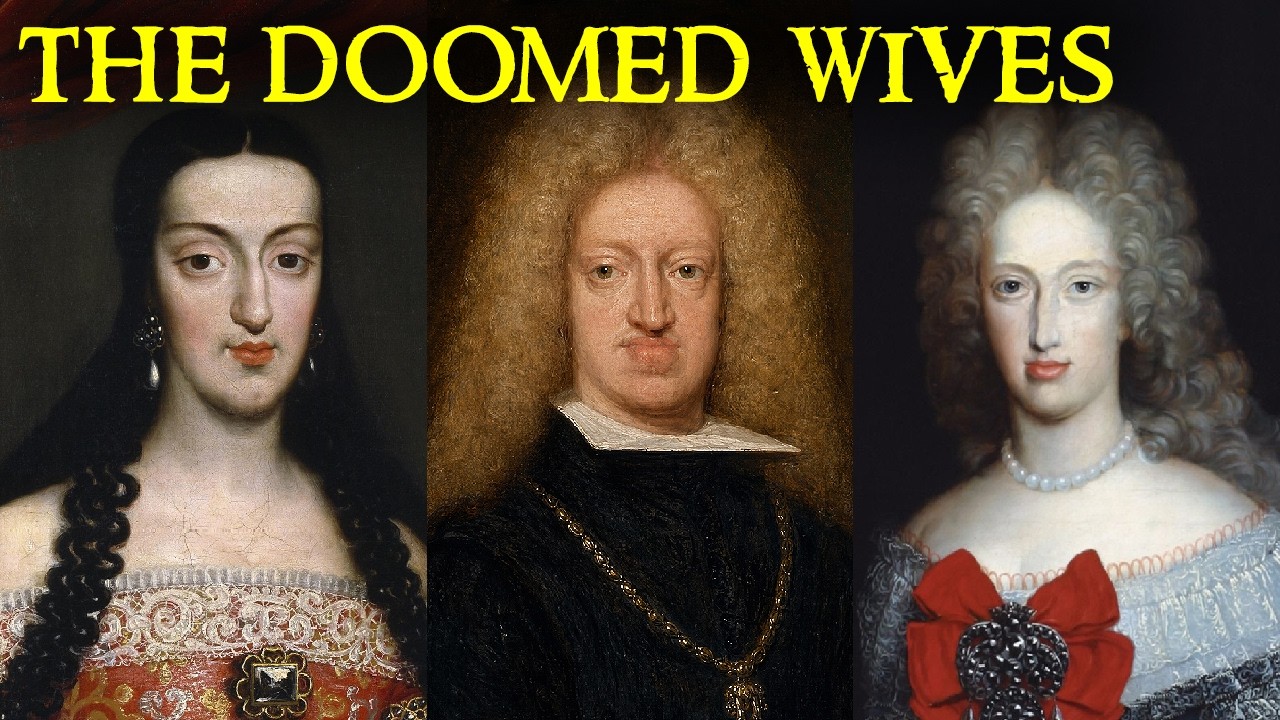
His half-brother Balthasar Charles had long been heir to the throne but died in 1646, a week short of his seventeenth birthday, from a suspected case of smallpox. When Philip IV died on September 17, 1665, Charles succeeded as king at just four years old. A long minority followed, with his mother Mariana and his illegitimate half-brother John of Austria struggling for control of the government. Part of the reason for the power struggle was the widespread recognition that even when Charles came of age, he might never rule independently.
His body never fully developed. He struggled to walk without assistance. He had the pronounced Habsburg jaw that made chewing and speaking difficult. Contemporary accounts described developmental delays and intellectual limitations.
Many at court believed his condition could only be the result of sorcery, and he became known as El Rey Hechizado, the Bewitched King. The reality was more troubling. For generations, the Spanish and Austrian branches of the House of Habsburg had intermarried, producing close cousins generation after generation. Charles’s father, Philip IV, was both the uncle and the husband of his mother, Mariana of Austria.
She had originally been intended to marry Philip’s son Balthasar, but after his death, Philip married his own niece instead. Charles’s chronic health problems were almost certainly linked to this long history of inbreeding. Some historians have suggested he may have suffered from hydrocephalus, but his exact condition remains uncertain, and most scholars believe his illnesses had multiple causes. Despite his frail appearance, Spanish court painters carefully softened his features in portraits, presenting him as dignified and even somewhat handsome to potential brides abroad.
Because the future of Spain depended on one thing: Charles needed a queen. From a young age, contemporaries doubted whether he would be capable of fathering children. Yet the king had to try, especially as the direct male line of the Spanish Habsburgs had grown dangerously thin. By the 1670s, negotiations were underway across Europe to find him a bride.
There were initial discussions that Charles might marry his own niece, Maria Antonia of Austria, the daughter of Holy Roman Emperor Leopold I. Such a union would have kept the crown within the House of Habsburg but would have intensified the already extreme inbreeding. The match proved impractical though, as Maria Antonia was still very young, and Spain could not afford to wait. A Portuguese match with Isabel Luisa, Princess of Beira, was briefly considered but never gained momentum.
A French alliance proved far more appealing. Relations between Spain and France had been strained for years, particularly under Louis XIV, whose wars in the 1660s and 1670s had stripped Spain of valuable territory in the Low Countries and along its eastern frontier. A royal marriage offered a chance, however fragile, to ease that rivalry. The bride chosen was Marie Louise d’Orléans.
She was born on March 26, 1662 in Paris, only a few months younger than Charles. She was the daughter of Princess Henrietta of England and Philip I, Duke d’Orléans, the younger brother of Louis XIV. Marie Louise was Charles’s first cousin once removed, as her grandmother Anne of Austria was a daughter of King Philip III of Spain. The pair were also second cousins through other tangled family connections.
At her birth, both parents were said to be disappointed the child was a girl, with her mother reportedly exclaiming, “Then throw her into the river,” though she was quickly calmed by her mother-in-law. Despite that dramatic beginning, Marie Louise grew up to be her father’s favorite. She enjoyed a warm and relatively happy childhood, spending much of her time at the Palais Royal and staying often with her grandmothers, Anne of Austria and Henrietta Maria of France. In 1670, when she was just eight, her mother suddenly died.
The following year, her father remarried, taking Elizabeth Charlotte of the Palatinate as his new wife, and Marie Louise maintained a warm relationship with her stepmother. She received a careful education, learning to ride, sing, dance, and play instruments such as the harpsichord, while mastering the art of formal courtly conversation. Contemporaries spoke positively of her, describing “an elegant presence, of well-proportioned stature, with a serene and flattering countenance. ”
In July 1679, Marie Louise was informed that she was to marry the king of Spain.
She was devastated and is said to have spent months in tears, as she was deeply attached to her cousin, Louis Grand Dauphin, and had once hoped to become queen of France. But she had no choice. The decision had already been made. She left France for Spain, never to return.
Marie Louise met Charles for the first time on their wedding day, marrying him in person on November 19, 1679 at Quintanapalla, near Burgos. He was eighteen; she was just seventeen. Charles was deeply taken with his young bride, clearly captivated by her beauty. She, however, was far less enthusiastic.
Confronted with his frail and odd appearance, she was said to be shocked. Their attempts to have children were unsuccessful, almost certainly owing to Charles’s condition, though court officials did not discuss this directly. Marie Louise also found the Spanish court oppressively formal. Her movements were tightly controlled, her days rigidly structured, with meals taken in silence and often alone.
She clashed with Juan Francisco de la Cerda, the eighth Duke of Medinaceli, who became chief minister in the 1680s. He believed the French ambassador, Pierre de Villars, held too much power at court as Marie Louise’s close confidante. Villars was eventually expelled from Spain in 1681, leading to a fresh war between France and Spain in 1683. During the War of the Reunions, Marie Louise’s position at the Spanish court was especially difficult.
By the late 1680s, it had become clear that Marie Louise would never bear children. She was widely blamed for this failure and subjected to primitive fertility treatments that only worsened her health, leaving her with severe intestinal problems. She had also developed a taste for sweetened drinks made with lemon, cinnamon, and large amounts of sugar, and began to gain weight. In early February 1689, she fell gravely ill.
A severe fever set in, accompanied by intense abdominal pain, convulsions, and vomiting. Doctors were summoned, but there was little they could do. Over the years, Marie Louise had grown very fond of Charles. On her deathbed, she was said to have told him, “Many women may be with His Majesty, but none will love him more than I do.
” She died on February 12, 1689 at just twenty-six years old. Charles was devastated and was said to have loved her for the rest of his life. Rumors quickly spread, particularly in France, that she had been poisoned. An autopsy found no evidence to support this.
Her death was most likely caused by appendicitis, though severe food poisoning has also been suggested. She was laid to rest in the royal crypt at El Escorial. Marie Louise’s death led to a panic reaction in Madrid. The hope had always been that Charles could still have children, and with his health continuing to decline, the clock was clearly ticking.
Within weeks, the search was on for his second wife. The woman chosen was Maria Anna of Neuburg. She was born on October 20, 1667 at Benrath Palace near Düsseldorf, the twelfth child of Philip William, Elector Palatine, one of the most powerful princes in the Holy Roman Empire. In a rare departure from established Habsburg protocol, Maria Anna was not too closely related to Charles, only second cousins once removed.
Although she came from a more humble ruling family, the Spanish government noted that her mother had given birth to at least sixteen children, with most surviving into adulthood, and they hoped this fertility might transfer to Maria Anna. She was also described as attractive, tall, slim, and well-proportioned. In August 1689, just half a year after Marie Louise’s death, Maria Anna and Charles were married by proxy. The formal wedding took place in Spain on May 14, 1690 at the Monastery of San Diego, near Valladolid.
Maria Anna was twenty-two; Charles was twenty-eight. She would have already known his reputation for ill health and deformation, which had only worsened with age. Whatever she thought, she did not voice it. She focused on her duty as queen.
She made every effort to produce an heir, engaging in frequent relations with the king and even claiming to be pregnant on various occasions. At the same time, she encouraged Charles to undergo treatment to improve his fertility, making clear that the failure to produce an heir was not hers alone. She also became associated with the king’s exorcisms, carried out in the belief that he was bewitched. In Madrid, hostility toward the queen grew, and satirical verses circulated portraying her as a sinister, almost demonic figure.
Despite this, Maria Anna gained status as the presumed mother of the future monarch. She became a major figure at court and in European politics as Britain, Austria, and the Dutch maneuvered to ensure the Austrian Habsburgs claimed the Spanish throne rather than a French candidate when Charles died. All of Europe was waiting for that death, expecting inevitable conflict if there was no heir. By the mid-1690s, Charles was largely bedridden, his body collapsing.
It had become clear their marriage would not result in children. Charles was almost certainly impotent, and it was alleged he only had one testicle, described as black as coal. In November 1698, Charles published his will, naming Joseph Ferdinand of Bavaria as his successor, with the stipulation that he would inherit an undivided Spanish monarchy. Joseph Ferdinand was the son of Charles’s niece, Maria Antonia of Austria.
For a moment, the long-running succession crisis seemed resolved. But in 1699, disaster struck. Joseph Ferdinand died suddenly, likely from typhoid, at just six years old, throwing the question of the Spanish succession wide open again. Charles struggled on until November 1, 1700, surprising everyone by living to nearly thirty-nine.
Right before he died, though, he had thrown a final twist into the succession when he designated his French cousin, Philip of Anjou, as his successor. This triggered the War of the Spanish Succession across Europe, with France and Spain fighting a major coalition led by the Austrians, British, and Dutch. Maria Anna, who had clearly favored the Austrian succession, was left in a difficult position after her husband died. She remained in Spain, playing the part of the traditional widow, wearing black and commissioning a mourning portrait, while trying to cultivate a friendly relationship with the new French-born king, Philip V.
He was respectful and granted her a large pension, but as the war dragged on through the 1700s, she became a massive drain on the Spanish exchequer. Spanish and French officials alike began to criticize her presence, and some viewed her as a fifth column for the Austrian Habsburgs at the Spanish court. As a result, Maria Anna was exiled to Toledo. In 1706, the war reached Spanish territory.
With Austrian and British forces moving through the country, Maria Anna made an outward statement of support for her nephew, Archduke Charles, the Austrian candidate to succeed Charles II, who had seized Toledo. She was exiled again by Philip V’s government. She moved north of the Pyrenees and settled in Bayonne in southwestern France, living a life of limbo until the War of the Spanish Succession came to an end through a series of peace agreements signed in the Dutch Republic between 1713 and 1714. In the end, the Bourbon candidate, Philip V, was confirmed as king of Spain, under the condition that the crowns of France and Spain would never be united under a single ruler.
The Austrian Habsburgs received the Spanish Netherlands along with Spain’s Italian territories, including Naples and Milan. Maria Anna lived a long life as queen dowager after the war ended, continuing to reside in Bayonne through the 1720s and 1730s. It was typical for a widowed queen to remain in the country where she had been consort, so returning to Neuburg was not seen as an option. She maintained an aristocratic life, regularly commissioning portraits and corresponding with women from Europe’s royal houses.
She is also believed to have clandestinely married a local commoner in Bayonne, though the exact details have never been fully established. Throughout the years, she petitioned to be allowed to cross the Pyrenees back into Spain. The request was finally granted in 1738 after she became ill. Maria Anna headed to Pamplona and then to Guadalajara, where she died at the Infantado Palace on July 16, 1740 at seventy-two years of age.
She had no heirs and left all her possessions to Elizabeth Farnese, queen of Spain and wife of Philip V, who had petitioned ceaselessly on her behalf. She was buried in El Escorial alongside Charles’s first wife, Marie Louise. Her death marked the passing of the last queen of Spain from the Habsburg era.