In the spring of 1891, a contract surveyor named Hosea Drummond rode into the Ozark Mountains of southern Missouri on assignment for a St. Louis mining company. He was thirty-three years old, hardened by years of outdoor work, and tasked with mapping a remote section of the backcountry for potential mineral deposits. His destination was a small, unmarked settlement known locally as Ashford Hollow, a cluster of about two hundred souls living in a narrow valley reached only by treacherous trails.
The nearest telegraph office was a two-day ride away, which meant that whatever happened in Ashford Hollow, the rest of the world would not learn of it quickly. In the town of Millbrook, where he stopped to buy supplies, a shopkeeper grew uneasy when he heard the surveyor’s destination. People did not go to Ashford Hollow much anymore, he admitted, not since the Prior family trouble. Pressed for details, he would say only that it was old business and warned Drummond to keep to himself.
The journey took three days instead of two, as spring rains had washed out the trails. When Drummond finally reached the ridge overlooking the valley, he saw rough log structures with stone chimneys arranged around a dirt path. Descending as darkness fell, he was met by a man named Fletcher Mains, who agreed to let him camp beyond the creek. Mains also issued a warning: there had been trouble here, people were skittish, and it was best not to ask too many questions.
For the first week, Drummond kept to his work. The terrain was difficult, steep and overgrown, but the job was familiar. The settlers acknowledged him with nods but rarely spoke. The community seemed drained of life.
There was no laughter, no conversation, just mechanical motion. One evening, he heard a strange, haunting singing rising from the settlement and the forest around it. It lasted ten minutes, then stopped as abruptly as it had begun, leaving an unnatural silence in its wake. A visit to the trading post deepened his unease.
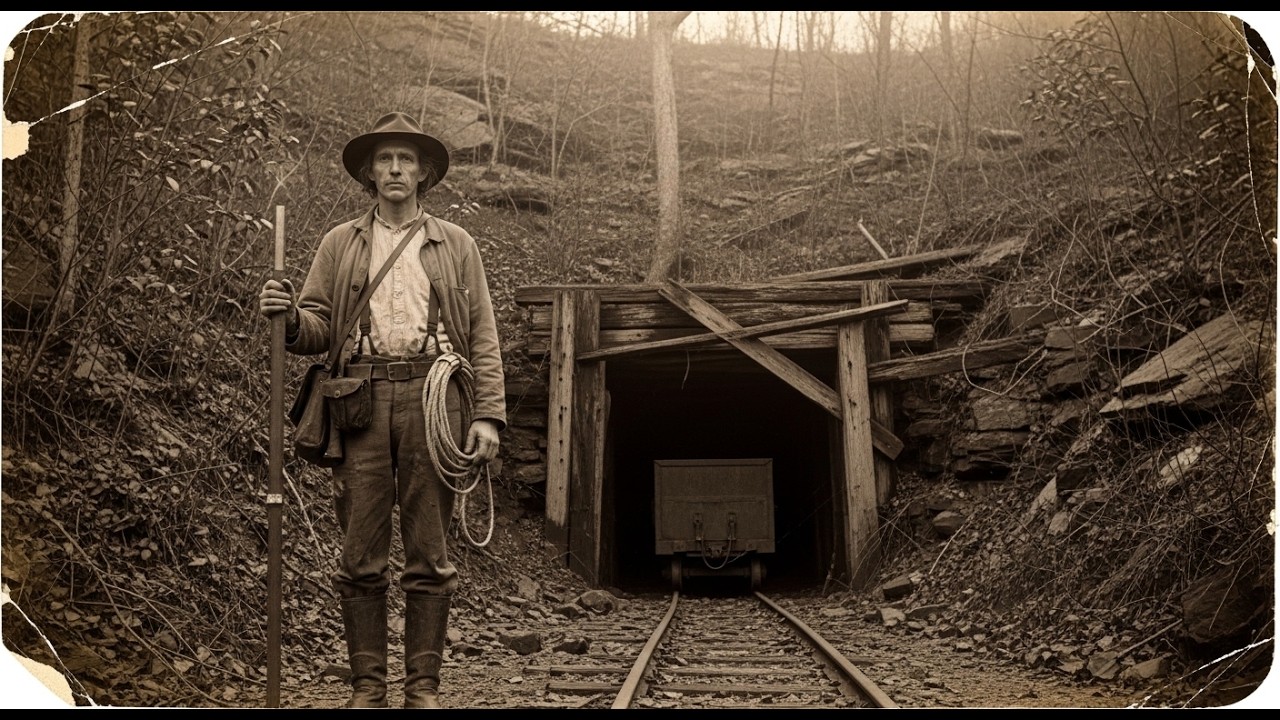
The woman who ran it, Vida Clements, confirmed that the quiet was permanent. When he mentioned what Fletcher had said about trouble, she told him plainly not to pry. On his twelfth day in the area, Drummond discovered something that defied explanation. While examining a hillside about half a mile from the settlement, he found a mine shaft that had been reinforced with timber supports.
The timbers were relatively fresh, only a few years old, and the stone around the entrance was gouged with deep scratches. Descending into the shaft, he entered a chamber full of abandoned mining equipment, but also heavy chains bolted to the walls, torn and stained clothing, and an iron ring set into the floor surrounded by marks that looked like fingernails scraping at stone. He left quickly, his heart pounding. That evening, he confronted Fletcher Mains.
The older man finally told him what had happened. The mine had been operated by a family named Prior, who arrived in 1886 with promises of lead and zinc deposits. They hired local men, and for about a year the operation seemed legitimate. Then the miners began to change.
They grew quiet, hollowed out, as if something had been taken from them. Some stopped going home at night and stayed instead at the stone building near the treeline, which had once served as the Priors’ headquarters. Everything unraveled in the fall of 1889. People began to disappear, first one, then two, then more.
Search parties found only empty clothing and scattered personal effects, never bodies. In a matter of weeks, forty-seven people vanished, every member of the Prior family and every worker connected to the mine. A state marshal from Springfield investigated, filed a brief report, and concluded that the missing persons had likely left voluntarily to avoid debts or legal trouble. The case was closed.
But the people of Ashford Hollow knew better. They tried to seal the mine, yet the seals did not hold against whatever was down there. The gouges in the stone had appeared after the disappearances, as if something had tried to claw its way out. Asked why they stayed, Fletcher replied that this was their home and they could not leave, so they simply learned to live with it.
The next morning, Drummond returned to the mine, equipped with lanterns and rope. He descended roughly a hundred feet to a second chamber, larger than the first, with visible tracks for ore carts. The walls were covered in carved symbols, flowing and irregular, unlike any alphabet he had ever seen. He began copying them into his notebook.
Then he became aware of a rhythmic, pulsing sound, like breathing. The sound came from deeper in the mine, where a passage that had been deliberately collapsed had since been broken through again. He squeezed into the narrow opening and emerged into a third chamber, enormous, far too large to have been excavated with 1880s equipment. The ceiling rose some fifty feet overhead.
In the center stood a structure unlike anything he had ever encountered, apparently built of stone, but organic in its form, as though it had grown rather than been constructed. When he touched it, he felt a hunger, ancient and bottomless, pressing against his mind. In that moment, he understood what had really happened in Ashford Hollow. The forty-seven people had not been victims of a mining accident or a natural disaster.
They had been offerings, sacrifices fed to whatever lived in the depths. The people of the settlement had known all along, which was why they had sealed the mine, refused to speak of it, and pretended it did not exist. Drummond left Ashford Hollow that night, riding through the darkness back to Millbrook. He filed a false report with the mining company, declaring the terrain unsuitable and the mineral deposits insignificant.
The company accepted his findings. But he did not walk away entirely. At the county records office, he researched the marshal’s investigation and found disturbing details. The official report was brief and perfunctory, but notes in the margins, written in a different hand, suggested evidence had been deliberately excluded.
Newspaper archives revealed that a follow-up article about the disappearances had been suppressed on an editor’s order. And there was mention of a representative from the United States Geological Survey who had visited the site shortly after the investigation, ordered the mine sealed, and threatened legal action against anyone who spoke publicly about what had been found. The cover-up was not accidental. Someone in authority had decided that the truth about Ashford Hollow was too dangerous to become public.
When Drummond wrote to government agencies seeking answers, he received only firm, polite refusals. The matter was closed, no further investigation was warranted. He spent the rest of his life carrying the secret. He married, lost his wife to illness, and never had children.
For more than three decades, he observed a near complete silence about what he had witnessed. In 1923, a journalist named Cornelius Wait contacted him. Wait was researching unsolved disappearances on the American frontier and had uncovered traces of Drummond’s old inquiries. They met in a cafe in Kansas City on a cold January afternoon.
Wait had documented over two hundred cases of unexplained vanishings, but Ashford Hollow stood apart: forty-seven people lost at once, followed by an information blackout and government involvement. Drummond told him everything. He showed the journalist his notes, his copies of the marshal’s report, the suppressed newspaper draft. Wait believed him, but he knew the full story could never be published.
In his book, published in 1925 under the title Vanished: Unexplained Disappearances on the American Frontier, he included only a sanitized mention of the case. The book sold poorly and was quickly forgotten. Drummond died in 1928 at the age of seventy. In his final years, those who knew him said he sometimes woke in the night gasping, claiming he could feel that hunger reaching for him across the miles.
Ashford Hollow was abandoned in the 1930s. The remaining families finally left, and the forest reclaimed the buildings. In 1946, the Army Corps of Engineers officially sealed the mine, filling the main shaft with concrete and placing a steel cap over the entrance. But people who have worked in the area since report strange sounds beneath the ground and that same smell of wet metal and decay rising from cracks in the earth.
Vegetation will not grow in certain places, and the ground feels wrong. Hikers and hunters occasionally go missing in that part of the Ozarks, never found. Locals attribute their disappearances to natural causes, but the old-timers say the thing in the mine is still there, still hungry, and still waiting. The official records remain sealed.
The full marshal’s report has never been made public. The geological survey’s investigation is classified. The only traces of what happened are fragments: Drummond’s notes, Wait’s incomplete account, and warnings passed down in whispers. Stay away from that valley.
Don’t go near the old settlement. If you hear something calling from beneath the earth, don’t listen.