The autumn of 1881 found the people of Yarrow Pass living in a valley so secluded that the rest of West Central Pennsylvania had largely forgotten it existed. The settlement held 312 souls, descendants of Welsh and Cornish miners who had come up from the river settlements in the 1780s to work the small iron and copper veins beneath the hills. By the time those veins played out in the 1830s, their families had put down roots too deep to pull. The miners became farmers, and the farmers became a quieter, more watchful breed of people, slow to invite strangers into their houses.
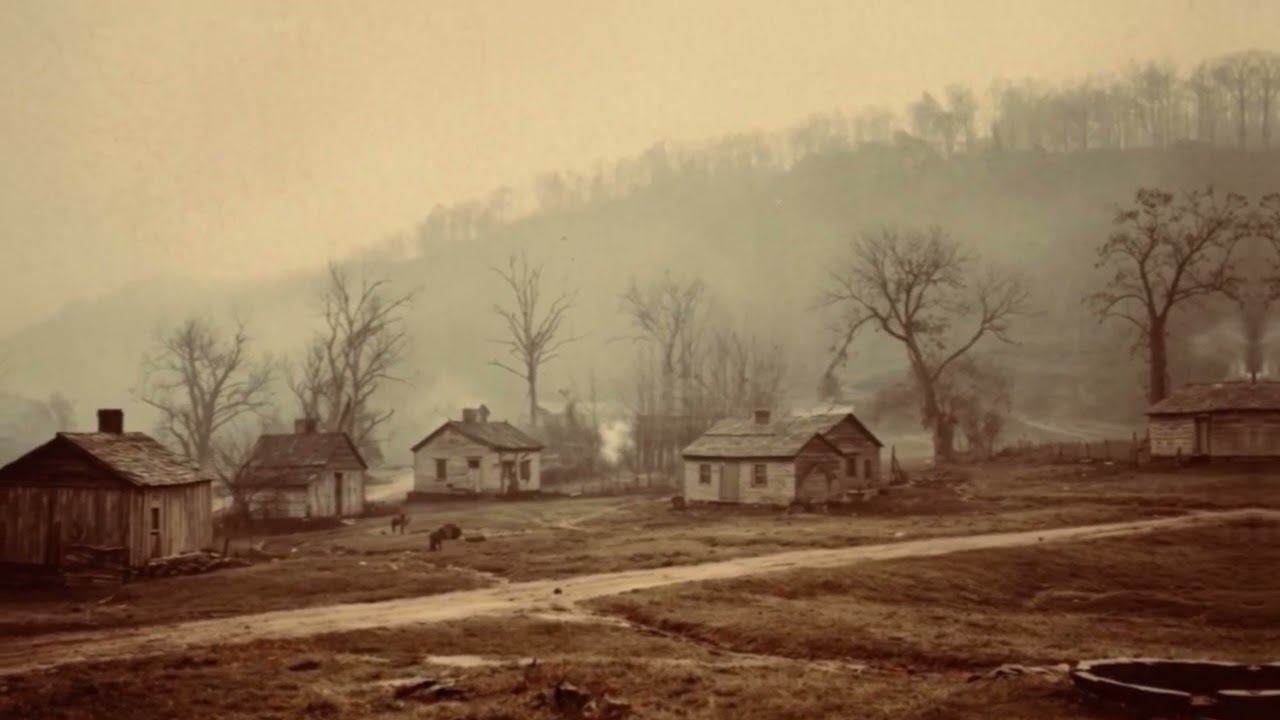
The valley sat in a bowl, with the hills closing in on three sides. There was only one road in and one road out, and they were the same road. To get in, you had to pass through a notch in the ridge barely wide enough for a wagon. Once inside, you were committed to the place.
On the morning of October 29th, a circuit preacher named Aljernon Whitlock rode into Yarrow Pass to give a service he had already delivered seven times that month in seven other valleys. He had been on the road since dawn and arrived around half past nine. The first thing he noticed was that the bell at the meeting house was not ringing. The second was that the road through town was empty.
Not merely quiet, but empty. There were chickens wandering in the road, which they would not have done if anyone was about. Only one chimney showed smoke. The pump at the center of the square was still running, the bucket beneath it overflowing, the water spilling into the dirt for some time.
He got down from his horse and walked to the meeting house. The door was unlocked. Inside, the hymn books were open on the pews, which was odd for a Saturday, and a half-eaten piece of bread rested on the lectern where he himself would have stood. The bread was still soft.
The general store was unlocked as well, with two cups of coffee gone cold on the counter and a ledger left mid-entry. The last line read “four pounds of nails to L. Penhallow on account,” and the pencil had stopped before the price could be written in. At the smith’s house, the forge was still warm, a horseshoe half-finished on the anvil, the metal now black but recently red.
The smith’s leather apron was hanging on a peg by the door. A smith does not leave his apron behind when there is work on the anvil. He went to seven more houses and found the same thing in each. Cooked food on tables, beds made, laundry on the lines.
In one kitchen, a kettle was still warm to the touch. In another, a knife had been left on a cutting board next to half a turnip. In a third, an old leather-bound Bible lay open by the window with a thumb pressed into the page at Ezekiel 37, the valley of the dry bones. There were dogs in some of the yards, and they came to him whining.
That was the only sound he had heard since he arrived. They followed him at a distance of about ten feet, and when he stopped, they stopped. He told the sheriff later that he could not remember ever feeling so watched by anything in his life, and he said the dogs were not the things doing the watching. By the time he reached his horse again, it was just after eleven in the morning, and he had searched roughly a quarter of the town.
Yarrow Pass had 312 people the night before. He could account for none of them. He rode hard to the next valley and from there a rider was sent down to the county seat. By late afternoon, a party of six men came back up the road with him, led by Sheriff Octavius Meade, a heavyset man of forty-seven with a mind that wanted explanations and did not trust silence.
He had been a soldier in the war and had seen towns emptied by disease, by raid, by fire. He knew what those looked like. This was not that. The party arrived just as the sun was setting.
Whitlock had not exaggerated. Nothing was broken, nothing burned, nothing overturned. The cattle were still in their pens and the horses still in their stables. A pie left to cool on a kitchen windowsill was stone cold but otherwise perfect.
The sheriff would later write that it was as if every soul in the valley had been called away to dinner and simply forgotten to come back. He had his men split the town into quarters, checking every house, barn, cellar, and cistern, calling names into the dark. He himself walked the road slowly, looking down at the dirt, searching for the footprints of 312 people walking somewhere together, because that many people could not move through a valley without leaving a road like trampled wheat behind them. He did not find any.
Whatever had happened there, he told the coroner, had not happened in any way he knew how to investigate. Around nine in the evening, a young deputy named Phineas Marberry came back to the square at a run. He had been searching the western edge of town, where the road curved up toward the higher pasture, and had found an old stone well on the property of a man named Ulisses Cobett. The well was deep, sixty feet by local reckoning, and had not been the primary source of water in years.
The deputy had walked past it twice without thinking anything of it. The third time, he held his lantern over the lip and looked down. When he got back to the square, he did not say what he had seen. He had taken his hat off somewhere between the well and the square and was holding it in both hands in front of him, the way a man holds a hat at a funeral.
His face in the lantern light was the gray-white color of old ash. The sheriff did not bring his men down into the well that night. He posted a guard at the lip and rode hard for the county seat, returning by dawn with three more men, two long ropes, a pulley rig, and the county coroner, a quiet, patient man named Tobias Quennel who had been doing autopsies in that part of the state for nineteen years. They rigged the pulley over the well at first light, and Quennel volunteered to go down first.
He was forty feet down before he called for the men above to stop. He stayed at that depth for almost ten minutes without saying anything. When he was finally raised back up, his hands, which had been steady going down, were shaking. He sat on the wall of the well for a long while before he could speak.
When he did, all he said was, “They are all in there. Every one of them. ”
When the men went down over the next four days, each body was wrapped in canvas and brought up one at a time. The recovery log, kept by the coroner in his own hand, listed every person by name and age, identified by what each body was wearing and by who in the recovery party recognized the face.
It matched the census taken in March of 1881 exactly. Every one of the 312 names appeared on both lists. There was no one missing. There was also no obvious cause of death on any of them.
No wounds, no bruises, no marks of strangulation, no signs of poison, no water in the lungs. They were simply dead, apparently healthy in the evening and gone by the morning. The coroner noted one consistent feature, which he wrote in the formal report in a single sentence and never spoke of again. The eyes of every single person in that well were open, and they were all looking up.
There was also the problem of the geometry. The well was sixty feet deep with a mouth no wider than four feet across, which gave it a space of roughly 750 cubic feet. The volume of 312 adult bodies was somewhere in the neighborhood of 1,200 cubic feet. The numbers do not match.
They cannot match. And yet the bodies were there, named, counted, and laid out in the meeting house in rows on the wooden floor. The coroner wrote in a private letter preserved by his family that the bodies were arranged, not stacked or thrown, placed with their heads turned in the same direction, facing east, none of them tangled, none of them overlapping. He wrote that it had the look of something done by hand, slow and patient, the way a clock maker lines up the small parts on a felt cloth before he begins his work.
He wrote that whoever had done it had not been in a hurry, and had not been alone, and had wanted very much for it to be tidy. The county did not want this story to leave the county. The railroad was making its decisions about where to extend its lines, and there were plans for new mines two valleys over. Sheriff Meade and his superiors wrote the incident up as a fever of unknown origin that had passed through Yarrow Pass in a single night.
The bodies were buried in a single mass grave just east of the meeting house. The Cobett well was filled in with stones and sealed at the top with mortar, and a small fence was put around it. The road into the valley was officially closed the following spring on the grounds that the buildings were a hazard. The sheriff dealt with the problem of the forty-three men who had been on the recovery team by asking each of them individually not to speak about what they had seen.
He told them that whatever had taken the people of Yarrow Pass might be one of those things the world was not yet ready to have explained to it, and that if the story got out, more people would come looking, and whatever was there might find more it could take. Most of them agreed. The silence held for twenty-two years. The story was finally released in 1903 by Sheriff Meade himself, in his last year in office, carrying the report in his own safe for over two decades.
He was sixty-nine years old. He told a young reporter from the Philadelphia Inquirer that he was making it public because he did not want it to die with him. The story ran on page four of the Sunday edition on May 3rd, 1903, under the headline “A Mountain Mystery Now 22 Years Old,” and was reprinted in seven other papers over the following ten days. There was no follow-up investigation and no government inquiry.
Within ten years, the forest had taken most of the valley back. There were private accounts that suggested the official record never told the whole truth. A surveyor named Wendell Garrick, who stayed in Yarrow Pass for nine days in late September of 1881, kept a journal in which he wrote of a sound he heard at night coming from somewhere west of the Cobett property. He described it as the sound of a great many people speaking very quietly at a great distance all at the same time, rising and falling, pausing, and beginning again.
He slept poorly, had recurring dreams of the whole town in the meeting house looking up at something he could not see, and left at first light on October 3rd, writing that he would not come back to that valley. He never did. He married in 1885 and lived a long, happy life, but for the forty-four years of their marriage, his wife wrote, he insisted that the window in their bedroom be shut every single night, regardless of the season, and would check it himself before he came to bed. On the night he died, the last thing he said to her was that he could hear them coming.
A hunter named Asher MountJoy, crossing the old Yarrow Pass tract in the autumn of 1907, heard the same sound coming from inside the sealed well and became absolutely certain that whatever was speaking down there knew his name. He left the county that night and never returned, and his descendants passed down for four generations the rule that no MountJoy was to set foot in that county for any reason, in any season. A farmer in the next valley over, a man named Levvenia Sturbridge, wrote in his farm journal on the evening of October 28th, 1881, that he heard a sound from over the ridge like the singing of a great crowd of people very far away, rising and falling three times before it stopped. After it stopped, the whole valley was so quiet he could hear his own heartbeat in his own ears.
He never wrote another word about it. The family rule on that farm was to close the kitchen window before sunset on the 28th of October, every year, without fail. The well is still there, sealed, on state game commission land behind a low iron fence. There is no marker and no plaque.
A clause in the original land transfer from the county to the state in 1915 requires that the mound remain undisturbed in perpetuity because the land’s previous owners had reason to believe that something below the surface should not be allowed easy passage upward. The rule has been followed for generations. The moss on the stones of the mound is thicker on the east side, the side where the bodies were facing.