In the weeks after Gettysburg, Robert E. Lee sat down to write the official report on which history would judge him. Beneath the precise, formal language of that document lay an admission few have fully read. The most famous general of the Confederacy quietly acknowledged that his artillery had failed him at the moment it was needed most.
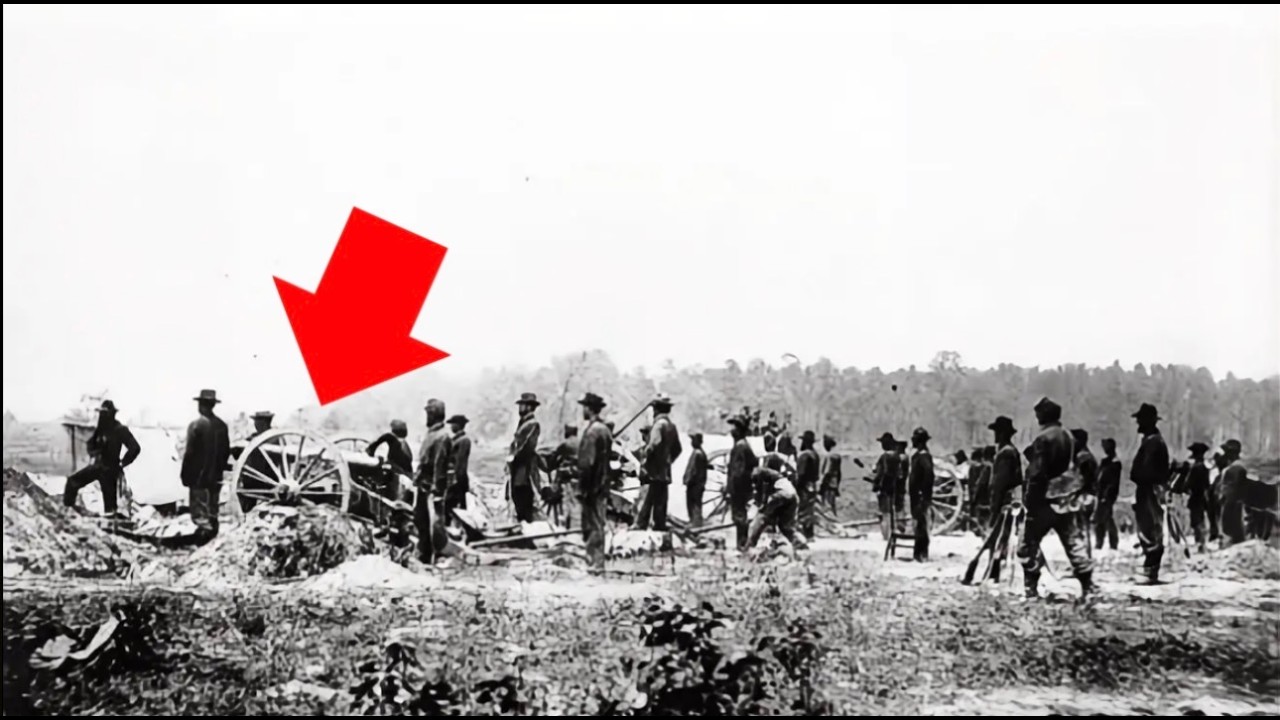
He did not explain the defeat the way defeated generals usually do. He wrote with the precision of a man who had spent hours analyzing exactly why the plan had broken down, and what he wrote pointed directly at the Union guns, the artillery that had outperformed his own in a way that changed Lee’s view of the arm for the rest of the war. The context for what Lee actually wrote begins in the afternoon of July 3, 1863, in the hour before Pickett’s Charge. Confederate artillery under Colonel Edward Porter Alexander opened fire around one o’clock.
Roughly 170 guns were aimed at the Union center on Cemetery Ridge, with the objective of silencing the Union batteries and disrupting the infantry positions the coming attack would have to cross. It was, at that time, the largest concentration of artillery fire the Confederacy had ever attempted in a single engagement. Alexander had spent the morning positioning his guns with great care, and the bombardment that followed was so loud that, according to multiple accounts, it was heard more than one hundred miles away in Pittsburgh. By any measure of sound and spectacle, the barrage was overwhelming.
By the measure that truly mattered, the disruption of the Union guns awaiting Pickett’s infantry, it fell far short of what the plan required. Union artillery chief Henry Hunt had prepared for exactly this scenario in a way the Confederate commanders had not fully anticipated. Instead of answering the Confederate bombardment with continuous, full counter-fire, Hunt deliberately reduced his guns’ rate of fire in the middle of the engagement, conserving ammunition and giving Confederate observers the impression that Union batteries were being knocked out faster than they actually were. Some Union guns fell silent entirely, not because they were destroyed, but because Hunt ordered them to stop firing and wait.
Confederate officers watching through the smoke interpreted that silence as proof the bombardment was working. In reality, it was a deception that would cost Pickett’s men dearly once the infantry advance began and those same guns opened fire again at very close range. When Alexander sent word to Longstreet that ammunition reserves were running low and that the infantry must advance immediately if it was to advance at all, the decision to launch Pickett’s Charge rested on an artillery assessment that was wrong in crucial ways. The Union guns on Cemetery Hill had not been silenced.
They had been preserved. And as roughly thirteen thousand Confederate soldiers advanced across open ground, those guns opened fire with a coordination and intensity the Confederate planners had not expected. Artillery fire tore gaps in the advancing ranks from the very start of the attack, long before the infantry came within range of Union rifles. By the time Pickett’s men reached the stone wall at the Union center, entire regiments had been shredded by shells and case shot directed from guns the Confederate bombardment was supposed to have silenced hours earlier.
This was the background against which Lee, about two weeks after the battle, sat down to write his official report to the Confederate War Department. Official post-battle reports by Civil War commanders tend to be cautious documents, written with the awareness that they would be read by superiors, the public, and ultimately by history. Lee’s report is no exception in tone. But within that formal official language, Lee addressed the artillery preparation directly.
What he wrote acknowledged something important: the bombardment preceding the infantry attack had not accomplished what it was intended to accomplish, and the failure to adequately neutralize Union artillery fire had contributed directly to the destruction of the infantry that followed. Lee used no dramatic language. He did not blame Alexander by name, and he accepted the broader responsibility for that day’s outcome in words that have since become among the most quoted associated with the battle. But the substance of what he wrote traced the failure of Pickett’s Charge, at least in part, to an artillery problem, guns that failed to do what Confederate planning assumed they would do, against Union guns that operated with a discipline and coordination the Confederate bombardment had failed to disrupt.
The most famous words associated with Lee at Gettysburg did not come from the written report. They came from the field itself, in the hours immediately after the attack collapsed. As the survivors of Pickett’s division streamed back across the ground they had just crossed, Lee rode out to meet them. According to the testimony of several soldiers present, he told them repeatedly that the fault was entirely his own.
“It is all my fault,” he was reported to have said, taking personal responsibility in front of the men who had just watched their friends die in an attack he had ordered. That public acceptance of blame became one of the defining images of Lee’s character for generations of readers, seen as evidence of a commander unwilling to shift responsibility onto his subordinates. What is missing from that famous moment is the more technical, more specific admission Lee made in writing afterward, once the immediate emotion of the battle had faded and he had the opportunity to analyze what had gone wrong. Edward Porter Alexander himself, who commanded the artillery that day and lived for decades after the war, spent a large part of his remaining life reflecting on what went wrong during the bombardment.
His postwar writings reached a level of technical detail Lee’s official report never attempted. Alexander identified several specific failures. Confederate ammunition, much of it produced in wartime facilities with inconsistent quality control, contained a large proportion of defective fuses that caused shells to explode too early, too late, or not at all, reducing the actual destructive impact of the bombardment below what the number of guns suggested. Confederate gunners, unable to see clearly through the smoke that quickly covered the field, had no reliable way to observe where their shells were actually landing relative to Union positions.
This meant that fire that should have been corrected as the bombardment continued was instead delivered at the same estimated range, regardless of whether those estimates were accurate. Most importantly, Alexander was given no effective means of communicating with the infantry commanders about the true state of Union artillery once smoke made visual assessment nearly impossible, meaning the final decision to launch the infantry attack was based on information that was already outdated by the time it reached Longstreet. What makes this comparison worth examining is not simply that Confederate artillery performed poorly. It is that Union artillery under Henry Hunt represented a level of institutional organization the Confederate army had not yet reached by the summer of 1863.
Hunt had spent the war building a centralized system of artillery reserve, ammunition supply, and coordinated fire control, making artillery a unified arm of the Union army rather than a collection of batteries loosely attached to individual infantry divisions. That system allowed Hunt to make the kind of calculated, disciplined decision he made during the bombardment, deliberately reducing fire to preserve ammunition and deceive Confederate observers. It was a decision requiring central authority over artillery deployment and a level of trust in that authority from Union infantry commanders who had to accept reduced fire cover without panic. The Confederate artillery arm, still organized in a decentralized way and closely attached to individual corps, had no equivalent structure capable of making or executing such a decision.
Lee’s private correspondence in the months following Gettysburg, away from official reports, shows his broader engagement with this very problem in less formal language than a document addressed to the War Department required. In letters to Confederate President Jefferson Davis written that summer, Lee returned repeatedly to matters of artillery supply, ammunition quality, and the general state of the ordnance branch of the Army of Northern Virginia, pressing for improvements in the areas Alexander would later identify as causes of failure during the July 3 bombardment. Lee was not merely processing an emotional loss in these letters. He was identifying a structural weakness in his army’s capability and pushing, in the practical language of a commander planning future campaigns, toward addressing that weakness before the next major engagement.
The artillery reforms that followed over the next year, though never complete enough to fully close the gap with Union artillery by the end of the war, trace their roots directly to the lessons Lee and his ordnance officers drew from what happened at Gettysburg. Students and faculty at Washington College, where Lee served as president in the years after the war, recalled conversations in which Lee discussed the Battle of Gettysburg with a level of technical precision that surprised those who expected him to avoid the subject entirely. Multiple accounts from former students describe Lee, when the battle came up, returning to the same essential point: that the artillery preparation on July 3 had not accomplished what it should have, and that the failure concerned physical and organizational limitations of the Confederate ordnance system more than the courage or skill of the men serving the guns. Lee, according to these accounts, was notably reluctant to discuss the battle in terms of individual blame, consistent with the public stance he had taken on the field immediately after the attack failed.
But when pressed on the details of what went wrong, the artillery preparation was the detail he consistently returned to, more than higher-level command decisions, more than the individual conduct of any particular officer. The gap between Union and Confederate artillery capability at Gettysburg did not appear overnight, and understanding its origins helps explain why Lee’s admission carried so much weight. The Union army enjoyed access to more standardized and reliable supplies of artillery pieces throughout the war, including larger numbers of rifled guns capable of greater range and accuracy than the smoothbores that still made up a large portion of Confederate batteries by 1863. The Confederacy’s industrial base, concentrated in a few foundries such as Tredegar Iron Works in Richmond, could not match the North’s capacity for manufacturing weapons, standardizing ammunition, and maintaining consistent quality control at the scale the war demanded.
Confederate batteries at Gettysburg used a mixture of gun types and calibers, complicating ammunition supply in ways that Union batteries, relying on a more centralized and standardized manufacturing system, did not have to contend with to the same degree. This was not a failure of courage or tactical skill on the part of Confederate artillerymen. It was a structural industrial deficiency that no amount of skill in operating the guns could fully overcome. Lee recognized this industrial reality more than most Confederate commanders, partly because his responsibilities as commanding general required him to deal directly and repeatedly with supply issues that officers focused only on tactics could largely ignore.
Throughout 1863 and into 1864, Lee’s correspondence with the Confederate ordnance bureau reflects a commander fully aware that his army’s artillery arm was operating under a persistent material disadvantage against an opponent whose industrial capacity was expanding while the Confederacy’s remained essentially static, or in some categories, actually deteriorated under Union blockade pressure. Ammunition quality was a recurring subject in this correspondence. Confederate gunpowder manufacturing, dependent on domestic saltpeter production and blockade-run imports that became less reliable every year, could not match the standardized output of Union powder mills, and the defective fuses Alexander identified after Gettysburg were, in this broader context, a symptom of an industrial problem rather than an isolated manufacturing failure particular to that one battle. A specific tactical concept deserves clarification here because it precisely explains what Lee meant when he referred to the failure of counter-battery fire in his report.
Counter-battery fire refers to artillery directed specifically at destroying or neutralizing the enemy’s artillery, as opposed to fire directed at infantry or fortified positions. The entire logic of the July 3 bombardment depended on effective counter-battery work. The Confederate guns had to substantially silence or degrade the Union artillery on Cemetery Ridge before Pickett’s infantry advanced, because infantry crossing open ground under fire from intact artillery faced a level of destruction that historians of the period understood clearly even before Gettysburg proved it at the most costly possible scale. When Lee’s report acknowledged that the bombardment had not achieved its purpose, he was specifically admitting a failure of counter-battery fire, a technical military judgment with precise meaning rather than a vague expression of regret.
The Union guns that should have been neutralized were not neutralized, and the infantry paid the price for the difference between what the artillery plan required and what it actually achieved. This distinction matters because it separates the assessment Lee actually documented from the broader mythology that grew around Gettysburg in the decades after the war. Much postwar commentary on the battle, particularly that produced by former Confederate officers with personal or political reasons for shaping how the defeat was remembered, focused overwhelmingly on infantry command issues: whether Longstreet had moved quickly enough, whether Stuart’s cavalry had failed Lee by straying too far from the main army, whether Ewell should have exploited his advantage on the first day of fighting. Artillery rarely featured prominently in these debates, partly because blaming guns and gunners made for a less compelling story than blaming specific generals whose personal choices could be examined and criticized.
Lee’s own writings suggest he understood the technical material dimension of the defeat more clearly than the mythology that developed around him after the war credited. He was thinking about ammunition quality and counter-battery effectiveness at a moment when much public discussion of Gettysburg was already narrowing toward simpler stories of individual heroism and individual failure. The consequences of this artillery gap extended far beyond Gettysburg itself, shaping how the Army of Northern Virginia fought for the rest of the war. In the campaigns that followed, particularly the Overland Campaign of 1864 and the subsequent siege of Petersburg, Confederate artillery doctrine increasingly focused on defensive positioning rather than the kind of large offensive bombardment attempted at Gettysburg.
Lee’s army, dug in behind trenches for extended periods rather than maneuvering in the open as it had done early in the war, relied on artillery placement to defend fixed lines rather than to support offensive breakthroughs against fortified positions. This shift reflected, at least in part, an acknowledgment that the kind of sustained coordinated offensive bombardment Union artillery could maintain was not something Confederate artillery, given its material limitations, could reliably match or overcome. The lessons of July 3, 1863 did not disappear once the immediate shock of defeat faded. They became embedded in how Lee’s army approached artillery in every subsequent campaign.
Hunt, for his part, continued refining the centralized artillery command structure that had performed so effectively at Gettysburg, and Union artillery doctrine grew more sophisticated as the war continued. The gap between the two armies’ artillery arms, already significant in July 1863, widened further over the next two years as Union industrial capacity continued expanding while Confederate capacity, exhausted by blockade and the increasing difficulty of importing critical war materials, struggled merely to maintain existing production levels. By the time the war ended at Appomattox in April 1865, that disparity in effectiveness, proven so costly at Gettysburg, had widened further rather than narrowed, a slow confirmation of the unfavorable structural side Lee had identified with precision in the weeks after Pickett’s Charge failed. It is worth pausing on why this specific technical admission matters more than the famous quotation about personal fault.
Accepting blame in front of the withdrawing soldiers is an act reflecting strength of character, deserving of the respect it has received for a century and a half as a sincere display of responsibility from a commander who could easily have blamed his subordinates. But in itself, it explains nothing about why the attack failed. It is a moral statement, not an analytical one. The artillery admission is different.
It represents Lee doing the harder, less flattering work of actually diagnosing the underlying mechanism of failure rather than simply accepting blame for an outcome whose deep causes remained unexamined and unexplained. The general who says the fault is entirely his own has accepted responsibility. The general who precisely identifies which part of his plan broke down and why has done something that actually serves the army’s future performance. Lee did both, in different documents for different audiences, and the second of those acts has received far less attention than it deserves.
There is also a broader historical significance to this admission that extends beyond Lee’s career, into how the Civil War is understood as a turning point in military history generally. Gettysburg occurred at a moment when artillery technology and organization were evolving faster than the tactical doctrine of either army had absorbed. Rifled artillery, improved fuse technology, and increasingly centralized command structures for coordinating fire across multiple batteries were all relatively recent developments in 1863. Armies that adapted to these developments more effectively gained a real, measurable advantage over armies that did not.
Henry Hunt’s performance at Gettysburg represents one of the clearest examples in the entire war of a commander who fully absorbed what modern artillery organization could accomplish. Lee’s own admission, read alongside Alexander’s postwar technical analysis, represents the Confederacy acknowledging that in this particular respect, they were still catching up to a form of warfare the Union army had already begun to master. This is not to say that artillery alone determined the outcome of Pickett’s Charge, or that better counter-battery fire would have guaranteed a different result on July 3. The Union position on Cemetery Ridge held real advantages beyond its artillery.
Interior lines allowed Meade to move reinforcements quickly, elevated ground gave defenders clear fields of fire, and infantry positioned behind a low stone wall had cover that no preparatory bombardment could fully eliminate. Lee himself never claimed, in the report or in any documented later conversation, that artillery alone caused the defeat. What he identified was one correctable element within a larger failure, a piece of the puzzle representing something the Confederate army could realistically work to improve in future battles, unlike the courage of the troops or the difficulty of the ground itself. That is precisely why this admission carried practical weight beyond the immediate aftermath of the battle.
It pointed to a solvable problem rather than merely confining an irreparable one.