In the winter of 1934, an old man named Absalom Rutled arrived by rail in the small Wyoming town of Belelfrey Springs. He was 82 years old, and he signed the boarding house register with a purpose of stay that read simply: to die here. The widow who kept the house, Vera Holston, thought at first that he was joking. By December, she understood he had not been.
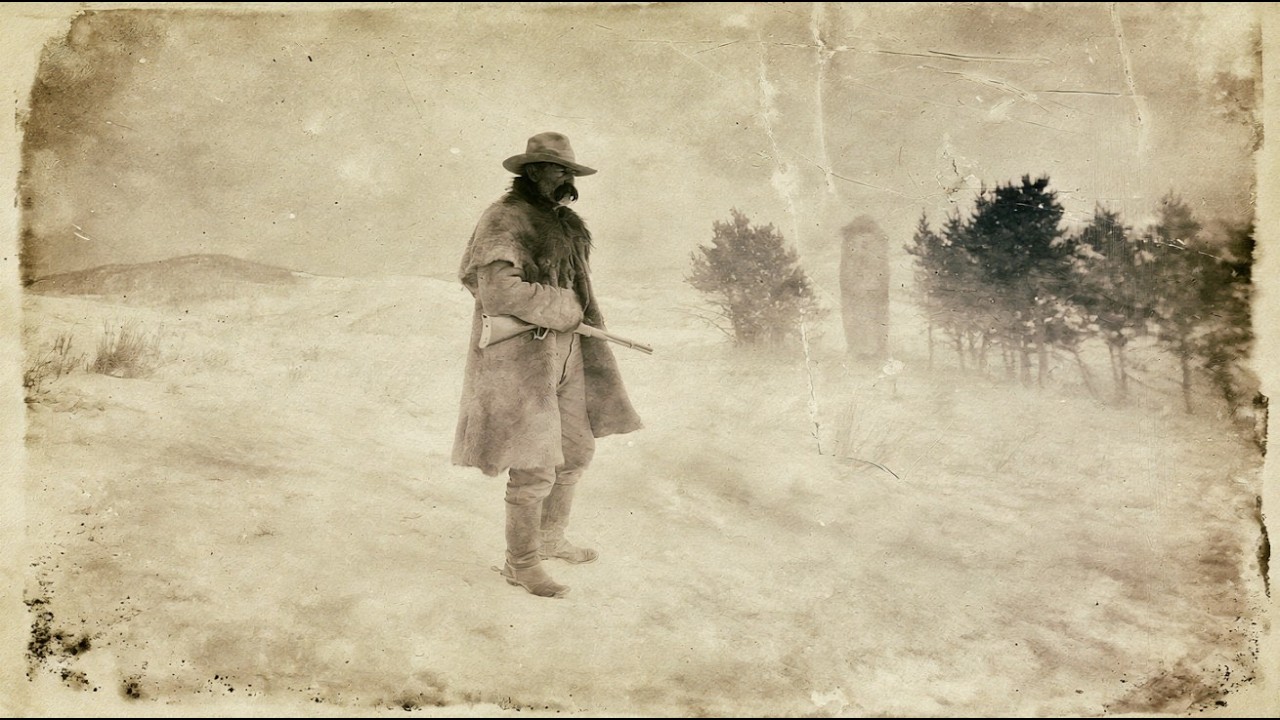
Rutled had come as close as he could bear to a place he had left in the winter of 1878, and he was determined not to be buried east of the Missouri. In the second week of December, his health gave out. He called Vera to his bedside and asked her to fetch a priest. She was surprised; he was not a Catholic.
But Rutled explained that a priest was the one kind of man who would listen to a dying man without laughing, without questions, and without running out of the room when it got bad. Vera went for Father Ignatius Folk, a 38-year-old priest from a German farming family in Wisconsin, whose parish lay in the next county. Father Folk arrived at nine in the evening. He sat down beside the bed, and the dying man asked him to sit quietly and hear what he had to say, because if he stopped, he feared he would not have the wind to start again.
Father Folk did not interrupt. For four hours and twenty minutes, he listened. Rutled began with the fall of 1878, when he was 26 years old and hunting buffalo out of a camp near Deadwood. He was part of a party of six: Merritt Yaws, the Kentucky-born leader who had fought at Chickamauga and never spoke of it; Cathkart Neighbors, called Cath, a Missouri tracker with a nose broken twice and an eye for sign that no one could match; Dorsy Kil Martin, a huge man from the California mines who talked to himself, hummed hymns while he worked, and slept outdoors in any weather; Oo Brazwell, a quiet 22-year-old Kansas boy who could put a ball through a buffalo’s lung at 400 yards; and Kesler Vandergrift, a Dutchman who drove the wagon, cooked, kept the animals, and swore at his mules in his own tongue.
That fall, following the sign of a small herd, they pushed west out of the Black Hills into Wyoming, up along the Powder River through country from which the Sioux had been driven the year before. They meant to hunt through the first snows and be home by Christmas. None of them made it home. They made their second camp on November 4, in a low draw between two ridges about 30 miles northwest of where Buffalo, Wyoming, stands today.
The first strange thing was the quiet. On a plains night in November, there should be wind, ice cracking on the river, wolves at a distance, the small sounds of a country breathing. That night the wind died and did not come back. The country went as still as a room with the door shut.
Merritt stood with Rutled at the edge of camp and said he had heard such a stillness only once before in his life, the night before his father died. The next day, Cath went out to scout. He found 12 buffalo in a shallow bowl below the ridge, standing in a circle, facing outward. They did not move as he approached.
One turned its head and looked at him, and Cath said it did not have the look of a buffalo in its eye, but the kind of look a man gives you when he knows your name. The party moved camp two miles east. That night they set a watch, something they had not done in years. There was no reason to; the Sioux were gone and wolves would not come in on six armed men.
But Merritt ordered it, and no one argued. During the first watch, Oo woke Rutled and led him to the edge of camp. At the treeline, roughly 200 yards away in the moonlight, stood a shape. It was upright, taller than a man, and perfectly still in a way no living thing should be.
When it moved, it took a step in the crusted snow, and there was no sound. Then, between one moment and the next, it was gone. In the morning they found tracks, but not where the thing had stood. The tracks were 50 feet out, in a straight line.
They came in from the east, stopped, and went back the same way, on the same footprints. They were longer than a man’s boot by half, and there were too many toes. Rutled would not say how many, not even at the end. Cath looked at the tracks, then asked Merritt if they could leave.
Merritt wanted to finish the hunt, but Cath pressed him, saying he had had a feeling like this twice before and both times had lived to regret not acting on it. Merritt made a bargain: one more day. If nothing happened, they would stay. If something happened, they would leave.
Cath warned him it was a fool’s bargain, because if something happened, it might be too late to leave. Merritt held to it. The day passed cleanly. They found a real herd of nine buffalo and took seven.
It was good, clean work, and Merritt was in a better mood. Oo, however, had been quiet since the night before. He did not read his book of Psalms by the fire that evening. He sat with his rifle across his knees, his eyes fixed on the treeline.
Around midnight, Rutled woke to a strange wind, blowing from all directions at once into the camp, as if something big was breathing in. On the wind was a smell of old snow and burnt hair, and underneath that something older, something he could not place and could not name. When morning came, Oo was gone. His rifle stood upright in the snow by the fire, planted like a fence post.
His footprints led out of camp about 30 yards north and then simply stopped, both feet side by side as if he had halted, and then there were no more prints. Cath circled the point three times and found no other track in any direction. As they stood there, they heard Oo’s voice. It came first from the west, clear as if he were at the edge of camp, calling, I’m over here.
Then again from the east, behind them. Then again from a low place in the draw they had passed days earlier. Cath fired three shots straight up into the sky. The calling stopped.
They tried to leave that afternoon, but the horses rolled their eyes and would not be saddled. One horse bit through Dorsy’s sleeve and drew blood. Kesler’s lead mule, patient enough in ordinary weather to carry a coffee pot hanging from its harness, kicked at Rutled and nearly killed him. It took three hours to get the animals ready, by which time it was dark.
They agreed to sit up by the fire, back to back, weapons out, until first light. That was the night Cath went. He was there at midnight. At some point Rutled closed his eyes for a moment.
When he opened them, his back was against nothing. Cath was gone. His rifle lay across the log where he had been sitting. His boots sat by his untouched bedroll, laces neatly tied, as if he had stepped out of them and walked away in his stocking feet.
There were no prints anywhere. Kesler, who had been looking directly at him, said Cath had not stood up and had not walked away. He had simply not been there anymore, between one blink and the next. Kesler, a stout man who did not cry, was weeping.
They rode that night, heading east. The stars did not move. All night they stayed fixed overhead. When the sun came up, it came up between the east and the north, in the wrong place.
They rode all day, and the land did not change. They passed the same red sandstone formation three times, though they had never turned. Merritt finally reined up and said quietly, We are being turned. Toward evening they crested a rise.
Below them, in a shallow bowl of snow, were the 12 buffalo, still standing in a circle, facing outward. Their breath did not steam. Their eyes did not blink. And in the center of the circle stood the shape.
Rutled would give only three details: it was tall, it wore something that was neither skin nor cloth nor fur, and it was looking directly at him. He knew, without hearing anything, that it knew his name. Merritt said, Absalom, do not look at it. Then he turned his horse and said, Ride.
What followed came back to Rutled in fragments. Merritt praying Psalms in a voice Rutled had never heard him use. Dorsy humming his mother’s hymn steadily for hours, his eyes wet. Kesler’s wagon falling behind in the night.
And then a woman’s voice ahead of him, off to the north side of the trail, calling his name the way his mother had called him in for supper. She had been dead 11 years. He would have gone to her. But Merritt reached over without looking and took hold of his bridle and would not let go for four hours.
Every time the voice called, Merritt pulled the horse back to the line. Rutled said plainly that Merritt saved his life that night. By dawn of the second day, Dorsy was gone. Rutled looked back and saw him riding, his mouth still shaping the tune.
A minute later he looked again. The horse walked on with the reins hanging loose, and Dorsy’s coat lay folded neatly across the saddle. Merritt said not to turn around. Kesler’s wagon was gone too.
That evening they reached a trapper’s cabin on a bend of the Powder River. The trapper, Elias Pricket, was a man of about 60 with a face like tanned leather and three fingers missing from his right hand. He took them in without questions, put them by the fire, and set out whiskey. Merritt sat down at the table, put his hands flat on the wood, and did not stand up again.
Three hours later he was dead. He had no wound, no fever. Elias examined him and said only, This man has just stopped. They buried him in a clearing behind the cabin, a cross of two pine pieces driven into the ground, with the name Merritt Yaws and the year 1878 carved into it.
Rutled said the Lord’s Prayer over him, the only prayer he knew all the way through. Before he left, Elias made him promise he would ride east and never come back into that country. Rutled kept the promise for 56 years. He told no one what he had seen.
Not his wife, not his brother, not the men he worked with on the railroad. He held it for more than half a century, he said, because he did not think there was a man alive who could hold it. He was telling it now because he was about to become a listener himself and did not want to arrive with it in his mouth. Father Folk asked him one question: what did he think it was?
Rutled said it was not a demon, because a demon knows the shape of a man. It was not a beast, because a beast has business with the world. It was not hungry and it was not angry. His conclusion was that there are places on this earth that were not made for people, where the ground remembers something older than any living thing that has ever walked upright, and that once in a great while, when the snow is deep and the wind is still, something in those places notices we are on it, takes a look, and takes what it wants.
Then he said the worst part. He did not think it had been hunting them. He thought it had been calling them home. It believed they belonged to it.
Oo went to it, Cath went to it, Dorsy went to it, Kesler, he believed, went to it. Merritt refused. And Rutled had refused every winter for 56 years, whenever the snow reached a certain depth and the wind went still and he heard that voice again, calling him home. Around three in the morning, Absalom Rutled’s breathing stopped.
Father Folk sat with him, said the prayers for the dying, and then wrote down what he had heard in his notebook. He kept it between the pages of his Bible and never showed it to another priest. The old man was buried in the Catholic cemetery outside Belelfrey Springs, with no next of kin to claim him. Father Folk died in 1961 of a heart condition in Rock Springs, Wyoming.
His younger sister found the notebook in his Bible, kept it in her attic, and it was donated with the family papers to a historical society in the Wyoming State Archives after her death in 1972. On the last page, in an unsteady hand, Father Folk had written a single line: God forgive me. I believed him. Vera Holston lived until 1947.
Years later, a young woman writing about the town’s older buildings asked whether anything unusual had ever happened at the boarding house. Vera said something unusual happened only once. Every winter since the old man died, when the snow grew deep and the wind went very still, around three in the morning, she heard a voice in the back garden calling. It said the same three words every time.
Come home now. When the young woman asked whose voice it was, Vera said it was a woman’s voice most winters, sometimes a man’s, and once a voice she did not know, calling for her. She never went to the window. Whatever is calling, she warned, is not asking.
Once you let it see you, it is too late. The young woman never printed any of it, but she wrote it down in a private notebook, and 40 years later she gave it to a granddaughter. That is how the story of what Absalom Rutled saw in the snow in the winter of 1878 finally came out into the world.