In the final two years of World War II, as Germany’s military position collapsed, the Nazi regime armed boys barely old enough for adolescence and sent them to the front. These young soldiers, some as young as fourteen, fought alongside elderly men and veterans, armed with rifles, machine guns, and anti-tank weapons. For the Allied and Soviet troops facing them, a teenager with a weapon was just as lethal as an adult, and the brutal realities of close-quarters combat meant that many of these boys were killed in action. But the darker question is whether adolescent German soldiers were also shot after surrendering.
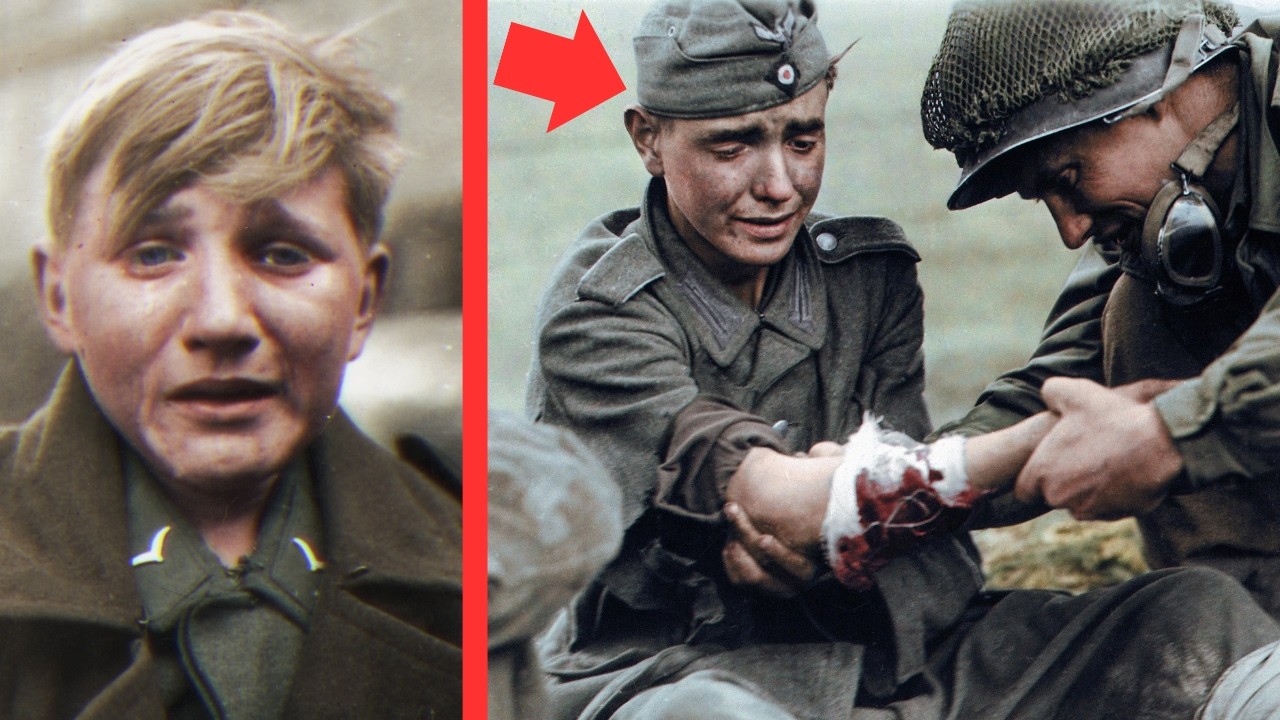
There were documented cases where they were. The reason so many teenagers ended up in uniform was rooted in Germany’s catastrophic manpower shortage. By 1943, the Wehrmacht and the Waffen-SS were bleeding experienced soldiers faster than they could be replaced. The Nazi regime turned to its youth organizations, particularly the Hitler Youth, which had long been preparing boys for military life through physical training, weapons instruction, and ideological indoctrination.
In 1943, the Waffen-SS formed the 12th SS Panzer Division Hitlerjugend, drawing heavily on boys born in 1926. By the time the division fought in Normandy in June 1944, many of its soldiers were only seventeen or eighteen years old. As the situation grew more desperate, the regime pushed even younger boys into service. In 1945, the Volkssturm, a national militia meant to defend Germany itself, mobilized mid-teenagers alongside far older men.
Propaganda celebrated young fighters who attacked enemy armor with Panzerfausts, the cheap single-shot anti-tank weapons that could destroy a tank at close range. For the Allies advancing into Germany, this created genuine uncertainty. A boy who looked harmless might be hiding a grenade or a Panzerfaust, and in the chaos of urban fighting and woodland battles, soldiers often had only seconds to decide whether someone presented a threat. In those moments, many teenage fighters were shot on the spot, not because of their age but because they were armed and resisting.
Being captured, however, did not guarantee safety. Under the laws of war, a German teenager who genuinely surrendered was entitled to protection as a prisoner of war, and the deliberate killing of a surrendered prisoner was illegal. Millions of German soldiers, including the very young, surrendered to the western Allies and survived, being searched, disarmed, and sent to prisoner-of-war camps. But there were also numerous documented cases, and certainly many more that went unrecorded, where German soldiers were shot and killed even after surrendering.
The reasons varied. Anger over fallen comrades, revenge, broken discipline, fear that prisoners might still be armed, and the confusion of fast-moving battles all contributed. Some Allied soldiers developed particular hostility toward Waffen-SS formations, which were closely tied to Nazi ideology and associated with atrocities. One unit that gained a grim reputation was the 12th SS Panzer Division Hitlerjugend itself.
During the Normandy campaign, members of the division killed Canadian prisoners of war, including those captured near the Abbaye d’Ardenne. When knowledge of such killings spread, it deepened bitterness between the opposing forces. There is also evidence that Allied units carried out unlawful killings of German prisoners during the same campaign, some of them directly in retaliation for the actions of the Hitlerjugend division. In such an atmosphere, the very young soldiers of an SS formation could become victims of revenge, even though killing prisoners was technically illegal.
For angry enemy troops, the insignia on a uniform could matter far more than the age of the boy wearing it. The Eastern Front was even more brutal. By 1945, the Red Army was entering Germany after nearly four years of devastating war on Soviet soil. German forces had carried out mass executions, starvation policies, reprisals against partisans, and the destruction of settlements, causing the deaths of millions of Soviet civilians and prisoners of war.
This created an atmosphere of intense hatred and a thirst for vengeance. German soldiers, including young ones, could face extremely harsh treatment. Some were killed during combat, and many died after being captured, while enormous numbers of German prisoners of war were eventually held in Soviet captivity for years. But youth alone was not the reason a captured boy was targeted.
Many of these teenagers were viewed as fanatical Nazis. Nazi propaganda had deliberately portrayed young fighters as heroes to be admired, and during the final battles of 1945, including the Battle of Berlin, boys fighting tanks with Panzerfausts were presented as models for others to emulate. Some Hitler Youth members even continued fighting after organized resistance had collapsed in their areas. This meant Allied soldiers could not assume that someone was harmless simply because he looked fifteen or sixteen years old.
In close-quarters combat, a soldier who saw an armed teenager would react instantly. Tragically, there was little chance to accurately determine someone’s age before firing. It was a matter of kill or be killed. Ultimately, the young German soldiers were not shot because they were teenagers.
They were killed because they were legitimate enemy combatants, armed and fighting against seasoned Allied and Soviet troops supported by tanks, aircraft, and artillery. Some of them did become victims of unlawful reprisals and the killing of prisoners, especially when they belonged to hated formations or when the fighting had been particularly savage. But the most disturbing aspect of the final years of the war was larger than any single battlefield atrocity. A regime that was already defeated was feeding its own children into a war it could no longer win.
Boys who should have been in school were given guns and Panzerfausts instead of pens and sent to face the most experienced armies on earth. Many surrendered and survived. Many died fighting. And some, after laying down their arms, were killed anyway.
The tragedy of these young soldiers was not just the way they died on the battlefield, but that the state which should have protected them instead consumed them in its own desperate final stand.