On Christmas Eve 1945, five children went to sleep in a two-story wood-frame house at the edge of Fayetteville, West Virginia, and were never seen again. The Sodder family—George, Jennie, and nine of their ten children—had settled in for a quiet holiday night. By morning, the house was gone, and the official record said the children had burned beyond recognition. Their mother, Jennie Sodder, never believed it.
Not for one day of the rest of her life. And the details she uncovered in the ashes, or rather, the details she failed to uncover, would turn a family tragedy into one of the most disturbing unresolved mysteries in American history. George Sodder had come to America from Sardinia as a thirteen-year-old boy, alone and penniless. By 1945, he had built a small trucking business hauling coal and freight through the mountains of Fayette County.
He was known as an opinionated man, and in a town full of Italian immigrants with ties to the old country, he made a dangerous habit of loudly and publicly criticizing Benito Mussolini. Some who knew him said he did so almost recklessly. That detail would haunt the case for decades. That night, the children in the house were Maurice, fourteen; Martha, twelve; Louis, nine; Jennie, eight; Betty, five; and two-year-old Sylvia.
Three older siblings—Marion, John, and George Jr. —were also home. Earlier that evening, a stranger appeared at the door claiming to sell life insurance. He looked at the house, looked at the fuse box, and told Jennie unprompted that the fuse box would cause a fire.
He told her the house was going to burn. She dismissed him as an odd salesman and sent him away. That same night, she received a strange phone call from an unfamiliar woman’s voice, laughing in the background of what sounded like a party. The woman said nothing of importance, and Jennie hung up.
Around one in the morning, Jennie woke to the sound of something striking the roof. A hard thud. She dismissed it as a branch or an animal and lay back down. She would spend the rest of her life wondering if that decision cost her five children.
Waking again to the smell of smoke, she found the downstairs office engulfed in flames. The fire spread with a ferocity that seemed unnatural for a house fire. George woke and pulled the three older children to safety, but Maurice, Martha, Louis, Jennie, Betty, and little Sylvia were still upstairs. What followed was a chain of failures that defied coincidence.
Marion ran to the crank-style telephone to call the fire department. The line was dead. Cut, or so it seemed. George ran outside.
The front door was locked or jammed. He went for the ladder that always leaned against the side of the house, the one he used for his trucking business. It was gone. He ran to his two coal trucks, maintained daily for his livelihood, and tried to start them so he could drive one close enough to climb onto the roof and reach a window.
Neither engine would turn over. A rain barrel that usually stood full near the house was empty and frozen solid. A neighbor saw the flames and had to physically drive into town to raise the alarm, because the local fire department could only be reached through a switchboard operator, and the Sodder line was dead. It took hours for the fire department to arrive, despite being stationed only a few miles away.
By then, the house was a collapsed ruin. When the ashes were sifted, nothing was found. No bones. No teeth.
No fragments of six human bodies. A house fire hot enough to fully consume human remains, including bone, would need to sustain temperatures near two thousand degrees for well over an hour. Witnesses said the Sodder fire burned itself out in less than forty-five minutes. Human bone does not vanish in an ordinary residential fire.
It chars, it cracks, it remains. Yet nothing resembling human remains was ever conclusively found. The county coroner ruled the deaths accidental anyway. Case closed.
Jennie Sodder refused to accept it. In the weeks after the fire, she returned to the site again and again, digging through the frozen ash with her own hands. She found hardened lumps that were later determined to be root vegetables from the cellar, not human remains. She found a spot of ground roughly the size and shape of a human body that had somehow remained untouched by the fire, grass still visible in the middle of a house that supposedly incinerated her children.
And then she discovered that a state highway crew, unconnected to the family or the investigation, had covered the entire foundation with several feet of fresh dirt. When George confronted them, he was told it was routine road work. He never believed it. Weeks after the fire, the missing ladder was found, laid flat in a ravine some distance from the house.
It had not been destroyed. It had been deliberately moved and hidden. Then the reports began. A woman who ran a tourist stop along a nearby highway said she saw a car full of strangers speeding past her establishment in the early hours of Christmas morning, and in the back seat were several children.
One of them, she said, bore a striking resemblance to Betty Sodder. A hotel worker in a nearby town said that the morning after the fire, several children were seen in the company of agitated adults who refused to answer questions. Nearly two years later, Jennie received a photograph in the mail with no return address. It showed a young boy who looked unmistakably like her son Louis, aged appropriately since the fire.
On the back was a cryptic message: a bird flies with a strange nest is not always safe in her own bed. The family began to piece together a theory. George Sodder’s outspoken criticism of Mussolini had made enemies. Some believed the fire was not an attempt to kill the family, but a cover for an abduction.
Children taken in the chaos, given to sympathizers, their names changed, their memories buried as deep as the dirt poured over the foundation. It explained the missing ladder. The disabled trucks. The dead phone line.
The stranger who predicted the fire. The empty rain barrel. The unburned patch of grass. The complete absence of bone.
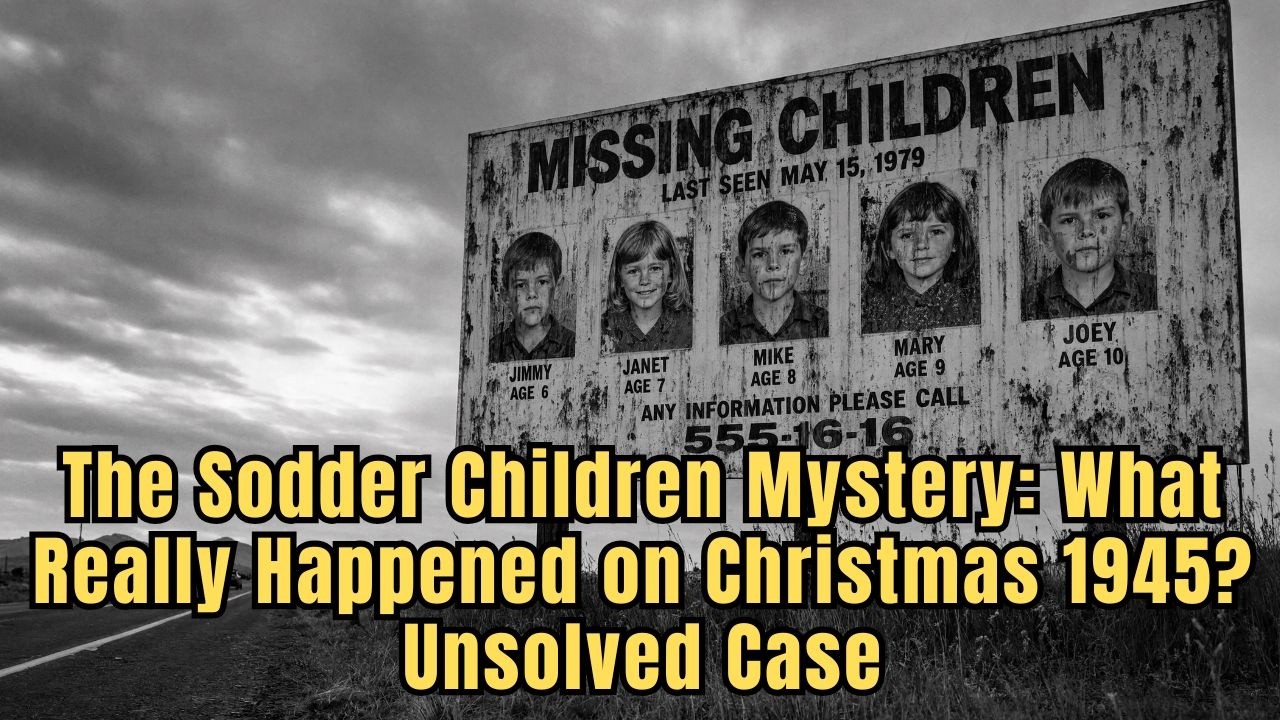
The sightings of children who looked exactly like the missing Sodders. In 1947, George and Jennie erected a billboard along Route 16 outside Fayetteville. It showed photographs of their five missing children and offered a reward that eventually grew to five thousand dollars, an enormous sum for a working-class family. The billboard stood for decades, repainted over the years, a permanent public wound on a mountain highway.
Jennie kept a private file of clippings, letters, and tips. She hired a private investigator. She wrote to reporters, politicians, and eventually the FBI. George Sodder personally wrote to J.
Edgar Hoover pleading for the Bureau’s help. Hoover reportedly responded that the FBI would investigate only if local authorities requested their involvement. The local officials who had ruled the fire accidental never made that request. The FBI’s hands remained tied.
George Sodder died in 1969, after nearly a quarter century of chasing tips and rumors, still believing his children were taken, not killed. Jennie outlived him by two decades, keeping the search alive, maintaining the billboard, and every single night leaving a porch light burning outside the new home the family built on the same property, in case one of her children found their way home. She died in 1989, forty-four years after the fire. The mystery refused to rest.
The surviving siblings gave interviews over the decades, and renewed forensic interest in the case raised more questions than answers. Fire investigation experts noted that the details did not sit comfortably with the official accidental fire ruling. Some suggested arson. Some suggested a cover-up involving local officials.
Some pointed to organized crime connections to George’s trucking business. Some simply said the case as officially recorded did not add up. Nearly eighty years later, the fate of Maurice, Martha, Louis, Jennie, Betty, and Sylvia Sodder remains formally unsolved. No official retraction of the accidental death ruling has ever been issued.
No arrest was made. No confession was given. No remains were ever conclusively identified. The case remains one of the coldest cold cases in American history.
Somewhere, perhaps, children who do not know their true origins grew up under different names, while a mother in West Virginia kept a porch light burning for forty-four years, waiting for them to come home. Or perhaps the fire was not a kidnapping at all, but a murder so carefully executed that nothing was ever meant to be found. The unbearable truth is that no one knows.