The number that decided the carrier war was never painted on any flight deck. It was a fraction, one-third, a requirement written into the organizational tables of the Imperial Japanese Navy, which stipulated that every naval air unit must hold reserve aircraft equal to one-third of its operational strength. The carriers never came close. On December 7, 1941, Soryu sailed with 63 aircraft and nine reserves.
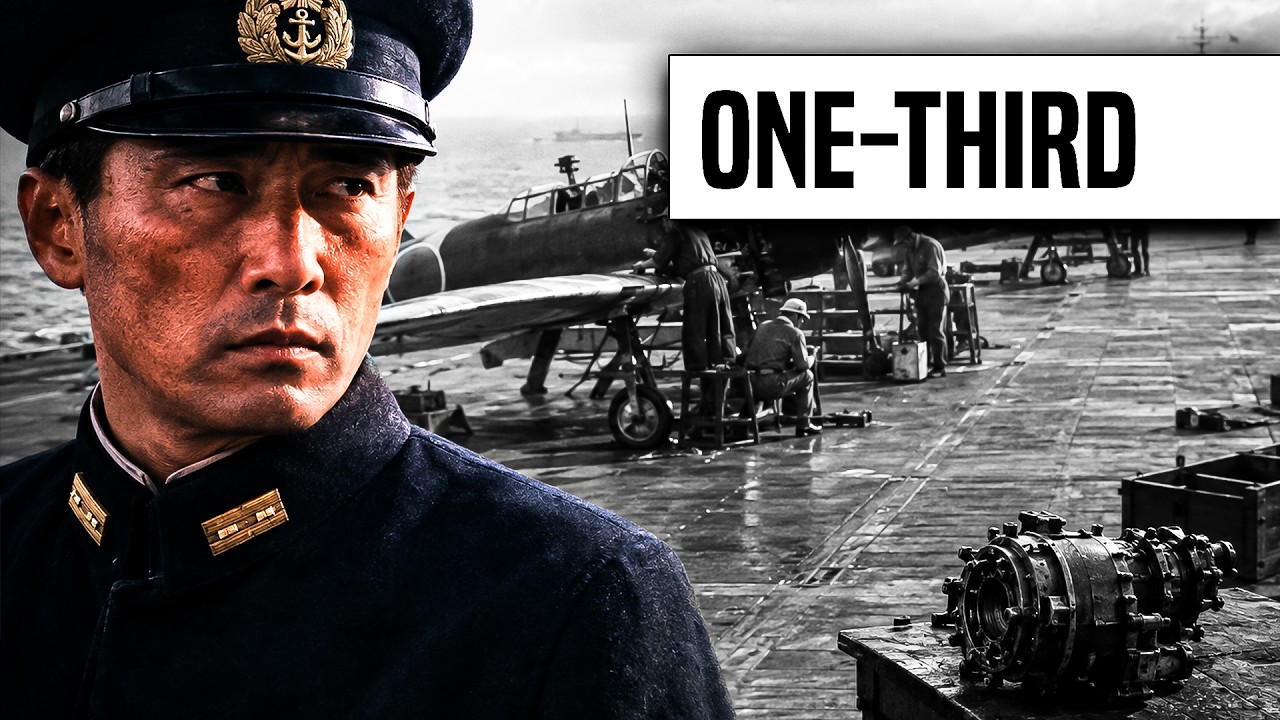
Hiryu, built to a modified version of the same design, carried 64 aircraft and nine reserves. One-third of 63 is 21. Soryu took nine spares, roughly one reserve for every seven aircraft. The two big Shokaku-class carriers did no better, carrying 12 reserves against 72 aircraft.
By the first days of April 1942, four months into the war, the navy’s land-based air units had no reserve aircraft at all, and stood below even their authorized operational strength. When the Eleventh Air Fleet asked for replacement planes, the Navy General Staff refused because the carriers had priority and they too were running short. The spare aircraft is the ultimate spare part, and the United States Navy discovered that fact embarrassingly years before the war. In 1928, supply officer Lieutenant E.
Dorsey Foster was serving aboard Langley, the navy’s first carrier, a converted collier named Jupiter that had spent the decade as an unarmed flight deck test platform. Foster set out to assess how well the ship could support the aircraft she carried. He found a complete stock of spare parts for conventional inline engines. Every aircraft aboard was equipped with a radial engine.
For the engines the ship actually operated, no spares existed at all. Three years later, working at the Naval Aircraft Factory in Philadelphia, Foster produced the first written allowance lists for spare parts for the fighters, dive bombers, and torpedo planes on Lexington, and put them into effect. An allowance list specifies which spare parts and how many accompany each aircraft type, so that a part failing on Tuesday does not necessarily ground the aircraft on Wednesday. Naval aviation had entered World War I with fifty aircraft and thirty-nine pilots.
By 1940, it had been authorized fifteen thousand aircraft, and logistics capability had not kept pace. In February of that year, the management of the Naval Aircraft Factory wrote to Washington recommending a single office to handle supply ordering, inventory, and stock movement for all naval aviation aircraft. The Aviation Supply Office opened on October 1, 1941, on the second floor of a warehouse in the Philadelphia Navy Yard, with 200 civilian employees and 14 officers under Captain Oscar Liddle. By the time of the attack on Pearl Harbor, sixty-seven days later, the navy had authorized 27,500 naval aircraft, and the new office was expected to supply them all.
Japan began the war at full strength in spare parts, at least at the airfields from which the war was launched. In December 1941, the navy’s 22nd Air Flotilla supported the attack on Malaya from three airfields in and around Saigon. Its units were at full strength in aircraft and crews, fuel and spare parts were abundant, and Zero fighters were disassembled and fully inspected after every 150 flight hours. During those first weeks, the one-third rule seemed to fit reality closely.
Then squadrons moved south to captured airfields, and maintenance units fell behind. Ground crews arrived late or in numbers too small to keep up, so pilots ended up maintaining their own aircraft and building their own quarters. The 23rd Air Flotilla wrote off 88 aircraft in the first three months of the war. Half ended up wrecked on bad runways, 30 percent wore out and were sold as scrap.
Enemy fire accounted for 18. When the navy flew its first nine fighters into Legaspi in the Philippines, two crashed on landing. At Tarakan in Borneo, the Tainan Air Group brought in 27 Zeros and lost two at the end of the runway. Then came June 1942 and the Battle of Midway, which cost Japan four carriers and something much harder to replace than airframes.
As Mark Peattie summarizes in the history of Japanese naval air power, the navy’s skilled mechanics either went down with the sinking ships, especially at Midway, or were left behind at forward bases when Japanese forces withdrew. A sinking carrier targets its maintenance men, and the navy had never had enough of them. The Solomon Islands turned all of this into routine. In the first ten months of the war, the navy completed only one new air base in that region, Buin on Bougainville, with a single runway.
On October 8, 1942, 15 Zeros landed there and seven were seriously damaged. Whenever the runway was wet, it wrecked roughly ten aircraft a day. When ground crews reported the field unserviceable, the Combined Fleet chief of staff, Admiral Matome Ugaki, complained in his diary about their weak minds and said they would have to make do. Guadalcanal lay 675 miles from Rabaul, with no auxiliary landing fields in between.
In the first two days of that campaign, 18 dive bombers ran out of fuel and fell into the sea. Rabaul itself was the navy’s main southern air base, and even there aircraft were refueled by hand from 200-liter drums because fuel trucks were scarce. Its maintenance level was so poor that of 60 fighters and 40 bombers available, only 30 could take off on an ordinary day. That Rabaul figure describes a typical day, and the published report gives no specific date, so there is no single morning anyone can point to.
Throughout 1942 and 1943, aircraft readiness in the Southwest Pacific fell by roughly half. The navy had been planning to operate from bases 2,400 miles from Tokyo without transport aircraft or supply ships. A carrier carried spare parts so that one week of failures would not ground an entire squadron. In December 1942, Foster, now a captain, became the navy’s chief of aviation supply.
The office had needed its own headquarters almost from the start. The first site considered, an open lot next to the navy yard, was rejected as unsuitable; Veterans Stadium was later built on that same ground. Instead, the navy took over 135 acres of clay ground in northeast Philadelphia with a brickyard on it, and built a depot there at a cost of ten million dollars, expending nearly six million man-hours of work. When it opened on July 17, 1943, it had 323 officers and 2,209 civilians on its payroll.
Foster described that workforce, mostly from Philadelphia and the surrounding cities, as unconstrained by tradition or rigid doctrine. On the Japanese side, the army and navy did not even share what they had. Army aircraft in New Guinea flew 1,500 miles to Manila for engine changes, even though the navy had heavy maintenance facilities nearby at Rabaul. The army’s main repair base at Halmahera lay 1,000 miles behind the front and never functioned as planned, because of shortages of equipment and technicians.
Humidity corroded metal parts and wiring. Fungus grew in electrical equipment, and lubricating oil evaporated or leaked from the equipment it was meant to protect. Shortage was also turning into a problem of sheer variety. By the end of the war, the Japanese armed forces together produced at least 90 basic aircraft types, 53 for the navy and 37 for the army, plus 64 variants.
The army built its aircraft around a 24-volt electrical system. The navy used a different voltage, and their gun mounts differed as well. The armed forces, fighting the same enemy on the same ocean, could not agree on a standard voltage. With few technicians, they were split into small groups to cover all that equipment.
Identifying, cataloging, and distributing the right part to the right unit at the right time was beyond them. Aircraft radios became hard to maintain and spare parts for them so scarce that many pilots removed them to save weight. Commanders showed little interest in sending men to armed forces schools, and the schools themselves showed little interest in logistics. Technicians at forward bases were not trained well enough to repair the manufacturing defects they found in new aircraft.
In July 1943, a naval pilot at Buin wrote that exhausted ground maintenance crews prayed for tractors like the ones the Americans had in abundance, and that they knew they would never get them. Looking back, Commander Masatake Chihaya compared struggling Japanese airfield operations with the massive American airfields built faster than he had expected, and said he stopped wondering why his unit was defeated. A spare part that exists only on a planning table is simply a wish. As the war moved back toward Japan, the repair system grew shorter, but spare parts never became plentiful enough.
By 1944, a growing lack of spares for older aircraft was grounding fighters and bombers, and minor damage that a well-equipped depot could easily have repaired often meant an aircraft never flew again. The navy’s newest carriers were still being planned the old way. Unryu, commissioned on August 6, 1944, was scheduled to carry 12 Zeros with three more stored, 27 dive bombers with three reserves, and 18 torpedo bombers with two in crates. That made eight spares for 57 aircraft, roughly one in seven.
The same ratio Soryu had carried in December 1941. Unryu was sunk on December 19, 1944. In 1945, American forces reached a village near Clark Field in Luzon. The Japanese air units there had dispersed their aircraft widely around the base, and maintenance efforts had collapsed.
Hundreds of aircraft sat on the ground with minor faults. One might lack a carburetor, while a neighboring aircraft had a good carburetor but no landing gear. Because no one had arranged to move the part from one to the other, both were as useless as if they had been shot down. An American intelligence officer who inspected the field after its capture said what he found was evidence of chaos and disorder.
In that village, the Americans found 200 new aircraft engines, most still in shipping crates. Ground maintenance teams had hidden them in small stacks of three or four under houses, rice mills, huts, and public buildings. Carburetors, fuel pumps, generators, and propellers were scattered through fields and under buildings, some buried at random with other tools. The initial count of aircraft at and around Clark exceeded 500.
Japan had the spare parts, but had no way to find them. By the end of 1945, the Aviation Supply Office and its support unit had 507 officers and 6,076 enlisted personnel, with five billion dollars recorded on its lists. Foster became a vice admiral in 1949, was appointed chief of the navy’s material division that same year, and retired in 1951. Shortly after Japan’s surrender, the United States Strategic Bombing Survey reached its conclusions about Japanese air power.
On this point it settled for a single sentence: by American standards, the Japanese never recognized the importance of adequate maintenance, and therefore could not concentrate a large part of their air strength at one time or in one place.