In the winter of 1968, one of the most famous women on earth checked into a hospital in Geneva after spending most of the previous nine months confined almost entirely to a single hotel room. Sophia Loren, at 34, was about to give birth to her first child, and the road to that moment had run through a decade of legal warfare, public condemnation, and personal loss that would have broken a lesser career. Loren had been born Sophia Costanza Brigida Villani Scicolone in Rome on September 20, 1934, and raised in genuine poverty in Pozzuoli near Naples during and after the Second World War. Her father, Riccardo Scicolone, never married her mother, Romilda Villani, and was largely absent from her childhood.
The war years in Pozzuoli were dangerous; the town had a munitions plant and was bombed repeatedly. The family sheltered in a railway tunnel during raids, and Loren later described near starvation, a shrapnel injury to her chin, and a hunger that leaves permanent marks on how a person relates to food for the rest of their life. She was so thin as a child that neighbors reportedly called her a stick. By her teens, she had transformed physically and was competing in local beauty contests, which in postwar Italy functioned as one of the few available routes out of poverty for a girl with no money and no connections.
In 1950 she placed in a Miss Italia competition, and in 1951 she took uncredited roles as an extra in the Hollywood production Quo Vadis, shot at Cinecittà in Rome. It was in this period that she caught the attention of film producer Carlo Ponti, who was 22 years her senior and already one of the most powerful figures in Italian cinema. Ponti put her under contract, guided her career, gave her the professional name Sophia Loren, and eventually fell in love with her. There was one significant obstacle.
Ponti was already married to a woman named Giuliana Fiastri, and Italy in the 1950s did not permit divorce under any circumstances. The solution they attempted was legally creative and, as it turned out, catastrophic. In September 1957, Ponti obtained a Mexican divorce from Fiastri and married Loren in Mexico by proxy, meaning neither of them was physically present at the ceremony. Two lawyers stood in for them several thousand miles away.
As far as Mexico was concerned, they were married. As far as Italy was concerned, they were not, and Ponti was now a bigamist under Italian law. Loren was 23, on the verge of becoming a genuine global star, and had just entered a marriage that her own country considered a criminal act. Ponti faced bigamy charges.
Loren, in the eyes of Italian law and of a Catholic Church that held enormous cultural authority at the time, was a concubine, and that word was used about her in print. The couple were denounced from pulpits, Catholic organizations campaigned against her films, and she received hostile mail condemning her in religious terms. They could not safely live in Italy together as husband and wife. By 1962, they had the Mexican marriage annulled simply to end the legal exposure, leaving them, after five years of fighting for it, unmarried again and back where they had started.
That same year, Loren won the Academy Award for Best Actress for Two Women, becoming the first performer ever to win for a role in a non-English language film. She was simultaneously the most acclaimed actress in the world and a woman whose own country did not recognize her marriage. The solution took another four years and required them to stop being Italian. In 1965, with Giuliana Fiastri’s cooperation, Ponti obtained a legitimate French divorce.
All three of them took French citizenship to make it legally possible. On April 9, 1966, Loren and Ponti were married in France, legally and permanently, nine years after their first attempt. She was 31. She had wanted a child for most of a decade, and the two years that followed would test her more severely than the courts ever had.
She lost a pregnancy in 1963 and another in 1967. Both losses were devastating. She later wrote about watching new mothers at a hospital and finding that her entire life as a film star registered as essentially worthless by comparison. The second loss was especially hard.
She was 32, newly and legally married at last after nine years of fighting for it, and the thing she had waited for had slipped away a second time. She wrote that she did not know whether it would ever be possible, and that the fear of a third failure was almost worse than the losses themselves. When she became pregnant for a third time in 1968, a Swiss gynecologist named Hubert de Watteville proposed an approach extreme even by the standards of the era. Loren would remain effectively immobile for the duration.
She took a suite at a hotel in Geneva and stayed there resting for most of the nine months. She did not work. She barely moved. The most famous woman in Italian cinema spent the better part of a year in a single room waiting.
Ponti traveled back and forth. Visitors came to her. She described the period as simultaneously the longest and most hopeful of her life. It worked.
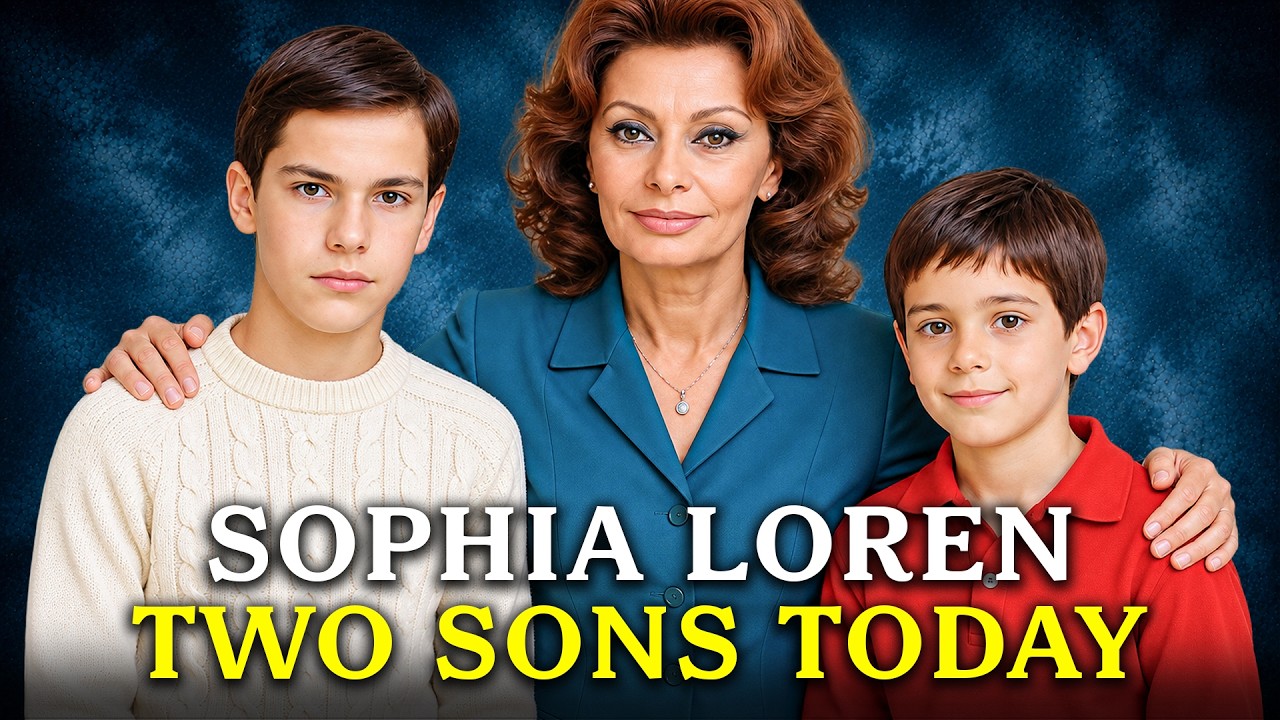
On December 29, 1968, Carlo Ponti Jr. was born by cesarean section in Geneva. Loren later wrote that she had not slept at all the night before, and that her real fear was not the surgery but the ending of the pregnancy itself, a state she had wanted so badly and waited so long for that she was reluctant to see it conclude. Four and a half years later, on January 6, 1973, a second son arrived, also in Geneva, after a second carefully managed pregnancy.
They named him Edoardo. Loren had achieved, at 38, the thing she had spent her entire adult life wanting. She responded by doing something almost nobody at her level of fame does. She walked away.
Loren substantially stepped back from filmmaking to raise her sons. Through the 1970s and into the 1980s, her output dropped sharply, and the projects she did take were increasingly selected around whether they could accommodate a family rather than around career strategy. In the years immediately before the boys arrived, she had made Marriage Italian Style, Yesterday, Today and Tomorrow, Arabesque, and A Countess from Hong Kong opposite Marlon Brando under Charlie Chaplin’s direction. She was at the absolute peak of her commercial value in the period of an actress’s career when the offers are best and the window is shortest.
She walked away from that momentum deliberately. The family lived in Geneva for practical and legal reasons as much as personal ones. The boys were raised Swiss in their daily lives while remaining entirely Italian in their household. They spoke Italian at home and ate Italian food, much of it cooked by their mother, who has written two cookbooks.
Both sons have described the household in remarkably similar terms across the decades since: relatively normal in its rhythms, with a mother who cooked, who was present, and who did not conduct herself at home as a film icon. Carlo Jr. has said he cannot identify any single moment when he understood what his mother actually was to the world, that the realization arrived gradually, assembled over years out of small clues, including the fact that the people who occasionally came to dinner were people like Sylvester Stallone. There is an aspect of the boys’ childhood that rarely appears in affectionate retellings, having to do with the era into which they were born.
The 1970s in Italy are remembered as the Years of Lead, a period of political violence and, critically for wealthy families, kidnapping. Ransom abductions of the children of rich industrialists and celebrities became common, the most notorious case being the 1973 abduction of John Paul Getty III in Rome, during which the 16-year-old’s ear was severed and mailed to a newspaper to force payment, the same year Edoardo was born. For a family with the Ponti fortune and the Loren name, this was not an abstract concern. It is one of several reasons the family’s center of gravity remained in Geneva, and it shaped the degree of privacy the parents insisted on around their children.
That protectiveness had a cost, a somewhat enclosed childhood, and a benefit, neither boy grew up as a public figure, which meant that when each eventually chose a career, they chose it without an existing audience expecting anything specific from them. Ponti senior was also a significantly older father, 56 when Carlo Jr. was born and 60 when Edoardo arrived. Whatever pressure came with that, it does not appear to have come in the form of anyone pushing them toward the family business.
Both sons have described the household as one where the arts were simply present rather than imposed. What did intrude on that childhood, when Carlo Jr. was 13 and Edoardo was nine, was the Italian state for the second time in the family’s history. In 1974, Italian tax authorities came after Loren over her 1963 and 1970 tax returns, alleging she had underdeclared her income.
The case ground on for years through the notoriously slow Italian court system. She maintained throughout that the filings had been handled by her accountants and that any error was theirs, and she appealed repeatedly. The courts were unmoved. In May 1982, Loren returned to Italy and reported to a prison in Caserta near Naples to serve a sentence.
She was 47 years old. One of the most celebrated actresses in the world was processed into an Italian prison over a tax dispute, in a region not far from the town where she had grown up hungry during the war. She served 17 days before being released. She has spoken about it since without much bitterness, describing it as something she chose to face directly rather than continue avoiding.
The sequence is difficult to ignore: Italy denounced her marriage in the 1950s, refused to recognize it into the 1960s, drove the family to French citizenship, and then jailed her in the 1980s. Carlo Ponti Jr. , the elder son, became a conductor. There was no obvious family precedent for it.
He trained seriously and at length, studying at the conductors institute in Connecticut under Harold Farberman, continuing in Los Angeles, and then relocating to Austria to study at the Vienna Music Academy, working through the kind of lengthy technical apprenticeship that conducting requires and that offers no shortcuts regardless of anyone’s surname. Conducting is almost uniquely resistant to nepotism. An orchestra of 80 professional musicians will not follow a conductor they do not respect, and they form that judgment within minutes of a first rehearsal. From 2000 to 2018 he served as associate conductor of the Russian National Orchestra, served as music director of the San Bernardino Symphony for just over a decade, and in 2013 he founded the Los Angeles Virtuosi Orchestra, an ensemble built around a specific mission of supporting music education, particularly for young people who would not otherwise encounter classical music at all.
On September 18, 2004, he married Hungarian violinist Andrea Mészáros at St. Stephen’s Basilica in Budapest. The couple had two children, a son named Vittorio Leone, born in 2007, and a daughter named Beatrice Lara, born in 2012. The marriage ended in divorce in 2022 after 18 years.
In July 2025 he remarried. Edoardo Ponti took the opposite route. He was educated at Aiglon College in Switzerland, graduating in 1990, and then crossed the Atlantic for the University of Southern California, where he graduated magna cum laude in 1994 with a degree in English literature and creative writing. He stayed at USC for a Master of Fine Arts in film directing and production, completing it in 1998.
He built his professional base in Los Angeles. His first feature, Between Strangers, released in 2002, starred his mother. He has worked steadily since, and a pattern emerged early and has held: Edoardo has repeatedly directed his own mother, and the collaborations have generally been small, serious, and emotionally exposed. In 2014, he directed her in a short film adaptation of Jean Cocteau’s one-woman play The Human Voice, a punishing piece in which a woman conducts a final telephone conversation with a lover who is leaving her.
In 2007, he married actress Sasha Alexander. The couple have two children, a daughter named Lucia Sofia, born in 2006, and a son named Leonardo Fortunato, born in 2010. Edoardo’s most significant professional achievement arrived in 2020, and it involved coaxing his mother out of an 11-year absence from film at the age of 85. The Life Ahead was an adaptation of Romain Gary’s novel The Life Before Us, about a Holocaust survivor, a former prostitute living in a run-down Italian port city who takes in the children of sex workers and eventually forms a bond with a 12-year-old Senegalese orphan who has been stealing from her.
It was not a gentle valedictory role. The character is ill, declining, sometimes confused, frequently unglamorous. Loren agreed. The film shot in Bari in southern Italy, was released by Netflix in November 2020 in the middle of a pandemic that had closed cinemas worldwide, and it found an enormous streaming audience.
It brought Loren a Golden Globe nomination and a David di Donatello award for Best Actress. She was 86 by the time the awards arrived. Loren said of her son that he knows her extraordinarily well, that he knows every inch of her face, and described that knowledge as extending to her heart and her soul. Carlo Ponti Sr.
died on January 10, 2007 in Geneva of pulmonary complications. He was 94. His career had been extraordinary by any measure. He produced Federico Fellini’s La Strada, which won the first Academy Award for Best Foreign Language Film, David Lean’s Doctor Zhivago, Michelangelo Antonioni’s Blowup.
He was made a Knight Grand Cross of the Order of Merit of the Italian Republic, the highest civilian honor available from the country that had once prosecuted him for marrying the woman he spent 41 years with. Sophia Loren turned 91 in September 2025 and lives primarily in Geneva. In 2023 she suffered a fall, fracturing her femur and pelvis, and underwent surgery. She came through it.
Italy, which once prosecuted her twice, has spent the last several decades honoring her more or less continuously, and a museum dedicated to her opened in Pozzuoli, the town where she grew up hungry. What is genuinely unusual about the Loren-Ponti family is what did not happen. There is no acting dynasty here. Two sons were born to a woman who at the time of their births was among the most recognizable human beings on the planet and to a father who controlled one of the most powerful production operations in European cinema, and neither became an actor.
One went into classical conducting, a field where the family name is worth nothing. The other went into directing, but arrived there through a literature degree and a graduate film program rather than through his father’s office. There is also no scandal, no estate litigation, no competing memoirs, no public estrangement. The four grandchildren have grown up similarly out of view.
Loren’s own explanation for how the family turned out this way has been consistent for decades and is fairly simple: she stepped back at the height of her career and stayed back long enough to actually raise them. The Academy Award, the international stardom, the status as one of the defining faces of an entire era of cinema, all of it was set down for a stretch of years in Geneva in favor of something she had wanted since her twenties and had twice been unable to have. Nearly six decades after that woman spent nine months in a Swiss hotel room refusing to move, her two sons are in their fifties, working in music and film, raising four children between them, and carrying a surname that has never once required them to trade on it.