George S. Patton Jr. held command of the United States Third Army as it drove across France and into Germany after the Allied invasion of Normandy in June 1944. His reputation rested on a combination of qualities that set him apart from nearly every other senior commander of the war: a theatrical public image, an abrasive personal style, and an unshakable conviction that victory belonged to the side that attacked first and hardest.
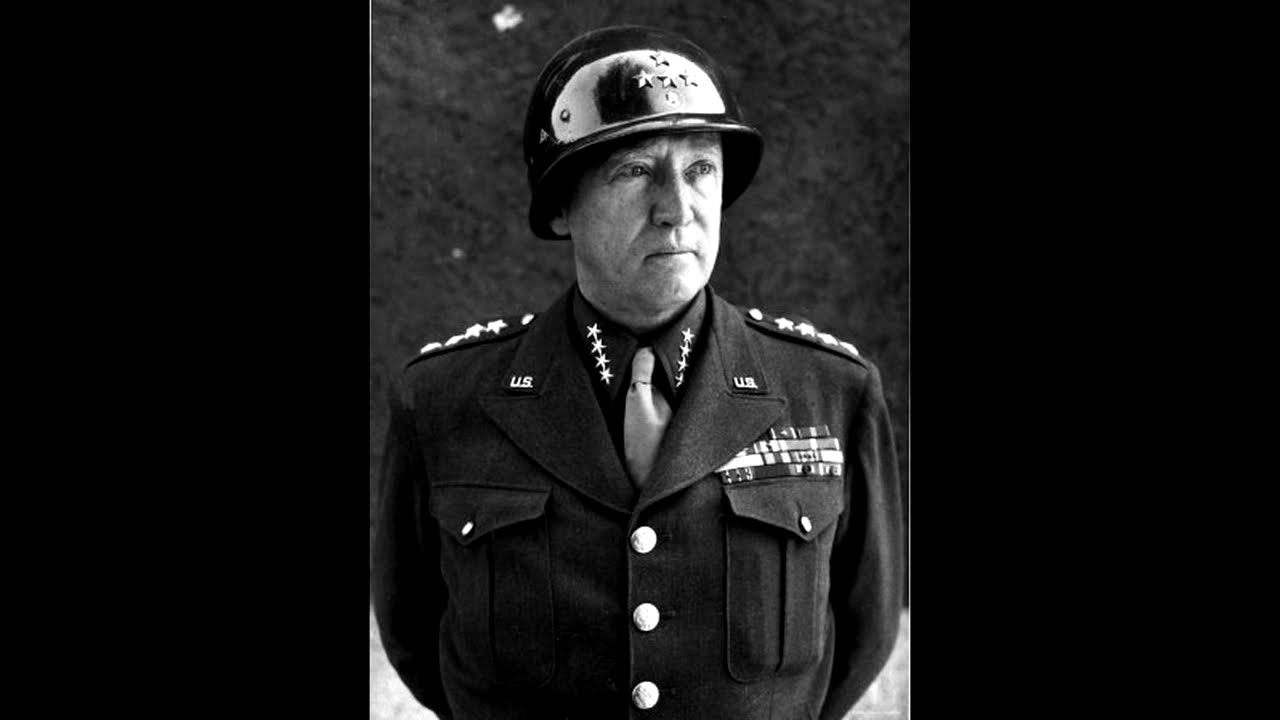
His speeches, delivered in a voice that carried both threat and inspiration, drew intense loyalty from the troops under his command. His insistence on leading from the front, often in harm’s way, reinforced the image of a general who demanded nothing from his soldiers that he did not demand from himself. That philosophy of rapid, aggressive offensive action proved decisive in the European theater. While Allied commanders disagreed among themselves about Patton’s judgment and conduct, the German high command held him in a different regard.
They considered him their most dangerous opponent on the Western Front, a commander whose unpredictable thrusts could unravel defensive lines that slower, more methodical generals might have allowed to hold. To the Germans, Patton was the embodiment of mobile warfare, and they tracked his movements with the same urgency that Allied intelligence tracked theirs. The Third Army’s performance after Normandy gave the Germans ample reason for that fear. Once the breakout from the beachhead was achieved, Patton’s forces moved with a speed that outran supply lines and outflanked German positions faster than the enemy could react.
His columns drove through the Brittany peninsula, then wheeled eastward across France in a pursuit that covered distances the German command considered impossible. Towns and cities fell in rapid succession as the Third Army exploited every gap in the crumbling German front. His tanks advanced not in careful, measured bounds but in long, daring strokes designed to keep the enemy off balance and deprive him of time to establish new defensive positions. The German counteroffensive in the Ardennes, launched in December 1944, created the crisis that defined Patton’s most famous moment of the war.
The attack, which became known as the Battle of the Bulge, struck the Allied line at its weakest point and drove a deep salient into American-held territory. The situation was grave. The Allied command was caught off guard, and the path to vital supply ports appeared open to the German advance. While other commanders scrambled to contain the breakthrough, Patton was already moving.
He anticipated the need for a relief force before the order arrived and repositioned his divisions to strike the southern flank of the German salient. When the command came to turn the Third Army northward and attack, Patton was ready. The speed of his response surprised even his own headquarters. His forces disengaged from their eastward advance, shifted direction, and launched a counterattack that struck the Germans in the flank and helped halt their offensive.
The relief of Bastogne, where American paratroopers were surrounded and under heavy attack, became the symbolic high point of that operation. Patton’s armored columns broke through to the besieged town, reopening the supply route and forcing the German command to reckon with a new threat on their southern flank. The counteroffensive stalled, then reversed, and the German army in the Ardennes was driven back to its starting line with heavy losses. Patton’s methods were not without controversy.
His public statements repeatedly created problems for Allied leadership. He made remarks that offended allies and drew criticism from the press. He was relieved of command at least once during the war for striking a soldier he accused of cowardice, an incident that nearly ended his career. He chafed under commanders he considered too cautious and did little to hide his disdain for what he saw as excessive deliberation.
His personal conduct, including instances of insubordination and undiplomatic speech, forced repeated interventions by senior officers to keep him in command. Yet each controversy was followed by a demonstration of his effectiveness on the battlefield, and the Allied leadership, however uncomfortable with his behavior, could not argue with his results. The final campaign of the war saw the Third Army push deep into Germany, crossing the Rhine and advancing into territory that had not seen Allied soldiers since the early years of the conflict. Patton’s forces drove through the German heartland, capturing cities and industrial regions that had sustained the German war effort.
The advance continued until the German surrender in May 1945 brought the war in Europe to an end. Patton’s war ended with the surrender, but his life did not. In the months that followed, he was assigned to command of the Fifteenth Army, a formation tasked with occupation duties rather than combat. It was a position far below the prestige of the Third Army command he had held during the war, and he made no secret of his dissatisfaction.
He spoke openly about his belief that the Soviet Union would eventually become an adversary of the United States, comments that further strained his relationship with Allied leadership and added to the perception that he was a man out of step with the postwar order. His death came not on a battlefield but on a peacetime road. In December 1945, he was involved in an automobile accident that left him paralyzed from the neck down. He died on December 21, 1945, thirteen days after the crash.
His burial reflected the bond he had formed with the soldiers he commanded. He was laid to rest at the Luxembourg American Cemetery and Memorial, among the wartime casualties of the Third Army. He had requested to be buried with his men, and the request was honored.
The grave site, surrounded by the graves of the soldiers who had served under him, became the final statement of a commander whose life had been defined by his relationship with the troops he led, his aggressive pursuit of victory, and the lasting impression he left on both his allies and his enemies.