Shortly after one in the morning on June 28, 1865, the whaling bark Brunswick, out of New Bedford, Massachusetts, flew the American flag upside down in distress in the Bering Strait. The damage to her hull lay below the waterline, and by mid-morning nine other whaling vessels had gathered to offer help. The assembled captains agreed to condemn the ship and auction off her cargo and gear. Then another vessel appeared from the south, a three-masted auxiliary steamer flying the Stars and Stripes.
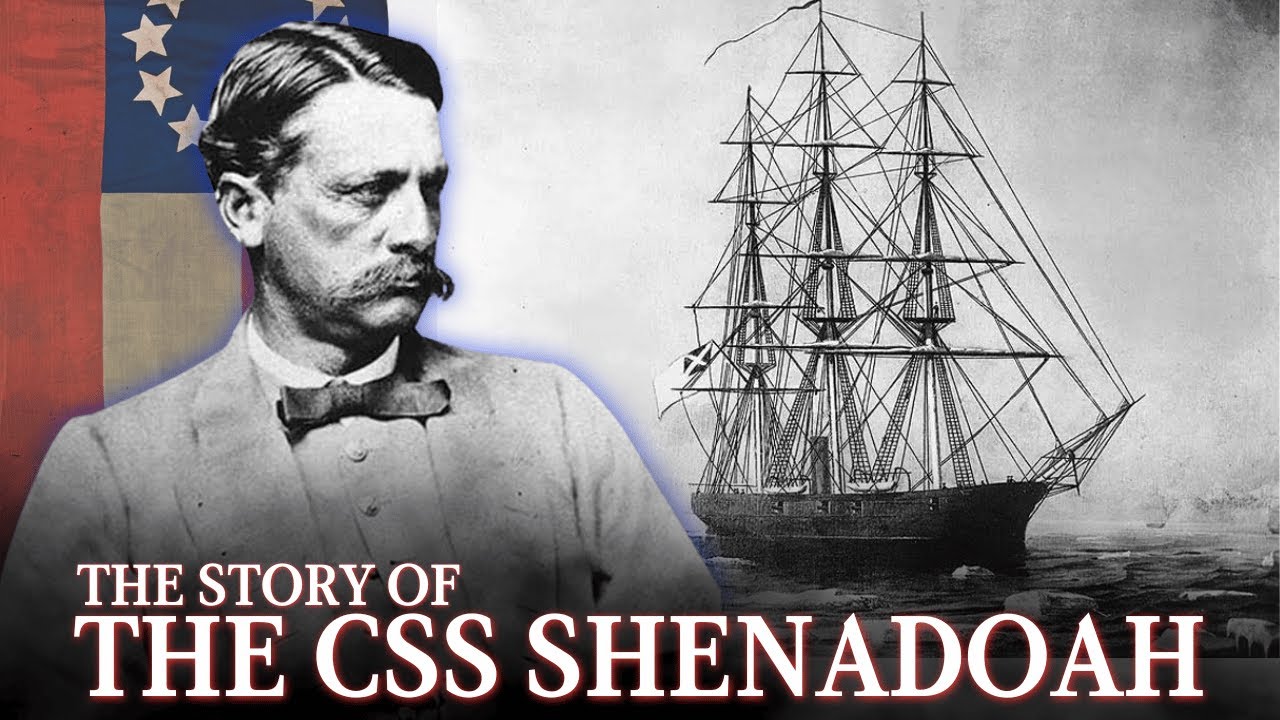
When Captain Jeremiah Ludlow of the Isaac Howland rowed over to request aid, it was granted, though only after hesitation. Five small boats were lowered, and uniformed naval officers sat among the men in them. Then a cannon blast rang out. The American flag came down, the Confederate battle ensign went up, and a voice announced that all ten vessels and their cargo were now the property of the commerce raider CSS Shenandoah.
With no wind and nowhere to run, more than three hundred whalers became prisoners of war. Two ships, the James Maury and the Nile, were spared and bonded to carry the prisoners away. The rest were stripped, set on fire, and left to drift among the ice floes. It was the most successful day of the Shenandoah’s career.
But the triumph was written in ignorance. The date was June 28, 1865, eleven and a half weeks after Robert E. Lee’s surrender at Appomattox, nine weeks after Joseph E. Johnston’s surrender, and weeks after President Andrew Johnson had declared armed resistance effectively at an end.
The ship’s crew had no idea the war was over. In destroying the whaling fleet that day, they had fired the last shots of the Confederate nation without knowing it. The Shenandoah was not the first Confederate raider, but she was among the last. Before her came the Sumter, the Florida, the Georgia, and most famously the Alabama, which under Raphael Semmes captured sixty-five prizes in twenty-three months.
These raiders shared a common origin. Most were built in England through the work of James Dunwoody Bullock, a former United States naval officer from Georgia, sent to Liverpool in June 1861 by Confederate Navy Secretary Stephen Mallory to secretly build a navy for a government with no credit and no open ports. By 1864, the Confederacy was desperate. Union forces were pressing on every front, and Mallory issued orders to target the North’s whaling fleet, concentrated in New England, the seed of abolitionism.
The goal was economic ruin: higher insurance rates, collapsing industries, and a weakened Abraham Lincoln heading into reelection. Bullock found his ship in Glasgow, a vessel called the Sea King, launched in August 1863 and already proven in merchant service. To turn her into a raider without violating British law, Bullock arranged a rendezvous off Madeira with a tender ship carrying crew and armament. On October 19, 1864, the converted cruiser put to sea under a new name: CSS Shenandoah.
Her commander was Lieutenant James Iredell Waddell, a North Carolina native and Naval Academy graduate who had been struck from the United States Navy rolls for jumping ship in 1861. At thirty-nine, broad-shouldered and aloof, he had never commanded a ship in combat. His executive officer was twenty-four-year-old Lieutenant William Conway Whittle, a recent Annapolis graduate, and together they led a handful of young lieutenants nearly two decades younger than their captain, a gap that would strain discipline later. The ship set out severely undermanned, with officers hauling at the anchor and too few men to work the coal-fired engines.
Still, prizes came quickly. In November and December, the Shenandoah captured and destroyed a succession of American vessels, burning the Charter Oak, the D. Godfrey, the Susan, the Lizzie M. Stacy, and others.
Prisoners were paroled or taken aboard. A few crewmen from each captured ship signed on. Wadell disdained the formalities of waiting for the ship’s British registry to be cancelled, gambling instead on speed. After rounding the Cape of Good Hope, the Shenandoah reached Melbourne, Australia, on January 25, 1865, ninety days out of Madeira.
The visit became a diplomatic crisis. Crowds flocked to see the Confederate cruiser; locals and even some crew from visiting American ships plotted against her. One torpedo was placed against her hull but failed to explode. American Consul Blanchard worked to encourage desertion, while the Confederate officers were fêted by Melbourne society.
When Waddell refused to allow a search of his vessel, police surrounded the ship. He threatened to abandon ship and surrender his crew as prisoners, and Governor Darling backed down. After twenty-three days, the Shenandoah steamed out, carrying forty-two stowaways who had joined the crew along with volunteers recruited in port. The ship’s true mission now resumed: the destruction of the Arctic whaling fleet.
Crossing the Pacific, the Shenandoah stopped at Ascension Island in the Carolines, capturing four vessels and taking more than one hundred thirty men, most of them Hawaiian, who were freed ashore. From the captured ships came charts of the whaling grounds, along with fresh provisions that would feed the crew for eleven months. There was also news, and none of it good for the Confederacy: Sherman had taken Atlanta and Savannah, Hood’s army was shattered, and Wilmington was doomed. Still, the crew believed they were at war.
In May, the Shenandoah entered the Arctic. There, in the Bering Strait, the destruction began in earnest. On June 22, the summer solstice, the ship took five whalers. The next day another, and the day after that more.
Through the end of June, vessel after vessel was captured, stripped, and burned. On June 28 came the great haul that opened this story: eleven ships in a single day, nine of them sent up in flames. In the space of a week, the Shenandoah had destroyed more than twenty whalers and driven the New England whaling industry to the edge of ruin. But on August 2, off Mexico’s southern coast, the Shenandoah stopped the English bark Barracuda and found San Francisco newspapers aboard.
The war was over. It had been over for months. In Liverpool, James Bullock had written Waddell weeks earlier, telling him of Confederate defeat and ordering him to stop and surrender. The letter had gone wherever the raider might make port, but it never reached the ship.
Now, with newspapers as proof, Waddell ordered the guns disarmed, the gunports filled, and the smokestack whitewashed. The hunter became hunted. With every Union warship searching for him, Waddell had to find a port where surrender would be accepted. His officers voted, and they chose Liverpool.
The Shenandoah sailed south around Cape Horn and across the Atlantic, more than nine thousand miles. On November 6, 1865, the only Confederate ship to circumnavigate the globe anchored in the River Mersey. Just before surrendering, the quartermaster hauled down the Confederate ensign, the last one to fly during the American Civil War, folded it, and presented it to Whittle, who passed it to Waddell. Then Waddell officially surrendered the ship to the captain of the HMS Donegal.
When told they could go ashore but could not take their belongings, none of the crew moved. Each man, when asked his nationality, answered that he was a southerner, regardless of his actual origin, and they were all allowed to walk free. In thirteen months and fifty-eight thousand miles, the Shenandoah had destroyed thirty-two vessels, ransomed six more, and taken more than a thousand prisoners. The value of the ships and cargo destroyed reached $1.
4 million. In Waddell’s own words, the last gun in defense of the South was fired from her deck. The aftermath stretched far beyond the war. The United States lost more than half the tonnage of its merchant marine, roughly eight hundred thousand tons, to foreign flags and another hundred and ten thousand tons to Confederate raiders.
The loss of the Arctic whaling fleet was never fully rebuilt, and in time this destruction proved an unintended blessing: the near-elimination of the whaling industry in those waters helped save humpback, bowhead, and Pacific gray whales from extinction. The Shenandoah herself was auctioned off in Liverpool. She was sold to an agent for the Sultan of Zanzibar, who intended to make her a private yacht, but she proved too expensive to maintain. Instead, renamed El Majidi, she served as a merchant freighter until 1879, when she struck an uncharted reef and disappeared beneath the Indian Ocean, claimed by the same waters she had crossed as a raider years before.
Waddell, pardoned in 1875, returned to the United States and served as a captain in the Pacific Mail Steamship Company. He died in 1886 at the age of sixty-one and was buried in St. Anne’s Cemetery, just outside the United States Naval Academy.
The war he fought so long without knowing it had ended shaped the fate of an entire industry, the final shots of the Confederacy, and, in ways no one could have predicted, the survival of the great whales.