Lyndon Johnson had told his wife what was coming. “You will soon be the prettiest and richest widow in the state of Texas,” he said. He did not mention the others. On January 22, 1973, at the LBJ Ranch in Johnson City, Texas, he died of cardiac arrest.
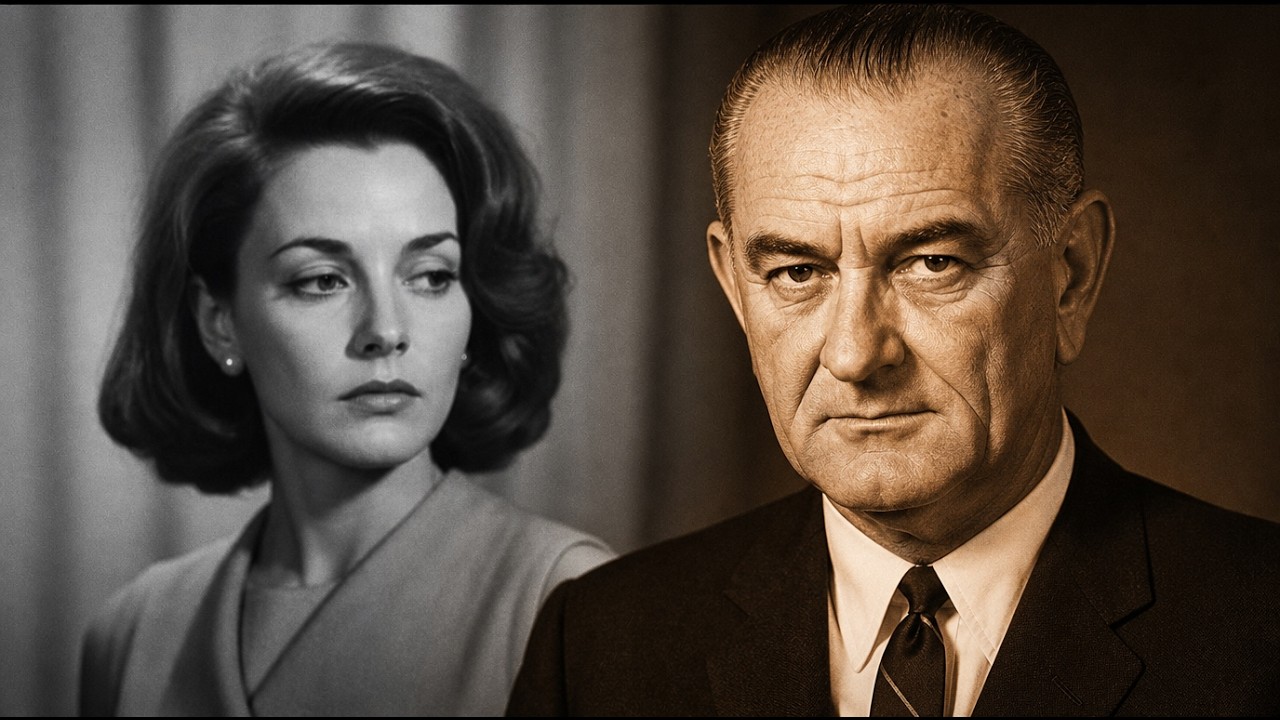
Lady Bird was away at a meeting when it happened and raced to the hospital, but he was already gone. An aide present when she arrived later described her as calm, serene, and very much in control of herself. What she was feeling was deep, but it was not visible. Before his death, three parties had made their own calculations about what would happen to the women in Johnson’s private life once he was gone.
His family calculated that the official record was clean: a long marriage, a devoted wife, a president who built the Great Society and was broken by Vietnam. The private arrangements that had run alongside the public biography could stay where they had always been — managed, dispersed, officially denied. A woman in Dallas calculated that she had waited long enough. She had been waiting since 1948.
She had a son she had been raising for twenty-two years, and she had a story she intended to tell. And the historians who would reconstruct the period calculated that the primary documentary record would eventually surface what the official account had omitted. The first volume of Robert Caro’s multi-volume biography of Johnson, The Path to Power, was published in 1982. It named the first woman.
That same year, the second woman named herself at the Dallas Press Club. The third woman outlived them both, built a wildflower center in Austin, and filled an archive with 1. 75 million words of diary that the world has read approximately one-seventh of. Johnson said she would be the richest widow.
He did not say she would be the last one standing. She made sure of that herself. The first woman was Alice Glass, born in 1911 in Llano, Texas, a small farming town. Nearly six feet tall with strawberry blonde hair, she struck biographers with an intensity that made rooms rearrange themselves around her.
In 1937, at age twenty-six, she met Lyndon Johnson. Her circumstances were complicated. She was living at Longlea, a vast Virginia estate owned by Charles Marsh, a newspaper magnate and one of the most powerful political patrons in Washington. She was Marsh’s mistress.
Johnson came to Longlea, and the relationship that followed ran from approximately 1938 into the early years of his presidency. According to Caro’s documented research, Alice Glass believed in the late 1930s that Johnson was a rare politician, a man who genuinely cared about poor people and felt the weight of the powerless. She had read widely and thought carefully about politics, applying rigorous criteria. Johnson, she concluded, met them.
She was wrong, and she came to understand that she was wrong. Caro reported that Johnson at one point considered leaving Lady Bird for her, but the consideration did not persist. Alice Glass remained at Longlea, moved through her own complicated arrangements with Marsh, and watched Johnson’s career proceed. Then came Vietnam.
The escalation she watched from the mid-1960s convinced her that the man she had believed in had made what she called one of history’s errors. She could not be associated with him. More precisely, she would not be. She burned every letter he ever wrote her — not to protect his reputation, not to protect the marriage or the family or the political legacy, but to erase her own name from proximity to a decision she considered catastrophic and a man she had misjudged.
She never spoke publicly about the relationship. She died of cancer on December 9, 1976, in Marlin, Texas, at sixty-five. The record she left was the record she chose, which is to say almost nothing. What survives exists in Caro’s research, sourced through people who had been at Longlea.
She burned the primary evidence because she was ashamed of the association. That is a different thing from protecting someone. Madeleine Duncan Brown was born July 5, 1925, in Dallas. She worked as a media buyer at Glenn Advertising, a professional woman in the postwar Dallas business community.
She met Lyndon Johnson in 1948 at the Adolphus Hotel during his Senate election celebration. According to her own account, set out in her memoir Texas in the Morning, published in 1997, and in numerous interviews including a 1987 People magazine profile, what followed was a twenty-one-year relationship. Johnson, she said, arranged a house for her in Oak Cliff, a new car every two years, and charge cards. The logistics were handled through a Dallas attorney named Jerome Ragsdale so that nothing connected directly to Johnson.
The Johnson family denied all of it, at every stage, in every forum, for as long as the question was put to them. On December 27, 1950, Madeleine Brown gave birth to a son she named Steven Mark Brown. She said he was Johnson’s child. The paternity was never legally established.
Steven grew up in Dallas under his mother’s name. Johnson, per Brown’s account, acknowledged him privately but never publicly. The family denied the acknowledgement along with everything else. In November of 1982, the same year Caro’s first volume named Alice Glass, Madeleine Brown stood at the Dallas Press Club and announced publicly what she had carried for thirty-four years.
The Johnson family’s response was immediate and categorical denial. In June of 1987, Steven Mark Brown filed a $10. 5 million lawsuit against Lady Bird Johnson, claiming his legal birthright as Johnson’s son. The case entered the Dallas court system.
On September 28, 1990, Steven died of lymphatic cancer. He was thirty-nine. He died before the case was resolved, before any member of the Johnson family acknowledged him, before any legal determination was made about who his father was. Madeleine Brown lived with that for twelve more years.
In October of 1992, a Dallas jury convicted her of forging her aunt and uncle’s will signatures. She received ten years of probation. The judge said at sentencing that he did not want her to profit from the fraud. Her memoir covered the twenty-one-year relationship, the son, and the arrangement in Oak Cliff.
It also contained passages disputed by historians and never independently verified, including her claim to have attended a party at the home of Texas oil magnate Clint Murchison the night before the Kennedy assassination, at which she said she witnessed Johnson make statements implying foreknowledge. The Johnson family denied the account, and no independent witness confirmed it. Madeleine Brown died June 22, 2002, in Dallas, at seventy-six. She had outlived Johnson by twenty-nine years and Steven by twelve.
The legal case was never resolved. The paternity was never established. The inheritance never came. She had said what she believed to be true in every forum available to her for twenty years, and she died with nothing legally confirmed.
Lady Bird Johnson was born Claudia Alta Taylor on December 22, 1912, in Karnack, Texas. A nursemaid nicknamed her Lady Bird as a child, saying she was as pretty as a lady bird, and the name stayed. She earned two degrees from the University of Texas, one in history and one in journalism, and met Lyndon Johnson in 1934. He proposed on their first date.
She said no several times before she said yes. In 1937, she funded his first congressional campaign with $10,000 of inherited money. Without her capital, that campaign does not launch. The political career that produced the Senate majority leader, the vice president, and the thirty-sixth president of the United States begins with Claudia Taylor’s inheritance.
She knew about Alice Glass. She knew about the others. Her only public statement on the subject across sixty years of marriage and widowhood was this: “My husband loved people. He loved all people.
Now, half the people in the world are women. You don’t think I could have kept my husband away from half the people in the world, do you? ” That was the entirety of her public accounting. One sentence.
Stated once. Never elaborated upon. She had begun building before he died. She launched the Highway Beautification Act in 1965, driving legislation through a Congress full of men who considered wildflowers a frivolous concern, and worked on environmental causes throughout the White House years.
She published A White House Diary in 1970, eight hundred pages drawn from the 1. 75 million words she had dictated into a recorder across those years. The full diary sits in the LBJ Library; the world has read approximately one-seventh of it. In 1971 she was appointed to the University of Texas System Board of Regents.
She received the Presidential Medal of Freedom in 1977 and the Congressional Gold Medal in 1984. In 1982, she founded the National Wildflower Research Center outside Austin, later renamed the Lady Bird Johnson Wildflower Center. It became the primary institution of her independent legacy, a research and preservation organization focused on native plants across the American landscape. It is still operating.
She died July 11, 2007, in Austin, at ninety-four. She had outlived Alice Glass by thirty-one years, Lyndon Johnson by thirty-four, and Madeleine Brown by five. Three endings, three completely different choices about what to do with what they knew. Alice Glass burned the letters because she could not bear to be associated with the man who had made one of history’s errors, and she died leaving almost nothing behind because she wanted it that way.
Madeleine Brown stood at the Dallas Press Club and spent twenty years fighting to have her son’s existence legally acknowledged; Steven died at thirty-nine before any acknowledgement came, and she died with nothing confirmed and nothing resolved. Lady Bird Johnson said half the world was women, said nothing further, built a wildflower center, filled an archive with 1. 75 million words, and outlived everyone. Johnson told Lady Bird she would be the prettiest and richest widow in Texas.
He was right about that. What he did not calculate was thirty-four more years of her building something he would never have had the patience for — a wildflower center in Austin, a Congressional Gold Medal, an archive the world has barely begun to read. He told her what she would be.
She decided what she would build.