By the summer of 1942, Italy had been at war for two years, and Benito Mussolini, the dictator who had ruled the country for two decades, saw enemies everywhere. Among the threats he feared most was a young man of twenty-six serving in the Italian Royal Navy, a sailor whose very existence threatened to expose the dictator’s carefully constructed public image. That young man, Benito Albino Mussolini, bore the dictator’s name, and he insisted on telling anyone who would listen that he was the true firstborn son of the man who ruled Italy. Before that year was out, he would be dead, killed inside a Milan asylum, his body buried in an unmarked grave, erased as thoroughly as the paper records of his birth.
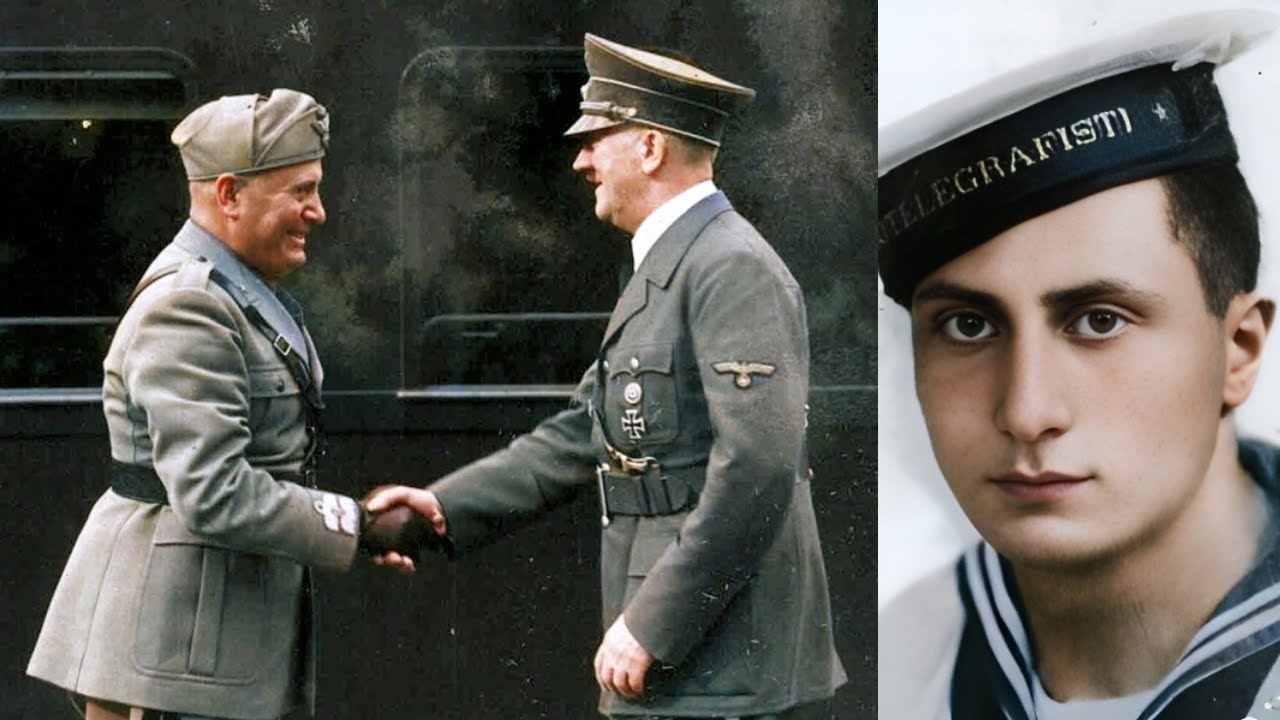
The story of Benito Albino Mussolini begins long before his father seized power, in the years when Mussolini was still a struggling socialist journalist. Born in 1883, Mussolini had grown up in a household shaped by his father’s radical politics. He attended a boarding school run by monks, where he was remembered as both shy and defiant, and he later qualified as a schoolmaster. But in 1902, rather than submit to compulsory military service, he fled to Switzerland.
There he drifted through cities like Geneva and Bern, working odd jobs while absorbing revolutionary ideas about direct action, strikes, and the overthrow of democratic systems. He organized meetings, wrote speeches, and served as secretary of the Italian workers’ union. At one point he even met Lenin. He was arrested for advocating violent strikes and deported back to Italy, only to return to Switzerland.
In December 1904, he finally returned home, taking advantage of an amnesty for desertion, and resumed teaching. In 1909, he left Italy again for Trento, a city then within the Austro-Hungarian Empire, where he worked as a secretary and journalist for local socialist groups. It was near Trento, in the village of Sopramonte, that he met Ida Dalser, the daughter of the town’s mayor and a woman of respectable local standing. She had studied in Paris and returned to open a French-style beauty salon in Milan, a business that attracted wealthy clients.
When and where she first met Mussolini is not firmly established, but by the time he became editor of the socialist newspaper Avanti in 1912, their relationship had deepened. When Mussolini split with the socialist party over whether Italy should enter World War I, he resigned from Avanti and launched his own newspaper, Il Popolo d’Italia. Ida Dalser helped fund his ambitions, giving him money and reportedly pawning her jewelry to support his new enterprise. She eventually sold her salon so he could continue publishing.
The couple were allegedly married in 1914. In 1915, Ida gave birth to a son, named Benito Albino Mussolini after his father. But even before the child was born, Mussolini had begun a relationship with Rachele Guidi, a mistress who would later bear several of his children and become his recognized wife. A decree from the city of Milan recorded that Mussolini was required to make maintenance payments to Ida Dalser for the child, but the first family was effectively abandoned.
Mussolini ignored his first wife and son, refusing to fully accept the boy who bore his name. When Italy entered the war, Mussolini served in the army. After the conflict, he returned to politics and in 1921 founded the National Fascist Party. The following year, he led about twenty-five thousand black-shirted paramilitary supporters in the March on Rome, forcing the king to appoint him prime minister.
Once in power, Mussolini understood the importance of projecting an image of a clean, strong, scandal-free leader. The existence of a first wife he had never divorced, and a son he had neglected, threatened to destroy that image. He was technically a bigamist, and the revelation could have turned public opinion against him. Ida Dalser, however, refused to disappear quietly.
She continued to claim she was the dictator’s rightful wife and denounced him openly. She even alleged that while in Milan he had taken bribes from the French government to campaign for Italy’s intervention in the war on France’s side, a charge that would have branded him a traitor. Mussolini was furious. The police placed Ida under constant surveillance, and her son was followed as well.
Officials tracked down and destroyed the paper evidence of the marriage and relationship, including birth certificates, hoping nothing would remain to haunt the dictator. But not all documents were ruined. A record from 1915 survived in which Mussolini acknowledged Dalser as his wife and Benito Jr. as his son.
Another from 1916 repeated the acknowledgment and promised financial support. By then in power, Mussolini continued to deny the boy’s existence. Ida kept pressing her claims before fascist officials, but in 1926 she was arrested. According to accounts documented in the source, she was abducted on Mussolini’s orders, beaten, forced into a straitjacket, and declared insane by doctors.
She spent the rest of her life confined in mental hospitals, dying in 1937, suspected by some of a brain hemorrhage. With her death, Mussolini silenced the woman who had threatened to expose his past. His son proved a harder problem to erase. Young Benito Albino Mussolini was also taken by officials and told at an early age that his mother was dead.
At fifteen, in 1931, he was adopted by the former fascist police chief of Sopramonte, a household where Mussolini could presumably control the boy’s care. He was sent to several boarding schools, forbidden from referring to Mussolini as his father, and ordered to change his name to Bernardi. But the young man knew the truth. When he was old enough, he enrolled in the Italian Royal Navy and served while remaining under close government surveillance.
He is assumed to have served on ships during World War II. Yet he continued to tell people he was the son of Mussolini, and for that he was deemed dangerous. Shortly after his service, he was arrested and, like his mother, committed to a mental hospital. There was nothing psychiatrically wrong with him; he was telling the truth.
But because the truth threatened the dictator, Mussolini silenced his son by institutionalizing him. Held in an asylum in Milan, Benito Albino Mussolini was killed by doctors inside the facility. The source presents different accounts of how he died. Some claim he was killed in July 1942 at the age of twenty-six by coma-inducing injections, a lethal dose of medication that sent him to sleep permanently.
Others document that he died from electric shock treatments administered to his body while inside the institution. Either way, his death is considered to have been organized in an attempt to erase him from history, an act that ran parallel to a deliberate execution. If the accounts are accurate, the dictator of Italy ordered the killing of his own firstborn son, who was then buried in an unmarked grave. Mussolini’s downfall followed not long after.
In July 1943, about a year after Benito Albino’s death, the dictator was arrested and deposed. The tragedy of Ida Dalser and Benito Albino Mussolini reveals the ruthlessness of the man who ruled Italy and later became Adolf Hitler’s closest ally. He would stop at nothing to prevent the public from learning about his first marriage, a secret that could have fueled dissent against him. He was a bigamist and a father who had abandoned his child, and in the end, he organized the deaths of both his first wife and his son inside medical facilities.
They remain forgotten victims of the man who built his power on a carefully protected public image.