At 9:10 on the morning of June 19, 1944, a 42-year-old American submarine commander from Minneapolis put his eye to the periscope and locked onto the largest target of his career. His torpedo data computer was broken. He fired anyway. Six torpedoes raced through the water.
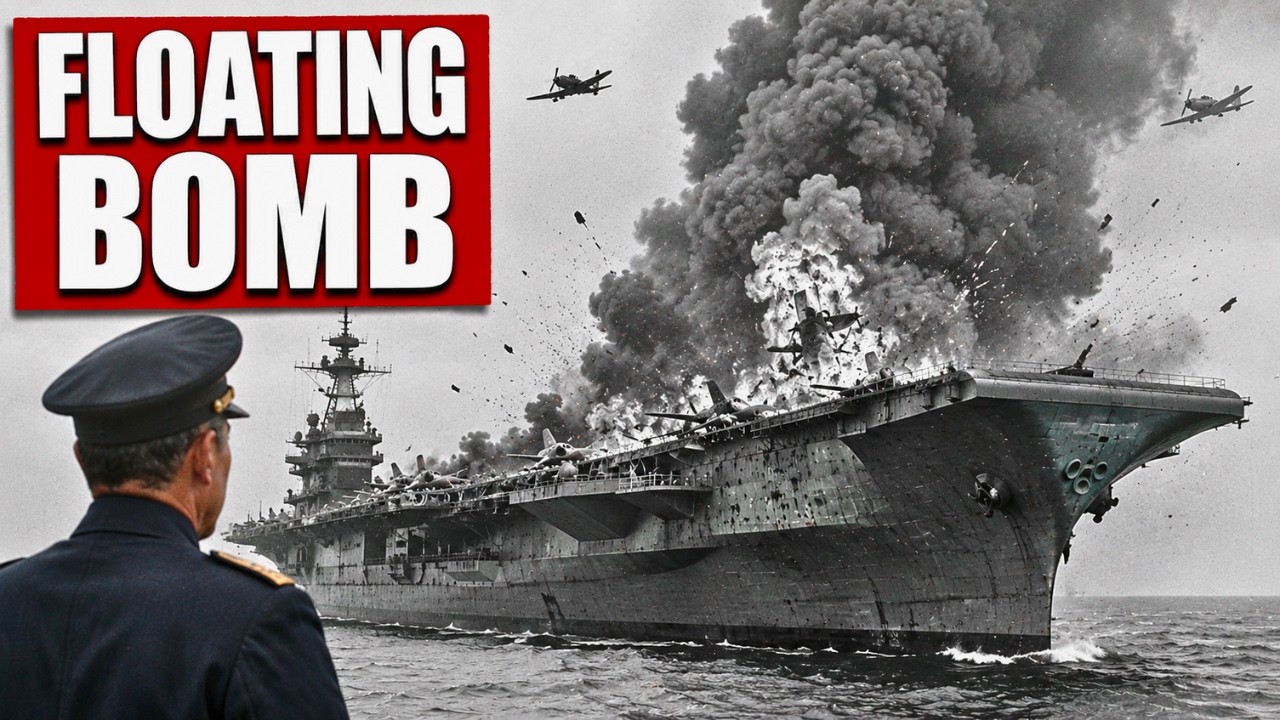
Four would miss. One would be intercepted by a Japanese pilot who crashed his plane into it. Only one would strike the largest aircraft carrier the Empire of Japan had ever built. The damage seemed light.
The ship kept fighting. Her admiral refused to abandon her. Six hours later, 1,650 Japanese sailors would be dead—not because of that torpedo, and not because of any American weapon at all. They would be killed by one of their own officers.
A good man. A competent man. A young officer deep in the ship who looked at a bad situation and gave an order that seemed completely logical to him. This is the story of how logic sank a warship, and how a submarine commander from Minneapolis went to his grave believing he had missed.
At dawn, the sky over the Philippine Sea was a pale blue, empty except for the smoke of ships stretching to the horizon in every direction. Nine Japanese carriers, five battleships, thirteen cruisers, twenty-eight destroyers, and 473 aircraft were warming their engines on wooden decks wet with morning dew. At the heart of this fleet stood one ship towering over the rest. Two hundred and sixty meters long, nearly 30,000 tons of steel, with an armored flight deck thick enough, her designer had promised, to absorb a 500-kilogram bomb without a scratch.
Her name was Taiho, the Great Phoenix. She had been at sea for exactly three months and twelve days. By nightfall, she would be at the bottom of the Philippine Sea. This was not a story about a torpedo.
It was a story about one order, given quietly and in good faith by a man trying to save his ship. Six days earlier, on June 13, the great Phoenix had raised anchor at Tawi-Tawi, a secret fleet base hidden among the islands of the southern Philippines. She sailed at the head of a formation carrying the last real hope of the Imperial Japanese Navy: every carrier still able to fight, every experienced pilot who could be spared, and every barrel of oil that could be gathered from the shrinking edges of an empire in its final decline. Two days after sailing, on June 15, more than 70,000 American troops stormed the beaches of Saipan.
Saipan lay inside Japan’s inner defense ring. If it fell, American B-29 bombers based on its runways could reach Tokyo. Admiral Soemu Toyoda, commander of the Combined Fleet, issued the order the Japanese Navy had been preparing for since the beginning of the war. Operation A-Go: the decisive battle, a final gamble with everything they had to sink the American carrier force before it could protect Saipan.
Commanding that gamble, sailing east across the Philippine Sea, was Vice Admiral Jisaburo Ozawa. At fifty-seven, tall for a Japanese man at nearly six feet, he was a quiet, watchful, professional naval officer who had spent decades studying the American enemy he now had to destroy. Ozawa chose Taiho as his flagship, his floating headquarters, the command center of every carrier in the fleet. On the morning of the nineteenth, at 7:45, Ozawa ordered the turn into the wind.
Taiho’s deck crews hurried to launch positions. Sixteen Zero fighters, seventeen Judy dive bombers, and nine Jill torpedo bombers—42 aircraft in the second attack wave—roared into the salty air. Among the Jill pilots waiting to take off was a young, quiet, unremarkable petty officer named Sakio Komatsu. He had been briefed for a routine attack: fly, find the American carriers, drop his bomb.
He would not return home. He would not even finish taking off before the world changed. About fourteen nautical miles to the east, at periscope depth, another man was watching Taiho through a foggy glass lens and preparing to kill her. Commander James W.
Blanchard, forty-two years old, a graduate of the United States Naval Academy, class of 1927, commanded the submarine USS Albacore. Through the periscope, he watched a Japanese carrier the size of a small city slide across his field of view. He did not know it was Taiho. He did not know he was aiming at the flagship of the entire Japanese carrier fleet.
He knew only that it was large, close, and unaware. Blanchard set his firing data—range, bearing, speed, angle—and fed the numbers into the torpedo data computer. Then the first strange thing happened. The computer failed.
At the most critical moment of his career, the machine meant to calculate the perfect firing solution simply stopped working. Blanchard had two choices: wait and lose the opportunity forever, or fire manually, fire on instinct. Six torpedoes, 21 inches wide, each carrying more than 600 pounds of Torpex explosive, left Albacore’s forward tubes and raced toward Taiho. Because of the broken computer, the spread was wide.
Very wide. From the very beginning, four of the six torpedoes were on courses that would miss. Blanchard did not yet know that the broken machine that had stolen his perfect aim would end up saving thousands of Japanese lives that day. On board Taiho, Petty Officer Sakio Komatsu opened his fuel valve.
His Jill trembled, rolled forward, and lifted off the flight deck into the morning sky. He had been airborne less than a minute. He banked his plane, looked down, and saw six white lines, six wakes of bubbles, six trails cutting through the blue water toward the ship he had just left—toward the flagship of the fleet, toward 2,100 men who did not realize they were about to die. Komatsu had a crew of two behind him, a navigator and a radio operator, and a mission to win the war.
He had three seconds to decide. He did not use the radio. He sent no signal. He did not hesitate.
He pushed the control stick forward and drove his plane straight into the water. The Jill struck the sea directly in the path of the nearest torpedo. The impact shattered the aircraft. The torpedo detonated on contact with the wreckage.
A column of white water shot into the sky. Komatsu was gone. His crew was gone. The torpedo was gone.
The crew on Taiho’s deck, watching from the flight deck, did not fully understand what they had just seen. Some thought a plane had crashed on takeoff. Some thought a torpedo had missed. Only a few realized that a young petty officer, in the last three seconds of his life, had sacrificed himself for their ship.
He was not a kamikaze. The kamikaze corps did not exist yet. Komatsu had never been trained to die deliberately. He saw a threat, calculated the solution, and executed it the only way his plane could.
His sacrifice destroyed one torpedo. Four more, thanks to Blanchard’s broken computer, had already missed. One remained. At about 9:10, the sixth and final torpedo struck Taiho on the starboard side, near the number one elevator, directly below the flight deck and directly above the ship’s forward aviation fuel tanks.
The explosion was deep, muffled, almost polite. No fireball, no flames—just a heavy concussion that traveled through the steel into the boots of every sailor on board. Lights flickered. Coffee cups slid across tables.
On the bridge, Captain Kikuchi steadied himself against the bulkhead and waited for damage reports. On the surface, the news was good. The armored flight deck was intact. Every one of Ozawa’s carefully sealed compartments was doing exactly what it was designed to do.
Water rushed into the forward elevator pit but did not spread. The ship’s speed dropped from 33 knots to 32. One knot. The forward elevator jammed, its platform dropped about six feet.
Damage control parties hauled wooden planks below, and within 30 minutes they had patched the flight deck well enough to resume landing operations. Ozawa considered the situation from the bridge. Some of his staff suggested he transfer his flag to another ship. Ozawa refused.
Taiho was still fighting. Taiho was still fast. Taiho was still Taiho. He would not abandon his flagship over a scratch.
At 9:40, the Phoenix resumed combat operations. Aircraft continued launching. Aircraft continued landing. Radar continued sweeping.
The mood on board was calm, almost cheerful. They had absorbed the hardest blow American submarines could deliver and were still afloat, still fighting, still the flagship. None of them knew that beneath their feet, sealed inside the ship they were so proud of, something had already gone terribly wrong. The torpedo had not just disabled the elevator.
It had torn open the seams of the forward aviation fuel tanks. The fuel in those tanks was not what any of them assumed. It was not clean, high-grade aviation gasoline. It was something far worse.
And in a quiet office deep in the ship, a young officer—well-meaning and hardworking but lacking the experience the moment demanded—was trying to figure out how to handle the smell of fumes beginning to fill the lower decks. He calmly and logically decided to open every ventilation duct on the ship. The Great Phoenix had four hours left. In the passageways below, the smell became tangible.
Sailors suffered headaches. Some began vomiting. In some enclosed compartments, men felt dizzy simply walking through them. But no one above the rank of senior petty officer treated any of this as an emergency.
At 2:00 in the afternoon, the second wave of Japanese aircraft had returned to the carriers, or what was left of them. Only a fraction of the pilots who had launched that morning came back. On Taiho’s deck, ground crews prepared to recover the returning aircraft, refuel and rearm them, and send them out again—refueling and rearming on a ship whose entire atmosphere had become a fuel-air bomb. Fuel hoses ran through passageways thick with vapor.
Ordnance crews carried live ammunition through compartments that would turn into a furnace at the first spark. Somewhere on board Taiho, at about 2:30 in the afternoon of June 19, 1944, something small happened. No one will ever know exactly what it was. The most likely explanation, settled on by modern naval engineers and historians, is that the original torpedo hit had damaged the ship’s electrical system.
Frayed insulation, cracked connections, small hidden faults that had been silently building toward collapse for the past five hours. At exactly 2:30, one of those faults gave way. A generator arced. A relay touched bare wire.
Somewhere in the guts of the Great Phoenix, a single spark jumped between two pieces of metal. The spark met the vapor, and every compartment on Taiho, from bow to stern, from keel to flight deck, ignited at the same moment. The armored flight deck, 75 millimeters of hardened steel backed by 20 millimeters of Ducol plate—the deck her engineers had designed to mock a 500-kilogram bomb—leapt upward in the middle like a sheet of tin foil under a hammer. The hangar decks exploded outward, not upward, not in a fireball, but sideways, as if a giant inside the ship had spread his arms and pushed.
Steel plates the size of houses fell into the sea. The armor belt on the ship’s side, protection designed to stop a naval shell, split open along its weld lines. Every light on the ship went out in a single moment. The generators stopped in that same moment.
The pumps stopped. The propellers stopped. The radar died. The radios went silent.
At 3:00 in the afternoon, a half hour after the first explosion, Taiho was wreckage. She was still floating. She was still technically upright. She was drifting.
She had no power, no communications, and was beginning to list as thousands of tons of seawater poured through the torn hull below the waterline. Uncontrolled fires were moving toward the stern. On the bridge, Ozawa’s staff surrounded him and spoke quietly and respectfully. The meaning was clear.
The admiral had to leave. Command of the fleet, the fight against the Americans, the war itself, could not be managed from the bridge of a burning ship. Ozawa did not answer at first. The tradition he had grown up in was old, clear, and cruel.
A commander stays with his flagship. A commander sinks with his flagship. It was not a rule written in any manual. It was a rule carved into the heart of the Imperial Japanese Navy officer corps, written there in the blood of admirals for forty years.
Ozawa was prepared to comply. His chief of staff spoke again, more urgently. The fleet still had a war to fight. Shokaku was lost.
Two carriers of the First Mobile Fleet had been lost in a single day. The pilots still alive and the ships still fighting needed a commander. And there was something else. On the bridge of Taiho, in a place of honor, hung the framed portrait of Emperor Hirohito that every warship in the Imperial Japanese Navy carried.
It was not decoration. It was sacred. Under no circumstances could the Emperor’s portrait be allowed to sink with the ship. Leaving the Emperor’s portrait to sink with Taiho would be a disgrace greater than the loss of the ship itself.
Ozawa looked at the portrait. He gave the order. The portrait was taken down, wrapped, and carried carefully away from the bridge by an officer whose only mission from that moment on was to make sure it reached another undamaged warship. At about 3:30, the destroyer Wakatsuki came alongside Taiho and lowered a boat.
Ozawa, his staff, and the Emperor’s portrait were transferred to the destroyer. Ozawa was transferred again, to the heavy cruiser Haguro. At 4:06 in the afternoon, the flag of the First Mobile Fleet was raised aboard Haguro. Behind him, Taiho was spending her final minutes.
Captain Kikuchi had ordered the evacuation. Sailors streamed to the flight deck from every hatch still open. Some carried the wounded. Others carried nothing.
They jumped from the flight deck into the sea, twenty meters down into the water. Of the roughly 2,150 men aboard Taiho on the morning of June 19, only about 500 survived. At 4:28 in the afternoon, a second massive explosion tore through what remained of the Great Phoenix. The stern rose, the bow dropped, and the ship—which had been in service for only three months and twelve days—rolled onto her side and began her long slide into the darkness.
Taiho sank stern-first into waters 3,000 meters deep in the middle of the Philippine Sea. The oil slick she left behind stretched for miles and burned for hours. Forty miles away, on the bridge of USS Albacore, Commander James Blanchard knew none of this. He knew only that he had fired at a large Japanese carrier that morning, that he had been depth-charged for hours by angry Japanese destroyers, and that he had survived with his submarine and crew unharmed.
He believed he had hit his target, but not fatally. He was disappointed. He spent the rest of the war believing he had failed to sink Taiho. Only after the war, through captured Japanese records, did he learn the truth.
With a single hit from his broken submarine and a damaged torpedo data computer, he had sunk the largest and newest carrier in the Imperial Japanese Navy. The Battle of the Philippine Sea, when it ended the next day, was the worst defeat in the history of the Japanese carrier force. Three carriers lost. Six hundred aircraft lost.
Hundreds of trained pilots lost, most of them boys who could never be replaced. The United States lost 123 aircraft and not a single ship. Japan had come to the Philippine Sea with a plan for the decisive battle that would save Saipan and turn the tide of the war. It left with a shattered fleet, an empty sky, and a country that had run out of pilots.
Saipan fell three weeks later. B-29s began flying from its runways that autumn. Tokyo began to burn. Taiho was the ship that was supposed to prevent all of that.
She had the armored deck. She was modern design. She was the answer to the American Essex-class carriers coming out of shipyards at a rate Japan could not match. She was the Imperial Japanese Navy’s last best chance to fight the war it had started on nearly equal terms.
She lasted three months and twelve days. She was not sunk by an American torpedo, though a torpedo hit her. She was not sunk by an American submarine, though a submarine fired at her. She was ultimately killed by an order issued by a young officer whose name appears in no book.
A good man, a competent man, an honest man who looked at a bad situation and did what his training, his logic, and his best professional judgment told him to do. Open the vents. Clear the ship of fumes. He failed to save the ship.
He did what anyone else would have done. He did what the book said. The book was wrong. Every navy in the world would rewrite its damage control manuals in the years after the war because of what happened on board Taiho.
Every carrier built after 1944 would have its fuel system, ventilation system, and emergency protocols redesigned with the Great Phoenix in mind. The price of those lessons was the lives of nearly every man on board her.