In the spring of 1864, Robert E. Lee’s Army of Northern Virginia still held the line against every Union thrust toward Richmond. Outnumbered, outgunned, and running short on nearly everything except grit, these lean, hard-fighting men remained the heart of the Confederacy. Across the Rapidan River, a new commander had taken charge of the Union armies.
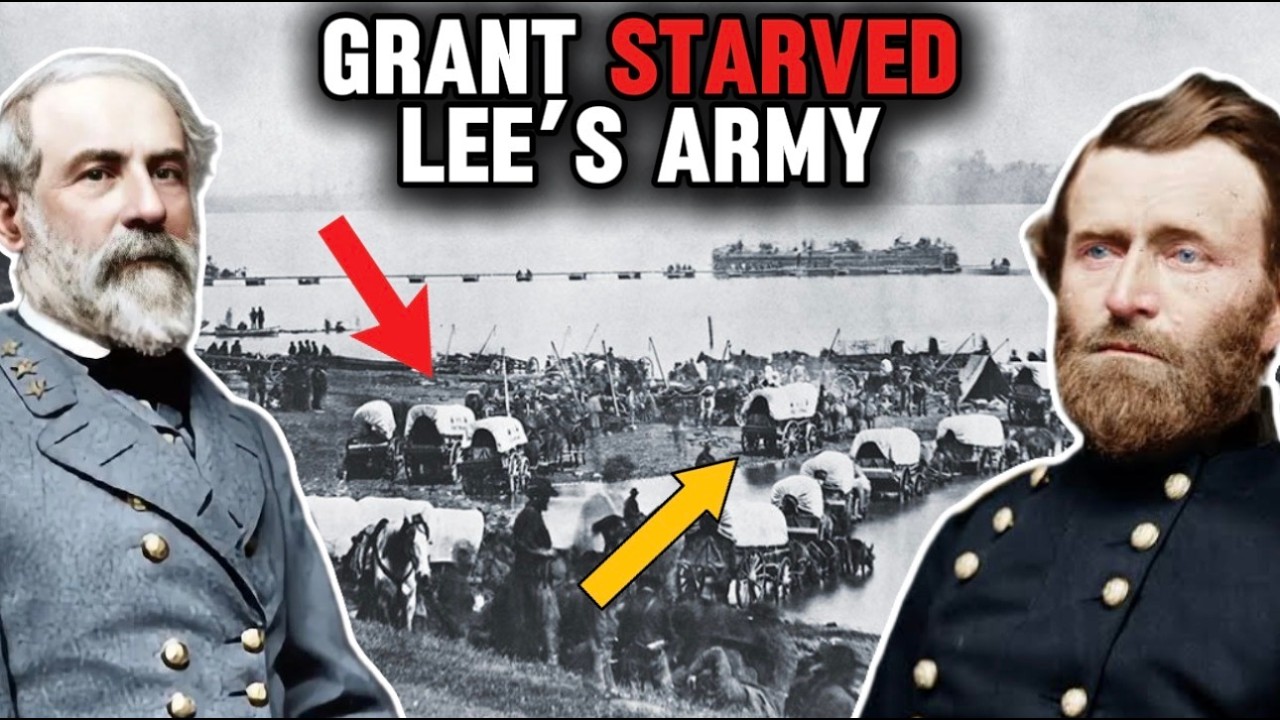
Ulysses S. Grant did not look like a hero. Short, rumpled, perpetually chewing on a cigar, he lacked the dash that made Lee a legend. But Grant understood something his predecessors never grasped.
Battles alone would not win this war, not in the East, where Lee could always slip away and strike again. What would break the Confederacy was something quieter, slower, and more relentless. A silent killer. Grant had come East with a brutal directive from Abraham Lincoln: destroy Lee’s army, not capture Richmond first, not win a glorious field victory.
To do that, Grant knew he had to fight a different kind of war, keeping constant pressure, never letting Lee rest, never giving him the chance to choose the time and place of battle. Even more, Grant understood that Lee’s army lived and died by its supply lines, the railroads that fed it, the wagons that hauled its food and ammunition, the ports that kept foreign goods coming in. Cut those arteries, and the army would bleed out without a single decisive clash. The Overland Campaign had been hell.
From the Wilderness in early May, where smoke and tangled underbrush turned day into night and the wounded burned alive in the flames, to Spotsylvania’s Bloody Angle, where men clubbed each other with rifle butts in trenches so packed with bodies you could walk across them without touching the ground. Cold Harbor in early June was the worst. Grant ordered a frontal assault against entrenched Confederates, and in less than an hour, nearly 7,000 Union soldiers fell. The survivors wrote home that it was the most hopeless slaughter they had ever seen.
Grant later said he regretted it more than any order he ever gave, but he did not retreat. He did not pull back across the Rappahannock like every Union commander before him. On the night of June 12th, he quietly slipped his entire army away from Lee’s front, crossed the James River on pontoon bridges, and marched south toward Petersburg. Lee, expecting another move north or east, was caught flat-footed.
For once, Grant had stolen a march on him. Petersburg was not Richmond, but it might as well have been. A sleepy town of 18,000 before the war, it sat at the junction of five railroads. The Richmond and Petersburg line brought supplies from the capital.
The Southside Railroad reached west toward Lynchburg and the farms of the Shenandoah. The Weldon Railroad stretched south to Wilmington, North Carolina, the Confederacy’s last major open port, where blockade runners still slipped through with rifles, powder, and precious foreign goods. Without Petersburg, Richmond could not eat. Without Petersburg, Lee’s army could not fight.
Grant understood this the moment he crossed the James. So did Lee, once he realized what was happening. But by then, it was too late to stop the first Union probes. On June 15th, Union forces under General William F.
Smith slammed into the thinly held outer defenses east of Petersburg. They nearly took the city that day. Beauregard, commanding the few thousand Confederates on the spot, threw everything he had into the line and begged Lee for help. Lee, still unsure where Grant had gone, hesitated just long enough.
By the time he rushed his men south, the chance for a quick Union victory had slipped away. Grant, having learned the bitter lesson of Cold Harbor, refused to order another bloody frontal attack. Instead, he dug in. By late June, the two armies faced each other across a line that stretched more than 30 miles, from the Appomattox River on the east to the southwest of Petersburg.
The siege had begun, and with it, the silent killer went to work. Grant’s first move was to make sure his own army would never go hungry. He turned City Point, a sleepy landing on the James River just north of Petersburg, into the largest military supply depot the world had ever seen. Steamboats and ocean-going ships arrived day and night, unloading crates of hardtack, barrels of salt pork, sacks of coffee, ammunition, medical stores, even prefabricated hospitals and railroad track.
Grant’s chief quartermaster built a massive wharf, warehouses covering acres, and a military railroad that snaked right up to the front lines. At its peak, City Point handled more tonnage than the port of New York. Soldiers joked that they could smell the coffee brewing from the trenches. For the Union army, it was a miracle of logistics.
For Lee’s men, watching from across no man’s land, it was a daily reminder of what they lacked. The Confederates were already hurting by midsummer. Rations had been cut again and again. Cornmeal mixed with ground peas or acorns became the staple.
Fresh meat was a memory. Men boiled wild onions and pokeweed just to fill their stomachs. Desertions, once rare in Lee’s army, began to climb. A man from North Carolina slipped away at night because his wife’s last letter said the children were starving at home.
Lee wrote to Richmond pleading for food, for horses, for shoes. The replies were always the same. There was nothing to send. Grant did not sit idle.
He stretched his lines westward, one cautious mile at a time, forcing Lee to stretch his own thinner. Every time Lee extended his trenches to cover a new threat, he pulled men from somewhere else. And every time Grant reached a new railroad, he tore it up. In late June and early July, Grant sent two cavalry divisions under James Wilson and August Kautz on a long raid deep into the Confederate rear.
They tore up miles of track on both the Weldon and Southside Railroads, burned depots, and wrecked bridges. In August came the decisive strike. On the 18th, Union General Gouverneur Warren’s 5th Corps slammed into the railroad at Globe Tavern, just south of Petersburg. Lee counterattacked hard, sending A.
P. Hill’s men forward in the brutal summer heat. For three days, the fighting raged around the torn-up tracks. In the end, Grant’s men held the line.
They had seized a stretch of the Weldon Railroad. Lee could no longer use it all the way into Petersburg. Supplies now had to be unloaded at Stony Creek Depot, 16 miles south, and hauled by wagon over terrible roads, a 30-mile round trip for every load of corn and bacon. Horses died by the hundreds.
The trickle of food into Petersburg slowed to a drip. Lee tried to fight back. In late August, he struck at the Union position at Reams Station, hoping to retake the railroad. For a few hours it worked, but Grant simply reinforced and held.
In October, another Union push toward the Boydton Plank Road and the Southside Railroad failed to take the last rail line, but it stretched Lee’s defenses even further. His army now covered more than 40 miles of trench with fewer than 35,000 effective men. Many were barefoot. Many were sick.
All were hungry. Winter came early and hard. The trenches filled with freezing mud. Rations dropped to a quarter pound of meat a day when it came at all.
Men boiled their shoes for soup. One soldier from Alabama wrote home that his company had eaten every dog in the regiment and were now eyeing the rats that ran along the parapets. Desertions became a flood. By February 1865, Lee was losing more men to the rear every week than he was losing in combat.
He wrote desperately to Jefferson Davis that unless something changed, the army would melt away. Davis could do nothing. The Confederacy was collapsing from within. Sherman had marched through Georgia and was now in the Carolinas.
The ports were closing. The railroads were being torn up faster than they could be repaired. Grant watched it all from his headquarters at City Point. He did not gloat.
He simply kept the pressure on, extending his own military railroad west, bringing fresh troops, fresh supplies, fresh horses right up to the fighting. While Lee’s men shivered and starved, Union soldiers received new overcoats, new blankets, and regular mail from home. The contrast was cruel and deliberate. By March 1865, the end was in sight.
Lee’s last hope was to break out, swing west, and join Joseph Johnston’s army in North Carolina. To do that, he needed the railroads. Grant knew it. On March 29th, he launched his final offensive.
Sheridan’s cavalry and the second, fifth, and sixth corps swung wide to the southwest, aiming for the last rail line and the roads that led west. Lee scraped together every available man, including George Pickett’s division, and sent them to Five Forks, a lonely crossroads that controlled the approach to the Southside Railroad. On April 1st, Sheridan smashed into Pickett’s force. The Confederates were routed.
The Southside Railroad fell the next day. On April 2nd, Union troops broke through the main line south of Petersburg in a massive assault. Lee sent word to Richmond: evacuate. The government fled that night.
Petersburg itself fell the following morning. Lee’s army streamed west along the Appomattox River, trying to reach supplies ordered to Amelia Courthouse. When they arrived on April 4th, the rations were not there. The trains had been delayed, the orders lost in the chaos.
For two days, the men waited in the rain, chewing on whatever they could find in the empty fields. Then they marched again, weaker than ever. Grant’s forces pursued relentlessly, cutting off every road south, burning bridges, capturing wagon trains. At Sailor’s Creek on April 6th, thousands more Confederates were surrounded and forced to surrender.
Lee’s army, once 80,000 strong, was down to fewer than 30,000, many too weak to carry their rifles. On April 7th, Grant wrote a simple letter to Lee. The results of the last week, he said, must convince you of the hopelessness of further resistance. Lee read it by the side of the road, surrounded by his starving men.
He knew Grant was right. Two days later, in the parlor of a brick house in the village of Appomattox Courthouse, the two generals met. Lee, immaculate in his best gray uniform, asked for terms. Grant, still in his mud-spattered private’s blouse, offered them generously.
Officers could keep their sidearms. Men could keep their horses. Everyone could go home, so long as they observed their paroles. Then Grant ordered 25,000 rations sent forward immediately from his own supplies.
The men who had been living on acorns and boiled leather for weeks would eat that night. The Army of Northern Virginia laid down its arms on April 9th, 1865. There had been no single Gettysburg, no Waterloo, no grand decisive battle to end the war in the East. There had been the Overland Campaign’s bloody fights, but after Cold Harbor, Grant had refused to play that game again.
Instead, he had used the railroads, the wagons, the endless flow of supplies from City Point, and the steady westward creep of his trenches to do what bayonets could not. He had starved Lee’s army into surrender. The silent killer had won. Years later, when Grant sat down to write his memoirs, he reflected on the campaign with characteristic understatement.
He had not set out to fight a war of starvation, he said, but once the armies settled into the trenches around Petersburg, the logic became clear. Lee could not feed his men indefinitely. Grant could. The end had come not with a roar, but with the slow, grinding collapse of supply lines and empty stomachs.
Historians would later call it the first modern war, a conflict decided as much by logistics as by courage. To the men who lived it, it was simpler than that. One side had everything it needed to keep fighting. The other simply ran out of food.
They remembered how the war ended, not because Lee was outfought on some glorious field, but because he was outfed, outsupplied, and slowly, relentlessly starved. Grant had not needed a single big battle after Cold Harbor. He had needed only to keep the pressure on and let the silent killer do its work.
It was a victory won not by the flash of sabers or the thunder of guns, but by bread and bacon, by railroad ties and wagon wheels, by the simple, relentless fact that one side could keep its men alive and the other could not.