In June 1968, the nation watched Ethel Kennedy kneel on the floor of a hotel kitchen in Los Angeles, her husband dying moments after winning the California primary. It was the image that would define her for the next fifty-six years. She spent those decades being introduced as the most devoted wife in American politics, and that devotion was real. But it was the least interesting thing about her.
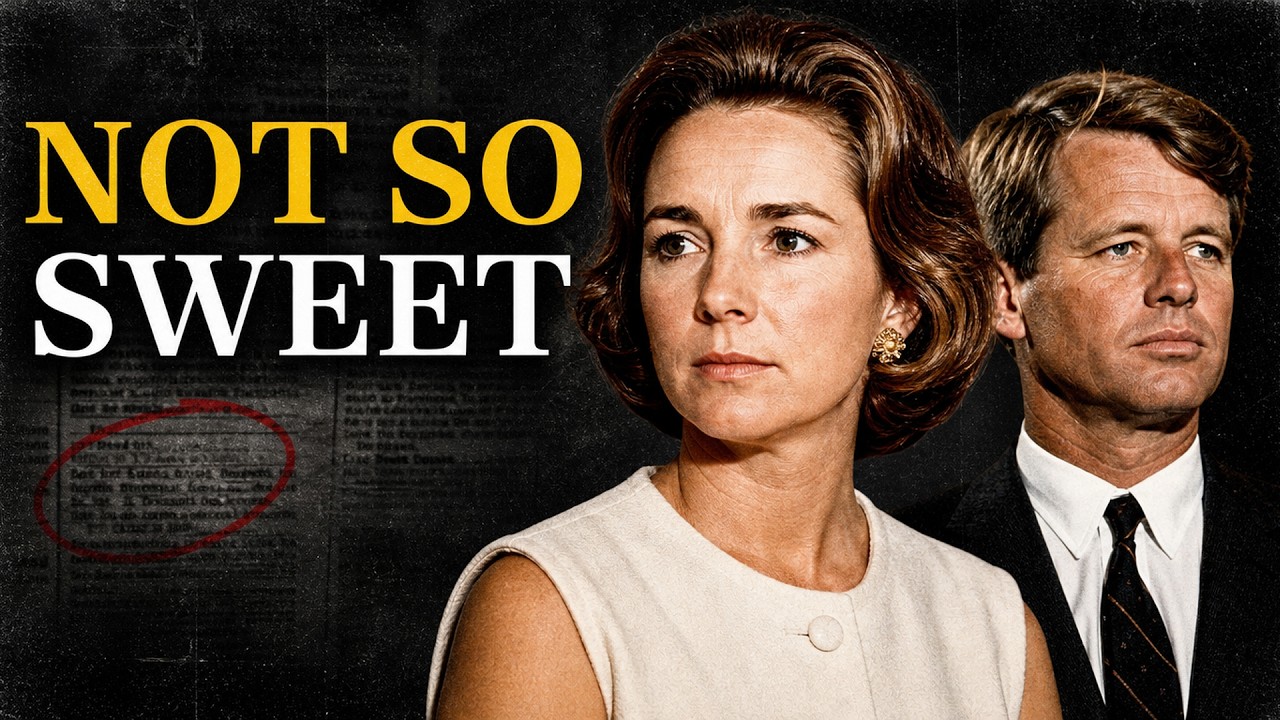
She had been her husband’s most consistent advocate for the race that ended in that kitchen. She had cut off the family she came from and barely spoken of them again. And when it was over, the National Archives handed a grieving widow control of her dead husband’s papers, and historians spent four decades asking her permission. The story begins with a ski trip in December 1945.
Mont Tremblant, Quebec. Jean Kennedy brought her college roommate on a family holiday, and the roommate was a seventeen-year-old named Ethel Skakel. Her brother Bobby came too, and he barely registered her. He was involved with Pat, the older Skakel sister, the prettier one by the accounts of the period, and certainly the calmer one.
For roughly two years, Bobby Kennedy went out with one sister while the other made herself impossible to overlook. That detail explains a woman who spent fifty years trying to be more Kennedy than the Kennedys; no one tries that hard if they were the first choice. The Skakels had more money than the Kennedys and about a tenth of the control. Her father started as a railroad clerk on eight dollars a week and built Great Lakes Carbon into one of the largest privately held companies in America.
By 1936 he had installed seven children in a thirty-one-room house in Greenwich, Connecticut. Biographers who talked to the neighbors decades later came back with the same picture from different doors: guns in the house, wrecked cars, serious drinking. Her father kept his distance from the church. Her mother, Ann, was ferociously Catholic and drilled it into the daughters.
The girl absorbed two rules that never came off. God was not up for discussion, and family embarrassments were not either. That family generated plenty that needed not discussing. Her father died in a plane crash in 1955, and her brother George died in another one eleven years later.
Decades on, a nephew would stand trial in one of the most notorious murder cases in the country. Almost none of it ever entered Ethel Kennedy’s public story. She learned silence in a thirty-one-room house full of secrets. You do not explain your family.
You outrun it. Her courtship of Bobby Kennedy was not a courtship. It was a campaign, and she ran it. In 1946, while he was still half attached to her sister, she rang doorbells in Boston for Jack Kennedy’s first congressional race, for a family she had not joined.
At Manhattanville, she wrote her senior thesis on Jack’s book Why England Slept. Before there was any proposal, Ethel Skakel had studied that family the way other students study for finals. Bobby got something out of it too. He was the seventh child, small for a Kennedy, permanently in the shadow of a dead older brother and a charming older one.
Here was a girl who believed in him with a ferocity nobody else was offering, before he had done anything worth believing in. That devotion was real, and it was also her entry fee. The courtship carried warnings if anybody had wanted to read them. He was awkward and slow about it.
She is said to have joked that her competition was not another girl but God. This was not a man swept away. This was a man deciding that the loud Skakel girl who adored him fit the life his family required. They married on June 17, 1950, at St.
Mary’s in Greenwich. The Boston Globe printed the quiet part: the marriage, it said, united two large fortunes. The wedding previewed the next forty years with almost unkind precision. On the Kennedy side, choreography and political usefulness; Jack was best man and worked the reception like a stop on a schedule.
On the Skakel side, her brothers turned it into a demolition derby of drunken pranks that mortified the bride. She was marrying out of one chaotic dynasty into a colder and better organized one. From the early 1950s onward, she oriented her entire existence toward Hyannis Port and away from Greenwich. Her family of birth simply stopped appearing in her story.
What replaced it was a system, and the system had conditions. The first was production. Rose Kennedy had nine children. Ethel would have eleven, roughly one every eighteen months from 1951 to 1968, as though fertility were a scored event.
The second was service. In 1952, the young couple moved into a Boston rooming house so Bobby could run Jack’s Senate campaign, and Ethel, pregnant, organized the tea parties that put the candidate in front of thousands of women voters. The newsreels filmed those receptions, rooms of women in hats queuing around the block, and the woman running the logistics appears in none of the captions. The third was precedence.
Her husband belonged to the family before he belonged to her, and her job was to keep a household running while the men were somewhere else. She did not resist, and the nickname that came back around the family circle was that she was more Kennedy than the Kennedys. By 1955, the Kennedys were not her in-laws. They were the entire structure she was standing on.
Then, in one afternoon, the family she had been quietly leaving was destroyed. On October 3, 1955, her parents’ private plane went down near Union City, Oklahoma. Both were killed. There was no long public mourning, no visible turn back toward Greenwich.
Friends described a grief that was intense and almost entirely private, sealed off exactly the way her mother had taught her. Within a year, she and Bobby were buying Hickory Hill, the thirteen-bedroom estate in Virginia, from Jack and Jackie, who were letting it go after Jackie’s stillbirth. She took the house where her sister-in-law’s hopes had collapsed and turned it into the loudest address in Washington. Hickory Hill is where the myth got manufactured.
Newspapers showed America a glorious circus: eleven children, horses, dogs, a sea lion, touch football on the lawn, parties where fully dressed guests ended up in the pool. In 1962, the historian Arthur Schlesinger went in wearing his suit, and Washington talked about it for weeks. She was cast as the anti-Jackie, unpretentious, fun, fertile, devout. Behind it, an estate of a dozen children and rotating staff ran essentially alone, with Ethel pregnant for most of it.
Between 1951 and 1968, she was pregnant eleven times, buried both parents and a brother, ran a thirteen-bedroom estate, and hosted the most socially demanding household in Washington, while her husband belonged in every meaningful hour to his brother’s administration. Then Dallas. November 1963 did not only kill a president. Bobby fell into a depression his biographers describe without softening it.
Gaunt, withdrawn, wearing his dead brother’s coat, gone for the better part of a year. Contemporary accounts describe Bobby and the widowed Jackie bound together in mourning, while Ethel, whose faith made grief almost a theological error since Jack was surely in heaven, kept the household loud and the sorrow off-limits. She responded the only way she ever had: activity, more children, and a relentless push to get him moving again. When he ran for the Senate from New York in 1964, she campaigned pregnant, and the machine restarted.
Then came the decision that remains the most uncomfortable documented fact in her life. The 1968 campaign was substantially her doing. Bobby agonized for months over challenging a sitting president. His advisers split.
His brother Ted urged caution. Ethel pushed. Evan Thomas, who worked from archives and hundreds of interviews, called her Bobby’s most consistent advocate of a run for the White House. Two things drove that at once, and they cannot be separated.
She believed he was the best hope the country had, and Jackie’s husband had worn the crown that never came to her. On March 16, 1968, he declared in the Senate Caucus Room, the same room where his brother had declared eight years earlier. Ethel, pregnant with their eleventh child, went out on the trail beside him. For a few months, the marriage was what the myth had always claimed it was, two people fused into one purpose, visibly happy and visibly effective.
On April 4, Martin Luther King was assassinated, and Bobby, against police advice, climbed onto a flatbed truck in Indianapolis and delivered, unscripted, one of the great speeches in American history. Ethel was on that trip, visibly pregnant. After seventeen years of waiting rooms, she was standing where the history was happening. It lasted eleven weeks.
On June 4, he won the California primary and came down to the Embassy Ballroom to claim it. What happened ninety seconds later, in a service corridor behind the ballroom, does not exist in full footage. Ethel was three months pregnant and steps behind him. He died the next day.
Six months later, on December 12, she gave birth to a daughter whose father had been dead half a year. The Requiem Mass at St. Patrick’s was carried by all three networks. Then the funeral train went south, and two million people lined the tracks between New York and Washington.
Ethel walked the length of those cars, thanking supporters one at a time. It was genuinely brave. It was also the moment she took over the family business of grief. America expected the widow to disappear into black.
What happened instead was harder and stranger. She helped establish the Robert F. Kennedy Memorial and installed herself as the permanent keeper of his causes. She refused, essentially forever, to speak about the assassination, not to reporters and far more consequentially, not to her children.
Her sons told interviewers that their father’s death was simply not discussable at home. The older boys came apart. David died in Palm Beach in April 1984 at twenty-eight. Michael died in a skiing accident in 1997.
She buried two sons the way she had buried her parents, her brother, and her husband, publicly composed, privately sealed. She never remarried. In 1991 she gave People magazine the line that defined her second act. Remarrying, she said, would be adultery.
You can hear that as devotion. You can also hear it as the final form of a deal she made in 1950. She had traded her identity for a name, and widowhood was the last office that name would ever give her. And while the country was busy pitying her, something else was happening that took forty years to become visible.
After the assassination, the National Archives let Ethel Kennedy take control of her husband’s papers. Not the government. The widow. For more than four decades, dozens of boxes covering his years at the center of American power sat at the Kennedy Library under family control.
Historians who wanted them had to ask her. Many asked, most waited, and scholars complained publicly that the fullest record of Robert Kennedy was held by the person most invested in one version of it. Access came selectively. Writers the family trusted got in.
Writers it did not trust waited, and every waiting year hardened the love story version into settled history. Substantial releases only began around 2012. The woman remembered as the passive half of a great man’s story spent half a century as the gatekeeper of that story’s evidence. In November 2014, President Obama put the Presidential Medal of Freedom around her neck at a televised ceremony in the East Room of the White House.
She was eighty-six, smiling in every frame of it. She died in Boston in October 2024 at ninety-six. Three presidents eulogized her. December 1945, a seventeen-year-old at Mont Tremblant on a holiday with a family she has not joined, watching a boy who is dating her sister.
That is where she started. She never stopped being the second choice, and she seems to have known it. Jackie got the White House, the magazine covers, and the mystique. Rose got the papal title.
Joan got sympathy. Ethel, who sacrificed more than any of them to belong, was never going to wear the crown. So she took something else instead. She was not given the archive.
She asked, at the exact moment when nobody in America could refuse a woman who had knelt on that floor, and she never let go of it again. For forty years, every historian who wanted to know what that marriage had actually been like had to write to Hickory Hill and wait. Most of them are still waiting. There are streets named after Bobby Kennedy, an airport, a stadium, a federal building.
There is no version of that marriage on any shelf anywhere that she did not approve.