Christina Onassis inherited a legendary shipping empire and an island in the Mediterranean, yet those closest to her described a woman carrying a deep and quiet sorrow. Over her thirty-seven years, she walked down the aisle four times, searching desperately for something her fortune could never secure: someone who would simply stay. Each marriage left her more isolated than before. The press whispered about a tragic curse, but her story raises a harder question.
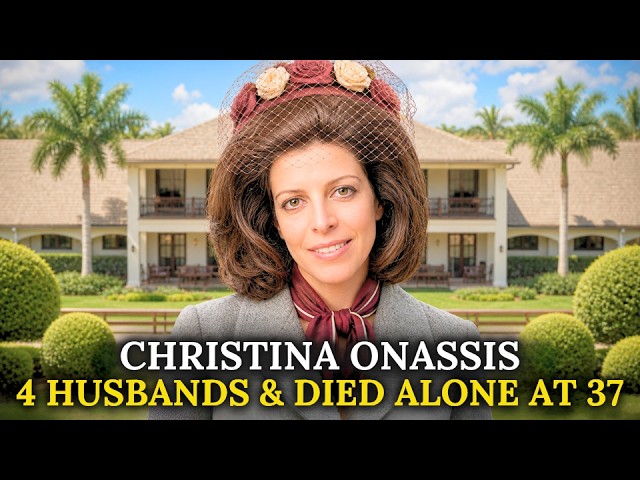
Did she choose the wrong men, or did the immense shadow of the Onassis name make unconditional affection impossible? She was born into a world most people cannot comprehend. Her father, Aristotle Onassis, built a global shipping dynasty from the ashes of a difficult youth. He commanded fleets of oil tankers, owned Olympic Airways, bought the private island of Scorpios, and sailed the world on a superyacht named after his daughter.
He mingled with presidents, opera stars, and European royalty. Her mother, Athina Livanos, came from another powerful Greek shipping family and was considered one of the great beauties of her era. But her marriage to Aristotle was an alliance between empires, not a refuge. In that glittering yet emotionally fractured household, two children were born.
Alexander arrived in 1948, and Christina followed on December 11, 1950, in New York City. Her childhood was cut off from ordinary reality. She grew up moving endlessly between Manhattan penthouses, grand Parisian residences, and sunny Monte Carlo casinos, raised by a rotating army of servants whose names she barely knew. She was educated in exclusive schools alongside children of privilege but felt completely isolated.
She was transported across oceans on private jets and yachts bearing her name, yet a ship named after you offers no warmth when its cabins feel empty. She learned very early that constant luxury does not mean emotional security. Within the Onassis household, affection was a complicated currency. Aristotle was obsessed with legacy and placed the full weight of his expectations on his male heir.
He adored Alexander, seeing in his son the bright future of his dynasty. Christina was not neglected, but she was always aware of the imbalance. Her father’s love was real yet unpredictable, never the steady presence she desperately needed. She spent her childhood competing for the attention of a man who was always looking elsewhere.
Any fragile sense of family shattered in 1960, when her mother divorced Aristotle. Christina was only nine. In this high-stakes world, even familial heartbreak was treated like a calculated business transaction. Athina eventually married Stavros Niarchos, one of Aristotle Onassis’s fiercest rivals in global shipping.
For young Christina, the message was devastating. She watched the adults she trusted most use marriage, money, and power as weapons against one another. She learned a harsh lesson early: relationships were rarely simple or pure. People around her operated with hidden agendas.
A child raised among the wealthiest people on earth, never allowed to believe love could be unconditional, develops a deep and invisible scar. In 1968, the fragile structure of her world cracked again. Aristotle Onassis married Jacqueline Kennedy. The world saw Jackie as an untouchable icon, the grieving widow of an American president.
The wedding took place on the private island of Scorpios, and the international press treated it as a spectacular union of money and American royalty. But for seventeen-year-old Christina, Jackie represented something else entirely: another beautiful, demanding woman stepping into the spotlight and capturing whatever remained of her father’s attention. Jackie was not a villain in this story. She was a woman navigating her own survival after profound public tragedy, seeking security that Aristotle’s fortune could provide.
But to a teenage daughter who had spent her whole youth waiting to be a priority, the marriage felt like a final, quiet replacement. The relationship between the two women remained cold and distant. Throughout the shifting dynamics of her broken home, Christina relied on one true anchor: her older brother. Alexander was her closest companion, confidant, and protector, the only other person alive who truly understood the burden of their family legacy.
He was the designated heir, meant to carry the commercial empire and absorb the immense pressure of their father’s expectations. He was her refuge in an unpredictable life. But the Onassis dynasty was about to take a blow from which it never recovered. In January 1973, Alexander died in a plane crash during takeoff at Athens airport.
He was deeply involved in aviation, following the example of his daring father. He suffered catastrophic brain injuries and died the next day at just twenty-four. When his heart stopped, a vital part of Christina died with him. Her last shield was gone forever.
The sudden loss of the golden son broke Christina, but it destroyed her father. Aristotle Onassis, the man who dominated oceans and intimidated world leaders, withered before everyone’s eyes. He had poured his legacy, his immense pride, and his entire vision of the future into his only son. Without Alexander, the vast shipping empire suddenly lost meaning.
He suffered from myasthenia gravis, a severe neuromuscular disease. The tragic irony was unavoidable: the titan who dictated terms to the financial world could no longer control even his own muscles. He died in Paris in March 1975. Within two years, the pillars of Christina’s existence had been violently torn away.
Her brother was gone. Her mother had died in 1974. Now her father was gone too. At twenty-four, Christina Onassis was completely alone, inheriting a massive share of the Onassis fortune, enormous business interests, the Mediterranean island, and staggering bank accounts.
A grieving young woman suddenly became one of the most watched heiresses on earth. The press marveled at her wealth, but the question remained: had she inherited a global fortune or a life sentence of unbearable grief? In 1971, before the family tragedy struck, Christina attempted a determined act of independence. She was twenty, suffocating under the precisely arranged plans her father had made for her.
That summer, she crossed paths with Joseph Bolker, an American real estate broker from Los Angeles. He lacked the aristocratic pedigree of the powerful men surrounding her family. He was not Greek and not an heir to a historic shipping fortune. He was forty-seven, twenty-seven years older, with multiple previous marriages and children.
By every measure, he was the opposite of what Aristotle Onassis wanted for his only daughter, which made him incredibly attractive to her. Bolker was charming, devoted, and warm. He seemed to offer something entirely different from a strategic corporate merger. For the first time in a long while, Christina felt seen as a young woman looking for a place to rest.
They quietly eloped to Las Vegas on July 26, 1971. For an heiress to one of the largest private fortunes in the world, a simple wedding chapel in Nevada was the ultimate rejection of her golden cage. But challenging a man like Aristotle Onassis came at a terrifying price. When he learned of the Las Vegas wedding, his reaction was volcanic anger.
He threatened to disinherit her and waged relentless psychological war on the couple through his network of lawyers and intermediaries. The daily stress of fighting a global empire proved too much for the new marriage. It barely lasted nine months, ending quietly by 1972. Bolker was not a villain trying to steal her fortune.
Years later, he spoke of Christina with genuine affection and lasting sadness, remembering her as a beautiful, fragile person simply overwhelmed by forces larger than both of them. After her father’s death in 1975, Christina stopped running. Exhausted by grief and rebellion, she surrendered to the system and chose precisely the kind of respectable, calculated marriage her father would have demanded. Alexander Andreadis was the heir to a prominent Greek family in banking and shipping.
It seemed a flawless merger. They shared the same aristocratic lineage and moved in the same exclusive Mediterranean circles. He understood the complex, high-stakes rhythm of international shipping. It felt safe.
But a marriage built entirely on paper rarely withstands the harsh reality of daily life. Christina was genuinely competent. She was required to protect a massive private shipping fortune, negotiate with seasoned executives, and manage a geopolitical machine that many men assumed she could not control. She handled worker strikes, global market fluctuations, and veteran executives who initially doubted her simply because she was a woman.
She sat at the head of heavy mahogany boardrooms and made bold decisions about oil tankers. This immense competence created deadly friction at home. Andreadis came from a deeply traditional culture and expected to play the dominant husband with his new wife gracefully in a supportive role. But Christina was a chief executive fighting every day to maintain absolute control over her family legacy.
The warm, comfortable illusion of romance evaporated under harsh practical reality. The marriage lasted barely over a year, ending after about fourteen months. Doing the right thing, marrying the right class, and following every rule did not equal happiness. In the late 1970s, at the height of the Cold War, Christina made a choice that stunned the international community.
Through the daily operations of her maritime empire, she met Sergei Kauzov, a Soviet citizen working quietly as an official in a state-run shipping agency negotiating with the Onassis fleet. He had no historic family wealth, no celebrity glamour, and no connection to Greek or French aristocracy. For the outside world, it was an unequal and baffling marriage. But for a woman drowning in opportunistic suitors, his ordinariness was his greatest asset.
He seemed balanced and genuine. The Washington and European press treated the romance as a matter of international significance, speculating wildly about hidden motives and intelligence operations. But the simplest explanation was the one nobody wanted to believe. Christina was simply exhausted by men who looked at her and saw only a bank vault.
In August 1978, she married Sergei in Moscow. She traded the sunny luxury of Monte Carlo for the strict, closely watched world of the Soviet Union. She endured the harsh Russian winters, the restrictions, and the eyes of the state upon her because she desperately wanted to believe this unexpected marriage had finally given her a safe place. But the cultural gap was simply too wide to bridge.
The relationship collapsed within a short time. She returned to Paris and Greece carrying a new painful wound: even when a man did not belong to the world of money, she still could not be sure she had been chosen for herself. By the early 1980s, after three highly public and exhausting divorces, Christina still carried a quiet, stubborn belief that forming a traditional family was possible. Then she met Thierry Roussel, a handsome French businessman and heir to a lucrative pharmaceutical fortune.
Unlike her previous husbands, he had his own inherited wealth and an understanding of the European elite she lived among. He did not seem frightened or bewildered by the Onassis name. She poured every remaining ounce of her energy into him. They married on March 17, 1984.
Less than a year later, on January 29, 1985, she gave birth to a daughter, Athina Hélène Roussel, whom the world would come to know as Athina Onassis. For Christina, the baby was a living miracle. For the first time in thirty-four years, she experienced a bond that was pure, free of hidden agendas. She was terrified by the responsibility but overwhelmed by the deepest happiness she had ever known.
While Christina decorated the nursery and dreamed of a quiet future, a destructive secret was already eating at the foundation of her home. Thierry Roussel was living a double life, maintaining a deep and ongoing relationship with a Swedish model named Marianne Gaby Landh. This was not a brief lapse or a passing temptation. It was a fully established parallel existence.
Just a few months after Christina gave birth to Athina, Gaby also had a child by Roussel. While Christina believed she was finally building a sacred, exclusive family unit, her husband was quietly dividing his days between two households, two women, and two newborns. The betrayal struck directly at her most paralyzing fear: that she was never enough. For an heiress with the resources to destroy him in court, the obvious response was to leave in anger.
But the human psyche shaped by deep childhood trauma is rarely that simple. She could not bear the overwhelming public humiliation of a fourth failed marriage. She deeply loved Thierry despite his glaring flaws and desperately wanted Athina to grow up with a father present in the home. So she made a painful, humiliating concession.
She tried to purchase the loyalty she could not secure naturally. She poured enormous sums of her personal fortune into Roussel’s life, aggressively financing his business projects, his lavish lifestyle, yachts, and endless comforts, praying that overwhelming material generosity would somehow anchor his wandering heart. No amount of money, patience, or tolerance could change the fundamental truth. The strain became unbearable, and by 1987 they officially divorced.
Roussel simply packed his bags and returned to Gaby Landh, the woman he would eventually marry. At thirty-six, Christina found herself standing among the ruins of her fourth marriage. After the collapse of her fourth marriage, Christina made a decisive choice. She withdrew entirely from the desperate search for a husband.
Her world shrank to a single focus: her daughter. She was determined to break the cold generational cycle of the Onassis family. She remembered the painful loneliness of her own childhood and refused to let her daughter inherit that emptiness. She showered Athina with every conceivable luxury, but more importantly, she gave her actual time and presence.
She was fiercely devoted and constantly present, offering a love that was absolute. But the human body keeps a precise, merciless record of emotional trauma. Behind the closed doors of her palaces, Christina fought a quiet, painful battle with her health. International tabloids had always been cruel about her appearance.
Under that pressure and deep insecurity, she suffered sharp fluctuations in weight, trapped in a vicious cycle of harsh diets. The weight of her overwhelming reality also brought crippling anxiety and chronic sleep problems. To quiet the noise in her head, she turned to prescription medication, barbiturates and sedatives. It was not reckless escapism for entertainment.
It was a desperate means of calming her racing thoughts. Europe had become suffocating. The Mediterranean was filled with ghosts of her past, and Paris teemed with celebrity photographers waiting for her next failure. She found rare relief in Buenos Aires, far from the judging eyes of the European elite.
South America gave her space to simply exist. She surrounded herself with a warm, loyal circle of friends in the local Greek community and, for the first time in years, felt the comfort of relative anonymity. In Argentina, she could walk down the street or sit quietly in a café without her family’s tragic legacy preceding every step. In the weeks before her death, Christina was staying outside Buenos Aires at the country home of Mariana and Alberto Dodero, close friends connected to the Greek shipping circle in Argentina.
The atmosphere was entirely normal, with no sense of impending catastrophe. On the evening of November 18, she enjoyed a pleasant dinner with her friends, full of warm conversation and plans for the coming days. She was a mother looking forward to returning to her three-year-old daughter in Europe. Later that night, she withdrew and went to take a bath.
By the morning of November 19, the house had turned to tragedy. She was found dead in the bathroom, gone suddenly at the age of thirty-seven. The sudden death of the thirty-seven-year-old billionaire triggered immediate global media frenzy. The official cause of death was recorded as acute pulmonary edema, a sudden accumulation of fluid in the lungs.
Some reports linked the condition to a heart attack, while investigators explored whether prescribed drugs or sedatives had played a role. They found no clear evidence of suicide, deliberate overdose, or criminal suspicion. The question remained: did she die of a sudden, isolated medical failure, or did her collapse leave behind a more painful human question? How much can one body endure after years of grief, physical stress, medication, and bone-deep loneliness?
She was brought back across the ocean to the Mediterranean waters she had tried so hard to escape. She was buried on the private island of Scorpios, beneath the quiet shade of cypress trees, beside the two men who shaped her life more than anyone else: her father Aristotle and her beloved brother Alexander. The golden cage that defined so much of her life had finally fallen silent. But the story of the Onassis dynasty did not end in that quiet family cemetery.
Christina left behind a three-year-old daughter, suddenly transformed into one of the richest girls on the planet. The immense fortune, the intense global scrutiny, and the crushing shadow of the family name now settled on Athina’s small, fragile shoulders. Yet Athina’s life did not simply repeat her mother’s path. She grew up in the quiet safety of Switzerland, raised by her father Thierry Roussel and Marianne Gaby Landh, far from the glaring lights of the Greek shipping world.
When Athina eventually received her enormous inheritance, she actively chose a completely different life, dedicating herself to professional show jumping, finding peace in the stables, and fiercely protecting her privacy from the cameras. Christina Onassis was often reduced to a series of public divorces, each marriage a desperate strategy for sanctuary. Joseph Bolker was her youthful rebellion. Alexander Andreadis was the calculated choice that fit her society perfectly but lacked any real emotional foundation.
Sergei Kauzov was a staggering gamble to find someone untouched by capitalist greed. Thierry Roussel was her final, heartbreaking hope for a real family, given a deep love never returned in the way she desperately craved. But it would be unfair to blame only the men she married for her unhappiness. Christina carried deep, invisible scars from the day she was born.
She wrestled constantly with unresolved grief, crippling trust issues, and exhausting struggles with her self-image. History often forgets her remarkable strength. She was not merely a weeping heiress. She was a skilled business executive who successfully managed a global shipping company in a ruthless field.
Those who truly knew her remember a warm, generous, loyal friend with a wonderful sense of humor. But no business acumen in the world could repair what had been broken from the start. From her lonely childhood in luxurious penthouses to her final days in South America, she rarely enjoyed the lasting emotional stability every child needs. Her life leaves behind one final painful question.
Was her tragedy simply a matter of repeatedly choosing the wrong men? Or was she born with a name that made it almost impossible to ever know if someone was truly choosing her?