On a February night in 1903, every window of the Winter Palace blazed with light. The Russian court had come dressed as a vanished century, in robes stiff with jewels carried from the Kremlin for a single evening. At the heart of the crowd danced Nicholas II, costumed as a long-dead tsar. Someone photographed his family that night in their finery.
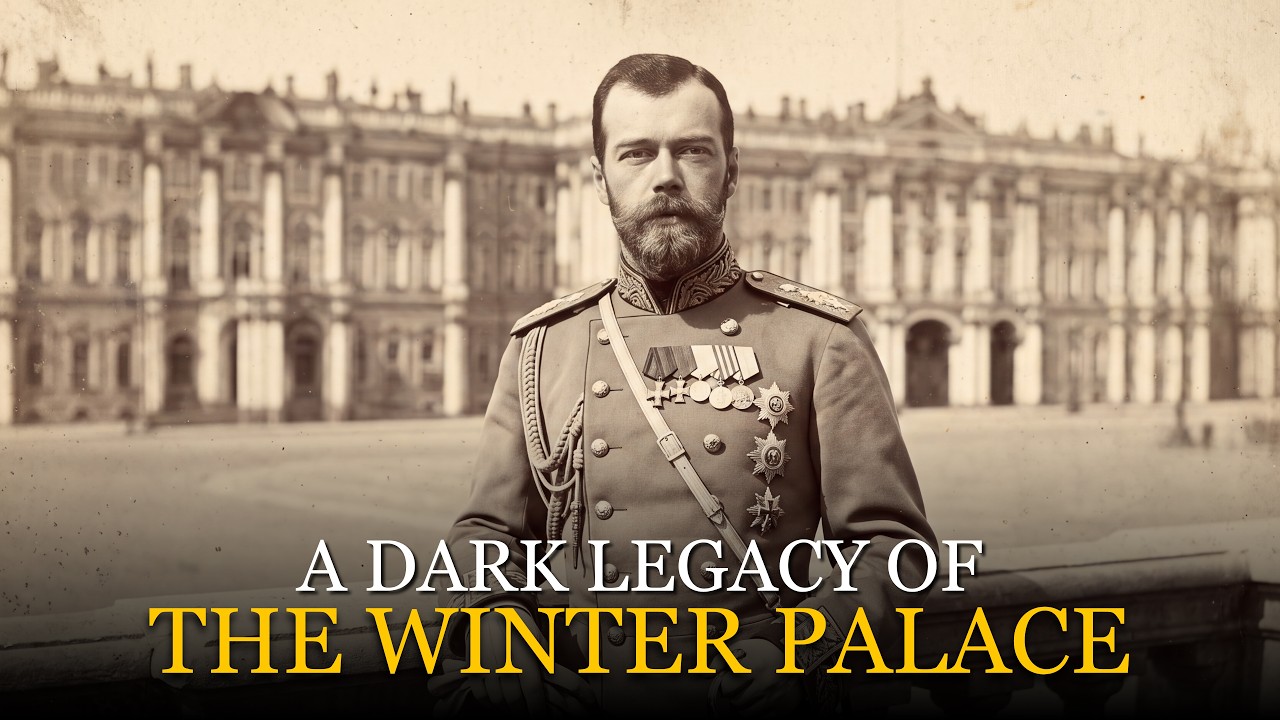
Within a dozen years, the palace would serve as a hospital, then a barracks. Within fifteen, almost every face in that photograph would be dead in a cellar far to the east. The palace had been built to outshine the West. In the 1750s, Empress Elizabeth, daughter of Peter the Great, wanted the largest palace in Europe, an answer in stone to every ambassador who still smirked at Russia as a land of snow and superstition.
She commissioned the Italian architect Francesco Bartolomeo Rastrelli, who worked in the manner now called Russian Baroque, all deep cornices, ranks of white columns, and gilded plaster. Work began in 1754 and continued for eight years. The principal facade ran more than seven hundred feet along the River Neva and stood close to a hundred feet high, crowned by more than 170 statues and stone vases. Inside, there were halls for the throne, private apartments, chapels, and staircases wide enough to march a company up.
The finished floor area exceeded 200,000 square meters. The original budget stood at about 859,000 rubles; the true cost climbed to nearly 2. 5 million. Much of it came from a state monopoly on the sale of drink and from raised duties on salt and alcohol.
The most beautiful building in the empire was paid for, in no small part, out of the salt on a peasant’s table and the vodka that carried a laborer through the dark half of the year. Elizabeth died in 1761 before the final rooms were complete. The palace was finished the following year, and in that same year the throne passed by coup to Catherine the Great. She made the palace the beating center of her government and began, almost privately, to turn part of it into a refuge she called her hermitage.
That private collection of art grew into one of the greatest museums on earth. In December 1837, a fire broke out behind a wall near one of the state halls. The cause was never established with certainty, though the most repeated account blames a disused chimney sealed behind wooden paneling. Once the flames took hold, they ran through the timber-framed interior almost at will.
For nearly three days the palace burned, until the grandest house in Europe stood as a blackened shell open to the winter sky. Tsar Nicholas I’s answer was to order the palace rebuilt within a single year. Some 6,000 workers were driven onto the site and held there through the depth of winter and the heat of summer, working day and night without pause. The exterior was restored faithfully to Rastrelli’s design; the interiors were rebuilt under a court official named Kleinmichel.
The palace stood ready on the day the tsar demanded. The names of the men who did the work were never recorded. They survive in the record only as a round number. The couple who would lose all of it were married inside those walls in a hurry and in mourning.
In the autumn of 1894, Tsar Alexander III died unexpectedly, and his son Nicholas came to the throne almost overnight. With the court still dressed in black, Nicholas married Alexandra, a princess of Hesse and a granddaughter of Queen Victoria. She took the Orthodox faith and a new name. She was beautiful and painfully shy, and the shyness cost her far more than the beauty ever won.
The court saw her coldness and called her the German woman. She answered by turning away from them entirely, into her husband, her children, and her prayers. Nicholas was courteous, mild, and devoted to his family. By every honest account he was a decent man who would have made a contented country squire.
But he believed with absolute certainty that God had placed the whole of Russia in his personal keeping and that his sacred duty was to pass that power to his son exactly as unshared as he had received it. Russia in his day was a country of railways, factories, and strikes, yet he governed it as though it were still the older, sacred Russia of his grandfather. In 1904, Alexandra finally bore a male heir, named Alexei. The capital was told the succession was safe.
But the child had been born with hemophilia, the bleeding sickness carried through the royal houses of Europe by the descendants of Queen Victoria. His blood would not clot. A tumble or a bruise could open into deep internal bleeding that went on for days, twisting him with pain and carrying him again and again to the edge of death. There was no cure.
And it was a secret. The true condition of the heir to the Russian throne was hidden almost completely from the country he was meant to rule. Into that desperation walked Grigori Rasputin, a wandering holy man from Siberia. What he could truly do remains tangled and disputed.
What contemporaries recorded is that he seemed to ease Alexei’s suffering at moments when the physicians had given up. To Alexandra, he was the answer to her prayers, the one man God had sent to keep her son alive. A woman who believes that of a man will listen to him on matters far beyond the health of a sick child. Society saw only a hard-drinking peasant moving freely through the private rooms of the palace.
They did not know about the hemophilia. They filled the silence with cruder explanations, and the good name of the monarchy began to rot from within. From about 1895, Nicholas and Alexandra made their real home not in the Winter Palace but in the Alexander Palace at Tsarskoye Selo, fifteen miles outside the capital. By the standards of the imperial family, it was almost plain.
There they could raise their children, nurse their terrible secret, and shut the door on society. So the greatest palace in Europe stood through much of the final reign as a magnificent and mostly empty shell. The state rooms were thrown open for the great set pieces of the calendar, the winter balls, the receptions for ambassadors, the ceremonies no tsar could skip. But when each ceremony ended, the family withdrew, and the palace fell silent.
To every peasant in a distant village, the Winter Palace simply was the tsar. For much of that last reign, it was an abandoned house. In the same city, two Russias lived barely a mile apart. One gave jeweled Easter eggs from the House of Fabergé, shells of gold and enamel holding tiny jeweled surprises.
Between 1885 and 1916, about fifty of these eggs were made for the imperial family. The other Russia worked days of ten and eleven hours for wages that barely held body and soul together, in factories where the smoke hung thick over crowded, freezing rooms. On the morning of January 22, 1905, by the modern calendar, a priest named Father Georgy Gapon led a great river of people through the snow toward the palace. They came singing, carrying icons and portraits of the tsar, the little father they still believed would help them if only he could hear their voices.
Their petition asked for an eight-hour working day, a fair minimum wage, the right of workers to organize, and a national assembly elected by the whole people. It ended with a line that reads now like prophecy: if the tsar would not hear them, they would die in the square before his palace. Nicholas was not even there. He had left the city the day before for Tsarskoye Selo.
What met the marchers instead was the army. The soldiers opened fire on unarmed crowds carrying pictures of the tsar. How many died that day is still argued; the government’s official figures counted 96 dead and 333 wounded, while many later historians put the true toll far higher. Whatever the exact number, unarmed people had come to the tsar’s own house to beg, and they had been shot down in front of it.
They called it Bloody Sunday. The faith that had held the empire together for three centuries broke that day. It did not matter that Nicholas had not given the order to fire. The people had walked to the gate with his picture in their hands, and the answer had been bullets.
By the end of January, Russia went on strike. About 400,000 workers walked off the job in protest. Through the months that followed, unrest spread from the industrial cities into the countryside, the universities, and at last into the armed forces. In the autumn, a vast general stoppage paralyzed the country.
Faced with the real possibility of losing everything, Nicholas issued the October Manifesto, promising civil liberties and an elected national assembly, the Duma. It was the first time the Russian autocracy had accepted a limit on its own power. Nicholas hated every word of it and spent the years that followed quietly trying to claw back as much of the lost ground as he safely could. When he formally opened the first Duma in 1906, he did it in the Winter Palace, surrounded by the assembled grandeur of the court, in a hall built to make a human being feel small.
The First World War, which Russia entered in 1914, fell upon the empire like a hammer on cracked glass. The armies were brave, enormous, and badly led, and they were cut down in numbers that beggar the imagination. From the autumn of 1915, the state rooms of the Winter Palace were fitted out as hospital wards, named for the young heir. In halls where the court had once assembled in silk and diamonds, surgeons worked over the shattered bodies of peasant conscripts.
In 1915, Nicholas left the capital to take personal command of the armies at the front. It was a noble impulse and a disastrous choice. It bound his own name to every defeat that followed, and it left the government largely in the hands of Alexandra, isolated, distrusted, and leaning on Rasputin. In December 1916, a group of aristocrats, including a prince and a grand duke of the tsar’s own blood, lured Rasputin to his death and murdered him.
The prestige of the monarchy had fallen so far that such men felt driven to kill a peasant faith healer to save the honor of the crown. The end came in two waves. In March 1917, bread ran short in the freezing streets of the capital, now called Petrograd, and anger boiled over into mass protest. The crucial moment came when the soldiers of the city garrison refused to put the crowds down and turned to the side of the people.
Within days, Nicholas II abdicated the throne. Three hundred years of Romanov rule ended not with a battle but with a tired signature on a train stopped in a siding. In his place rose a provisional government, which installed itself in the Winter Palace. Its chief minister was a lawyer and orator named Alexander Kerensky.
The government met in the Malachite Room. But it was caught between a war it could not win and a people who wanted bread, land, and peace. Out on the edges of the capital, the Bolsheviks organized, patient and certain. On the night of October 25, 1917, by the old calendar, they made their move.
The palace was barely defended, held by perhaps 500 to 700 cadets, Cossacks, and a detachment of the women’s battalion. At about 9:40 in the evening, the cruiser Aurora fired a single blank shot as a signal. Then, mostly, very little happened. Small parties of armed men found their way into the enormous, poorly guarded building through unlocked doors, worked their way through its endless corridors, and came upon the ministers sitting in a small private room, waiting.
They were placed under arrest, and it was over. One historian called the affair almost bloodless. Below the state rooms lay the imperial wine cellars, and in the chaos soldiers and crowds broke into them. The looting grew so wild that the new authorities ordered the cellars destroyed.
Wine ran out into the gutters, red in the snow, and later fed a false legend that great blood had been spilled. The heroic version of the storming, the surging crowds and blazing rifles, was largely the creation of Sergei Eisenstein’s film a decade later. It was not what happened. The family had been taken east, first to Tsarskoye Selo, then to the Siberian town of Tobolsk, and at last to Yekaterinburg, deep in the Ural Mountains, shut up in a requisitioned house belonging to an engineer named Ipatiev.
The windows were whitewashed, the doors guarded. On the night of July 16, 1918, they were woken and told they were being moved for their own safety. They went quietly. Nicholas carried his sick son.
Then the guards filed in, their commander read out a sentence of death, and the room erupted in gunfire. It was neither quick nor clean. The daughters did not die at once. They had sewn a fortune in diamonds and jewels into the linings of their clothing, and the hidden stones turned the fabric into a kind of armor, glancing the first bullets away.
The killers had to finish their work at closer range with more shots and with bayonets. Killed with the family were four faithful servants who had stayed to the end: the doctor, the maid, the footman, and the cook. Eleven people in all, in a cellar far from any gold. The bodies were carried into the forest, damaged with acid and grenades, and buried in secret.
For sixty years, no one knew for certain where they lay. In 1991, the remains were exhumed and matched by genetic testing beyond reasonable doubt. In 1998, Nicholas, Alexandra, and three of their daughters were buried with honor in the Cathedral of Saints Peter and Paul. In 2000, the Russian Orthodox Church declared the murdered family saints, passion bearers, holy for the humility and faith with which they met their deaths.
The palace did the one thing the family could not. It survived. In the days after the Bolsheviks took the city, the Winter Palace was declared part of the state museums. The house of the tsars became the house of the public.
It endured the near-nine-hundred-day siege of Leningrad in the Second World War, suffered, and held. Today it stands as the heart of the State Hermitage, and millions pass through it every year, climbing the ambassador’s staircase built to make them feel small, walking freely through rooms built to say that ordinary people must be kept out. One of the Grand Dukes present at the ball of 1903 wrote a line that has outlived everyone in the room. While we danced, he said, the workers were striking.
That is the whole of it in nine words: the grandeur and the gathering storm in the same building on the same night, and the dancers unable or unwilling to hear the sound coming from the streets.