The winter of 1857 found Ulysses S. Grant on the streets of St. Louis, selling firewood to keep his family warm. His military life was behind him.
His future was a blank page. Eight years later, the same man would accept the surrender of the largest army ever to lay down its arms on American soil. Grant never wanted to be a soldier. At West Point he was an average student, indifferent to parade-ground discipline, skilled mainly in mathematics and horsemanship, where he once set a high-jump record that stood for years.
When he should have studied tactics, he read novels. He graduated in 1843 in the middle of his class, hoping not for glory but for a quiet job teaching mathematics at some college. Instead, he got the war he had been trained to fight. During the Mexican-American War from 1846 to 1848, Grant served as a young regimental quartermaster under both Zachary Taylor and Winfield Scott.
He learned war from the inside: how an army is fed and supplied, how it moves through hostile terrain, how it wins, and how it collapses. At Monterrey, he volunteered to ride exposed through sniper-filled streets carrying a message for ammunition, clinging to the side of his horse. He marched with Scott’s army to Mexico City. He came home convinced the war itself was unjust, a conquest imposed by a powerful republic upon a weak neighbor.
He later called it one of the most wicked wars ever waged. Yet he fought in it, and he fought well. He never forgot the lesson embedded in that contradiction: a soldier can act bravely for a cause he personally condemns. The years after the war nearly destroyed him.
He married Julia Dent, the sister of a West Point roommate, and loved her unconditionally for the rest of his life. But the peacetime army sent him to remote posts on the Pacific coast, first in Oregon and then California, hundreds of miles and months of travel from Julia and their small children. Isolated, homesick, and short of money, he drank to fill the emptiness. In 1854, still a captain, he abruptly resigned under circumstances never fully documented, and the rumors followed him for the rest of his life.
What followed was one failure after another. He tried farming a family plot near St. Louis, clearing the land himself, building a crude house with his own hands, and naming the place Hardscrabble without a trace of irony. The farm failed.
He tried collecting rents and debts in the city and failed at that too, lacking the nerve to pressure those who owed him. That winter he pawned his gold watch to buy Christmas presents. He hauled wood through the streets and sold it, a West Point graduate and former captain in a faded army coat, while people who had known him in better times crossed the street to avoid him. By 1860 he had abandoned any pretense of independence and was working as a clerk in his father’s leather shop in Galena, Illinois, sorting hides and keeping accounts under his younger brother’s supervision.
He was thirty-eight years old. The man was full of a strange contradiction that the coming war would expose. This general, who would lead some of the bloodiest campaigns in American history, was personally gentle and quiet. He loathed cruelty to animals and could not stand the abuse of a horse.
He refused to hunt. He disliked the sight of blood so much that he insisted his meat be cooked until nearly black. He rarely raised his voice, told no vulgar stories, and struck most people who met him as a modest, plain, unassuming presence. Then, in April 1861, Confederate cannons opened fire on Fort Sumter and the nation split in two.
The war that remade the country also remade Grant. He was one of the few men in Galena who actually knew how to lead soldiers. When the town formed a volunteer company, he trained them and brought them to the state capital at Springfield. Within months, the failed shop clerk became a colonel and then a brigadier general of volunteers.
He was assigned to the West, to the vast contested country drained by the Tennessee, Cumberland, and Mississippi Rivers. And there, in the Union’s first terrible year of defeat, he did something almost no Northern general dared. He moved forward. He attacked.
In February 1862 he advanced against Fort Henry and Fort Donelson, the Confederate forts guarding the river approaches to the South. Henry fell quickly to Union gunboats. At Donelson, in bitter cold, Grant formed a ring around the position and held it when a breakout nearly succeeded. When the surrounded Confederate commander asked what terms he could expect, Grant sent back a blunt reply: no terms except an unconditional and immediate surrender.
The fort surrendered with about fifteen thousand men, the largest capture of an army on the continent up to that time. It was the Union’s first major victory of the war, and a desperate Northern public seized on his initials and his answer. U. S.
Grant became Unconditional Surrender Grant. For the first time in his life, he was famous. Fame brought scrutiny, and scrutiny nearly destroyed him. In April 1862, at a rural meeting house called Shiloh in Tennessee, a Confederate army struck Grant’s camp at dawn and by afternoon had pushed his troops back toward the Tennessee River.
The first day was chaos and slaughter. Grant held through a night of pouring rain, refused to consider retreat, brought up reinforcements crossing the river in the dark, and counterattacked at first light to recover the field. But the scale of the killing horrified the nation. More Americans died in those two days at Shiloh than in all the country’s previous wars combined.
Newspapers called Grant a butcher, and whispers of drunkenness revived. According to accounts that later circulated, when his advisors pressed Lincoln to remove Grant, the president replied that he could not spare this man, because he fought. At this point, the story darkens, and honesty requires facing it directly. In December 1862, weary of the cotton black market trailing his army, and shocked to discover that his own father had quietly joined Jewish merchants in a cotton trading scheme, Grant issued General Orders Number 11.
In a single sentence it expelled all Jews as a class from his entire military district, which covered parts of Tennessee, Mississippi, and Kentucky, ordering them to leave within twenty-four hours. It was the most sweeping official act of anti-Semitism in American history. At Paducah, Kentucky, thirty Jewish families were ordered out of their homes, some of them longtime residents and at least two of them former Union soldiers. One merchant, Caesar Kaskel, refused to accept the order quietly.
He traveled by train to Washington and appeared before the president. After grasping the order’s full meaning, Lincoln had it revoked within weeks. Grant never publicly defended it. In later years he expressed sincere regret.
And as president he appointed more Jewish Americans to office than any of his predecessors. But the order had been real, and no later act of conscience could erase it. Through all this, Grant drove toward the one prize that would decide the war in the West. Vicksburg, the fortress-city on the high bluffs of the Mississippi, was the last great bastion holding the Confederacy together.
For months he had tried to reach it through swamps, floods, and failed canals. Then he staked everything on a single audacious plan. Cutting loose from his supply base, he moved his army down the west bank of the river, crossed the great river below the city, and entered Mississippi, living off the countryside. In a lightning campaign of less than three weeks he won five battles at Port Gibson, Raymond, Jackson, and Champion Hill, and drove the Confederate army back inside Vicksburg’s defenses.
He then besieged the city. On July 4, 1863, starving and exhausted, Vicksburg surrendered with its army of about thirty thousand men. The Confederacy was split in two. The Mississippi flowed uninterrupted to the sea under Union control.
And on that same day, far to the east, Lee’s great invasion of the North had been shattered at Gettysburg. The war had reached its turning point, and Grant alone had turned half of it. That autumn, Lincoln gave him command of the entire Western theater. Grant moved quickly to Chattanooga, where the Union army, after defeat at Chickamauga, was besieged and half-starved.
He opened a supply line, brought in reinforcements, and in November 1863 sent his troops storming up the slopes of Missionary Ridge, driving the Confederates from the heights and lifting the siege. The gateway to the deep South stood open, and Grant’s name now stood above all others in the Union army. Lincoln reached for him. In March 1864 Grant was promoted to lieutenant general, a rank last genuinely held by George Washington, and given command of every army of the United States.
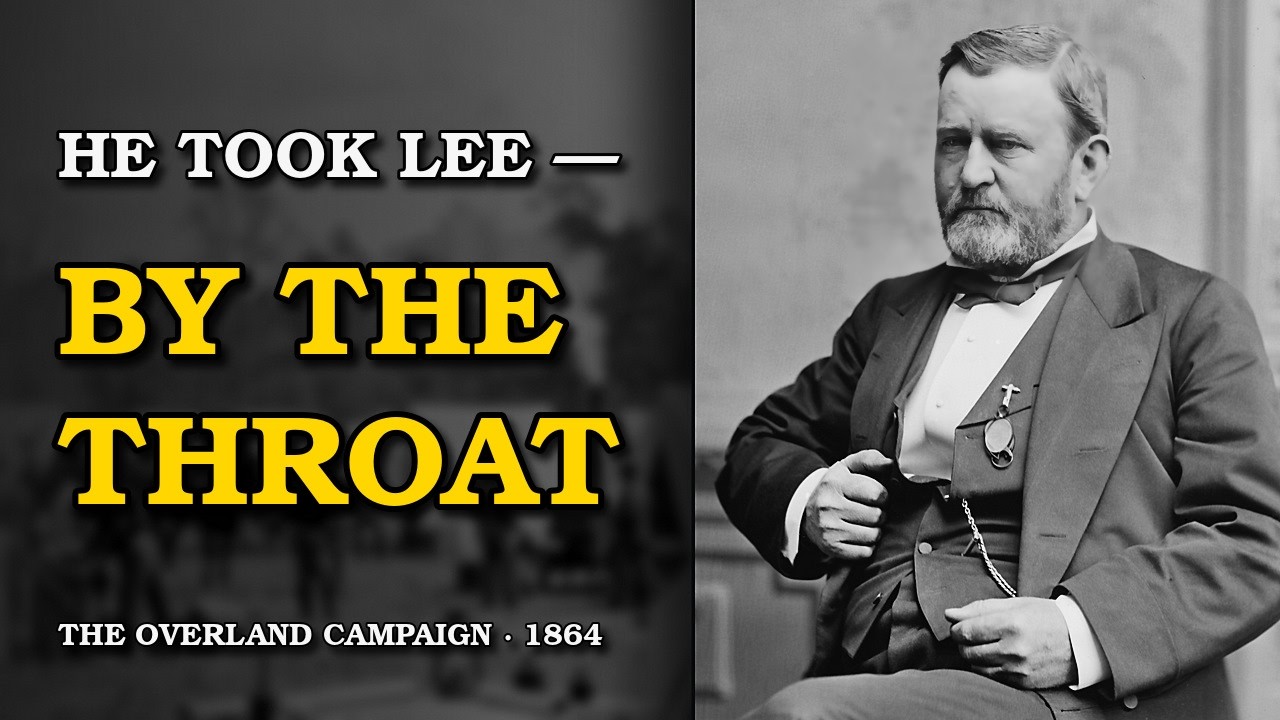
He came east to confront Robert E. Lee directly, bringing with him a hard philosophy his cautious Eastern predecessors had never managed. He would not fight one bloody battle and then retreat for months to recover. He would grip Lee’s throat and refuse to let go until the Confederate army was destroyed, whatever the cost.
The cost was terrible. In the spring and summer of 1864, in the tangled thickets of the Wilderness, in the trenches of Spotsylvania, in the killing ground of Cold Harbor, the two armies tore at each other in almost continuous combat unlike anything the war had yet seen. In the Wilderness, fires swept through the woods around the wounded. At Spotsylvania, forced to fight on the defensive, Grant sent word that he would fight it out on this line if it took all summer.
At Cold Harbor he ordered a frontal assault that was shattered within minutes, an attack he later admitted he regretted most. All across the North, casualty lists draped dark doorways, and the old cry rose again: butcher Grant. The warning should be honored. Grant’s army suffered terrible losses in that campaign, heavier in numbers than Lee’s, but he was the attacker, hurling himself against an enemy holding fortified ground in front of its own capital, the hardest and most expensive work of the entire war.
Lee’s smaller army was proportionally just as badly hurt, and unlike Grant, Lee could not replace his losses. Grant understood a brutal arithmetic the rest of the North struggled to accept. The Union could absorb its losses and refill its ranks. The Confederacy could not.
One of the strangest turns in Grant’s public image belongs to this phase of the war. The most famous photograph of the general on horseback, standing before his troops at City Point, Virginia, is a fake. A photographer named Levin Handy, nephew of the famous war photographer Mathew Brady, created it around 1902 from three entirely different pictures. Grant’s head came from a portrait taken at Cold Harbor.
The body and horse came from a completely different general named McCook. The background showed Confederate prisoners captured hundreds of miles away who had never laid eyes on Grant. The clues are there for a careful viewer. The rank shown on the shoulders is wrong for the moment.
The horse is not one Grant was known to ride. The seams give away the joins. For nearly a century this composite circulated as an authentic document until researchers at the Library of Congress finally broke it apart. It stands as a nearly perfect symbol for a man whose real achievements kept getting buried under fabricated images.
The end came in Virginia in the spring of 1865. Grant’s long siege of Petersburg finally broke through Lee’s weakening defenses. Richmond fell, and the Confederate army, hungry, exhausted, and surrounded, retreated westward. On April 9, in a private home at a crossroads called Appomattox Court House, Lee surrendered.
And Grant, who three years earlier had demanded unconditional surrender, now offered terms of astonishing generosity. Confederate soldiers would surrender their arms and go home unmolested, and those who owned horses could keep them for spring planting. When his own troops began firing victory salutes, Grant ordered them stopped at once. He said the war was over and the rebels were back in the Union, and he would not allow them to be humiliated.
In his own judgment it was the greatest moment of his life, and it was an act not of triumph but of mercy. The soldier had won the war. Now the nation asked the soldier to govern, and the judgment of the second half of his story is far harder than the first. In the bitter years just after the war, Grant broke with President Andrew Johnson over the fate of the defeated South and the freedom of the former slaves.
In 1868 he was elected president, running on the simple pledge of let us have peace. He inherited a South convulsed by the struggle of Reconstruction. At stake was whether four million people freed by the war would become citizens in fact or only in law. And here, as president, in the darkest period of his life, Grant answered with the best public work of his life.
Across the defeated South a secret terror had risen. The Ku Klux Klan, masked night riders, whipped, burned, tortured, and murdered to keep Black citizens from the polls and to overthrow the South’s elected Reconstruction governments. Local sheriffs and courts could not or would not stop them. Often they were part of them.
Grant went to Congress for power to act, and Congress passed enforcement acts in succession, the last and strongest known as the Ku Klux Klan Act of 1871. Grant had already pushed to create an entire new Department of Justice. He placed it in the hands of Attorney General Amos Akerman, a Georgian and former Confederate officer who proved one of the most determined defenders of the freedmen in government. In the autumn of 1871, in nine counties of upcountry South Carolina where the Klan reigned almost unchallenged, Grant suspended habeas corpus and sent federal troops and U.
S. marshals under a tough officer named Lewis Merrill. Hundreds of Klansmen were arrested, and hundreds more fled the state. Thousands across the South were indicted, and hundreds were convicted in federal courtrooms where the juries were largely Black.
The first Klan was broken, and it would not rise again in real strength for two generations. No president for the next century would use the power of the federal government so aggressively to protect the rights of Black Americans. The man who in 1862 had expelled a people as a class was, as president, the man who threw the whole strength of the state between that people and their intended victims. Over that bright record fell a shadow.
His administration became a national byword for corruption. In 1869 a scheme to corner the nation’s gold market sent a shock through the economy. His second term was staggered by one scandal after another, including the Whiskey Ring, which defrauded the government of tax revenue, and a bribery affair that reached his own cabinet and touched his personal secretary. Grant himself was never shown to have taken a dishonest dollar.
His weakness was a stubborn, trusting loyalty to men who did not deserve it. He could not believe that people he counted as friends would lie to his face. He was an honest man surrounded by dishonest men, and the gap between those two facts was nearly the whole tragedy of his presidency. Set against the scandals was a genuine triumph abroad: the peaceful settlement of the dangerous Alabama Claims with Britain, the dispute over British-built Confederate raiders, won through patient diplomacy and regarded as one of the greatest treaties of the century.
But the goodwill behind that work did not last. As the years passed, a weary North lost interest in soldiers and courts in the South. Northern newspapers railed against bayonet rule, and Grant himself, toward the end of his second term, grew more cautious about intervention. The protection he had fought for began to erode before he left office, and the world of the freedmen he had defended was soon abandoned to a long darkness.
He left the White House in 1877, and the world he had helped reshape now received him as a conquering hero. He and Julia set out on a tour of the world, drawing enormous crowds wherever they went. In Berlin he talked war with Otto von Bismarck, professional to professional. In England Queen Victoria received him, and the rulers of Egypt, India, China, and Japan honored him.
The failed clerk from the Galena leather shop had become, for a time, the most famous living American. And then, one last time, he lost everything. In 1884 Grant put his money, and worse, his trusted name into a Wall Street brokerage run by a young financier named Ferdinand Ward, whom the press called the young Napoleon of finance. Ward was a fraud running an immense swindle.
The firm collapsed, and at sixty-two Grant was bankrupt, humiliated, and poorer than on the day he sold wood on the streets. Almost simultaneously, his doctors told him that a persistent pain in his throat was cancer, the result of a lifetime of cigar smoking, and that it would kill him. What Grant did in his final year kept his story from ending in that ruin. To provide for Julia after his death, he sat down to write his memoirs.
His friend Mark Twain arranged for their publication with extraordinary generosity. Grant, in constant and growing pain, his voice first reduced to a whisper and then gone altogether, wrote on, wrapped in blankets on the porch of a borrowed cottage on a hillside in New York, racing against time. He finished the manuscript only days before his death, on July 23, 1885. The memoir proved a masterpiece, plain, honest, clear, and unsentimental, one of the finest works of its kind in the English language, a bestseller of its era that earned his widow a fortune and secured the family he had so often failed and fretted over.
He wrote it himself, every word, refusing to let anyone polish it, and that plainness was its greatness. No boasting, no excuses, just a soldier recording what he had seen and done in clear, measured prose. Mark Twain, who knew writing better than almost anyone alive, judged it the finest of its kind since Caesar’s Commentaries. Time has proven Twain right.
More than a century later the book is still read, still praised, still in print, long after the newspapers that called Grant a butcher and a drunkard have turned to dust. When Grant died, the nation mourned as it has for few men. The funeral procession in New York was among the largest the country had ever seen. More than a million people lined the streets.
And among those who walked beside his coffin were commanders from both armies, the Union generals he had led and the Confederate generals he had fought, including Simon Bolivar Buckner, the officer who had surrendered Fort Donelson and heard the words unconditional surrender a quarter century before. In death, this man had drawn the blue and the gray to walk together one last time. Look once more at the man. His most famous photograph was a fraud.
The legend called him a drunkard and a butcher. He failed in business again and again. He died bankrupt and in pain, writing to the last. Yet this endlessly underestimated man won the greatest war in his nation’s history, offered a defeated enemy mercy instead of revenge, broke the Ku Klux Klan with the full power of the state, and in the last ruined months of his life wrote a book that outlasted every insult thrown at his name.
The distance between Grant’s image and the record of what he actually did is the true measure of the man. The country misjudged him again and again. He was never quite what the picture showed.