For more than seventy years, the physical remains of Adolf Hitler consisted of little more than a fragment of skull, a few pieces of jaw, and some teeth. These fragments were locked away in the secret archives of the Soviet Union, later Russia, far from the reach of any Western scientist. That changed in 2018, when a team of French researchers was granted rare access to examine the material firsthand. Their findings would challenge decades of accepted history.
The mystery began in the final days of the war. In 1945, Soviet troops discovered the charred remains of two bodies in the garden of the Reich Chancellery in Berlin, along with other scattered traces in the area. Berlin lay in ruins, the German army was effectively finished, and this shallow, hastily improvised grave held the remnants of an equally hurried cremation conducted amidst the chaos of the war’s last days. The Soviet secret service took control of everything.
They collected the material, conducted their own autopsy, wrote internal reports, and guarded every detail under absolute secrecy. For decades, almost nothing left the Russian archives, not even for the Western allies, who at the time were still Soviet partners in the war. In 1946, part of the material, including fragments of skull and jaw, was taken to Moscow and stored in state archives, far from the eyes of any foreign researcher. What followed was silence that endured through the entire Cold War.
No Western researcher ever had direct access to these bones. Not historians, not doctors, not journalists. Only a very limited selection of Soviet and later Russian authorities knew exactly what was stored there. What existed on the outside were indirect accounts.
Testimony from dentists who had treated Hitler during his lifetime and who were interrogated years later by investigators. Old radiographs taken during the war and kept in American archives. Comparisons made from a distance, cross-referencing documents, photographs, and witness statements. But no one had ever touched the original material.
Every study published on the subject over the decades hit the same limitation: talking about bones that no one outside Russia had ever seen. That lack of concrete proof fueled speculation of every kind. The skull fragment was the most striking piece of the entire examination. It measured a little over ten centimeters and corresponded to the upper part of the occipital bone, where it meets the two parietal bones, the back and slightly lateral part of the head.
The most shocking detail was on the left side of this fragment. Researchers found a hole, roughly six millimeters wide on the inside, which opened in a star-shaped pattern on the outside, measuring eleven by sixteen millimeters, with seven fractures spreading outward like cracks in glass. That shape, a small hole on the inside and an exploded opening on the outside, is exactly the pattern of an exit wound from a firearm projectile. The shot did not enter there; it exited there.
This is compatible with a violent death caused directly by that gunshot, rather than by something that happened afterward. There was a second hole on this same fragment, different and irregular, without the same fracture pattern. This was characteristic of damage that occurred after death, likely from handling, transport, or time spent buried. Around the fragment were darkened marks, as if the bone had been exposed to intense heat.
This matched the official account that the body was burned shortly after death. There were also brownish stains, the kind that appear on bones long buried in the earth. A skull with signs of gunshot, fire, and burial, three elements that together told a very specific story. But for the scientists, the teeth proved even more revealing than the skull.
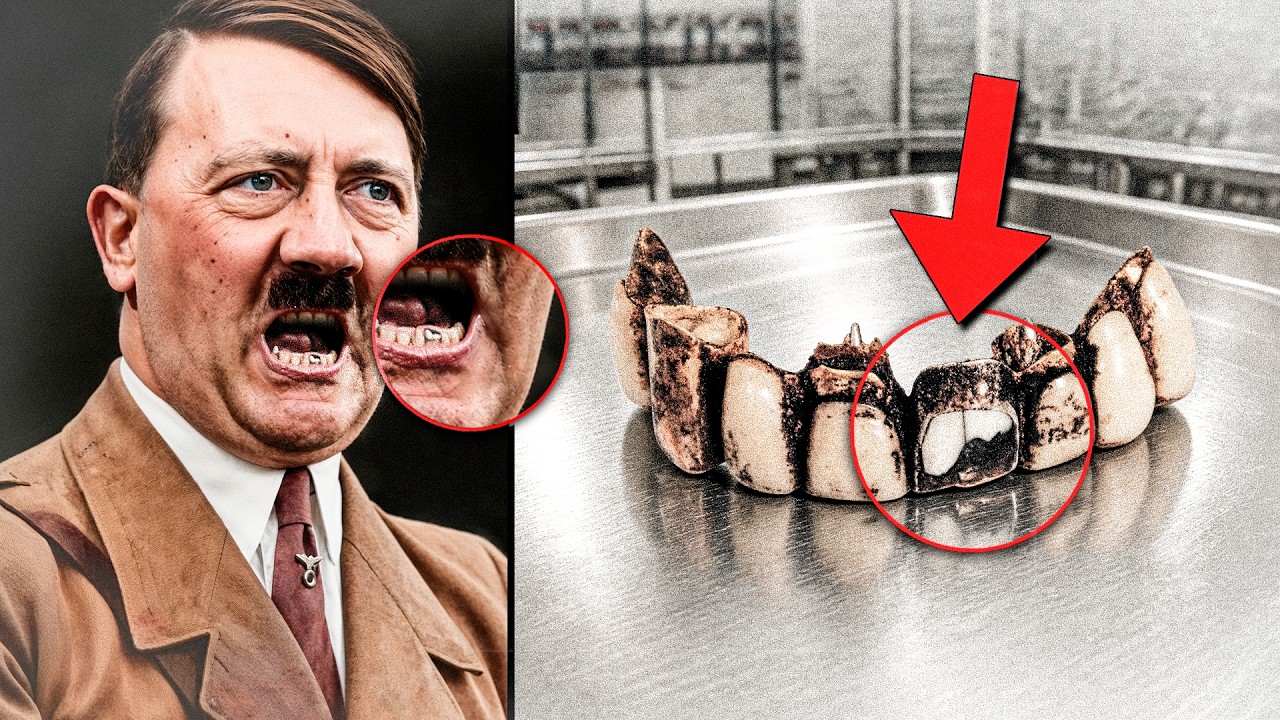
They examined a fragment of the upper jaw, just over four centimeters, with a nine-unit dental bridge made of yellow metal, possibly gold, ending in a premolar on the right side. They also examined three fragments of the lower jaw of varying sizes, each with its own dental prosthetic work, along with signs of bone reabsorption and wear on the front teeth near the incisors. The most interesting discovery was not the material itself, but what was embedded in it. Using high-precision microscopes, scientists found tiny scratches and wear marks on the surfaces of the teeth and prosthetics, compatible with years and years of use.
This was the kind of metallic trauma that only appears after a long time of chewing, speaking, and living with that material in the mouth. They also found severe wear on virtually all preserved dental surfaces and greenish tartar deposits concentrated right at the junction between the teeth and the gums on both sides. There was a strange detail as well: small blue deposits, ranging from one to thirteen millimeters, scattered across both the metal prosthetics and the tooth enamel, including ceramic surfaces, mainly in the region of the back teeth. In the gaps between the teeth and in the corners where teeth met the prosthetics, researchers found crystalline, sandy-looking deposits spread across nearly the entire length of the jaw.
On the periphery of the areas affected by cremation, remnants of muscle tissue were still visible, a reminder that behind all this technical analysis was once a living person. No one knows with absolute certainty where the blue coloration came from. But the researchers proposed a striking hypothesis: could these stains be the result of a chemical reaction between cyanide and the metal of the prosthetics, gold, platinum, iron, at the exact moment of death? If Hitler had indeed ingested cyanide, as the official account claimed, it was possible that the poison reacted chemically with the metal inside his own mouth, leaving a mark that lasted more than seventy years.
The scientists themselves admitted it could have happened at the moment of death, during the cremation process, or even during the period the remains were buried. Without a deeper chemical analysis of the stains, no single explanation could be confirmed. Another fascinating detail lay in what the scientists did not find. Using scanning electron microscopy, they searched for muscle residue, the remnants of meat that stick to the teeth of anyone who eats animal protein, even after decades.
They found nothing. No muscle fibers, no traces compatible with meat in any of the examined tartar fragments. Instead, they found plant structures embedded within the tartar, crystalline structures, clay-like layered structures, and tiny irregular structures only a few micrometers across, associated with the presence of nickel, possibly remains of the fragmentation of the dental prosthetics themselves over the years. This fit perfectly with one of the best-known facts about Hitler: in his final years, he reportedly followed a vegetarian diet.
The researchers were cautious, having examined only two fragments of tartar, not the totality of possible deposits. Still, it was a considerable indication, the kind of detail that alone proves nothing but fits neatly into everything already known about his eating habits. The clay-like structures also matched another piece of historical information: that Hitler suffered from chronic gastric pain, possibly gastritis or an ulcer, and took medications based on alginate and bile salts to treat it, according to preserved lists of medicines in the archives. The body, through the mouth, had unintentionally kept clues about the routine, diet, and even the health of the person to whom it belonged.
The question of where the fatal shot actually entered generated the most debate. The most repeated version held that Hitler placed the gun in his mouth and fired a classic intraoral shot, combined with the ingestion of poison, a double suicide in the same instant, cyanide working internally and the bullet guaranteeing no chance of survival. This version appeared in the first Soviet reports and over time became common sense, repeated in books, documentaries, and reconstructions. But the scientists found a detail that called this version into question.
They searched the surfaces of the dental tartar for residues of antimony, lead, and barium, three chemical elements that usually become impregnated in the mouth when a gunshot occurs near or directly inside the oral cavity. This was the same logic used in criminal forensics to identify whether a weapon was fired at close range. They found absolutely no trace of these elements, no antimony, no lead, no barium, nothing. This could be an indication, not definitive proof, but a considerable indication that the final shot was not fired inside the mouth.
The researchers raised the possibility that the point of entry may have been in another region of the head: the right temple, the right frontal region, or perhaps a posterior part below the jaw. The 2018 examination came after decades of refusal. The Russian secret services, the FSB, and the state archive, gave direct access to the remains to an independent team of French scientists. There were two analysis campaigns, in March and July of that year.
The work was rigorous, conducted in several different layers. First came visual analysis under binocular lenses, examining each fragment for marks, textures, and wear patterns. Then scanning electron microscopy, which made it possible to see microscopic structures with impressive detail, magnifying each particle thousands of times. Finally came elemental analysis, identifying exactly which chemical substances were present in each residue, essentially atom by atom.
The scientists then cross-referenced everything they found with old records, radiographs from 1944 kept in American archives, and the accounts of the dentists who had treated Hitler, present in Soviet files, including interrogations conducted shortly after the war. The most impressive part was the compatibility. The 1944 radiographs showed a cranial suture, the line that joins the bones of the skull, wide open. This matched the pattern observed on the skull fragment examined in 2018, even decades later.
And in the dental arches, the compatibility was even more precise, practically surgical. At the time of death, only four natural teeth remained, the four lower incisors, with enormous wear around them, a sign of an advanced stage of periodontal disease. There was a very specific crown, partially metallic, on one of the upper incisors, the type of restoration known among dentists as a window crown. And the most peculiar detail of all: an unusual metal bar, created specifically, connecting a lower right canine to a crown on one of the premolars, completely surrounding the middle tooth.
This solution was so specific, so custom-made to the anatomy of a single person, that it would be almost impossible to find something identical in another individual. This type of dental work is extremely specific, essentially a dental fingerprint. It matched point by point, tooth by tooth, with the official records of Hitler’s dentists, to such an extent that the researchers concluded it would be practically impossible for this set of characteristics to coincide by chance with any other person. Taken together, the skull, jaw, teeth, prosthetics, residues, absence of certain chemical elements, and comparison with old radiographs led the researchers to a direct conclusion.
The fragments found in 1945 and 1946 were compatible with the same individual. The skull belonged to an adult person. It had a projectile exit wound compatible with a direct cause of death. The dental information matched piece by piece with the official records of Adolf Hitler, both from the Soviet side and from the American side.
For the first time, with direct access to the material rather than reports from third parties or old photographs, science confirmed that the remains stored in Russia truly corresponded to the dictator. After more than seven decades of conflicting versions, this was the first time someone outside the Soviet and later Russian circle had the chance to see, touch, and scientifically analyze the material. The study did not definitively close every detail of the night of April 30, 1945. The scientists noted that future DNA analysis would still be useful to confirm beyond any doubt whether the skull fragment and the jaw fragments belonged to exactly the same person, since compatibility so far was established through morphological and dental characteristics, not genetic material.
But after more than seventy years of theories, contradictory versions, sealed archives, and nearly impossible access to the real traces, this was the study that came closest to placing a scientific final point on the story, not because it resolved every detail, but because for the first time, an independent team was able to confront the myth with the bone, the account with the prosthesis, and the legend with the tooth. Point by point, everything fit.