In the spring of 1866, a survey party entered a hollow in the Ozark Mountains of Arkansas to map land emptied by war. They found a road that appeared on no map the state had ever drawn. Expecting a burned homestead or an abandoned mill, they instead reached a wall of gray stone rising from the trees, taller than any building for a hundred miles in every direction. Behind that wall stood women dressed in black, who told the surveyors quietly that this place had always belonged to them.
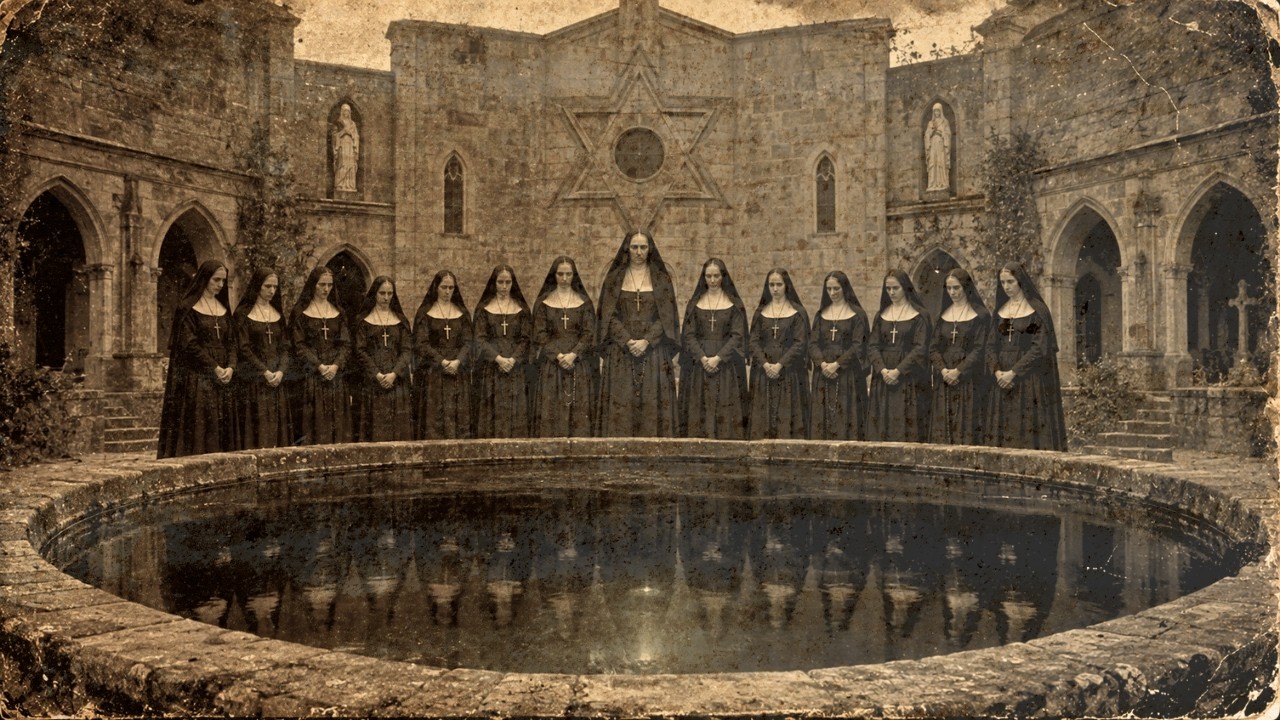
Every one of those women would be dead within four years. The children sent to live with them were never counted, never claimed, and never found. When the state of Arkansas finally sent men to ask what had happened in that hollow, they discovered that every record of the convent, every deed, every census page, every letter and business ledger and baptismal list had been thrown into the fire. The Ozarks in 1866 were a country in ruin.
War had swept the hills of northwest Arkansas twice, and each time it took something that never returned. Farms stood empty because the families that worked them had died, gone west, or simply vanished. Congregations had scattered like shot. Mills stood frozen with their wheels stilled and their channels silted.
Guerrillas still moved through the hollows at night, men who had learned in four years of irregular war that killing was easier than work and harder to punish. Into that emptied land, a small group of women came traveling north from the river. They did not arrive by wagon, because there were no wagons. They sent no word ahead, because there was no one to send it to.
The few settlers who saw them pass all told the same story in the same flat tone. The women came on foot. They wore black robes of a religious order, with the full old headdress and veil and heavy skirt. They walked in a loose line up the river road, heads bowed, carrying nothing.
That detail troubled the settlers before anything had happened at all. A shopkeeper at a crossing the locals called Pettis Ford counted them twice because the number unsettled him. Thirteen. Twelve in line and one separate at the front, taller than the rest, who never once turned her head toward his store.
He swore he could find no tracks behind them, and that they moved as though they weighed nothing at all. By winter they had established themselves in the gray stone building in the hollow that settlers were already calling Drowninglow, though no one could explain why. The sisters had not named it. The name was already on the tongues of people who had lived near that hollow for a generation, and none of them could tell you where it came from.
There was no record of a family by that name anywhere in the county files. There was no drowning anyone alive could remember. The hollow held only a spring and one stone-lined pool, and springs and pools do not drown anyone. Yet everyone in three settlements used the same word for the place, the way you use a word learned in childhood without ever being taught it.
And each of them spoke it a little more quietly than the words around it, and looked toward the hills as they did. A place gets a name like that because people drowned there often and memorably, until drowning became the name. But there was no history to anchor it. Either the drownings that named the place happened so long ago that every trace of them faded while the name survived, or the name did not come from the past at all.
A place cannot be named for its purpose except by someone who knew. The building itself was the second thing that stopped the surveyors. The women in black did not build it. They could not have.
The main structure was of dressed ashlar stone, gray and fitted so precisely that the men who examined it later said a knife blade could not slip between the joints. There was no mortar. The stone was cut so perfectly that it held by its own weight and fit forever. That is not something a small band of women who arrived on foot carrying nothing could do in one winter in the Ozarks.
Around the main house ran an outer wall, and here is the detail that every surviving description agrees on and no one could explain. The outer wall was not square and not round. It was a star. Six points of sandstone, low and enormously thick, designed with the geometry of the great star forts of the ancient world, walls built for a single purpose: to deflect cannon fire by presenting no flat face to strike.
That geometry is not decoration. It is mathematics made of stone, and it stood in rural Arkansas, in a farming valley where no artillery had ever been aimed and no army had ever marched. A six-pointed star fort of dressed ashlar in a hollow named for drowning, with at its heart a spring and a black pool. Thirteen women had appeared from nowhere to live above it.
The sisters began bringing children that winter. The first outsider to spend a full night inside the walls of Drowninglow and live to write it down was a man named Elias Ward, a widowed physician who had come to the Ozarks after the war because the settlements had no doctor. He rode a circuit of forty miles, delivering babies in cabins by firelight, setting the broken bones of men who worked alone and fell far from help, treating the fevers that rose from the bottoms every summer, and burying those he could not save. In late autumn of 1866, a rider came after dark to summon him to the hollow.
A child there was sick, the rider said, and the sisters had asked for the doctor by name. That was strange, because Ward had never met the sisters, never exchanged a word with anyone at Drowninglow, and did not even know until that moment that there were children in the hollow at all. He went anyway. He wrote that the river road leading to the hollow was in better condition than any road in the county, graveled and clear, though it passed no house that would explain its maintenance.
He wrote that the great gray gate in the star wall stood open, that no one came out to meet him, and that the moment he walked his horse under the wall, the sound of the night forest stopped completely. No wind, no insects, no owls, no distant barking. He said silence had a pressure, and that it settled on his ears like deep water. Inside the main house, the mother superior received him.
He described her as tall and pale and unhurried, a woman who moved as though all the time in the world belonged to her. She signed the receipt for his services with a single initial and a family name. Fayle. It is the only name we have for her, and it appears in no church record, no immigration list, no ship manifest that anyone has found on either side of the ocean.
Mother Fayle took him to the child, a girl of about eight lying in a narrow bed in a long stone dormitory. Ward stopped at the threshold, because the dormitory held dozens of beds in two long rows, every one of them neatly made and cold, and all of them were empty except for that one child. He did what he could for her. She was burning with fever and never fully woke, and he worked over her until the early hours.
As he worked, he asked the quiet doctor’s questions. How long had she been sick? What had she eaten? And looking across the rows of empty made beds, where were the rest of the children?
Mother Fayle answered the first two questions in few words. The third she did not answer. When Ward asked again, gently, she told him the other children were receiving their lessons below, and that he need not concern himself about them. There was something in the way she said the word below that made Ward decide not to ask a third time.
He wrote that he had questioned killers with less fear in his chest than he felt asking that pale woman a simple question about children. The dormitory floor was warm under his boots. Warm as a floor is when a fire burns beneath it, a living, steady warmth rising through the stone. Though it was late autumn, no smoke rose from any chimney he could see, and no stove burned in any room he entered.
And through that warm floor came a dull sound, felt more than heard, a sound he could not name and never stopped hearing afterward in his quiet moments. He called it a hum. Not human voices, not wind, not any machine he knew. A low, even, unchanging hum rising through the soles of his feet and settling in his teeth.
It was present the entire time he was in that house. Before dawn the girl’s fever broke. Unable to sleep on the hard bed they gave him, disturbed beyond endurance by the warmth and the hum and the empty beds, he rose and walked the corridor. He found the sisters, all of them, awake in the darkness of a long room at the end of the hall that he took for a chapel, though it held no cross and no lit candle.
They were not kneeling. They were not praying, at least not aloud, and not in any language he knew. They stood in orderly rows, all facing the far wall where the altar should have been, and where instead he found a low arched opening in the stone, black and leading downward. The hum was much stronger there.
It came from that dark arch like breath from a mouth. The sisters swayed, all of them slightly, together in a slow and regular motion in time with the sound, like a field of grain, like seaweed in a current. He stood in the doorway longer than he meant to, nailed to the spot, and then Mother Fayle’s voice came from the darkness, low and clear, without turning her head. She told him the child was sleeping now and that he should sleep too, that morning would come.
He understood. It was a door closing gently in his face. He returned to his bed and lay in the dark with his eyes open and the hum in his teeth until gray daylight came. Then he rose, took his horse from the gate, and rode out of the valley.
He wrote at the end of his letter that as he descended the end of the graveled road and crossed an invisible line, the sounds of the world returned to him all at once, wind and birds and distant water coming back like a held breath released. And he found himself weeping over the saddle of his horse, a lonely old man on a road at dawn. He could not have told you then or ever why he wept. Children are the point where the records truly darken.
There were children. That is not in dispute. In the years immediately after the war, orphaned and abandoned and relinquished children moved across this country in numbers that are genuinely hard to comprehend. The solution the age arrived at was to load these children onto trains and send them west, to be handed over at station platforms to whoever would take them, sight unseen.
They were called orphan trains, and they moved hundreds of thousands of children. The records of who stepped off at which platform and went with whom and vanished into what fate are mostly completely empty. That was only one river feeding the same dark stream. There were local war orphans, Ozark children whose fathers had died fighting and whose mothers had died of the sickness and hunger that followed.
There were indentured children, handed over to families or institutions that promised to raise them in exchange for their work until adulthood, a practice that was common, legal, and almost entirely unrecorded. It was not strange for a convent in that country and that year to take in such children. It was expected. It looked like charity.
And that is exactly what made it a perfect trap. Drowninglow took them in, and the few settlers who spoke of it decades later still remembered the wagons. They came up the river road at dusk, always at dusk, never in full daylight. In the back of the wagons were children, sometimes a few, sometimes a dozen, hunched in silence.
Quieter than children should be, one old woman said. All through the years that Drowninglow received children, no one outside those walls was ever seen aging. No one ever escaped to a neighboring farm to tell a story. No one was ever placed with a family in the county after growing up, as was done with convent children anywhere else in the world.
No one ever reappeared years later to say, I was raised at Drowninglow, and this is what happened there. They went up the road, and that road was the last anyone ever saw of them. A woman named Amelia Frost tried to prove where those children went, and because of her we know what we know, which is very little. She wrote for a newspaper in Little Rock, and in the early 1870s she became convinced that something had been buried in that hollow in every sense of the word.
She gave a year of her life to it. She rode the county on a rented horse, settlement to settlement, cabin to cabin, gathering the accounts of people who had lived near the place, patient over months in earning the trust to make them speak about something they had all agreed, without ever discussing it, never to speak of. Then she took what they told her to the capital, to the offices where records are kept, to compare the folk accounts against the paper documents. She was the first to discover that the papers were gone.
A census page that should have listed Drowninglow Hollow and everyone in it had been cut from the bound volume with a sharp blade, a clean cut near the spine. The deed that should have recorded ownership of the land under the star wall did not exist and appeared never to have been recorded, though the building on that land was unquestionably the largest and most expensive in the entire county. When she wrote to the church, to the diocese that would have held authority over any Catholic order working in that region, asking for any record at all of the nuns who served at Drowninglow, she received a curt reply informing her that no such order had ever been recognized or approved, that no nuns had ever been sent by the church to any place called Drowninglow, and that the diocese had no knowledge of any convent at that location. She was thanked for her inquiry and asked not to correspond further.
A building too grand for its occupants to have built, on land with no recorded owner. A convent full of children run by an order the church swore never existed, in a hollow whose census page had been cut from the record with a blade. Every thread one might follow to the truth had been pulled and burned before Amelia Frost ever touched it, and she was tracing it only a few years after the events, while witnesses were still alive. Someone knew early that questions would be asked, and went through the records first and closed every door.
She did not stop. She found Elias Ward, then an old man near the end of his life, and obtained from him the letter I have been quoting, the full account of that night with the feverish child, the empty beds, the swaying sisters, and the hum. She found the shopkeeper’s story of the thirteen who left no dust and no tracks. She found the men who had spoken with the carrier before he fled the county.
Thread by thread, over that long year, she assembled the actual chronology of what happened in that hollow between the autumn the sisters entered and the night, four years later, when everything in it went dark at once. That chronology, which she built and could not get printed, is the backbone of everything that follows. To understand what happened at Drowninglow, you must understand the pool. Beneath the main house, cut into solid bedrock, was a cistern.
The settlers called it the pool or the well, though it was far wider than any well a man would dig. It was a chamber lined with the same astonishing dressed stone that sheathed the walls above, filled with water, and the water was black. Not murky. Black.
That flat, lightless blackness of water extending to a depth no light reaches. Its true depth was never measured, though men tried. Every time a measuring rope was lowered, it ran out completely. A hundred feet, two hundred feet, and once, on the only occasion Frost could document, a state surveyor let out every rope he had, then tied on more and let that out too, and never touched bottom.
And drew up his rope dry to the last inch, which is impossible in itself. He could not explain it and did not try. The pool did not behave like water. In dry summers, when every spring in the county went dry and the Kings River turned to gravel, the black water of Drowninglow did not drop a fingertip’s width.
In wet springs, when streams ran high and brown and loud, it did not rise. It held its level, constant and indifferent, as if connected to another source and obeying a different weather than the sky’s. Except on those rare and terrible occasions when it did rise. And on those occasions, without exception, children died.
The first death Frost could date with certainty occurred in the winter following the sisters’ arrival. A local man named Toll, who occasionally hauled goods for the convent and was one of the rare outsiders permitted past the gate, came down from the hollow one gray evening white as ash and refused, for any money, to go up again. He told the story to two men before he sold his few possessions and left the county for the west, and nothing was ever heard of him again. Years later, both men told the story to Amelia Frost, and their accounts matched in every essential detail.
Toll said he had been in the lower part of the house, near the pool, waiting to be paid for a load of goods, when he saw one of the children. A small boy, seven or eight years old, standing at the edge of the black water with his back to it, facing the sisters who stood in their orderly rows in the darkness. Toll said the boy was not tied, was not resisting, was not crying. He was quiet, the quiet of the children in the wagons.
And as Toll watched, unable to move or speak, the boy simply stepped backward off the stone edge into the black pool and went under without a sound, without an audible splash, and the water closed over where he had stood. Not one of the thirteen women turned her head. Then, Toll said, the water rose. He stood frozen watching the flat black surface climb the dressed stone, slowly and steadily and silently, past the place where the boy had drowned, rising toward the feet of the standing women.
He did not wait to see how high it would go. He ran. He ran out of the lower house and across the silent yard and through the open gate, and he did not stop running until the ordinary sounds of the forest closed around him again. And as he ran, he swore he heard the hum change behind him.
He said it rose. He said its pitch and its strength climbed, just as a sound rises when the thing that makes it is being satisfied, or answered, or fed. The children who died at Drowninglow—and Frost was able to document at least nine deaths with evidence strong enough to fix the time and circumstance of each—died dry. That is the thread that runs unbroken through every account of every death, and the detail no one could ever explain.
The bodies, when bodies were found, when a child’s remains were found in the woods below the hollow or washed up on a gravel bank of the Kings River miles away, showed every clear medical signature of death by drowning. Water in the lungs, the particular swelling and pallor of skin that a physician learns to recognize and cannot mistake. Ward was called to examine two of them and recorded in clear clinical language that these children died with their lungs full of water. About that there was no doubt.
And yet their clothes were dry. Their hair was dry. The ground beneath them was dry, with no wet trail leading to them, no sign that a wet body had been dragged or carried there. Children who died drowned, lungs full of water, lying dry in dry places, as though the water that killed them had given them up and returned to where it came from, leaving death behind and removing all trace of itself.
Nine times Amelia Frost was able to count them and verify. There were certainly more she could not count. And through all of it, over four full years, the sisters did not change. No sister sickened for a single day.
No sister aged, no back bowed, no hair grayed, no step slowed. No sister left the hollow for any reason. No new sister was ever seen arriving by the river road. Yet their number remained exactly constant every time anyone could count them.
Twelve, and one more bringing it to thirteen. When one died, and in the end they all died, another simply appeared in the line to fill the place. No one could say when or from where, because there was no road she could have traveled without being seen. In the early spring of 1870, a circuit preacher named Josiah Crane, a hard man with an iron Old Testament soul who rode the same forty miles of hills that Ward rode, carrying the gospel to settlements that had no church and no Sunday and no comfort but what a passing preacher brought them, decided that Drowninglow was not the house of God at all.
He had heard the stories of the valley, the wagons that went up full at dusk and came back empty, the children who were never seen again, the women who did not age and did not eat. He became convinced it was his duty before God to ride up there and see the children with his own eyes and put an end to whatever was being done to them. Against the advice of everyone who knew him and cared for him, he rode his horse alone up the river road to the hollow. He carried, according to the accounts that survived, a Bible and a lantern to face the dark ahead.
Some said he also carried a pistol in his coat. We know he arrived, because a boy from a farm downriver saw him pass. We know in broad and terrible outline what happened in the hollow that night, because Crane went up on a night when all of Drowninglow could be seen from the tall hills above the river bend, and there were people on those hills. They all said they had been drawn there by the hum.
For the first time in the four years the sisters had lived in the hollow, the hum was loud enough to be heard outside the star wall, through the woods and across the valley and the river, pulling people from their farms and up onto the hills, as a strange light in the sky pulls people from their houses to stand and stare and be afraid together. What those witnesses saw—at least five of them, whose accounts Frost collected separately and found to be identical—is the reason Drowninglow is not merely a sad story of cruelty in an isolated place. They said the hum came across the valley that night like a storm coming, a pressure you feel before you hear it. As it rose, the gray walls of Drowninglow in the moonlight seemed to breathe, swelling and settling, swelling and settling.
Stone does not do that. They knew stone does not do that. They said a light came up from the ground inside the ring of the star wall. Not firelight, not lantern light, not any warm color of flame.
A pale light, they all said. Cold. One of them described it to Frost as the color of the sun seen from under deep water, from a great depth, looking up. And that pale light pulsed slowly and regularly, in perfect time with the rhythm of the hum.
In that pulsing watery light, they could see the sisters, below, inside the walled yard. All of them, the thirteen, in their black robes, standing in orderly rows around the low arched opening in the stone. In the middle of the sisters, small from that distance, stood a man holding a lantern. They knew it was the preacher’s lantern.
As they watched, the preacher’s lantern went out. Then the water rose. Not from the sky. There was no storm.
The sky above the hollow that night was clear and hard and full of stars, the moon was high and bright, and not a single drop of rain had fallen in that country for over a week. The water did not fall. It rose. It came out of the earth, through the black arched opening in the heart of the yard.
It filled the space inside the star wall. It was black, and it was rising. It did not spread outward or run down the hills or dissipate across the valley as floodwater spreads and runs and dissipates. It stayed within the six points of the star, contained behind those angular gray walls exactly as water is contained within the walls of a cup.
And it rose, past the stones of the yard, past the doors of the lower house, up the gray facade of the main building, and it kept rising until the water inside the star wall was higher than the outer wall itself. A column of black water stood above its banks, defying every known law of water. A standing tower of black water in the moonlight, with a cold pale watery light shining from below through its entire height from the distant arch, and the sisters somewhere inside that water, and Josiah Crane somewhere inside that water. The hum by that time was so vast and all-encompassing that the witnesses on the hills, every one of them, said the same nearly unbelievable thing.
They felt it reach into their chests and take hold of their hearts and stop them. It held them stopped for a long moment outside of time, and then let them go, and their hearts surged back into beating. The tower of black water stood, they said, for the length of a slow count to sixty. Held there above its banks, lit from within, humming with a sound that stopped hearts.
Then it fell, all at once, the way a held thing falls in the instant it is finally released. The whole black column went down, straight down, into the yard, through the arched opening, down into the pool from which it had risen. It vanished in the blink of an eye, and with it the hum died, and its pale lights went out, and the hollow was in an instant just a silent dark hollow of the Ozarks under a clear spring moon. The gray walls of Drowninglow stood as they had always stood, wet to a certain height and dry above it, ringed by an even line of brown packed sediment left by the black water.
A new mud line. Formed in a single night before the eyes of witnesses, in the only place in the world where all the old and inexplicable mud lines on every buried wall suddenly had an explanation. And it was an explanation no one on that hill, and no one who has stood at Drowninglow since, has ever dared to face directly. When the settlers finally gathered the courage to go up the river road to the hollow, which took them three full days, they found the place empty.
The great gray gate in the star wall stood open. The yard inside was perfectly dry, with no sign that a tower of black water had stood in it nights before. Only that fresh level line ran around every wall at the height of a tall man. The long dormitory was silent, every narrow bed neatly and squarely made, cold, and empty.
The chapel at the end of the corridor was silent, and the low arched opening at its far end was there, black and descending, and none of those hardened men dared approach within ten feet of it, and none of them could tell you why, only that approaching it was unthinkable and that your whole body resisted it. The sisters were gone. All of them, thirteen. Josiah Crane was gone.
They found his lantern on a stone of the yard, cold, its glass cracked through, its wick burned to nothing. And the children were gone. Every child, every empty bed, every small pair of shoes vanished from the shelves beside the dormitory door. Every trace of every child who had walked that fear-filled road through four years of dusk was gone, as though the water that had taken them had taken the last of them all at once and closed over the place where they had been.
They found Josiah Crane a week later in the river at the shallows below a gravel bar. Drowned. His lungs were full of water. His clothes were dry.
And over the next month, as the Kings River gave up its dead one by one, they found the children. Not all of them, not even most, but enough. Small bodies among the reeds and on the gravel bars for miles downstream, all drowned, all dry, laid out on the banks by the receding water as though careful hands had arranged them. And something about those small bodies the men who recovered them carried with them to their graves, and spoke of rarely and only late at night.
The men swore that some of those children were children who had walked the river road in the first winter the sisters came. More than four years before that night. Children whose grieving fathers or frightened wagon drivers had watched them climb into the cart in the autumn of 1866. They had not aged.
They had not decayed. They lay on the gravel of a spring in 1870 as though they had drawn their last breath that morning. Dead for four years and unchanged by a single day. Drowned and dry and perfect and gone.
Within a season of that night in the hollow, the county courthouse burned. We are told that courthouses simply burned in those years, constantly, carelessly, chimney fires and dry summers and drunken clerks, and that this is why so much of the recorded history of this entire region and this entire era has been lost. The courthouse fire that season consumed the property records, the census volumes, and the county’s copy of every legal document that could have revealed who owned the land under the star wall, who worked at the convent, how many children had been indentured there and who had indentured them, where they came from, and where they were meant to go. The diocese closed whatever file it had or did not have, and never spoke of Drowninglow again.
The state of Arkansas, when Frost finally embarrassed a minor official into ordering an investigation, sent two men up the river road to the hollow to see for themselves. They returned and submitted a report saying they had found a collapsed stone structure of no interest, apparently abandoned, of unknown age and origin, and recommended the matter be considered closed. The report was a single page. Then that single page, the last official document produced by Drowninglow and the last thread, disappeared from the file into which it had been placed.
Amelia Frost, who held the report in her hands for one afternoon and copied a few lines from it, could never afterward prove it had existed at all. She eventually published what she had, everything she had gathered in that long year, in a thin pamphlet she paid to have printed herself and almost no one read. The pamphlet itself is now nearly impossible to find. Only one or two copies in private hands, and nothing in any library or archive in the state, which may be the ordinary and unnoticeable fate of a self-published pamphlet from the 1870s, or may be another small clean thing swept quietly from the table by the same hands that had tampered with the census and burned the courthouse and lost that single page.
Which of those is true depends entirely on how much you believe of what you have heard. Amelia Frost died a few years after publication, still young, of fever as the record says. Her journals and collected papers, her account ledgers, her copies and letters survived her for no time at all. No one who inherited her possessions could later say what had become of them.
Drowninglow settled into the earth and into legend, a story to frighten children about wicked drowning nuns, something the old people of those hollows would not speak of, their mouths closing tight upon it, until at last those who remembered and had lived it were gone, and the river road grew over, and the star wall sank another inch slowly into the soil, and the world moved on as it always does from places humanity has silently agreed not to look at again directly. But the stones are still there. The gray star wall still stands, its six points blunted under a century and a half of decaying leaves and slow ruin. It has sunk to the chest of a standing man, so that what was once a fort you could ride a wagon into is now just a low broken ring of stone among the trees.
The main house is only a shell, but the walls still stand. The dressed gray ashlar that no man in that county could have cut. The joints that still refuse to admit a knife blade. And if you enter what was the chapel and make your way to its far end, you will find a low arched opening in the stone, black and descending, and you will find that you do not wish to approach it.
The closer you get, the more your whole body draws back, and you cannot explain why. No more than the frontier men could explain it. No more than Ward could explain why he wept on the road. The mud line is real.
You can walk to that hollow and lay your living hand flat on a level line of packed brown earth that runs around a building standing on a slope. A perfectly level line on a slanted wall, which ordinary weather and ordinary time cannot and do not do. Only a standing flood does that. The deep places of that structure, the lower rooms, the passages near the arch, are colder than the surrounding earth by more than any reasonable calculation of shade and stone and depth can explain.
And I did not approach the arch. I stood in the doorway of that chapel as Ward stood in a doorway 160 years ago, felt the full weight of my body refusing to go forward, turned, and walked back into the yard within the star. And when I stood in that dry yard inside the six gray points, the sound of the forest stopped behind me. The birds fell silent.
The wind died at the wall, and through the dressed stone, I felt a hum in my teeth more than I heard it with my ears. A constant, patient, waiting hum. And I walked down out of that hollow, and I did not stop walking until the ordinary sound of the living world came back to me, like water closing over a drowned man.