On her wedding day in September 1982, Carolyn Jones smiled for the photograph, wearing a lace cap to cover the hair she had lost to chemotherapy. Not long before, she had been told the cancer inside her was terminal. She married anyway, because that was the kind of woman she was: someone who refused to stop reaching for the things she wanted until the moment she could no longer reach. Most people remembered her as Morticia Addams, with her pale skin, dark eyes, and slow, gliding walk across a black-and-white set.
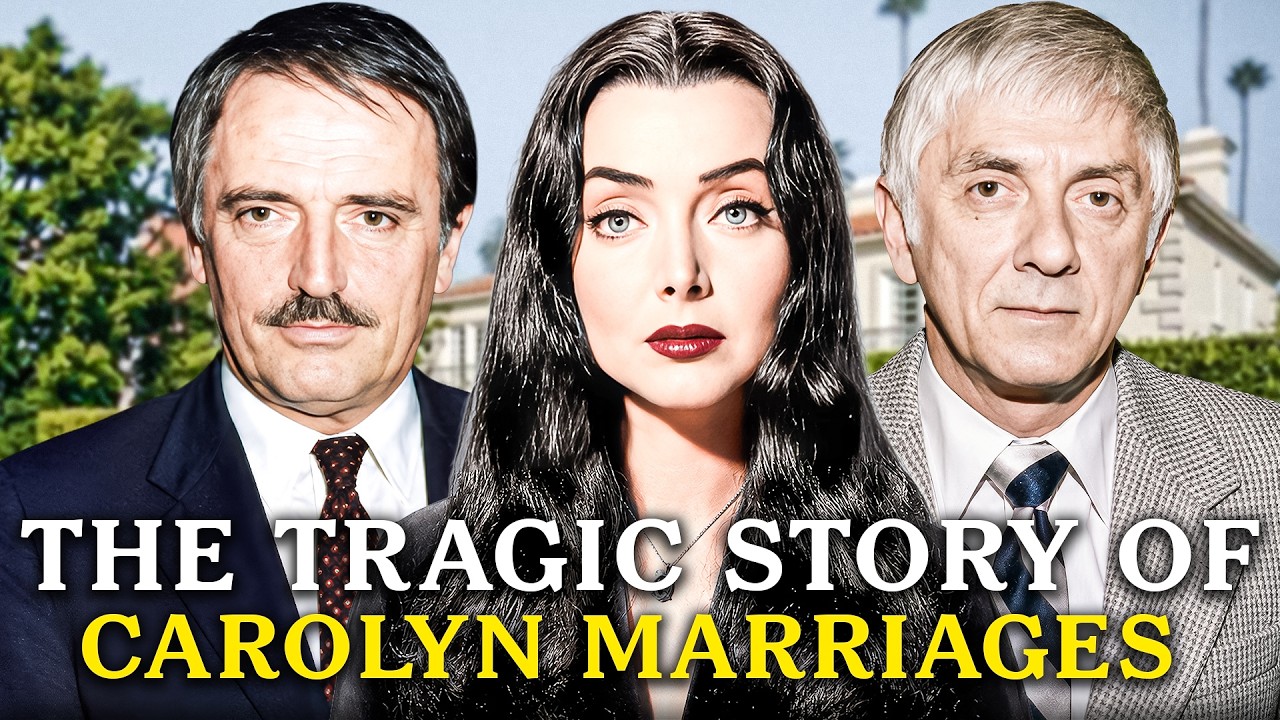
But behind the character was a real woman with a real life, one far stranger, more painful, and more fascinating than anything she ever played on screen. Four marriages, a career that soared and crashed and soared again, and an ending that even now is hard to sit with. Carolyn Sue Jones was born on April 28th, 1930, in Amarillo, Texas. Her father, Julius Alfred Jones, was a barber.
Her mother, Chloe Janette Southern, was a housewife. By 1934, when Carolyn was four years old, Julius had walked out on the family, leaving Chloe to raise Carolyn and her younger sister alone. They moved in with Carolyn’s maternal grandparents, and in that house in Amarillo, with its tight finances and missing father, she grew up. Severe childhood asthma kept her indoors while other children played outside.
When she could not go to the movies, which was often, she read Hollywood fan magazines cover to cover. She memorized the names of studios, directors, and cinematographers, studying the gossip columns the way other children studied geography. Years later, in a 1961 interview, she described her childhood matter-of-factly: her health prevented her from going to school, she was not well enough to play outside, and her activity was mental rather than physical. She had long since turned that limitation into something useful.
From an early age, she told anyone who would listen that she was going to become an actress, not as a vague dream but as a specific, fixed intention. She attended Amarillo High School, where she studied elocution and won first place in the tri-state declamation contest in her junior year. After graduating in 1947, she asked her grandfather to pay her tuition at the Pasadena Playhouse in California, one of the most respected acting schools in the country. He was not immediately enthusiastic, but the story goes that Carolyn sat on the steps of Southern Methodist University, which he had taken her to visit, and wept and pleaded until he changed his mind.
She enrolled at seventeen, possibly lying about her age, and threw herself into the work with an intensity that impressed her teachers and fellow students alike. It was during those years at the Pasadena Playhouse that her first marriage began. Don Donaldson was a former United States Army Air Corps officer from Detroit, about eight years older than Carolyn, studying at the same school. They married in Las Vegas on June 20th, 1949, followed by a second ceremony in Los Angeles on August 19th, 1950, suggesting some complexity around the first.
Carolyn was nineteen, Don was twenty-six. The whirlwind marriage did not last. The precise reasons she never discussed at length. The divorce happened before she had properly launched her film career, and she moved on with the forward momentum that characterized everything she did.
She absorbed the loss, returned to her craft, and kept moving. By the early 1950s, her career began to move in earnest. A talent scout spotted her at the Pasadena Playhouse in a production of Dark of the Moon and connected her to Paramount Pictures. Her first film appearance came in 1952’s The Turning Point, a small uncredited role.
Then came The Big Heat in 1953, another uncredited part as a nightclub hostess, and House of Wax in 1953, in which she played the woman Vincent Price’s character turns into a wax statue of Joan of Arc. The pattern that had begun in that first marriage, the speed, the passion, the faith that this time would be different, would repeat three more times. The second marriage would define her career almost as much as the role she was still years away from playing. In the early 1950s, Aaron Spelling was nobody.
He was a young man from Dallas, Texas, with a degree from Southern Methodist University and a prize for playwriting, but in Hollywood he was barely treading water. When he and Carolyn met, he was earning around $100 a month directing a show for Preston Sturges. She was working backstage at a theater called The Players Ring, essentially for nothing. They married on April 5th, 1953.
She converted to Judaism as part of the union. They were, by most accounts, genuinely in love, a couple of broke, ambitious young people in Hollywood. For the first several years, Carolyn was the one holding the financial reality of the marriage together. Aaron acknowledged in later years that she took jobs that were, in his word, trash, so he could stay home and write.
In 1953, she was cast in From Here to Eternity, one of the most anticipated films of the year, which would go on to win eight Academy Awards. She contracted pneumonia and had to withdraw. The role went to Donna Reed, who won the Academy Award for Best Supporting Actress for it. The near miss is a genuinely painful Hollywood footnote.
But other things came. In 1956, she appeared in Invasion of the Body Snatchers, which became a landmark of the genre, and in Alfred Hitchcock’s The Man Who Knew Too Much, alongside James Stewart and Doris Day. In 1957, she appeared in The Bachelor Party, directed by Delbert Mann. She was on screen for eight minutes, and she received a nomination for the Academy Award for Best Supporting Actress.
She did not win the Oscar, but the nomination confirmed what the industry had been noticing: Carolyn Jones could do things with small amounts of screen time that most actors could not do with fifty minutes. That same year, 1958, she appeared alongside Elvis Presley in King Creole, widely regarded as the best film Presley ever made, and she won the Golden Globe Award for New Star of the Year. In 1959, she worked with Frank Sinatra in A Hole in the Head, with Dean Martin in Career, and with Anthony Quinn and Kirk Douglas in Last Train from Gun Hill. For a brief window, Carolyn Jones looked like she was going to be one of the defining film actresses of her generation.
But during that window, something began to go wrong in the marriage. Aaron’s career shifted from acting to writing and then to producing, and his trajectory only went up. Carolyn’s trajectory had begun to flatten. The studio system that had once supported her was changing, and at home the balance of the marriage had shifted.
In October 1963, they separated. The language used at the time was the familiar language of mutual affection that had outlasted romantic compatibility. The divorce was finalized in August 1964. Carolyn did not ask for alimony.
Aaron gave her their house as part of the settlement, and the community property, around $400,000, was divided between them. It was, by Hollywood standards, remarkably clean. They remained friends genuinely, and in the 1970s, when Carolyn was working her way back into a career that had gone cold, she guest starred on several shows produced by Aaron Spelling, including Fantasy Island and The Love Boat. The same year her marriage ended, Carolyn Jones was offered the role of Morticia Addams in a new television series called The Addams Family, based on the cartoons of Charles Addams that had been running in The New Yorker since the 1930s.
Aaron Spelling was the one who talked her into taking it. Carolyn had always considered herself a film actress, and television felt like a step down. But the role was the lead, a character with genuine comic and dramatic range. She took it, and she was extraordinary.
The Morticia she created was unhurried, elegant, completely unaware that the world found her family disturbing, and deeply, sincerely in love with her husband, Gomez. She moved in a tight custom-made dress, wearing a long black wig and dyed eyebrows, with a deliberate stillness that became her signature. The series ran from September 1964 to April 1966, sixty-four episodes in two seasons. It was a cultural phenomenon and a durable one.
Carolyn received a Golden Globe nomination. The network cancelled it anyway. Not because the ratings collapsed; the ratings were solid. But ABC decided the time slot and format were better used elsewhere.
Carolyn later reflected with characteristic honesty that she had expected the typecast risk to be manageable because people remembered her film career. She had been wrong. Studios and producers looked at Carolyn Jones and saw Morticia Addams. They had difficulty seeing past it to the woman who had been nominated for an Academy Award.
The late 1960s were lean years. Parts were infrequent, and she took anything that let her keep working. It was during this lean stretch that her third marriage began. Herbert Greene was one of the most respected musical directors in Broadway history, a Tony Award winner who had conducted The Music Man and worked as a vocal coach with some of the biggest names in theater and film.
He and Carolyn crossed paths in the theater world, he was her vocal coach, and what began as a professional connection became something more. They married on December 19th, 1968, in Beverly Hills. It was Carolyn’s third marriage and Herbert’s third as well. They moved to Palm Springs, away from the industry.
The early years of the marriage appeared relatively settled. But the pull of Hollywood was something Carolyn could not permanently resist. She missed the work, the camera, the particular electricity of being in front of an audience. In 1976, she appeared in the horror film Eaten Alive, directed by Tobe Hooper, and in Wonder Woman as Hippolyta, the mother of the title character played by Lynda Carter.
In 1977, she appeared in Roots, the landmark television miniseries, playing Mrs. Moore, the wife of a plantation owner. She did four episodes of Fantasy Island and an episode of The Love Boat, both produced by Aaron Spelling. On April 5th, 1977, she filed for divorce from Herbert Greene.
The marriage had lasted nine years. She was forty-six years old, divorced three times, back in Los Angeles. Something was already growing inside her that she would not discover, or at least not acknowledge, for several more years. Peter Bailey Britten was an actor, younger than Carolyn, less prominent, working in the industry at a level significantly below hers.
They met and fell into a relationship that lasted as friends and companions, and eventually partners, for approximately five years before they married. The relationship was, by all reports, a warm one, quieter and more companionable than her previous marriages. In 1981, Carolyn was cast as MNA Clegg in the CBS daytime soap opera Capitol, a power-hungry political matriarch, scheming and formidable. The show debuted in March 1982.
And then, in March 1981, she had been diagnosed with colon cancer. The diagnosis came while she was still preparing for Capitol. She processed it alone, quietly, and then decided how to handle it in front of other people. She told no one on the set.
She told her colleagues she was being treated for ulcers. She continued to show up, hit her marks, delivered her lines. She was completely professional. There was a period in late 1981 and into 1982 of what appeared to be remission.
And then in 1982, the cancer returned. It had spread to her liver and her stomach. It was terminal. At that point, Carolyn Jones made two decisions.
The first was to keep working. She continued to play MNA Clegg for as long as she physically could, getting into a wheelchair when she could no longer stand, having her scenes written or repositioned to accommodate her failing mobility. The second decision was to marry Peter Bailey Britten. On September 25th, 1982, they were married.
She wore the lace and ribbon cap to cover the hair she had lost during chemotherapy. She knew she was dying. He knew she was dying. They got married anyway.
The ceremony was private, no press announcement, no carefully worded statement. Her co-star Jane Daly later described her with a specificity that has stayed in the record: Carolyn was determined to keep playing that character until she literally could not get the words out of her mouth anymore. Indomitable is the word she used. In July 1983, Carolyn Jones fell into a coma at her home in West Hollywood.
She died on August 3rd, 1983. She was fifty-three years old. Her body was cremated the following day. A memorial service was held in Altadena, California, on August 5th.
She is buried at Melrose Abbey Memorial Park in Anaheim, alongside her mother. Before she died, she told her sister what she wanted her epitaph to say. She wanted it to say she gave joy to the world. Four marriages, no children, a choice she had made with Aaron Spelling, deciding that the demands of a career and a family were not something she could hold simultaneously, a decision she carried forward through everything that followed.
An Academy Award nomination at the peak of her powers, a Golden Globe, a role that made her face known to millions, and then, paradoxically, made it harder to be seen as anything else. A career that spanned more than three decades and included more than thirty films and dozens of television appearances. The four marriages tell their own story. Don Donaldson was a young woman’s first attempt at love, brief, impulsive, soon outgrown.
Aaron Spelling was a partnership of equals that became unequal as his career found its true scale, ending with more grace than it had reason to. Herbert Greene was a retreat from the industry, a slower decade in Palm Springs that ultimately could not hold her. Andrew Peter Bailey Britten was the final arrival, the person she chose, with full knowledge of how little time was left to be with at the end. The cancer she fought in those final years was as relentless as everything else in her life had been difficult.
She did not step away from the camera to rest. She showed up in a wheelchair on a daytime soap opera and played a scheming political matriarch while telling her colleagues she had ulcers, a performance of ordinary professional normalcy that required as much skill and endurance as anything she ever did on screen. She had chosen this life at seventeen, weeping on the steps of a university she did not want to attend, begging her grandfather to let her go to Pasadena and become what she had always known she was going to be. She had held on to it through four marriages, an Oscar nomination, a cancellation, typecasting, and terminal illness.
In the end, she was exactly who she said she was going to be.