In the spring of 1897, the people living below the ridge in Letcher County, Kentucky, did not speak the name of the family that lived above them—not aloud, and not on paper. When the county register was pulled from its shelf, the pages recording two births and one marriage had been carefully torn from the binding. The Ottwell sisters, Mercy and Tabitha, were the last of a line that had settled the hollow before the county had a name. Mercy was thirty-two, tall, with pale gray eyes and the hands of a woman who milked goats and cut wood.
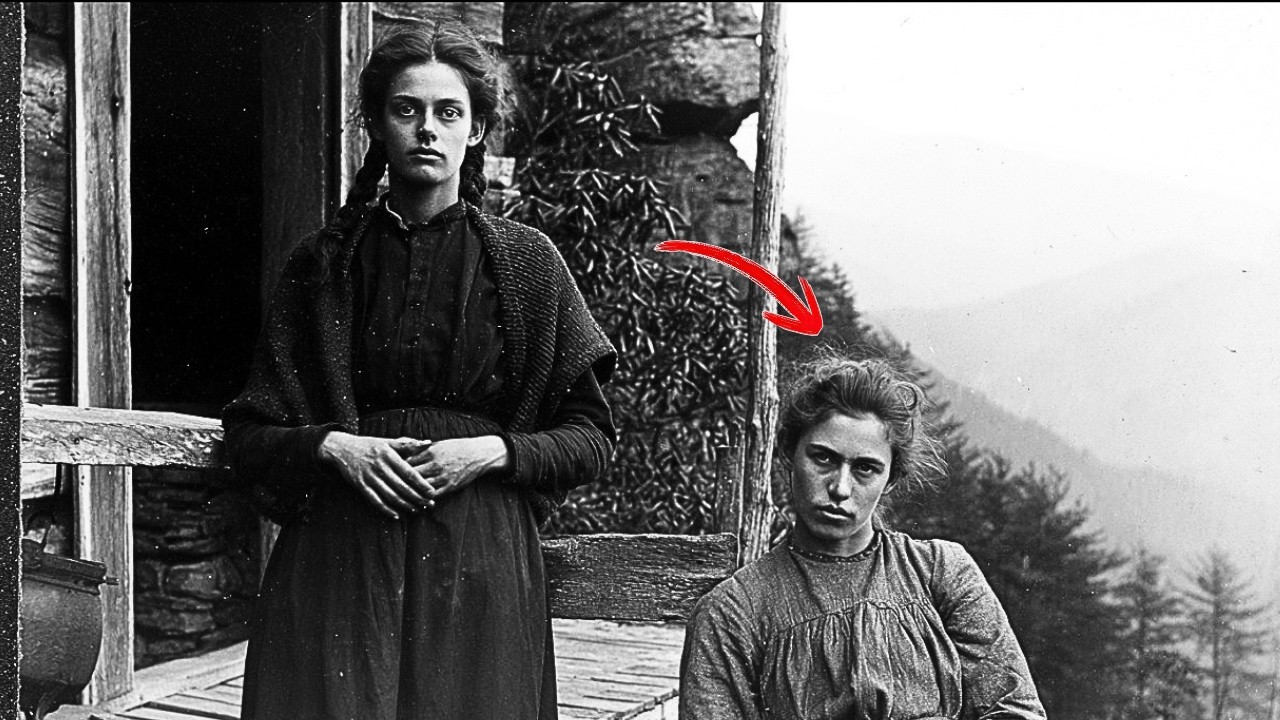
Tabitha, twenty-eight, was slighter, with copper-colored hair and a mouth that seemed always about to smile at something she had not yet said. They lived in the cabin where their mother had died. Their father, Absalom, had walked past the springhouse one November morning in 1889 and never returned. Nobody had brought his body home, and nobody ever claimed they would try.
The sisters were known for something else as well. Old Prudence Halloran, then sixty-eight, told anyone who sat still long enough that Mercy Ottwell had come down the mountain through a snowstorm with a jar wrapped in flannel, sat by her bed for a day and a night without eating or sleeping, and broke her fever by dawn. The sisters healed the sick. Their names had been struck from the church register by the previous minister, a man named Kelso, who served the valley from 1880 until 1896 and died of a stroke in his sleep.
In sixteen years, he had never once climbed the notch road to visit the family at the top. When pressed, he said only that his responsibility lay with those who came down to him. His replacement, the Reverend Elphinstone Corwin, had no such caution. On the second week of April 1897, he rode a borrowed mule up the notch road, a Bible under his arm and a question on his tongue.
When the mule refused to go farther, he tied it to a laurel tree and walked the last half mile on foot. Mercy met him on the porch. She did not seem surprised. She told him, before he could speak, that he was welcome to sit and she would make tea, but if he had come to strike their names from the book again, he could go back the way he came, because that had already been done.
Corwin wrote later to a friend in Cincinnati that he felt, in that moment, as though he were the one being examined. He asked about their mother. She had been sixty-one when she died. He asked about their father.
Mercy said he had passed the springhouse in November of ’89, climbed to the gap, and never come back. When Corwin asked gently what she meant, she looked at him a long moment with her cold gray eyes and said that some land was theirs to keep, and some they were never to set foot on. Her father had known the difference, and he chose to forget. Corwin asked whether he might pray in the house.
From the corner, Tabitha said, in a voice so low he almost missed it, that the house did not need that either. As he left, Mercy told him that if he heard singing on his way back, he must not turn around. He must keep walking. He must hum something loud and boring and not stop until he passed the sawmill.
She was not joking. He heard the singing about halfway down. It came from the trees on his left, then on his right, and then directly behind his ear, as if a woman were walking a foot behind him, matching his steps. He was certain it was Tabitha Ottwell’s voice.
He hummed a hymn he did not much like, kept walking, and did not turn. By the sawmill the singing stopped mid-word, and he stood in the last dusk light shaking so badly he could not untie the mule for a full minute. That was April 11, 1897. That was the beginning.
By the end of the month, three separate reports had reached Sheriff Silas Redcliff at the county seat. The first came from a traveling salesman whose horse had refused to pass a certain bend; he said only that he had felt watched. The second came from a widow named Orah Threadgill, who lived in the last cabin before the notch road began to climb. She had woken three nights in a row to the sound of someone trying her front door—not knocking, but trying the latch.
On the fourth morning she found a bundle of dried sage on her top step, tied with gray cloth. She knew who had left it. She brought it inside and slept undisturbed the fifth night. The third report came from Uriah Threadgill, her cousin, a forty-six-year-old timber man who believed in nothing he had not seen twice.
He described a place in the woods where the leaves in a circle the width of a wagon wheel had been turned over—not scattered, but turned, like a person turning over playing cards. There was something in the middle of the circle, in a small pile, which he had not approached close enough to identify. He had walked home by a longer route and would not return to his upper line until the leaves had grown over whatever it was. The sheriff asked him what he thought it was.
Uriah looked at him a long time and finally said he did not think it had been left for looking at. Sheriff Redcliff was a practical man, fifty-seven years old, eleven years in office. He had solved four murders and countless thefts, and he did not startle easily. He read the three reports, sat with them for a full day, then saddled his horse on the morning of May 2 and rode up the notch road with a deputy named Enoch Bledsoe, twenty-nine, whose only qualification was that he was the sheriff’s wife’s nephew and needed the wages.
At the cabin, the door was locked, which was itself unusual. Doors in Letcher County in 1897 were not locked, because locking a door in a small community was a way of saying something you did not want to say. The sheriff knocked. There was no answer.
He called out both names. From inside came a single sound—Bledsoe swore it was the sound of a chair being pulled back from a table. No footsteps. No voices.
He knocked a third time, said he had come only to ask about their neighbors and the reports he had received, and that he meant no trouble. Mercy opened the door. She looked as though she had not slept in a week. She said they had expected him, but not so soon.
He asked where her sister was. Resting. Whether he could speak with her. No.
He asked what had happened. She came out onto the porch, closed the door behind her, and said, in a very low and careful voice, that something had slipped in. She told him that her family had kept certain observances for a very long time. That her mother had known, and her grandmother before her, and that the land at the head of the gap was not land that could be left untended.
That her father, in the last year of his life, had come to believe the care was superstition, had stopped doing it, and had gone up in November of ’89 to prove there was nothing to fear. That was why he had not come back. She and Tabitha had kept the care since, with less precision than their mother had taught them, but they had kept it. It had been kept.
The minister’s visit had not caused what was happening. But it had been noticed. Something had used it as a gate. Something had followed him down the mountain, and after three weeks, it had come back.
This time, she said, it had brought company with it. When the sheriff asked what she wanted him to do, she told him to go back down. To tell the widow Orah Threadgill to burn the sage and stay awake with a lamp lit for the next three nights. To tell Uriah Threadgill not to walk his upper line at dusk until mid-June.
To go alone to the minister and tell him, if he could do it without frightening him, to burn the notebook he was keeping. She and Tabitha would handle the rest. The sheriff said he could not simply leave; if there was a problem, he was the one who was supposed to be there for it. Mercy Ottwell looked at him then and said, very quietly, that this was not the kind of problem he dealt with, and that his help would only make things worse.
And she told him that if he entered the cabin, he would see something he would carry with him for the rest of his life. She asked him, not as a suspect asking a sheriff, but as a neighbor asking a neighbor, not to go inside. He did not go inside. Bledsoe, who wanted to go in on principle, was turned back by the sheriff’s flat hand on his chest.
They walked back to the horses, and as they passed the widow’s cabin, the sheriff told her about the sage. She went inside without answering, came out with the bundle in a fire tong, and put it in her stove. When they reached the sawmill in the last light, Bledsoe stopped his horse and said he had heard singing on the road behind them for the last mile. The sheriff said he had heard it too.
Bledsoe asked what to do about it. The sheriff said, keep riding. What happened inside the cabin comes from two accounts. One was Mercy’s, given three weeks later, sitting at the widow Orah Threadgill’s kitchen table while Orah sat silent across from her.
The other was the minister’s notebook, which stopped mid-sentence on the ninth day and never resumed. Mercy told Orah that for the twelve days between the minister’s visit and the sheriff’s, the cabin was occupied. That was her word—occupied, like a country under a force it had not invited and could not, at that moment, remove. She had scrubbed the floors with vinegar and salt.
She had turned every mirror in the house to the wall. She had buried a piece of iron under the doorstep. Nothing ended the occupation. On the fifth night she sat holding her mother’s old handkerchief and asked her mother aloud, the only time in her life she ever did, what to do.
She heard no answer. What she heard was the sound of her mother’s shoes crossing the kitchen floor. She did not check. She stayed where she was.
On the eighth night, Tabitha woke her at three in the morning and whispered that someone was sitting in their father’s chair. When Mercy looked, the chair was empty, but it was rocking slowly in a room with no draft. She walked to it, put her hand on the back, and stopped it. It was warm, as if a man had just risen from it.
Tabitha began to cry—Tabitha, who had not cried since their mother’s death—and her crying was quiet and steady and did not sound like her at all. Mercy sat in the chair herself the rest of the night. Near dawn, she felt a hand rest very lightly on her head, and did not look up, and waited, and after a time the hand was gone. The next night the ladle moved from the kitchen shelf to the middle of the floor.
The night after that, every door in the cabin opened at once, at quarter past four in the morning. On the fourth night, Mercy woke to find Tabitha standing in the yard in her nightgown, and Tabitha did not know how she had gotten there, and said that a woman had told her to go out and see. Mercy barred the door with the wooden plank her father had cut for that exact purpose, unused since ’89, and sat in the front room the rest of the night with her father’s rifle across her knees, not because she thought it would do any good, but because holding it made Tabitha believe everything would be all right. On the ninth day, Mercy said, the thing in the cabin stopped pretending to be their father.
That sentence was what made Orah Threadgill, sixty-eight years old and not easily frightened, bank her stove that night with the door barred, and sit in a chair by the window with a lamp burning until dawn. On the tenth night, Mercy saw the treetops along the ridge above the springhouse bend, one after another, in a slow line moving toward the cabin. She went inside, barred the door, woke Tabitha, lit the four candles in the four corners of the front room, and lit a fifth candle that her mother had taught her never to light except in the most dire circumstances, and placed it in the middle of the table. They sat with their hands intertwined and waited.
Mercy would not say, at Orah’s table, what came that night. She said only that it circled the cabin once, stopped three times at the three windows, and at each window made a sound against the glass like a nail drawn slowly down a board. Tabitha’s hand went cold in hers. She did not look at the windows.
The fifth candle flickered at the third window but did not go out. After a long time, they heard, from high on the ridge, a single distant and mournful cry—not a scream, not a call, but a cry, the kind one gives when realizing something one had not wanted to realize. Tabitha pressed her hand and whispered, and told no one but Orah and would never repeat it, that the cry was in their father’s voice. They did not speak.
The candles burned down. Morning came, and the cabin was theirs again. That day Mercy saddled the old mule, put Tabitha on it, and walked her down the mountain herself, leaving her, weeping silently and steadily, in the front room of the widow Orah Threadgill. Orah asked where Mercy was going.
Back up. Orah asked when she would come back. Mercy said she would come back when she was finished with the care. And if she was not finished, Orah was to keep Tabitha as a daughter for as long as Tabitha needed it.
Then Mercy turned and walked back up the road. That was the last time anyone in Willowbrook Hollow ever saw Mercy Ottwell. It was May 7, 1897. The sheriff rode up on the ninth, with Bledsoe again, this time carrying a rifle.
The horses stopped half a mile short, lathered and trembling, and the two men walked the last mile and a half in the rain. The cabin door was open. The front room was perfectly in order. The four candles on the four corners of the shelf had burned down to small stubs.
The fifth on the table had burned completely, the wax running over the table’s edge into a pale, smooth pool on the floorboards. The stove was cold, but not cold of long death—it had been used within the last two days. The kettle held water, and the water was clear. Both beds were made.
Mercy’s Bible lay open on the small table beside her bed, to the ninetieth Psalm. Tabitha’s copper brush was in her drawer. Their mother’s shawl was folded at the foot of the other bed. Nothing had been taken.
Nothing had been broken. Bledsoe, who had hunted all his life, went out the back door and up the hill a hundred yards, and returned after twenty minutes to say that the springhouse was open and empty, and that behind it, in the woods, there was a circle the width of a wagon wheel where the leaves had been turned over to face the ground, and the earth in the middle had been swept clean. He was ready to go down whenever the sheriff was. They went down.
The sheriff filed his report. He listed the two women as missing. He did not use the word disappearance. He did not use the word abduction.
He wrote, in his own hand, that Mercy and Tabitha Ottwell had not been seen since the seventh and the ninth of May respectively, that the search of the cabin had produced no evidence of a struggle, that the cabin and outbuildings were in an orderly condition, and that the road above the sawmill was closed by his order until further notice. That last phrase, strange on its face, was what the county kept. The road was never reopened. In 1922, when the state was surveying a new farm-to-market road, a young engineer came to Letcher County to look at the notch.
He met with the sheriff—by then another man, Silas Redcliff’s nephew, who had taken office in 1916—and went home. The road was rerouted. On later maps, the old road is drawn as a dashed line, marked private, with no private owner listed. Orah Threadgill kept Tabitha for the rest of her life.
Tabitha did not speak a word from the day her sister left her at Orah’s door, with a single exception. In 1902, when she was thirty-three, Orah found her sitting up in bed, eyes on the window. Orah asked if she was all right. Tabitha said, without turning her gaze, in a steady voice as though she had been speaking every day of her life, that Mercy had finished the care.
That Mercy was still up there. That Mercy did not want to be brought down. And she asked that Orah not send anyone up. Orah asked how she knew.
Tabitha said she woke up knowing. That was all. She lay back down, and did not speak another word for the remaining thirty-two years of her life. She died in 1934, at sixty-five, in a bed facing east, because a note she had written asked that her bed be turned that way, so she could see her sister when she came.
She was buried in the churchyard in the hollow, under a small stone that reads: Tabitha Ottwell, 1869–1934, sister. The minister wrote her name in the register, in ink. He did not tear the page. He said at her grave that a woman who had waited thirty-two years for her sister to come down from the mountain deserved to have her name written in a book, and that whatever had been struck from the registers by the previous minister, he had no intention of knowing or correcting.
The Reverend Elphinstone Corwin left Letcher County in June 1897. He took a small parish in central Illinois, and died of pneumonia in 1914, at fifty-eight. His notebook, ending on the ninth day, was given to a nephew who donated it to a historical society; it is now in an archive in Chicago. The last complete entry, for the eighth day, states that he did not know what he had seen at the head of the notch.
He knew it was a woman. He knew it was not the older sister, and not the younger. He knew she was looking at him, and he knew she was smiling, and he knew she was standing where no woman could stand, because the ground behind her did not exist. Behind her, the mountain simply ended.
The entry for the ninth day contains a single line: God help me. Then an ink blot, and nothing. Silas Redcliff remained sheriff until 1915. He never spoke publicly of what happened in Willowbrook Hollow.
In a private letter to his wife, four years before his death, he wrote that he thought of the Ottwells’ porch at least once a week, and that the surest thing he knew was that not entering that cabin, when Mercy asked him not to, was the best decision of his career. He said he did not know what Mercy had been about to do that day, but standing on that porch looking at her face, he understood that she was about to do something on behalf of all of them—not for him, not for her sister, but for the whole valley. And that his job that day was to get out of her way. The road above the sawmill was never reopened.
Hunters in Letcher County say they have gone up in deer season and seen the cabin. Others say they have not seen it. Both may be telling the truth. Those who say they saw it say it looks as though it is still tended.
The paint on the front door looks fresh. The porch is swept. The remains of the four candles are still on the four corners of the shelf, and the fifth is still on the table, and the beeswax on the floor is still there, a pale, smooth pool shaped like a hand. They also say—these are the hunters who do not return a second time—that the cabin’s back door, the one that leads toward the springhouse, is always open.
And if you are quiet at the right hour and the wind is coming over the rim, you can hear someone humming, softly and steadily, from somewhere above the springhouse. A tune no one quite knows, but everyone thinks they have heard before. One old hunter, a man named Raven Coulter, said in the 1940s—when asked about it, after he had drunk enough to talk—that he heard the humming and knew, with no way of knowing, that Mercy Ottwell had been humming it since the seventh of May 1897, and would keep humming it at the head of that gap until the thing she had gone up to hold tired of being held. He said he did not think it would tire.
He said he thought Mercy, in her quiet and careful way, had agreed to that. When asked why she would do such a thing, he said that a woman who has tended something all her life comes to know it better than anyone, and that when the care becomes hard, the one tending it is the only one who understands the cost of letting it go. And that Mercy Ottwell had grasped on the seventh of May that letting it go would cost the whole valley. And that she had weighed that price simply and without fuss, the way a woman who had spent her life making tea for the dying would.
The county records fall silent after 1955, the last recorded incident, when a state patrolman stopped a car full of hunters trying to drive up the closed road and found them in considerable distress, asking to be taken to the county seat for questioning rather than remain on the road any longer than necessary. That questioning, as far as anyone knows, never took place. The patrolman drove them down, filed a short report, and requested a transfer to another county the following week. It was granted.
The hunters’ accounts did not match. One said he had seen a woman walking. Another said he had seen a light in the window of a cabin where no cabin existed. The third refused to confirm or deny anything, repeating only that the road above the sawmill had a wrong property to it, and that he wished to go home.
That last man, a forty-eight-year-old named Elwood Castlebury, moved out of Letcher County the following month and never returned. He was, according to the records, the last person to attempt the notch road. After that, the road was effectively forgotten. It appears on no county map printed after 1962.
The land it crosses is listed in the state assessor’s office as unsuitable for building. There is a note in the margin of the assessment record, written in an old hand no one has bothered to identify, which says, in the plainest language: no survey. That note has been copied, with the same wording, into every edition of the book since 1922, and no one in the county offices has ever been able to determine who wrote it first. Tabitha Ottwell is buried in the churchyard in the hollow, under a small unassuming stone.
There are no birth dates on the mountain. No mother, no father. Just: sister. The road stays closed.
The candles stay on the shelf. The springhouse door stays open. And Mercy Ottwell is somewhere above it, keeping a promise that was not, in the end, to God—the church had already struck her family from its book—but to something older than the book, to the valley below her, and to a younger sister she had walked down the mountain and left with a widow who had a warm stove.