In August 1969, on Max Yasgur’s dairy farm outside Bethel, New York, a crowd of 400,000 people gathered for a music festival that organizers had expected to draw only 50,000. The roads clogged, the rain fell in sheets, the food ran out, and the National Guard was called. The sound held. Twenty Macintosh MC3500 vacuum tube amplifiers, each hand-built in Binghamton, New York, and driving JBL speakers arrayed in columns on either side of the stage, played for three days straight through mud, rain, and August heat without a single failure.
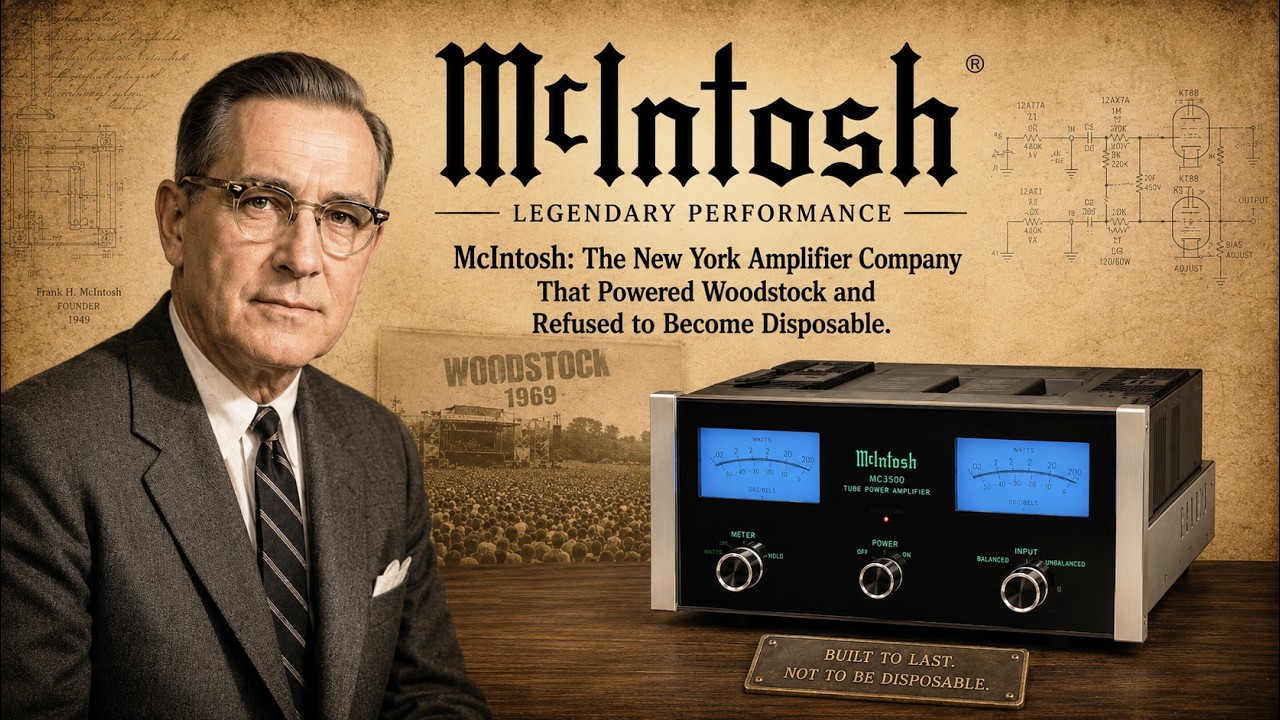
Bill Hanley, the festival’s sound engineer, had chosen Macintosh because it was, in his words, the best amplifier on the marketplace, the most reliable and quietest. The competitors hummed. Macintosh did not. The company that powered Woodstock began with a problem.
Frank McIntosh was born in 1906 in Omaha, Nebraska, in an era when radio was still a novelty. He earned degrees in mathematics and radio engineering and, by the late 1930s, was writing columns on broadcast technology for newspapers and holding an editing position at Popular Mechanics. By 1942, he ran a consulting firm near Washington, D. C.
, designing radio stations and sound systems for broadcasters, including the stations that carried Franklin Roosevelt’s fireside chats. But every amplifier he tested distorted at volume. The output transformer, the component that transferred the amplified signal to the speakers, bled power as heat and introduced phase shift that smeared the audio at exactly the frequencies where the human ear is most sensitive. In the early 1940s, a 50-watt amplifier that could reproduce the full range of human hearing without audible distortion did not exist.
The engineering community had largely agreed it could not be done. McIntosh did not accept the consensus. In 1946, he hired his first employee, Gordon Gow, a meticulous younger engineer who complemented McIntosh’s instincts with the patience needed to turn ideas into production. Together they attacked the output transformer.
Their solution was the unity coupled circuit, a bifilar winding technique in which the primary and secondary coils of the output transformer are wound together side by side rather than layered separately. The effect cancelled the leakage inductance and phase shift that conventional transformers introduced, delivering full rated power across the entire audible frequency range, from 20 hertz to 20,000 hertz, with almost no measurable distortion. In 1949, they built a prototype, the 50W1, which delivered 50 watts at less than 1% total harmonic distortion. No commercial amplifier on the market could match those numbers.
The same year, they incorporated as McIntosh Engineering Laboratory in Silver Spring, Maryland. The first production units shipped to broadcast engineers, recording studios, and the early generation of serious home listeners. In 1951, the company outgrew its Maryland space and moved to Binghamton, a small city in upstate New York with affordable industrial rents and a skilled manufacturing workforce. One of the first hires that year was Sydney Corderman, who arrived as head of research, engineering, and development and stayed for 40 years.
While Frank McIntosh ran the business and Gordon Gow handled sales, Corderman was the man in the laboratory, refining the unity coupled circuit and pushing the performance envelope of every amplifier that carried the McIntosh name. In 1956, the company built its own factory at Two Chambers Street, completing construction in eight months. The building where McIntosh amplifiers are still made today is the same one Frank McIntosh built in 1956. The 1950s were the decade of the American hi-fi boom, and McIntosh rose with it, but not for the mass market.
The MC30 arrived in 1954, a monaural tube amplifier delivering 30 watts in a chrome chassis. The MC60 followed the same year at 60 watts, the most powerful consumer amplifier in its class. These were expensive, heavy, and uncompromising, sold naked, without wooden cabinets or built-in turntables, to listeners who believed the distance between good sound and great sound was a physical reality measurable in distortion percentages. They were rare, but permanent.
Nobody who bought a McIntosh ever switched to a cheaper brand. In 1961, Corderman and the engineering team finished the amplifier that would become the most celebrated piece of consumer audio equipment ever produced. The MC275 was a stereo power amplifier delivering 75 watts per channel, driven by four KT88 output tubes, weighing 67. 5 pounds, and retailing for $444 at a time when that represented a month’s mortgage payment on a modest American house.
Its distortion was less than half a percent at any power level across the entire audible range, meaning it sounded the same whether whispering or roaring. Frequency response extended past 100,000 hertz. The MC275 remained in production from May 1961 through July 1973, and it would be reissued six times over the following six decades, outlasting the very technology it was built on. The decade that made McIntosh famous beyond audiophile circles was the 1960s.
In January 1965, the amplifiers that carried Lyndon Johnson’s inauguration speech to the crowd gathered on the National Mall were McIntosh units. In 1967, the company released its first solid-state power amplifier, the MC2505, but refused to abandon vacuum tubes as most of the industry did. It built both, tubes for those who wanted warmth, transistors for those who wanted power. The MC2505 also introduced the black glass front panel and illuminated output meters that tracked the amplifier’s power in real time, a design Gordon Gow had conceived himself, with gold lettering that glowed through a custom ink formulation no other manufacturer could replicate.
In 1968, McIntosh released the MC3500, a monaural vacuum tube amplifier producing over 350 watts. It was an industrial object the size of a suitcase, priced at just over $1,000, produced for fewer than four years, and bought mostly by professional sound companies. It was designed for a question no one had yet answered: could half a million people hear a guitar and recognize the guitarist? The MC3500 answered that question at Woodstock.
Those twenty tube amplifiers powered Richie Havens’s opening set, Santana’s breakout performance, Sly and the Family Stone at 3:00 in the morning, and Jimi Hendrix’s sunrise rendition of the Star-Spangled Banner. In 1973, the Grateful Dead played the Summer Jam at Watkins Glen, New York, where the crowd exceeded 600,000. McIntosh MC2300 amplifiers, solid-state units producing 300 watts per channel, were helicopter-rushed to the site to keep the music reaching the back of the crowd. The following year, the Dead’s sound crew, led by the legendary underground chemist turned audio engineer known as Bear, built the Wall of Sound: 48 McIntosh MC2300 amplifiers delivering 28,800 watts of continuous power through more than 600 speakers stacked three stories tall, weighing 75 tons, requiring four semi-trailers and a crew of 21 to transport.
It debuted on March 23, 1974, at the Cow Palace in San Francisco, and witnesses reported clear, detailed, undistorted sound six hundred feet from the stage. The Wall of Sound lasted six months before the Dead retired it as too expensive and too heavy. The 48 amplifiers survived. Band members and crew members kept them.
They survived because that is what McIntosh amplifiers do. The 1980s brought the compact disc, integrated circuits, and the mass-market logic of volume over fidelity. Manufacturing moved overseas. American hi-fi companies folded, merged, or were absorbed into conglomerates.
McIntosh said no, not with a manifesto, but by continuing to do exactly what it had always done: wind transformers by hand, seal them in tar, and test every finished unit in an anechoic chamber before shipment. The factory at Two Chambers Street did not get a robotic assembly line. It got craftsmen who stayed for decades because the work was worth staying for. Gordon Gow died in June 1989.
Frank McIntosh died the following year. The same year, Clarion, a Japanese car audio manufacturer, bought McIntosh Laboratory for $28. 6 million. What followed was a chain of ownership changes that would have killed any company held together by nothing more than brand equity.
Clarion bought McIntosh hoping to leverage the name in mobile electronics; it did not work. In 2003, DNM Holdings bought the company from Clarion. In 2008, Bain Capital acquired DNM. In 2012, Fine Sounds, an Italian audio distributor, bought McIntosh.
In 2014, the company’s own management, led by Charlie Randall, an electrical engineer who had joined the factory in 1988, bought it back. In 2022, Highlander Partners acquired the McIntosh Group. In November 2024, Bose Corporation acquired the entire operation. Six owners in 34 years.
Through every acquisition, the factory at Two Chambers Street kept building amplifiers the same way, because every owner who tried to understand McIntosh eventually understood that the hand-wound transformer was not a quaint tradition. It was the reason the amplifier sounded the way it did. Then there is the story of the name. In 1982, Steve Jobs approached Gordon Gow and asked permission to use the word McIntosh for a personal computer Apple was developing.
The project’s creator had deliberately spelled it with an a to differentiate it from the audio company, but Apple’s trademark application was rejected on grounds of phonetic similarity. Gow visited Apple’s headquarters, saw the prototype, and, on the advice of his lawyers, told Jobs no. Jobs secured a license anyway, and in March 1986, Apple acquired the exclusive right to the name for an undisclosed sum. The amplifier company kept building amplifiers.
It did not need Apple’s money. The MC275 has now been reissued six times. The current production model still uses the unity coupled circuit transformer Frank McIntosh and Gordon Gow developed in the late 1940s. It still runs on KT88 tubes and still weighs 67.
5 pounds. An original 1960s MC275 in working condition now sells for between $4,500 and $7,000, more than ten times its original retail price. In October 2021, Sotheby’s auctioned Jerry Garcia’s personal MC2300, identifiable by the Budweiser mascot sticker on its chassis that earned it the nickname Budman. It sold for $378,000.
Seven MC2300 amplifiers from the Wall of Sound sold at the same auction for a combined $688,700. An amplifier that retailed for under $2,000 in 1980 sold for nearly $400,000 forty years later. In 2012, McIntosh loaned original Wall of Sound amplifiers to the Rock and Roll Hall of Fame for a Grateful Dead exhibition. They were still working four decades later.
In 2023, McIntosh reissued the MC3500, the amplifier that powered Woodstock, at $15,000 per unit. It also opened the House of Sound in Chelsea, Manhattan, an 11,000-square-foot townhouse where visitors can hear the full product line, and it builds audio systems for Jeep’s Grand Wagoneer and Grand Cherokee. The factory employs roughly 170 people. Revenue was $25 million in 2021 and climbed to $42 million by 2022, a company nearly doubling its income while the global consumer electronics industry churned through products designed to be replaced every two years.
By the standards of a global audio market measured in tens of billions, that is a workshop. Somewhere in Binghamton, right now, someone is winding a transformer, copper wire around a core, loop after loop, by hand, the way Sydney Corderman taught the production floor when he arrived in 1951. When the winding is done, the transformer will be placed inside a metallic dome and sealed in tar. Then it will be mounted inside an amplifier that will be tested in a chamber where the only sound is the sound the machine produces.
Then it will be shipped to someone who will in all probability never buy another amplifier, because they will never need to. The American audio companies that chased volume are gone. The ones that chased price are forgotten. The one that chased fidelity, the small one, the stubborn one, the one that refused every shortcut and never left Chambers Street, is still winding the wire and sealing the tar.
McIntosh did not survive the audio industry by changing with it. It survived by refusing to.