On the morning of July 3, 1863, James Longstreet stood beside Robert E. Lee and told his commanding officer that the plan would fail. He said he had been a soldier his entire life, that he had served with men in companies, regiments, divisions, and armies, and that he knew what soldiers could and could not do. His professional judgment was that fifteen thousand men could not take the position they were being asked to seize.
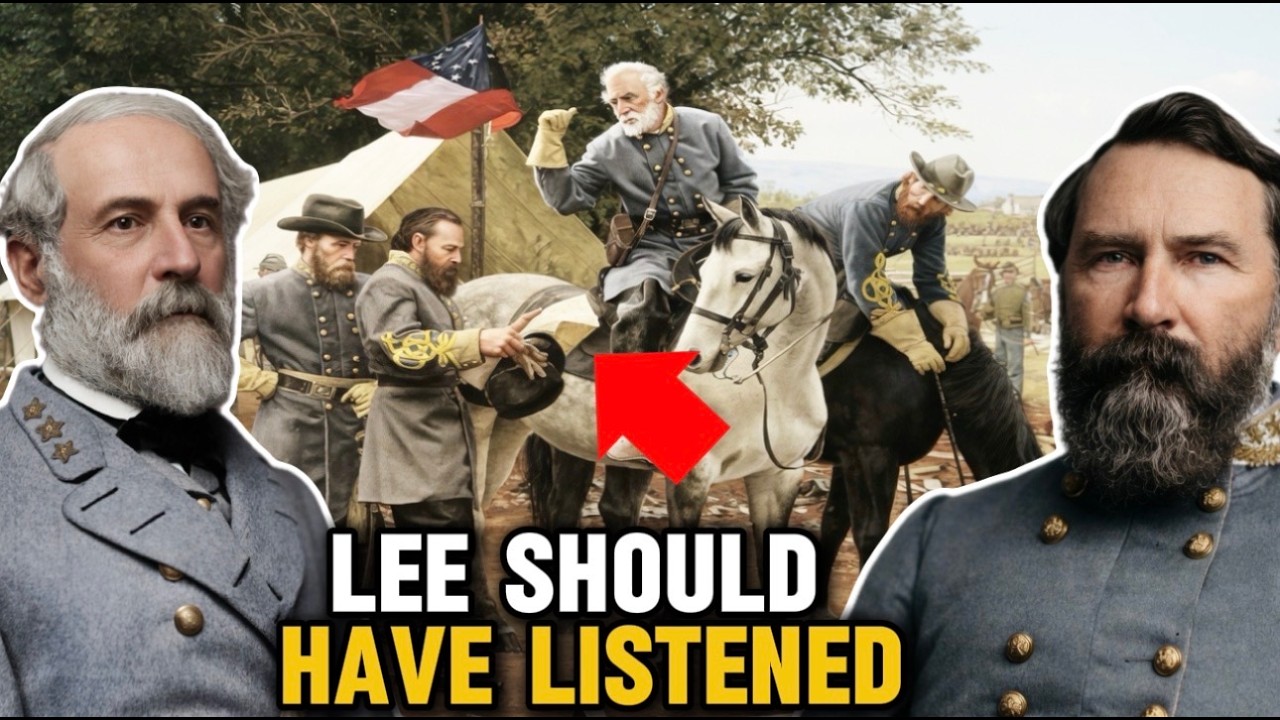
Lee heard the warning and gave the order anyway. Nearly half of the men who stepped onto that open ground in Pennsylvania did not come back. The Confederate assault lasted about twenty minutes against the stone wall before Union forces pushed it back. The battle was lost.
The invasion of Pennsylvania was over, and Lee began the long retreat into Virginia. Longstreet was right. Not right in hindsight, not right in the abstract, but right in the only moment that mattered. He would spend the next thirty years being blamed for the Confederate defeat at Gettysburg, described as slow, disloyal, and insubordinate by men who needed someone to carry the weight of a war they had lost.
The mythology that grew around the Southern defeat demanded a villain, and James Longstreet, who complicated matters by remaining friends with Ulysses Grant after the war and joining the Republican Party, fit the role perfectly. But what actually happened was far more interesting and far more tragic than the myth. Longstreet was not the villain of Gettysburg. He was the general in the Army of Northern Virginia who understood clearly what the war required of the Confederacy, and who had the misfortune of serving under a commander whose instincts ran in the opposite direction.
Longstreet was born in South Carolina in 1821 and raised in Georgia, the son of a Southern family with neither wealth nor prominence. He graduated from West Point in 1842 near the bottom of his class, not from a lack of ability but because his temperament found little to engage with in academic military education. He served in the Mexican War, where he was wounded at the Battle of Chapultepec and cited for bravery. He had a strong physical presence, steadiness under pressure, and was the kind of man others turned to in situations requiring composure.
Ulysses Grant was one of his closest friends at West Point, and their friendship lasted through most of their lives. They served as groomsmen at each other’s weddings. The war that placed them on opposite sides of the bloodiest conflict in American history did not destroy that friendship. It survived four years of killing and a life full of ordeals.
Longstreet entered the Civil War with a coherent theory of how the Confederacy should fight. It was not the theory Lee adopted. He believed the Confederacy’s best chance for victory lay in strategic defense. This was not passive defense, not simply occupying fixed positions and absorbing blows, but active strategic maneuvering designed to force the Union army to attack Confederate positions on ground the Confederacy had chosen.
The calculation was clear to him. The Union army outnumbered the Confederates, and its industrial capacity was enormous. Every Confederate soldier killed was harder to replace than every Union soldier killed. Every offensive operation drained resources the Confederacy could not afford to spend.
The smarter choice was to maneuver, find suitable ground, and let the enemy break against fortified positions while Confederate casualties stayed under control. It was sound strategy. But it was not what the Army of Northern Virginia was built to execute. Lee’s instinct was offensive at its core.
He believed in seizing the initiative, striking the enemy before it could organize, and creating the shock and disruption that would make the human cost of the war clear to the Northern public. The aggression that produced Second Bull Run and Chancellorsville was not incidental to Lee’s military career; it was its driving engine. Longstreet understood the value of aggression and could execute effective offensive operations when necessary. But he believed the overall strategic framework was wrong for a smaller force fighting on its own territory, and he kept saying so.
The Battle of Fredericksburg in December 1862 was the clearest demonstration of what war on Longstreet’s terms could produce. Ambrose Burnside led the Union army across the Rappahannock and attacked Confederate positions on Marye’s Heights. Longstreet defended the Confederate left, with infantry placed behind a stone wall along a sunken road at the foot of the heights. He positioned his artillery with such precision that he told Lee beforehand that a chicken could not survive on that open ground once his guns opened fire.
The Union launched fourteen attacks across the plain that day. All of them were stopped. More than twelve thousand Union soldiers were killed or wounded on Longstreet’s front in a single day, while Confederate losses there were a tiny fraction of that number. Fredericksburg was the embodiment of Longstreet’s argument in casualty figures.
He looked at the results and saw a template for how the Confederacy could survive. Lee looked at the same results and spent the following spring planning Chancellorsville, the most aggressive operation the Army of Northern Virginia ever conducted. The tension between their strategic philosophies did not reach a breaking point until the invasion of Pennsylvania. Lee invaded Pennsylvania in June 1863 with a logic that had genuine value at the level of grand strategy: relieve pressure on Virginia, threaten Northern population centers, and force a battle on terms that might break Northern morale before autumn.
Longstreet had discussed the campaign with Lee before the army moved north, and he carried with him what he understood as at least an implicit agreement that the army would fight defensively once it crossed into Pennsylvania. If contact came with the Union army, the Confederates would find strong ground and force the enemy to attack, repeating the Fredericksburg calculation on a larger scale. When the battle developed on July 1 without Longstreet’s main force present, and when Lee committed to fighting at Gettysburg instead of maneuvering to better ground, Longstreet felt the agreement had been abandoned. He proposed withdrawing south, placing the army between the enemy and Washington, and forcing the Union to attack.
Lee refused. The battle had begun. The fighting of July 2 has received more analysis than almost any other day of the Civil War. Most of that analysis has focused on the hours between Lee’s orders and the start of Longstreet’s attack on the Union left.
The more accurate observation concerns what actually happened once that attack was launched. Longstreet’s main force swept through the Peach Orchard, destroyed Dan Sickles’s Third Corps, and came close enough to seizing Little Round Top that the outcome hung on one Union brigade commander’s decision to hold a position that was almost empty when he arrived. The attack was not decisive, not because of when it started, but because there were no Confederate reserves to exploit what Longstreet’s men had taken. Lee had fed his strength into the battle piecemeal and had nothing left to pour through the gap his corps had opened.
Then came July 3. The conversation between Longstreet and Lee that morning was not a subordinate raising tactical concerns or using diplomatic language. It was a direct professional statement from a man who had spent thirty years in military service, saying the plan would fail and the soldiers sent to execute it would pay for that failure with their lives. Lee heard the statement but did not change the plan.
When Pickett reached Longstreet and asked whether his division should advance, Longstreet could not say yes. He turned his face away and nodded. Witnesses described that moment accurately enough in their later accounts to make it a document of value. A general unable to issue an order he considered a death sentence, issuing it with a nod because words were not within his reach.
What happened after Gettysburg showed what Longstreet could achieve when the command structure allowed him to operate on his professional judgment. He was sent west with two divisions to reinforce Braxton Bragg’s Army of Tennessee at Chickamauga in September 1863. He found a gap in the Union lines that Bragg’s other commanders had not noticed, and he drove through it with a force and coordination that shattered the right wing of the Union army, producing one of the most complete tactical victories of the war. Longstreet’s performance at Chickamauga is integral to any objective assessment of him as a combat commander.
He was not slow. He was not hesitant. He was a commander who read the battle clearly and acted on what he read. He returned to the Army of Northern Virginia in the spring of 1864.
On May 6, in the dense, tangled woods of the Wilderness, in nearly the same area where Jackson had been shot by his own men a year earlier, a volley of Confederate fire hit Longstreet in the throat and right shoulder. He was carried from the field on a stretcher, and the officers around him believed he would not survive. He did survive, though the wound damaged the nerves in his right arm and permanently changed his voice to a lower register that those who had known him before said was not his natural tone. He was absent from the campaign for five months.
He returned in October 1864 to find an army that had retreated into the defensive posture he had advocated from the start. Not because anyone had adopted his strategic framework, but because the army had exhausted its offensive capacity through three years of aggressive campaigning. The postwar campaign against Longstreet’s reputation was not a spontaneous reaction to genuine military failure. It was organized, deliberate, and sustained for decades by Jubal Early and a network of Confederate veterans who understood that controlling the narrative of why the South lost was a form of cultural and political power that had to be carefully constructed.
Early laid the foundations of what became known as the Lost Cause, promoting the idea that the Confederacy had been overwhelmed by numbers and resources rather than outgeneraled or outmaneuvered, and that specific men had failed at specific moments in ways that deprived the army of a victory it deserved. Gettysburg was the centerpiece of that argument. Longstreet was cast as the man whose slowness and inaction had denied Lee the battle he had planned to win. The narrative required significant distortion of the historical record.
It claimed Lee had ordered an attack at dawn on July 2, an order never recorded in writing. It required ignoring the terrain difficulties that delayed two divisions marching to their attack positions while being observed by Union lookouts on Little Round Top. And it required treating Longstreet’s documented professional objection to the July 3 assault as evidence of disloyalty rather than honest assessment. Early and his colleagues were not writing military history.
They were writing political history in service of a cultural program, and they did it effectively for a very long time. Longstreet’s response was to write back, another decision that hurt him in the cultural climate of the postwar South. His memoirs, published in 1896, made his case plainly and without apology, arguing that Lee had made a mistake at Gettysburg and that the army had waged the war under strategic terms incompatible with its actual position. In the South of the 1890s, a Confederate general who criticized Lee in print was not participating in a historical debate.
He was violating something like a sacred agreement. The reception of his book reflected that he had not been wrong in what he wrote, but that he was not forgiven for writing it. Professional historical assessment, developing over recent decades, has moved substantially toward Longstreet’s position on the substantive questions. Military historians who have studied the Gettysburg sources without the motive of protecting the Lost Cause narrative have generally concluded that the July 2 delay was not the result of disobedience, that Longstreet’s resistance to the July 3 assault was professionally justified by everything the battle confirmed, and that his strategic argument for defensive operations read Confederate strategic reality more accurately than Lee’s offensive approach.
This professional consensus has spread slowly into the public, partly because the Lost Cause version of Gettysburg was so entrenched in popular memory that changing it required rewriting a story that had been told again and again for a century and a half. What remains after the myths are stripped away is the picture of a general who combined real field ability with a strategic intelligence the army he served found no way to use optimally. He was at his best when circumstances aligned with his theory, as at Fredericksburg, Chickamauga, and the defensive operations around Petersburg that consumed the final year of the war. He was at his best on the morning of July 3, 1863, when he said what the situation required, was overruled, and watched thousands of men walk into the ground he had described, absorbed by it almost exactly as he had predicted.
Longstreet died in January 1904 in Georgia at the age of eighty-two, having lived long enough to see Grant die. The Lost Cause had become something like the official memory of the South, and his reputation in the public mind had been reduced to a cautionary tale about a general who failed his commander at the decisive moment. He spent four decades trying to correct that account of events. His attempt did not succeed in the way success is usually measured.
History corrected the record for him gradually and without ceremony. The professional reevaluations came, along with the recognition, slow and still incomplete in popular culture, that the man who said fifteen thousand men could not take that position was doing the simplest thing any military professional is supposed to do: reading the situation accurately and stating the outcome clearly. He did it at the right time, to the right person, in language that left no room for misunderstanding. It did not matter.
This is not, in the end, a story about Longstreet’s failure. It is a story about what institutions do with accurate judgment when the institution has already made its decision, and about the price one sometimes pays for that accurate judgment when events unfold exactly as the judgment predicted.