In December 1944, on a frozen field in northern France, Bing Crosby stood before roughly one hundred thousand battle-weary soldiers. It was the eve of the Battle of the Bulge. When he began to sing White Christmas, his famous baritone trembled and he fought back tears, aware that many of the young men before him would not survive the coming days. Crosby later called it the hardest performance of his life.
He had not wanted to sing the song at all. He said he had not come all that way to make the soldiers sad, but when he tried to drop it from his set, the troops shouted for it until he relented. So he sang, giving them a few minutes of bittersweet holiday dreaming before they faced the front. At the war’s end, a poll found that American soldiers rated Bing Crosby as the person who had done the most for their spirits during World War II, ahead of any general and ahead of the president.
Harry Lillis Crosby Jr. was born on May 3, 1903, in Tacoma, Washington, the fourth of seven children in a devout Catholic working-class family. When he was three, the family moved to Spokane, where his father bought an early phonograph, and the boy became entranced by music, playing Al Jolson records and dreaming of show business. At age seven, he picked up the nickname Bing from a comic strip called the Bingville Bugle, and it stayed with him for life.
His upbringing mixed an all-American boyhood with strict religious discipline at Jesuit-run schools. His mother hoped he might become a priest or at least a lawyer, and he dutifully enrolled at Gonzaga University with law in mind. But the jazz craze of the early 1920s swept him off that path. He joined a local band as a singing drummer, dropped out of college in 1925, and headed to Los Angeles with his friend, pianist Al Rinker, to chase a show business career.
The duo scraped by on vaudeville gigs as Two Boys and a Piano. Crosby proved a quick study in microphone technique, pioneering a smooth, intimate style of singing that came to be called crooning. Instead of projecting into large halls like the old belters, he sang softly into the microphone and let technology carry his warm voice. He idolized Louis Armstrong and mimicked his relaxed, conversational phrasing.
By the late 1920s, he and Rinker were discovered by bandleader Paul Whiteman, the King of Jazz, who added Crosby to his orchestra in 1926. Crosby soon teamed with Harry Barris to form the Rhythm Boys, a jazzy trio that became a highlight of Whiteman’s shows and gave Crosby his first taste of Hollywood in the 1930 film King of Jazz. In 1931, at age twenty-eight, Crosby landed his own nationwide radio show on CBS. The Bing Crosby Show was an instant sensation, drawing up to fifty million listeners at its peak.
Depression-era America fell in love with the easygoing baritone who sounded like a friend dropping by each week. He scored his first major record hits that same year, and his rich voice and gentle swing timing produced one chart-topping song after another through the early 1930s. Hollywood came calling, and Crosby signed with Paramount, making musical comedies. With his lanky frame, big ears, and self-deprecating humor, he became a likeable leading man in films like Here Is My Heart and Anything Goes.
By 1936, he was Hollywood’s hottest musical performer. In 1930, just as his solo career began, Crosby married rising actress Dixie Lee. She chose domestic life over stardom, and the couple settled in Los Angeles, raising four sons: Gary, born in 1933; twins Dennis and Philip, born in 1934; and Lindsay, born in 1938. They bought a sprawling four-acre estate in the San Fernando Valley, a twenty-room mansion with stables, a pool, and plenty of lawn.
To all appearances, life was picture-perfect. Crosby’s wholesome image as a devoted husband and father became part of his brand. But behind the façade, Dixie quietly struggled with alcoholism, and Bing ran the household as a strict, old-school patriarch. According to his eldest son Gary, Bing enforced weekly weigh-ins and lashed the boy with a belt if he gained too much weight.
In a private letter, Bing scolded his chubby teenage son, saying he did not want him to grow into a fat, unattractive slob. Within the high-walled Crosby estate, the genial public persona gave way to a demanding father who ran his home with iron discipline. Professionally, the late 1930s and early 1940s saw Crosby reach unprecedented heights. He was America’s first true multimedia superstar.
By 1940 he had placed dozens of songs on the charts, and he would ultimately amass nearly three hundred hit singles. He made fifty-eight movies and sold over three hundred million records. His signature onscreen partnership with Bob Hope and Dorothy Lamour began with Road to Singapore in 1940, and the wisecracking buddy act delighted wartime audiences across seven hit films. Hope and Crosby developed a genuine lifelong friendship.
As Hope later said, if a friend could have been made to order, he would have asked for one like Bing. In 1942, Crosby’s biggest musical triumph arrived. He starred with Fred Astaire in Holiday Inn, which introduced Irving Berlin’s wistful tune White Christmas. The song captured the ache of wartime holidays apart, and Crosby’s warm rendition struck a deep national chord.
The original 1942 master recording literally wore out from overuse, forcing Crosby to re-record it in 1947 so more copies could be made. It went on to sell an estimated fifty million copies, making it the best-selling single of all time. The same period brought critical acclaim. In 1944, Crosby took a dramatic turn as a warm-hearted priest with a golden voice in Going My Way, a role that earned him an Academy Award for Best Actor.
He reprised the character the following year in The Bells of St. Mary’s opposite Ingrid Bergman. In the winter of 1943, tragedy struck the Crosby home. Just days after Christmas, a fire ignited in the family’s Christmas tree, likely due to faulty wiring.
Within minutes, flames engulfed the Toluca Lake mansion. Dixie grabbed the children and fled through the smoke to the neighbor’s house. Bing was not home, enjoying an afternoon at the golf course. He raced back to find his beloved estate in flames.
The blaze gutted the mansion, destroying nearly all the family’s possessions accumulated over thirteen years. The family dog perished. Once the flames were out, Bing sifted through the charred debris and miraculously found one intact keepsake: a single burnt shoe containing two thousand dollars in cash, winnings from a recent race bet. The loss was estimated at a quarter of a million dollars.
Bing publicly expressed gratitude that his wife and children were safe. He moved the family to a rental, sold the ruined estate for the land value, and resolved to rebuild. The blaze proved a turning point in his life. In 1945, Crosby decided to fight the rigid schedule of live broadcasting.
Fed up with racing to the NBC studio every week, he demanded to pre-record his shows so he could attend to other interests, chiefly golf and family. The network refused, and Crosby walked away in a public clash. In 1946, he took his star power to the young ABC network, which agreed to let him tape his new show. The problem was that high-quality recording tape did not exist in America.
Army engineer Jack Mullen had brought back prototype magnetic tape recorders from Nazi Germany, and Crosby saw the potential immediately. He invested fifty thousand dollars of his own money to help the California electronics firm Ampex develop the first commercial tape recorders in the United States. In 1947, the Bing Crosby Show became the first American radio program recorded on magnetic tape. Crosby could record days in advance, edit out flubbed jokes, and insert witty ad-libs after the fact.
The result revolutionized broadcasting, ending the era of live radio and paving the way for tape and later video technology. Meanwhile, Bing’s personal world was under strain. The late 1940s saw Dixie’s health deteriorating, aggravated by heavy drinking. Crosby was a chronically unfaithful husband during this period, conducting a secret affair with actress Joan Caulfield.
The staunch Catholic in him refused to divorce his ailing wife, but he sought solace elsewhere. According to Caulfield’s sister, Bing confessed love and talked of marriage, only to be dissuaded by his priest and his own mother. Cardinal Spellman warned that Father O’Malley could never get a divorce. Bing ended the affair and returned to caring for Dixie, but the marriage remained deeply troubled.
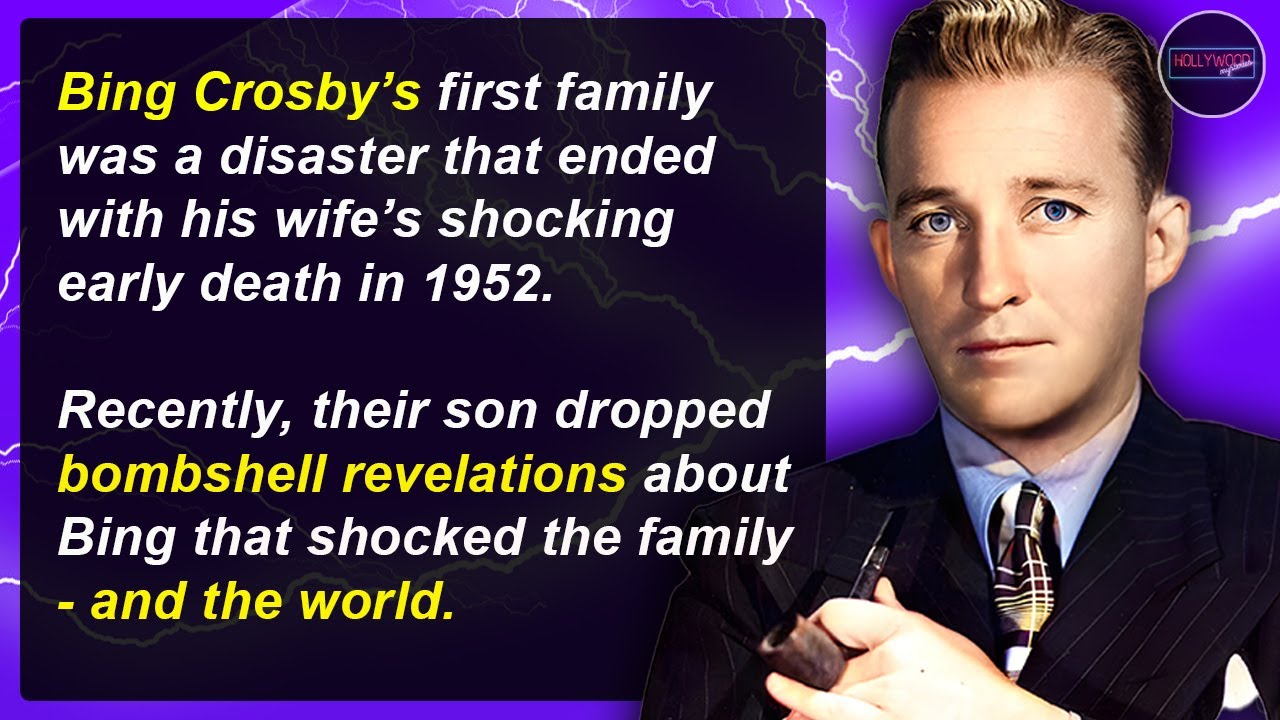
Dixie Lee was diagnosed with advanced ovarian cancer in 1952. In a controversial decision typical of the era, doctors and family hid the grim prognosis from her. Bing even flew to Paris for a film shoot to keep up the ruse of normalcy. On November 1, 1952, Dixie died at age forty, unaware until the end that her illness was terminal.
Bing was filming abroad and rushed home for the funeral, which became a media spectacle despite his efforts to keep it private. His son Gary recalled the scene as a circus, with his father grieving alone amid the flashbulbs. At forty-nine, Bing Crosby was a widower with four teenage sons. He channeled his energy into work.
In 1954, he delivered one of his finest screen performances in The Country Girl, playing an alcoholic has-been actor opposite Grace Kelly. The dramatic role earned him another Oscar nomination. In 1955, during a shoot for White Christmas, Bing met a young actress named Kathryn Grant, thirty years his junior. They married in 1957 and welcomed three children: Harry Lillis III, Mary Frances, and Nathaniel.
With his second family, Crosby took a markedly different approach. Now in his sixties and semi-retired from the Hollywood rat race, he had time for the new children in a way he had not had for his first four. His younger son Nathaniel later reflected that he believed his father had more time to spend with them. To the second family, Bing was a benign teddy bear, a far cry from the strict taskmaster his older sons had known.
By the 1960s, Crosby’s dominance naturally waned as rock and roll and youth culture took over the airwaves. He remained a respected presence, hosting the variety series Hollywood Palace from 1964 to 1970 and becoming the nation’s Christmas patriarch. Beginning in the late 1960s, Bing and his wife and children became staples of Christmas television specials, cementing his image as the ultimate holiday entertainer. A lifelong golf fanatic, he hosted the Bing Crosby Pro-Am tournament at Pebble Beach, often joking that golf, not music, was his true passion.
He had even turned down major roles if they threatened to interfere with his golf time. In 1974, Crosby underwent surgery to remove part of a lung due to a fungal infection, but he bounced back. In 1977, at age seventy-four, he embarked on a final concert tour of Britain. That September in London, he taped his last holiday special, Bing Crosby’s Merry Old Christmas.
The show featured an unlikely guest: rock star David Bowie, then thirty, who admired Crosby. In a now-legendary duet, the white-haired crooner and the androgynous rock star performed a medley of Little Drummer Boy and a counterpoint melody, Peace on Earth, uniquely devised for the occasion. Bowie later said Crosby was fantastic and that the old man knew everything about everything. The special aired on November 30, 1977, about seven weeks after Bing was gone.
On October 14, 1977, Bing Crosby died on a golf course in Madrid, Spain, after playing eighteen holes with friends. Walking off the green, he warmly congratulated his companions and invited them all for a Coca-Cola. Moments later, on the path back to the clubhouse, he collapsed from a massive heart attack and never regained consciousness. He was seventy-four.
Nearly three thousand people packed St. Patrick’s Cathedral in New York for a memorial mass. He was laid to rest at Holy Cross Cemetery near Los Angeles, beside his first wife, Dixie Lee. A few years after his death, Crosby’s image was upended by revelations from within his own family.
In 1983, his eldest son Gary published a memoir, Going My Own Way, alleging that Bing had been an abusive father who terrorized his four sons from the first marriage. Gary described harsh corporal punishment and emotional cruelty, including whippings with a belt, sometimes a metal-studded one, until welts rose or blood was drawn. Brother Philip immediately denounced the memoir as a pack of lies, insisting the family never got a whack they did not deserve. Dennis distanced himself diplomatically.
Lindsay supported Gary’s claims but also remembered the good times, recalling that his father would say good night, I love you, and that was heaven. Lindsay took his own life in 1989 after years of depression and alcoholism. Dennis died by suicide two years later. The two youngest sons of Bing’s first family succumbed to the same demons that had plagued their mother.
Leaked FBI files in 1999 added another dimension, revealing that Crosby had ties to organized crime in his younger days. Confidential memos showed a serious gambling habit and associations with mob figures like Jack Machine Gun McGurn and Bugsy Siegel. As early as 1930, he owed thousands to the mafia and had to beg friends to help pay off mobsters. One FBI report said Crosby was forced to pay ten thousand dollars to a New York gang leader to settle a debt.
The documents depicted him as a gambling womanizer with a drinking problem in his early years, a far cry from the milk-drinking family man he portrayed publicly. With time, perspective on Crosby began to level out. Biographers and critics reassessed his contributions to music and film in balance with his personal flaws. He pioneered the modern singing style, influenced figures from Sinatra to Elvis, and helped build the foundation of recording technology.
His younger children and second wife consistently defended him as a loving, if old-fashioned, father who regretted any mistakes. In a career spanning half a century, Bing Crosby defined an era from the jazz age to the atomic age. His voice was a soundtrack of American life, and every year at Christmastime, as White Christmas plays softly in the background, his warmth and his shadows remain part of the legend.