John Henry Holliday—known to history as Doc Holliday—was a dentist turned gambler, a frail man with tuberculosis who became one of the most feared gunmen of the American West. He was born on August 14, 1851, in Griffin, Georgia, to Henry Burrows Holliday and Alice Jane Holliday, both of English and Scottish descent. At twenty, he earned a degree in dentistry from the Pennsylvania College of Dental Surgery. But his life took a sharp turn when he was diagnosed with tuberculosis, the same disease that had already claimed his mother and sister.
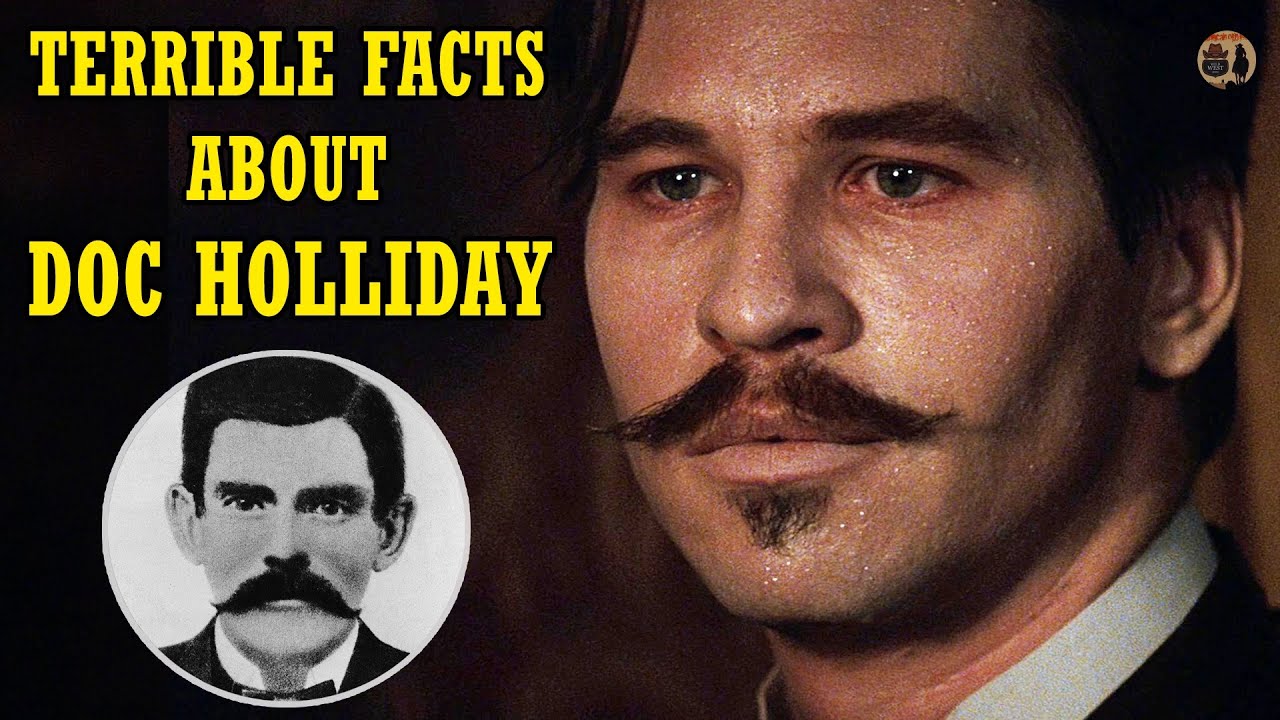
Whether it was the illness or his impulsive nature and quick temper that drove him from Georgia is not entirely clear, but he left his home and never practiced dentistry for long. Over the course of his violent life, Holliday was shot six times and survived five attempts to hang him. He nearly lost his life nine times in total. Popular legend credits him with killing more than a dozen men, but modern researchers have concluded the real number was closer to six.
Most of those killings were in self-defense. His preferred method was to aim for his attacker’s firing arm, a tactic that disarmed his opponent while inflicting painful but non-lethal wounds. In the summer of 1876, Holliday moved to Texas and began a new chapter. It was at Fort Griffin, in a saloon owned by John Shanssey, that he met two people who would define his future: Wyatt Earp and a woman known as Big Nose Kate.
Her real name was Mary Katherine Elder Harony. She was educated, strong-willed, fearless, and sometimes worked as a prostitute. She became the second woman with whom Holliday was known to be romantically involved, and she would remain a presence in his life for years. Holliday’s friendship with Wyatt Earp grew out of practical need.
When Earp, acting as a U. S. Deputy Marshal, was tracking a train robber named Dave Rudabaugh, he began a four-hundred-mile chase. Seeking information, Earp went to Shanssey’s saloon in Fort Griffin, where Holliday regularly dealt cards.
Shanssey told Earp that Rudabaugh had been there but that his whereabouts were unknown. He directed Earp to Holliday, who had played cards with the outlaw. Earp approached the meeting cautiously, aware that Holliday had little love for lawmen. But that evening, Holliday was remarkably forthcoming.
He told Earp that Rudabaugh had likely returned to Kansas. Earp passed that information to Bat Masterson, the sheriff in Dodge City, and it played a pivotal role in Rudabaugh’s subsequent arrest. Another incident from 1878 cemented the bond between the two men. Earlier that year, Earp had kicked two cowboys named Toby Driscoll and Ed Morrison out of Wichita.
That summer, the two men returned with a group of about twenty-four others and launched a brazen assault on Dodge City. Galloping down Front Street, they entered the Long Branch Saloon, vandalized the room, and harassed the customers. Earp burst through the front door in response to the uproar, but before he could react, a large number of cowboys had their guns pointed at him. At the same moment, Holliday, who was playing cards at the back of the room, noticed the commotion.
He quickly drew his weapon and pressed a pistol to Morrison’s head, forcing him and his accomplices to surrender their guns. Holliday’s decisive intervention saved Earp from a critical situation. It is curious that no newspaper in Dodge City covered the incident at the time, but whatever actually happened, Earp credited Holliday with saving his life that day. The two men became friends.
The most famous moment of Holliday’s life came at the O. K. Corral in Tombstone, Arizona. Holliday was present in Tombstone before the gunfight, and he fought alongside Earp and his brothers.
Witnesses said that during the thirty-second gunfight, Frank McLaury gained a late advantage over Holliday. When McLaury aimed his gun at him, he reportedly declared, “I got you now, you son of a bitch. ” Holliday’s retort, historically accurate according to the accounts, was, “You’re a daisy if you do. ” The meaning was essentially “good for you if you can.
” In the end, Holliday was unharmed, and McLaury was shot dead. The gunfight at the O. K. Corral became one of the most enduring stories of the American West.
Holliday was a prominent figure in its retelling, portrayed by Kirk Douglas in the 1957 film Gunfight at the O. K. Corral, Stacy Keach in the 1971 film Doc, Val Kilmer in the 1993 film Tombstone, and Dennis Quaid in the 1994 film Wyatt Earp. The 1993 film in particular revived Holliday’s image, largely due to Kilmer’s portrayal and its memorable lines.
In one scene, Holliday confronts the villain Johnny Ringo and delivers the line, “I’m your huckleberry. ” According to historian Gary L. Roberts, the phrase was actually popular at the time and meant “I’m the one you’re looking for. ” In another pivotal moment at the end of the film, Holliday again announces his presence with the same phrase, though Roberts clarified that there is no historical evidence supporting that particular scene.
Interestingly, “I’m your huckleberry” later became the title of Kilmer’s memoir. There are lesser-known facts about Holliday that complicate his legend. Although he died penniless at the age of thirty-six in Glenwood Springs, Colorado, he had at various points owned a dental clinic, a saloon, and even a silver mine. At one time, he was roommates with Frederick Walker Pitkin, who later became the governor of Colorado.
In 1879, when an extradition order was issued against Holliday, he went to Arizona to face murder charges involving Frank Stilwell. Pitkin, citing a technical error in the paperwork, refused to grant the extradition request. Holliday’s journey from Leadville to Glenwood Springs, a twenty-four-hour carriage ride over Independence Pass, was fraught with danger and suffering, especially for a man in his frail condition. His purpose in Glenwood Springs was not merely to soak in the hot springs.
He was searching for Indian medicine in the caves, hoping to cure his illness. As his life drew to a close, he sought the advice of Father Downey, a founding priest of St. Stephen’s who was said to be a friend of the ailing man. It is believed that Holliday turned to Father Downey perhaps to seek forgiveness for his sins.
Contrary to the popular films, Holliday did not kill Johnny Ringo, a member of the Cowboy gang. In fact, it was his longtime mistress Big Nose Kate who briefly ran away with Ringo. Holliday died on November 8, 1887. In a strange coincidence, Margaret Mitchell, the author of Gone with the Wind, was a relative of Holliday’s, and she was born exactly thirteen years later on November 8, 1900.
Holliday was also remembered as having feelings for his cousin Mattie Holliday. Although she ultimately chose to become a nun, she remained in regular correspondence with him throughout his life. Another curious note from his past is that he was once roommates with Frederick Pitkin, who later became governor of Colorado. In 1879, Pitkin refused to grant an extradition order against Holliday on a technicality, allowing him to face murder charges involving Frank Stilwell elsewhere.
The man who died penniless at thirty-six left a complicated legacy. He was a gentleman and a vagabond, a skilled gunman and a consumptive. He killed men, most in self-defense, and he saved the life of a future lawman legend.
The films and folklore have shaped his image, but the historical record shows a man of contradictions: educated yet violent, loyal yet unpredictable, and always aware that death was closer to him than to most men of his time.