The women closest to the leadership of the Third Reich lived lives that could not have been more different from one another. Some vanished alongside their criminal husbands. Others tried to conceal their connections to murderers. A few even tried to profit from those connections.
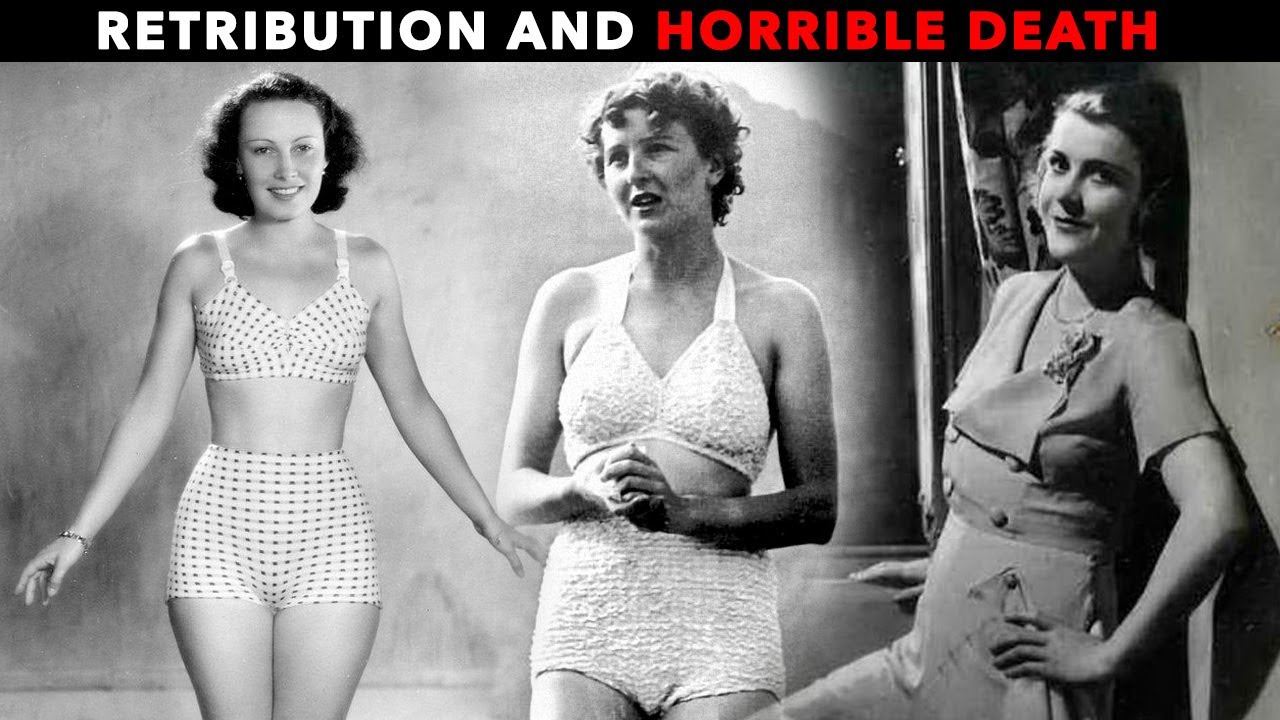
None of them, however, could escape the shadow of the regime they had married into. Eva Braun, Hitler’s only known lover, met him in 1929 when she was just seventeen. A forty-year-old man and a shop girl formed an attachment, and Hitler, whenever he visited the photo studio where she worked, made a point of showing her attention. He once offered to take her to the opera, adding, “You see, there are always men around me, so I know how to appreciate the happiness of being around a lady.
” Despite the obvious affection, Hitler ordered that Braun be checked for Aryan descent. Once confirmation came that she belonged to the purebred Aryans, he felt reassured and continued the relationship. Almost no one in Germany knew that a marriage had taken place between them. As the military situation on the front deteriorated, Eva twice attempted suicide without success.
Finally, on April 30th, 1945, she and Hitler carried out their last and successful suicide together. Renate Müller, oddly enough, was another of Hitler’s mistresses, though little is known about her. It is not certain where the Führer met the actress. What is known is that by 1935 there had been at least one instance of a strange affair between them.
Hitler, as a pronounced psychopath, apparently found pleasure not in the act itself but in something else entirely. According to the memoirs of a woman named Zesler, to whom Müller confided shortly before her death, the process was rather unusual. The two undressed and were about to go to bed when Hitler threw himself on the floor and demanded that she step on him. The scene was unbearable for her, but she gave in to his demands and began to stomp on him with her feet.
This excited him greatly. He asked for more and more, all the while saying that he did not deserve this and was not even worthy of being in the same room with her. The more she trampled him, the more aroused he became. It seems he was satisfied the same way quite often with his official wife Eva Braun as well, apparently believing that real leadership could only be understood by being trampled personally.
Renate Müller committed suicide in 1936 by jumping from a window, reportedly on Hitler’s orders. Emma Göring, a well-known theater and film actress in pre-war Germany, married Hermann Göring in 1935. Since Hitler’s wife was never introduced to the world, Emma quickly claimed the title of first lady of the Reich. The couple had a daughter, Edda, and Adolf Hitler himself became her godfather.
After Germany’s surrender and Göring’s suicide, Emma was sentenced in 1948 to one year in prison and the loss of a third of all her property. She was also banned from performing in theater and film for five years. In 1967, Göring’s wife published a book of memoirs. She died in 1973 after a long illness.
Magda Goebbels, Hitler’s favorite, had a truly Aryan appearance and became the face of the Ministry of Education and Propaganda. Hitler himself insisted on it. She worked in the ministry led by her husband, traveled to hospitals, and took part in public events, consoling widows and mothers who had lost their sons. She had already been married before Joseph Goebbels.
That husband was twenty years older, and his children from a first marriage were practically the same age as the nineteen-year-old Magda. He had also adopted the three sons of a deceased friend, whom Magda had to care for as well. Eventually she divorced, taking with her the son born during that marriage. She then married Goebbels and gave birth to six children.
After Hitler’s suicide, Magda wrote her final letter to her son from her first marriage, Harold Quandt. She wrote, “The world that comes after the Führer is not worth living in, and therefore I am taking the children with me. It is a pity to abandon them to live in the life that will come. Merciful God will understand why I decided to take my own salvation.
” On May 1st, 1945, all the children of the Goebbels couple died from an injection of morphine and poison. Exactly who administered it, the doctor or the parents themselves, remains unknown. After the children’s death, Magda Goebbels committed suicide along with her husband. Gerda Bormann, the wife of Martin Bormann, differed from the other wives at the top of the Third Reich in that she was almost originally a convinced Nazi.
Her father also supported the ideas of the National Socialist Party. The beautiful Gerda shocked everyone by choosing Bormann as her husband. Her parents had hoped their daughter would marry a prominent figure in the NSDAP, not the inconspicuous Bormann, who at the time had reached no special heights and even carried a criminal record for causing bodily harm. According to the memoirs of contemporaries, Gerda and Martin genuinely loved each other.
In 1944, Gerda called on German women to abandon monogamy. She had experience with this herself. She paid no attention when Bormann flirted with other women in her presence. When he began a fairly serious relationship with the actress Manja Behrens, he asked Gerda for advice and even shared his experience, and his faithful wife helped as much as she could.
After the surrender of Germany, Martin Bormann fled, and Gerda was admitted to a military hospital with a diagnosis of carcinoma. She died a few weeks later from the mercury poisoning used in her course of chemotherapy. Lída Baarová, a Czech actress, was invited to work in Germany and managed to win Hitler’s sympathy. After that, she became a frequent guest at receptions, and her career rose very quickly.
Living in an apartment next door to the Goebbels couple, she soon attracted the attention of the Minister of Propaganda. Goebbels lost his head so completely that he was ready to divorce his wife. He even submitted his resignation in order to officially divorce and leave with his beloved. Hitler, however, would not accept the resignation and categorically forbade Baarová from meeting Goebbels.
After that, her career collapsed. After the war in Czechoslovakia, she was convicted of collaborating with the Nazis. In prison she started a new romance, married, and later returned to her acting career, though she could no longer reach the heights she once had. The memoirs she published, in which she spoke about her connection with Goebbels, did not bring her fame.
Annelies von Ribbentrop met her husband herself, unlike the others described. When Ribbentrop still wore only the shoulder straps of a lieutenant and had five children, Annelies managed to arrange a meeting with Hitler. Thanks to that, Hitler soon noticed Ribbentrop and appointed him Minister of Foreign Affairs. Annelies was not convicted after the war.
She lived quietly and comfortably, publishing her memoirs after her husband’s death. She also sued for property with her relatives, but otherwise lived an uneventful and prosperous life. Inga Ley, wife of Labor Front leader Robert Ley, had three children with her husband. Despite the war, the couple adored entertainment and an idyllic lifestyle.
Prominent figures of science, art, and letters of the Third Reich often visited their home. After her last birth, Inga became addicted to morphine, explaining it by the pain she experienced. Despite treatment, the craving for the drug persisted. Unable to withstand the next course of treatment after the drug was withdrawn, Inga shot herself in 1942.
Ilse Heß was notable not only as the wife of Hitler’s deputy Rudolf Heß, but as Hitler’s personal secretary. It was she who typed the famous Mein Kampf. Fully supporting Nazi ideology, she took part in all events, served as her husband’s secretary, and was, in modern terms, a media figure. After the fall of Nazi Germany, she was imprisoned for about a year.
Later she ran a boarding school and published letters and correspondence with her husband that remain of considerable value to researchers. Until her death, Ilse Heß remained faithful to the ideology of Nazism.