November 1944. The Hürtgen Forest, on the German border. A morning of freezing rain. A German sniper, highly trained, part of a division that still possessed such men, lay hidden in a blind he had built two days earlier from tree roots and pine branches.
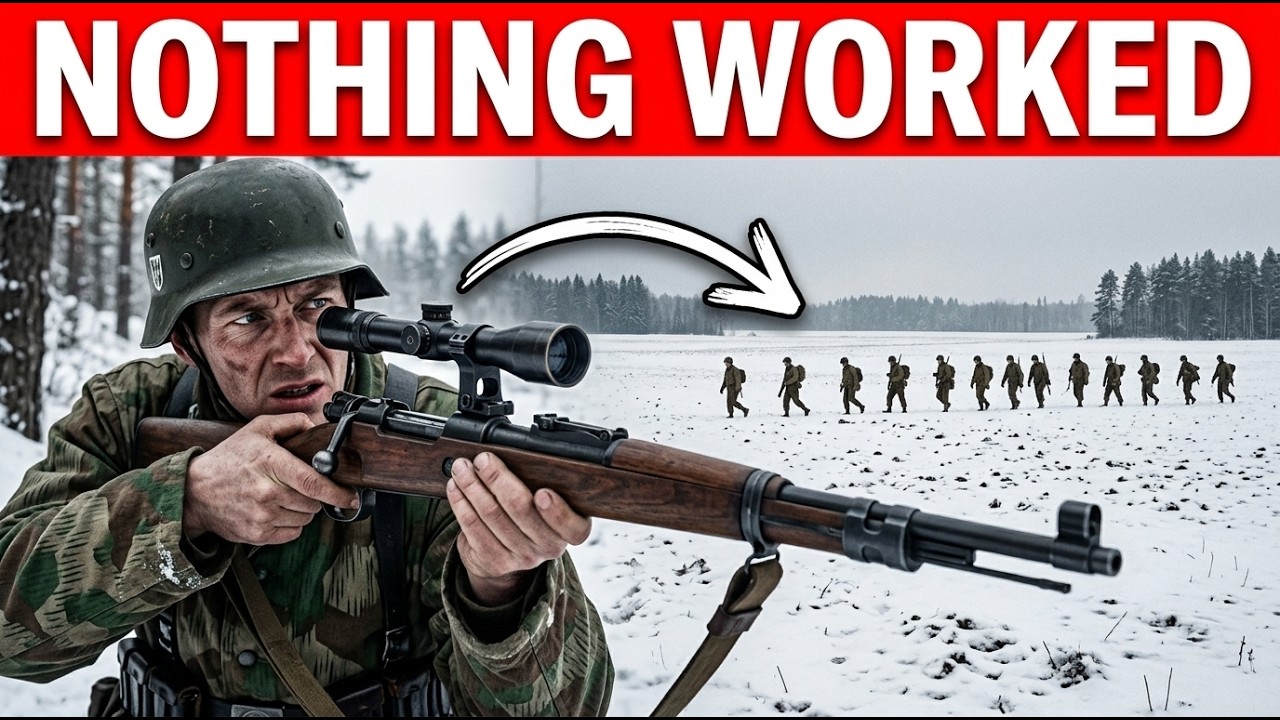
He watched a field about 250 meters wide: wet stubble, a slight rise, and no cover except a drainage ditch crossing the middle. On his side, a tree line his battalion had held for a week. On the other side, the Americans. He had done this many times before and knew exactly how the next ten minutes should unfold.
American infantry would emerge from the far tree line. The men would cluster at the front because they always clustered. He would target the man carrying the map case or the radio aerial, the squad would hit the straw and stay flat, and the attack would die in the open without ever reaching his woods. This was not arrogance.
It was the professional assessment of a man who had seen it happen repeatedly. That morning, it did not happen. What came out of the far tree line first was not men. It was smoke.
Mortar rounds bursting white across the middle of the field, thickening in the damp air, drifting exactly as someone intended. Then fire from the American side, aimed at nothing he could identify: bullets tearing through his tree line, the trunks, the underbrush, everywhere a man might be, with an intensity that made raising his head an act of faith. Through the smoke, in the seconds he could see anything, small groups of men were moving. Not in formation, not in a sweeping assault.
Three or four men would rise and run for a few seconds while somewhere to the left a machine gun hammered without stopping. Then they dropped. Then the same movement repeated with three or four others elsewhere. He fired once.
What came back within ninety seconds was not rifle fire. It was artillery, a concentration of fire that fell on the tree line behind him and erased it. Explosions among the trees hurled fragments downward into positions that were perfect against small arms. When the barrage stopped, the Americans were inside the drainage ditch, then inside his woods, and the battle among the trees was beyond his control.
German reports and postwar interviews are full of variations on this experience, and a phrase recurs: the Americans did not cross the field. They bought it. The Germans were right about American infantrymen. Their assessments, in interrogation reports, unit intelligence summaries, and postwar studies written by German officers for the Americans themselves, repeated the same observations again and again.
The Americans clumped. Under pressure, infantrymen drew together instead of dispersing, a human instinct that was deadly against mortars and machine guns. Their fieldcraft was mediocre. Camouflage discipline was poor.
Noise discipline was worse. American units were often heard before they were seen. They fired excessively and inaccurately, hosing the general area of a threat instead of identifying and engaging a target. In early battles they frequently went to ground under fire and stayed there, waiting for the situation to change, while the correct action was to move.
American training in 1942 and 1943 produced infantry who were less individually skilled than their German counterparts, and the soldiers themselves admitted it. But that assessment measured the skill of the rifleman. By 1944, the rifleman was no longer the unit of American combat power. He was one component of an integrated system, and that system included things the sniper in the pine roots could neither see nor shoot.
Consider what was actually crossing that field. Fire suppression. The American squad had automatic rifles, and the neighboring squad had a machine gun, and both fired at the German position not to kill anyone but to force the enemy to keep his head down for the twenty seconds the moving element needed. The distinction between killing fire and suppression fire is the most important idea in twentieth-century infantry tactics, and it is not intuitive.
It looks like wasted ammunition. It is not. A machine gunner who cannot look through his sights is, for those seconds, effectively out of the battle. The rifle itself.
Every man in that squad carried a semiautomatic rifle. The M1 Garand did not make the American a better marksman than the German with his bolt-action Mauser; in trained hands the Mauser was more accurate. But the Garand allowed a mediocre shot to produce accurate fire density that a manually loaded rifle could not match, without changing position or lifting his cheek to work the bolt. Multiplied at the platoon level, suppression became continuous rather than intermittent, and continuous suppression was what the moving troops needed.
Then the smoke. The white phosphorus and smoke shells that prepared the crossing were not decoration. Smoke on the battlefield is a way of buying time with chemistry. It does not stop bullets, but it hides the sightline that aimed fire depends on, and against a sniper whose entire craft rested on precise observation it was a direct countermeasure.
American units had smoke in enormous quantities at every level: hand grenades, rifle grenades, mortar rounds, artillery shells. When you have enough of something, you use it lavishly, and using smoke that way was a luxury. The rushes. No one crossed that field in a straight line.
Small groups moved in short dashes while other groups fired, then they switched roles. Rise, run for three or four seconds, long enough to cover ground and short enough that an enemy machine gun could not complete its track on you, then drop somewhere new. This was fire and movement, and its advantage was that it never gave the defender a target and a moment of calm at the same time. In some formations there was a further development particularly associated with Patton’s Third Army.
Advancing infantry fired constantly while walking, riflemen shooting from hip or shoulder into the ground and features ahead of them, not at specific targets, maintaining a steady rate as the line advanced. It looked like panic fire. It was the opposite. It was the calculated recognition that a defender with rounds falling around his position could not aim accurately, and that an advancing line that never stopped firing gave him not one second of quiet to do so.
The Germans, trained in fire discipline and short of ammunition, found it almost incomprehensible. It required a semiautomatic rifle in every hand and a supply system that did not care about consumption. Armor was often available. American tank battalions were attached to infantry divisions and distributed their companies to the regiments.
A rifle company crossing a field could often expect direct fire support from a vehicle capable of delivering high explosives to a specific window or strongpoint from a range no infantryman could match. Then the thing that decided the battle. The moment the sniper fired, he entered a system whose response time was measured in a minute or two and whose weight was measured in entire battalions. The American rifle company had a forward observer, an officer with a radio.
Behind that radio was a fire direction center that could calculate firing solutions for multiple artillery battalions and concentrate all their shells on one point simultaneously. A single sniper, a single machine gun, even the mere suspicion of an observation post in a church tower could draw a full artillery strike. To a German officer this was madness. Expending hundreds of shells against one man violated every principle of economy of force.
To an American company commander the calculation was different. Shells could be replaced. His men could not, and if they could, it would take weeks. On the German side, this exchange produced a specific and documented behavioral change.
The sniper’s power came from asymmetry: one well-hidden man disrupting an entire company. Fire, kill, move, fire again. Historically, that had been one of the best trades in war. The American response removed the asymmetry by making the trade prohibitively expensive.
Fire one shot and you informed the system of your location. What came back was not a duel. It was smoke to blind you, intensive fire to fix you, then high explosives. In forested terrain, shells burst in the branches overhead and fell down into your position.
That point deserves emphasis, because the Hürtgen Forest is where it was learned. In the woods, overhead bursts turned the canopy into a killing enhancement. A firing trench that protected you from ground bursts made you vulnerable to shells detonating twenty feet up. Both sides discovered this.
Both sides suffered from it. The side with far more shells suffered less. The behavioral result on the German side, described repeatedly by veterans, was a growing reluctance to fire at all except when a target justified the consequences. Machine gun crews held their fire until the range was very close.
Snipers fired and moved immediately, or did not fire at all. Observation posts stayed silent rather than reveal their positions. A defender who would not fire until the enemy closed, and could not stay in position after firing, had lost the two things that made defense strong: early engagement and prepared positions. There is a fair balance to acknowledge.
The American army’s infantry replacement system in the winter of 1944 was one of the worst parts of the entire war effort. Replacements were sent as individuals, not trained units, arriving at night to units in combat, handed to squads that had no time to teach them anything, and killed at rates far exceeding the men they replaced. The system that supplied shells so lavishly supplied infantrymen carelessly, and the army knew it and did not fix it in time. None of this meant the crossings were easy or cheap.
They were not. American rifle companies in the Hürtgen were destroyed and rebuilt repeatedly, and casualty rates among infantrymen, the small part of the army that actually engaged the enemy, were catastrophic. Replacements arrived and were killed before anyone learned their names. The system was effective.
It was not merciful, and the men inside it knew the size of the sacrifice. One more element existed, the one the sniper would have hated most had he known of it. Above, on any day the weather allowed, were light observation aircraft: unarmed, slow, flying low behind the American lines, with an artillery officer in the back seat and a radio. They loitered for hours.
They were practically invulnerable because German fighters were not available over the battlefield, and firing anti-aircraft guns at them invited the response the sniper had just experienced. An observer in one of those planes could see into the reverse slopes and tree lines no ground observer could see, and could talk directly to the guns. The German position was not watched only from the distant tree line. It was watched from above all day by a man who had nothing else to do.
This was the deeper point buried in the German criticism. The Germans measured individual soldier skill: marksmanship, fieldcraft, camouflage, noise discipline. By those measures they were better, and every honest American account agreed. But there was a second kind of skill, coordination: the ability of several different weapon systems operated by different men in different places to address the same problem in the same minute.
It did not show when you looked at a single soldier. It showed only when you looked at the whole event. By 1944, American infantry coordination was exceptional. A rifle company could, as routine, integrate its automatic weapons with its battalion mortars, its division artillery, sometimes attached tanks from a separate battalion, sometimes fighter-bombers overhead, all with a radio conversation of under a minute initiated by a lieutenant.
That ability was invisible from a blind 250 meters away. What the sniper saw was clumsy infantry clustering in the rain. What was actually approaching was a rifle company plus a mortar platoon plus a field artillery battalion, and on a clear day, an air liaison team. He was not defeated by the men in the fields.
He was defeated by an integrated system, and by late 1944 the Germans had lost the ability to respond in kind. Not because their doctrine was worse, but because their ammunition was rationed, their radios were failing, their reconnaissance aircraft were absent, and firing drew a response they could not survive. Their outstanding individual soldiers were fighting increasingly as individuals. The judgment is that the German criticism of the American soldier was accurate and irrelevant, and both halves matter.
Accurate, because it was true: the average American infantryman had less fieldcraft than the average German infantryman, and American units did the amateur things the Germans said they did, and men died because of it. Irrelevant, because the American army was not trying to win a marksmanship contest. It had made a deliberate decision, at the level of doctrine and industry, to substitute equipment for individual skill wherever possible, then build communications allowing a junior soldier to call down that equipment. Look at the field crossing again with that in mind, and it stops being infantry tactics and becomes an exchange rate.
Smoke, so the defender could not see. Automatic fire, so he could not raise his head. A semiautomatic rifle in every hand, so suppression never paused for reloading. Short rushes, so he never got a stationary target.
Artillery on call, so that once he did something effective, the reply came from an entire division’s guns. Every element was expensive in materiel and cheap in training. That was the point. The United States could not put a professional with five years of experience in every foxhole.
It could give a nineteen-year-old with one year of service a radio, a semiautomatic rifle, a mortar section, and twelve field artillery battalions. The sniper hidden among the pine roots had been one of the best infantry weapons ever used. By November 1944, he was being priced out of the battlefield. He was not defeated.
He was rendered uneconomical, because the American response to him cost the United States a few hundred shells, while the German response to that response cost Germany a trained soldier who could not be replaced. The sniper is a composite figure. The tactics are not. The American fire and movement, the use of smoke, the fire density of semiautomatic and automatic weapons, and the routine use of massive artillery against pinpoint targets are documented throughout the Northwest Europe campaign, as is the German complaint, voiced by men who had spent five years learning a trade that had become unaffordable.
Their individual soldiers were better. It no longer mattered. The war had moved to a different measure of strength, and the men in the muddy fields paid the difference in blood.