In the summer of 1876, a thirteen-year-old Lakota boy named Black Elk knelt in the dust beside a dying soldier. The man’s legs were still kicking. Black Elk’s knife was dull and would not cut clean, so he pressed the barrel of a gun to the soldier’s forehead and pulled the trigger. Then he took the scalp.
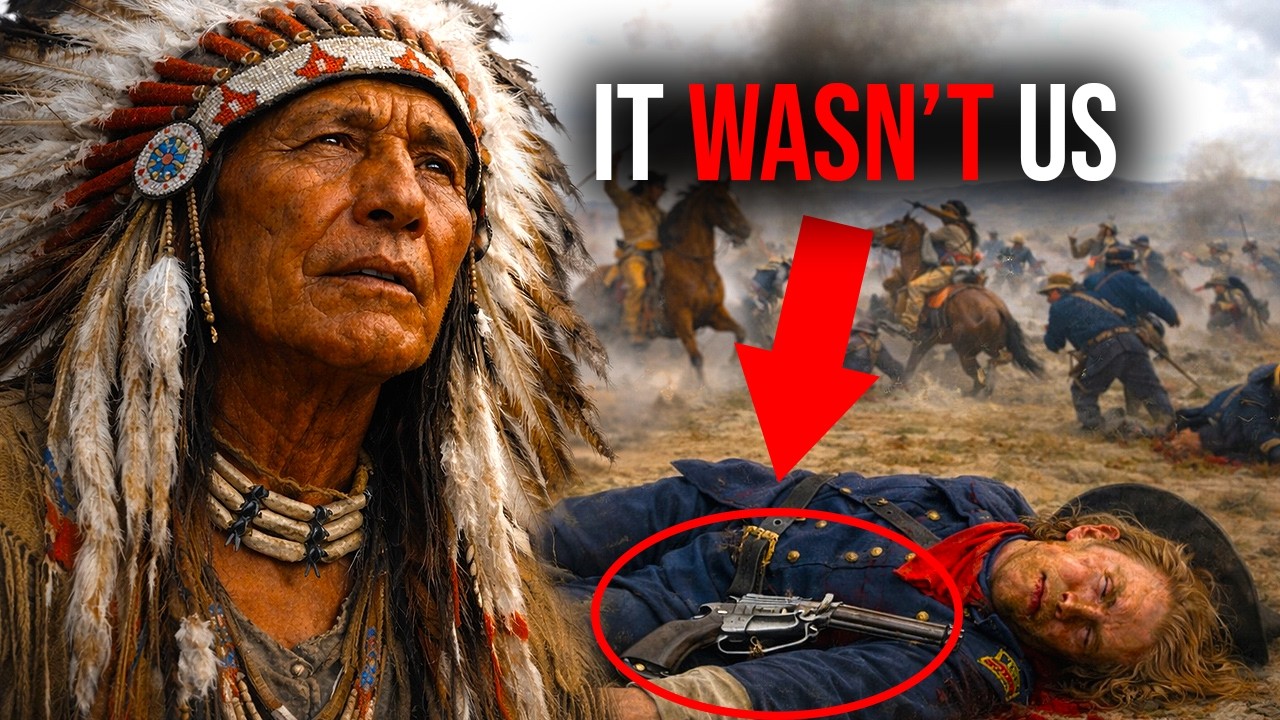
It was June 25, and the boy was a second cousin of Crazy Horse, an Oglala Lakota. He had just survived the Battle of the Little Bighorn, a fight America would spend more than a century trying to retell. For generations, Americans knew that day by one name: Custer’s Last Stand. It was painted, filmed, and mythologized as the noble end of a gallant officer.
But almost everything the public absorbed came from the losing side. The Lakota, Northern Cheyenne, and Arapaho told their own stories and were ignored, dismissed, or romanticized beyond recognition. Black Elk’s account was the most vivid and the most human of them all, and it shattered the myth entirely. The road to that valley began with a broken promise.
In 1868, the United States government signed the Treaty of Fort Laramie, guaranteeing the Lakota ownership of the Black Hills of South Dakota, land they held sacred. The treaty was clear. Then, in 1874, an expedition led by George Armstrong Custer confirmed gold in the Black Hills. Prospectors poured in by the thousands.
Instead of honoring the treaty and removing the trespassers, Washington demanded the Lakota sell or cede the land. When they refused, the government issued an ultimatum: report to designated reservations by January 31, 1876, or be declared hostile. Many bands refused. Sitting Bull’s Hunkpapa Lakota, Crazy Horse’s Oglala, the Northern Cheyenne, and the Arapaho gathered as they always had for their summer encampment, this time in the valley of the Little Bighorn River, a place they called the Greasy Grass for the thick vegetation along its banks.
They were not preparing for war. They were living their lives. The army launched a three-pronged campaign to force them onto reservations. It did not go well.
In March, Crazy Horse helped repel a cavalry attack on the Powder River. Then on June 17, just eight days before the Little Bighorn, he met General George Crook’s column of 1,300 soldiers at the Battle of the Rosebud. Crook was one of the most experienced Indian fighters in the army. Crazy Horse stopped him cold.
Crook retreated and played no further role in the campaign. A third column was on its way, led by a man with golden curls and a reputation for recklessness. Custer had graduated dead last in his West Point class of 1861, yet rose to brevet major general by age twenty-five through sheer audacity and a willingness to charge when other men hesitated. By 1876 he desperately needed a victory.
His career was tarnished by political scandal and a public dispute with President Grant. He was not riding toward the Greasy Grass with caution. He was riding with hunger. The American public never heard the Lakota side.
But Black Elk’s testimony, spoken decades later to the poet John Neihardt and published in 1932 as Black Elk Speaks, preserved what the victors actually saw. In late June, the Little Bighorn River cut through a wide valley in southeastern Montana, with cottonwoods lining the water and bluffs rising sharply to the east. Along the river, stretching for nearly three miles, sat the largest gathering of Plains Indians in living memory. This was not a war camp.
It was a summer congregation of families, elders, children, and horses grazing in herds so large they darkened the hillsides. Teepees stood in tribal circles, the Hunkpapa at the southern end, the Oglala further north, the Cheyenne and Arapaho beyond them. Black Elk’s family camped with the Oglala. He was a boy among warriors, watching, waiting.
Reliable scholarship places the number of warriors in that camp between 1,500 and 2,500. Many carried repeating rifles, Winchesters and Henrys captured or traded in previous engagements, alongside bows, lances, and war clubs. Some weapons had been taken from Crook’s men at the Rosebud just days earlier. These were not disorganized raiders.
Many were veterans of that fight and confident. Sitting Bull, the Hunkpapa spiritual leader, had recently performed a Sun Dance, offering pieces of his own flesh and falling into a trance. In that vision he saw soldiers falling upside down into the Lakota camp, tumbling headfirst from the sky like leaves. The people interpreted it as prophecy: the soldiers will come, and they will die.
East of the camp, Custer commanded roughly 600 men of the Seventh Cavalry. His immediate strike force, the column he would personally lead toward the village, numbered around 210. They carried single-shot Springfield carbines, powerful but requiring manual ejection and reloading after every shot, a critical disadvantage against repeating rifles. Custer refused Gatling guns because they would slow his march.
He refused additional cavalry reinforcements because he wanted glory for the Seventh alone. His Crow and Arikara scouts warned him emphatically that the village was enormous, far larger than anything they had ever seen. They told him there were more warriors in that valley than his regiment had bullets. Custer dismissed the warnings.
He was not worried about the size of the village. He was worried the Indians would scatter before he could attack. On the morning of June 25, he decided to attack immediately, without waiting for the other columns. General Terry and Colonel Gibbon’s force was still days away, and Crook’s column, though Custer did not know it, had already been defeated and withdrawn.
Custer split his regiment into three groups. Captain Frederick Benteen took 125 men to scout the bluffs to the southwest, effectively removing them from the coming fight. Major Marcus Reno took roughly 140 men with orders to cross the river and charge the village from the southern end. Custer himself took about 210 men and rode north along the bluffs east of the river, planning to strike from the opposite end in a classic pincer movement.
The plan required coordination between separated units, speed of execution, and a small, disorganized enemy. None of those conditions existed. Early that afternoon, Reno’s troopers came charging across the flats toward the Hunkpapa circle. There was a terrible moment of panic.
Women grabbed children and ran north. Men scrambled for weapons and horses, some still pulling on war shirts as they mounted. But the panic was brief. Chief Gall, the Hunkpapa war leader, rallied the defense with ferocious speed.
Some accounts indicate his wives and children were among the first casualties of Reno’s charge. Gall’s grief became a weapon. He organized a counterattack that closed on Reno’s men like a vice. Within minutes, the skirmish line buckled.
Reno ordered a retreat into timber, then a chaotic scramble across the river and up the steep bluffs to the east. Men were cut down as they fled. The retreat became a rout. Black Elk, from his position near the Hunkpapa circle, watched the chaos unfold, hiding briefly in the trees.
He was thirteen years old, and the world was exploding around him. Reno’s surviving men dug in on the blufftops, bleeding, disorganized, and effectively out of the fight. They would stay pinned there for a day and a half. With Reno neutralized, hundreds, then over a thousand warriors began streaming north along the river and through the ravines toward the sound of new gunfire.
Custer’s column had been spotted on the bluffs to the east. Crazy Horse moved through the ravines to the north and east with a force that cut off any possibility of retreat. From the west and south, more warriors surged up from the river. Riders poured through coulees, using the broken terrain to stay hidden until they were dangerously close.
On the ridge, the soldiers dismounted, some shooting their own horses and dragging the carcasses into rough circles as barricades. The Springfield carbines barked, one shot at a time, but the warriors were moving fast, firing from ravines and folds in the earth with repeating rifles. Dust rose in columns so thick they were visible for miles. The encirclement was complete.
No one was coming to save them. Black Elk moved toward the ridge with the mass of warriors. Dust and gunsmoke merged into a brown-gray fog. Fighters from both sides intermingled.
Then he saw the soldier on the ground, still alive, still kicking. The man had short hair, just a trooper, young and wounded. Black Elk approached. In his own words: he ground his teeth, and then Black Elk shot him in the forehead and got his scalp.
The dull blade caught on skin and hair. The soldier’s jaw clenched, teeth grinding against teeth, a sound Black Elk would carry to his grave. It was not bloodlust. It was a boy doing what the warriors around him were doing in a world where taking an enemy’s scalp was an act of honor.
He was becoming a warrior in real time. The fighting on the ridge reached its terminal phase. The remaining soldiers pulled into a shrinking perimeter at the top of the hill, crouching behind dead horses. Warriors fired arrows in high arcs that dropped behind the barricades.
Others charged on horseback, firing at close range, then wheeling away. The soldiers’ return fire grew thinner. Ammunition ran low. Some Springfields jammed as soft copper cartridge casings expanded in overheated barrels, and troopers clawed desperately at stuck rounds with their knives.
The weapons that were supposed to be their lifeline were failing in their hands. One soldier crawled away from the fighting and burrowed into thick brush on the slope below. The warriors shot arrows into the brush the way you would flush a rabbit. When that did not drive him out, they set it on fire.
The soldier emerged, stumbling and coughing. He never had a chance. The perimeter collapsed inward. The fighting became close, with war clubs, knives, and pistols discharged at arm’s length.
Some soldiers turned their weapons on themselves rather than face what was coming. Whether Custer died that way remains debated. Lakota accounts vary, and Black Elk did not claim to have witnessed his final moment. The firing sputtered, thinned, then stopped.
The entire fight on the ridge had lasted perhaps an hour, perhaps two. Bodies were stripped of weapons, ammunition, and clothing. Custer’s body, according to several accounts, was found with two wounds and relatively untouched. His famous golden curls were already gone.
He had cut his hair short before the campaign. The myth of the long-haired hero dying in a blaze of glory was false before the body was even cold. Black Elk walked back to camp in the fading light. He was thirteen years old.
He had killed. He had taken a scalp. He did not yet know that America would spend the next century pretending he did not exist. At dawn on June 26, approximately 210 soldiers of Custer’s immediate command lay dead on Last Stand Hill.
Not one survived. Including Reno’s fight and the hilltop siege, total United States casualties reached approximately 268 killed and 55 wounded. It was the worst defeat the army would suffer in the entirety of the Indian Wars. Lakota, Cheyenne, and Arapaho losses are harder to pin down, with estimates ranging from thirty to over one hundred killed.
The dead soldiers were left where they fell. The camp broke apart and flowed toward the Bighorn Mountains. A cry went up that soldiers were coming, and the people scrambled, only to laugh in relief when the approaching figures turned out to be Lakota warriors wearing captured cavalry uniforms, blue tunics and campaign hats stripped from the dead on the ridge. The battle was won, but the war was not.
The victory was used to justify everything that followed. Within two years, full-scale military campaigns crushed the remaining free bands. Crazy Horse surrendered in 1877 and was killed under suspicious circumstances at Fort Robinson. Sitting Bull fled to Canada, eventually returned, and was shot dead by reservation police in 1890.
The great buffalo herds were systematically slaughtered in a deliberate campaign to starve the people into submission. Then came Wounded Knee on December 29, 1890, when the Seventh Cavalry, Custer’s own regiment, surrounded a band of Lakota and opened fire, killing more than 250 people, most of them women and children. Black Elk’s account did not reach the broader public until 1932, fifty-six years after the battle. It was filtered through Neihardt, went out of print, and was largely ignored for decades.
Only in the late twentieth century, through Smithsonian research, archaeological excavation at the battlefield, and a new generation of scholarship, was his testimony fully recognized. Modern archaeology confirmed what the Lakota had been saying all along: the locations of bodies matched their oral history, and patterns of spent cartridges on the hillside confirmed the positions of warriors and soldiers. The unreliable voices turned out to be the most reliable sources of all. Black Elk grew into a holy man who spent his life trying to preserve the spiritual traditions of a people the United States tried to erase.
He stood at Wounded Knee when the Seventh Cavalry took its revenge fourteen years after the Greasy Grass. Through all of it, he remembered. The peace they fought for never came.
The age of the free Lakota ended not in the valley of the Greasy Grass, but in the decades that followed, slowly, deliberately, and with the full weight of a nation that could not forgive them for winning.