William Anderson killed more men in eighteen months than most Confederate regiments killed in four years of war. He never held a formal command in the Confederate army. He fought no set-piece battles, obeyed no chain of command beyond his own temper, and left behind a body count Union officers themselves struggled to calculate. By the fall of 1864, his name alone was enough to empty a Missouri town before he ever rode into it.
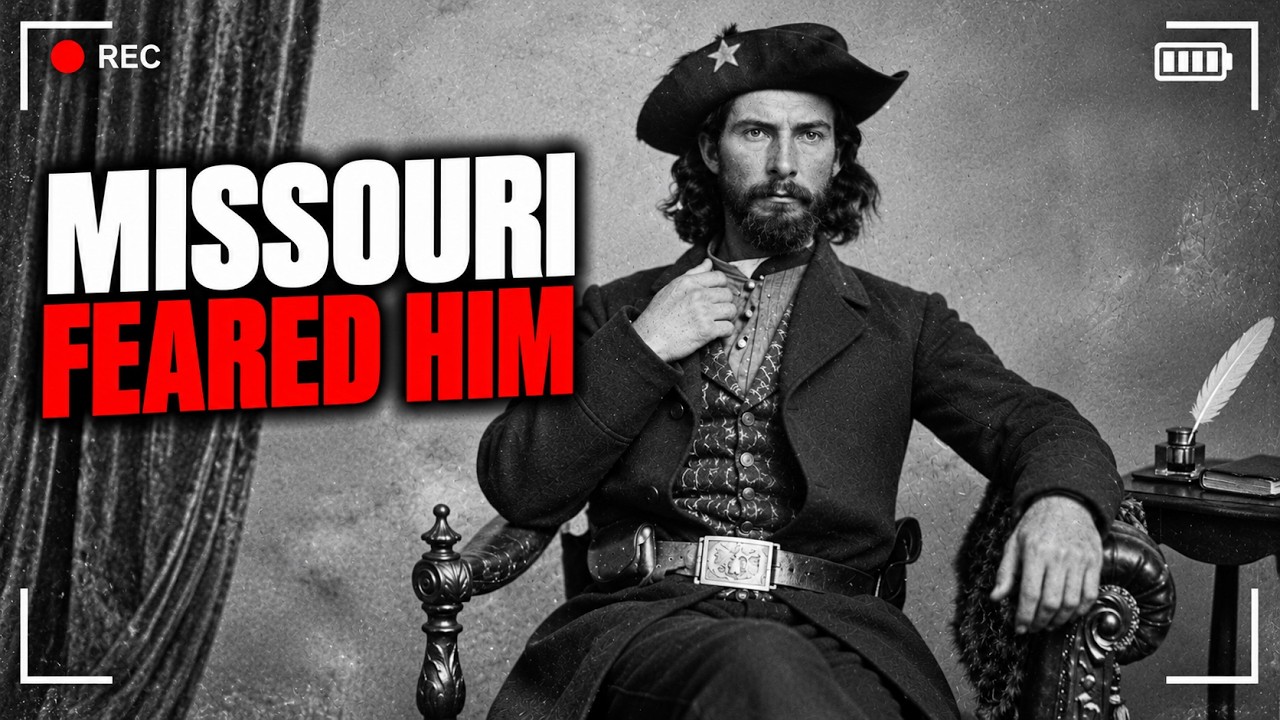
Born around 1839 or 1840 in Hopkins County, Kentucky, Anderson came from a family with no slaves and no fortune, but with a fierce pro-slavery conviction. His father, a hatmaker turned trader, moved the family west, first to Huntsville, Missouri, and then in 1857 to the Kansas border country near Council Grove, chasing the freight and horse-trading business booming along the Santa Fe Trail. That border was not peaceful ground. It was the front line of Bleeding Kansas, where pro-slavery settlers and free-state militias had been burning each other’s homes and shooting each other’s neighbors for years before the Civil War officially began.
Anderson grew up watching that war before it had a name. He learned early that on the border, the law was whoever arrived first with a gun and a claim. By his early twenties, Anderson was already a horse thief, running stolen animals down the Santa Fe Trail and selling them to whoever paid best, Union or Confederate. It made no difference to him.
In 1862, his father was killed in a confrontation over a horse with a man named Baker. Anderson and his brother Jim answered that death the way the border had taught them to answer it. They killed Baker, burned his house, and fled Kansas for Clay County, Missouri. When the war broke out, that skill set translated easily into guerrilla life.
In 1862, Anderson formed his own small band of raiders and began working the Kansas-Missouri border. Asked later why he chose that life, he said he had chosen guerrilla warfare to revenge himself for wrongs he could not honorably avenge otherwise. The Yankees, he claimed, had sought his life, failed to get him, and taken it out on his father and his property instead. That winter and spring, he moved between hideouts on both sides of the line, living off families who either believed in the cause or feared what refusal would bring.
In 1863, he folded his men into the guerrilla company run by William Clark Quantrill, the most notorious bushwhacker chieftain in the West. Under Quantrill, Anderson learned a style of warfare that had almost nothing to do with the war being fought in Virginia and Tennessee. There were no uniforms, no formal engagements, no rules of quarter. There was ambush, arson, and execution carried out by men who knew the local roads better than any regular army ever could.
Quantrill was older, colder, and more calculating. Anderson was younger, faster to anger, and already developing a reputation among the other riders as the man who did not stop when the shooting was finished. Then came Lawrence. In August 1863, Quantrill led somewhere between two and four hundred guerrillas into the free-state town of Lawrence, Kansas, and over the course of a single morning, they murdered between 150 and 200 men and boys, many of them dragged from their homes in front of their families.
Anderson rode with him. Witnesses later said he was among the most relentless killers that day, shooting men who begged and boys who ran, claiming afterward that he was there for revenge and that he had gotten it. The Lawrence raid was already one of the deadliest massacres of civilians in the entire war, and Anderson’s role in it marked him as one of Quantrill’s most effective and most feared lieutenants. But even before Lawrence, something else had already been building in him, something Union authorities in Missouri had done more than any Confederate leadership could offer to put there.
Weeks before the raid, Union General Thomas Ewing ordered the arrest of women connected to known guerrillas, using them as leverage against their male relatives. Among the women imprisoned in a makeshift jail in a three-story brick building on Grand Avenue in Kansas City were three of Anderson’s sisters: Josephine, Mary, and young Jenny, sometimes called Martha. The building was already unsafe. Guards had reported cracks, and an adjoining structure was being altered.
On August 13, 1863, the walls gave way. Josephine, fourteen or fifteen, was crushed to death in the rubble. Jenny’s legs were broken, leaving her crippled for life. Mary was badly injured.
Other women died with them, sisters and cousins of men who rode with Quantrill. Historians still argue over whether Union soldiers undermined the building on purpose or whether neglect and a rotten wall did the work for them. What is not seriously disputed is that the collapse hardened Anderson into something even Quantrill’s men found disturbing. Eight days later, he rode into Lawrence.
That October he was with Quantrill again at Baxter Springs, where the guerrillas smashed a Union column under General James Blunt and killed scores of men who never had a chance to form a line. By the spring of 1864, Anderson had broken from Quantrill entirely, taking his most loyal men and forming his own independent company. The split was personal as much as tactical. Quantrill wanted control.
Anderson would not take it. He no longer answered to anyone. What followed was the bloodiest single season of his life. Anderson’s band cut a trail across central Missouri that summer, raiding towns, burning rail lines, robbing stagecoaches, and killing Union soldiers and civilians with a method that set him apart even among guerrillas already used to brutality.
In July, they hit German settlements in Lafayette County. In August, they failed to take Fayette and lost men doing it. Near Rocheport, they killed soldiers and teamsters and left the bodies where they fell. Anderson began scalping the men his band killed, tying the scalps to his horse’s bridle as trophies, and his men followed his lead.
Union officers who recovered the bodies of soldiers killed by Anderson’s company described mutilations that went beyond anything they had documented from other guerrilla units in the state. Ears cut away. Faces ruined. It was during this stretch that newspapers on both sides began using the name that would outlive him: Bloody Bill.
He was still only twenty-four. The men who rode with him were often younger. Among them for stretches of that year were Frank James and his sixteen-year-old brother Jesse. They learned from Anderson the craft that would later make them famous in a different kind of war: how to stop a moving target, how to strip a man of his weapons before he understood what was happening, how to leave a place before the regulars arrived.
The single event that defined his legacy came on September 27, 1864, in the small railroad town of Centralia, Missouri. Anderson led somewhere between sixty and eighty men into the town that morning, some of them wearing stolen Union coats. They looted stores, drank what they found, robbed a stagecoach, and terrorized residents while they waited for a scheduled train. Union congressman James Rollins was among the passengers who narrowly escaped execution only by giving a false name and hiding until the guerrillas moved on.
When the North Missouri Railroad train pulled into the depot, Anderson’s men stopped it and pulled all the passengers off the cars. Among them were roughly twenty to twenty-four Union soldiers, unarmed and traveling home on leave after fighting in the Atlanta campaign under Sherman. Anderson had the soldiers separated from the civilians and ordered them stripped of their uniforms. Then he asked for a volunteer, someone who would presumably be spared to carry a message.
Sergeant Thomas Goodman stepped forward. Anderson kept his word on that one point and spared him. Goodman would spend weeks as a prisoner, the only man Bloody Bill is known to have taken alive and kept, and he later wrote one of the few firsthand accounts of what it was like to ride with that company after the killing was done. Every other soldier in that group was shot where he stood.
Anderson told them the Federals had killed and scalped men from his own command and left them on the prairie, and that from that day he would ask no quarter and give none. Witnesses in the town later reported that the bodies were scalped and mutilated after the killing. A German civilian in a blue shirt was shot with them. The train itself was set on fire and sent rolling down the tracks toward Sturgeon.
Frank James later said the mail car held more than thirteen thousand dollars. The depot burned behind them. That afternoon, Major A. V.
Johnston led about 155 men from the 39th Missouri Infantry in pursuit of Anderson’s band, tracking them to a camp southeast of town. Johnston’s men were mounted infantry, many of them on plow horses and mules, armed for a fight they thought they understood. What Johnston expected to be a straightforward punitive strike turned into one of the most lopsided defeats any Union force suffered against irregulars during the entire war. Anderson used a small party as bait on the open prairie, knowing Johnston would see them and come on.
When the Federals reached the middle of the field, the rest of the guerrillas rose from cover and charged from three directions with revolvers in both hands. They were better mounted and more experienced in this specific kind of fighting. They overwhelmed Johnston’s line in minutes. Nearly the entire Union detachment was killed, many after they had already tried to surrender.
Johnston himself was shot and then scalped. Combined with the massacre at the depot that morning, the day’s toll approached 150 Union dead. Some of the dead were mutilated in ways Union burial details would not forget: heads moved to the wrong bodies, ears taken, worse things done that the official reports recorded and then tried not to dwell on. Centralia made Anderson infamous even by the standards of a war that had already produced Quantrill and the Lawrence Massacre.
It also marked the peak of what he would ever accomplish. In the weeks after, while Sterling Price’s army tried and failed to take the state from the east, Anderson kept doing what he had always done: cutting telegraph wire, wrecking track, and forcing Union commanders to peel companies off the main fight to hunt a band they could not find until it wanted to be found. He rode to meet Price during that invasion. Price is said to have told him that with fifty thousand men like Anderson, he could hold the state.
It was a compliment that cost Price nothing and gave Anderson a moment of recognition from the regular army he had never joined. Union commanders in Missouri, already stretched by that same invasion, made hunting Anderson down a direct priority. They did not need to wait long. On October 26, 1864, Union militia under Lieutenant Colonel Samuel P.
Cox laid a deliberate trap near the town of Albany in Ray County. Cox was a former scout who understood how guerrillas fought. A local woman rode into his camp and told him where Anderson was. Cox positioned dismounted troops as bait, knowing Anderson’s guerrillas favored aggressive mounted charges against exposed infantry.
When Anderson’s band attacked the position, mounted Union cavalry held in reserve swept in from the flank. Anderson charged directly through the Union line during the engagement, a tactic that had worked for him before, yelling and firing as he came, wearing a white hat with a black plume, a richly embroidered guerrilla shirt, and four revolvers on his belt with two more across the saddle. This time, he rode straight into a wall of concentrated fire. He was shot twice in the head, once behind the left ear and once in the temple, and killed almost instantly.
Another rider who broke the line with him was found dead the next day. Anderson was twenty-four years old. What happened to his body afterward tells almost everything about how thoroughly Missouri wanted the state and the country to know he was gone. Union soldiers propped his corpse upright for a photograph by Richard B.
Kice of Richmond. A pistol was placed in his hand, the embroidered shirt still on him. The image was reproduced and circulated as proof. His pockets and saddle were searched.
They found human scalps among his possessions, a scalp tied to the bridle of his iron-grey mare, and a cord reportedly knotted with numbers representing men he claimed to have killed personally. Some accounts say soldiers cut off a finger to take his ring. Some say he was decapitated and the head displayed on a telegraph pole. Historians still dispute how far the mutilation went and how much of it is legend piled on top of a photograph that was already enough.
What is not disputed is that the body was paraded through Richmond and then buried in Pioneer Cemetery in an unmarked grave that went unrecognized for decades before local historians identified and marked it in the twentieth century. Anderson never held a Confederate military commission that Richmond formally sanctioned in any meaningful sense. He operated in a category of the war that both sides found convenient to disown when it suited them and useful when it did not. The Confederacy benefited from the chaos men like Anderson and Quantrill inflicted on Union supply lines and Unionist communities in Missouri, tying down federal troops that could have reinforced armies in Georgia and Virginia.
But Confederate leadership rarely claimed these men as their own in any formal military sense. After the war, some former guerrillas, including men who had ridden with Anderson, were treated by both former Confederates and Union authorities as something closer to outlaws than soldiers. Frank and Jesse James, who rode with Anderson at Centralia, would go on to build an entirely different kind of postwar notoriety, one that in some ways began exactly here, in the discipline of ambush and quick, ruthless violence that Anderson had taught them on the Missouri border. The guerrilla war Anderson fought was in its way a preview of a kind of conflict later generations would recognize by other names.
It had no fixed front. It blurred the line between combatant and civilian until that line barely existed. Missouri counted its Civil War dead differently than most other border states because so much of the killing there happened off any official battlefield, in farmhouses and rail depots and small towns like Centralia that never appear in the grand narratives of Gettysburg or Antietam. Regular armies measured success in miles of railroad held and capitals threatened.
In Missouri, the measure was whether a county still had enough men left to plant a crop and whether a family would open the door after dark. William Anderson’s story resists the neat moral arcs that make for comfortable history. He was shaped by real grievance, by a Union policy that imprisoned women and, whether by negligence or design, got one of his sisters killed. His father was dead.
His property was gone. The border had been teaching him the same lesson since childhood. But whatever grief lit that fuse, what followed was not justice and was not warfare in any conventional sense. It was a young man who discovered he had a talent for killing and pursued that talent with an intensity that outpaced every guerrilla he rode beside, including the men who trained him.
In eighteen months, he built a body count and a reputation that Missouri would not fully reckon with for generations. When he died at twenty-four, shot through the head on a battlefield of his own choosing, the state that had hunted him for over a year made sure everyone knew it and made sure the photograph proved it. Bloody Bill Anderson did not survive the war he helped make so brutal.
But the war he fought and the tactics he perfected in fields and railroad towns most Americans have never heard of outlived him by more than a century.