On December 12, 1941, five days after the attack on Pearl Harbor, a telephone rang at Third Army headquarters in San Antonio, Texas. The call was for Brigadier General Dwight Eisenhower, a staff officer almost nobody outside the army had heard of. The voice on the other end was Colonel Walter Bedell Smith, calling from Washington.
The message was brief: General George Marshall wanted Eisenhower in the capital immediately. No explanation was offered.
Eisenhower had never commanded troops in combat. He was known, if at all, for paperwork, logistics, and the quiet discipline of staff work. He did not ask why.
He packed a small bag and boarded a train east.
To understand the call, it helps to understand the man. Eisenhower was 51 years old and had spent more than a quarter century in the army. He had only received his first star in September 1941, after years as a lieutenant colonel and colonel.
His career had been built on unglamorous staff work across posts in Panama, Washington, and the Philippines.
His recent performance in the Louisiana Maneuvers had caught Marshall’s attention. That exercise, the largest peacetime military operation in American history, had pitted two field armies against each other across the swamps and pine forests of Louisiana. Eisenhower served as chief of staff for Third Army, translating vague strategic goals into clear orders for tens of thousands of soldiers.
He thrived in the chaos, breaking overwhelming problems into smaller, solvable pieces.
But the maneuvers alone did not explain the summons. The deeper reason lay in Eisenhower’s four years in the Philippines, from 1935 to 1939, where he served as principal military assistant to General Douglas MacArthur. He had spent those years helping build a Filipino National Army from almost nothing.
He learned the islands’ geography, its beaches, its mountain passes, and the painful gap between what the Commonwealth could afford and what genuine defense required.
Now, in December 1941, the Philippines were under direct Japanese attack. Japanese aircraft had struck Clark Field within hours of Pearl Harbor. Landings on Luzon were underway.
MacArthur, the man Eisenhower had once served, was now tasked with defending the islands against an overwhelming invasion. Somewhere in Washington, someone needed to think through what could realistically be done. Eisenhower was one of the few officers who understood the terrain, the men, and the specific character of the crisis.
Washington in December 1941 was a city running on adrenaline and insufficient sleep. The Munitions Building, which housed much of the War Department, hummed late into the night. Eisenhower arrived on December 14 and reported directly to Marshall’s office.
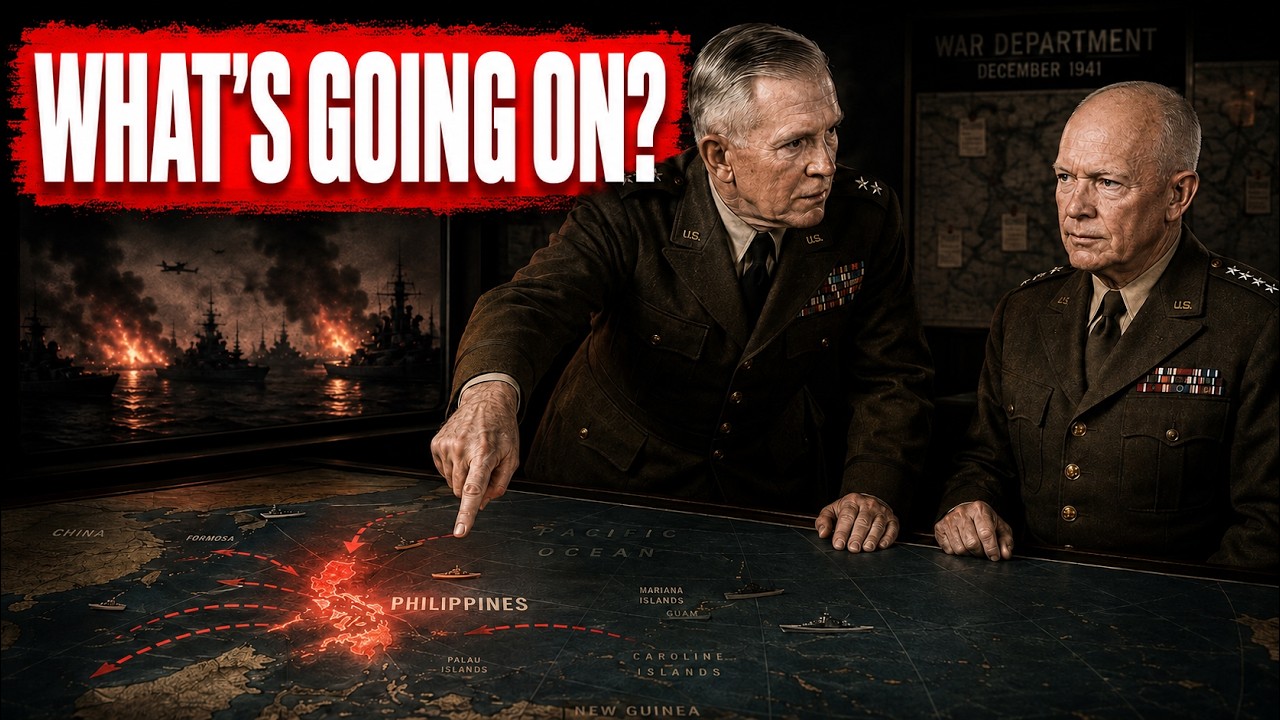
Marshall wasted no time. He briefed Eisenhower on the grim situation in the Pacific. Then he asked a question that would define the rest of Eisenhower’s career: What should America’s general line of strategy be?
It was a deceptively simple question. Marshall offered no hints. Eisenhower asked for a few hours to think it over.
Marshall granted the request.
Alone with a blank pad of paper, Eisenhower worked through the problem. He knew from his years in the Philippines how limited American resources there actually were. He knew the distances involved and the vulnerability of any relief convoy crossing the Pacific under threat of Japanese naval and air power.
He filled sheet after sheet with figures, crossing out lines and starting again.
The conclusion was difficult. The Philippines could not be reinforced or relieved at the scale MacArthur and the American public hoped for. A large-scale rescue was effectively impossible in the near term.
Yet Eisenhower argued everything humanly possible must still be attempted, not to change the military outcome, but because abandoning the appearance of effort would damage American credibility with allies and the Filipino people.
Marshall listened without interrupting. When Eisenhower finished, Marshall told him simply that he agreed.
The exchange was brief, but something important sat underneath it. Marshall had not asked the question because he lacked an opinion. He was testing whether this unproven brigadier general could arrive independently at a difficult truth under real pressure and deliver it without flinching.
Eisenhower had passed the test.
Marshall then explained his philosophy. Washington, he said, was full of officers skilled at explaining problems. They could analyze a situation from every angle and then stop, waiting for someone above them to make the actual decision.
What Marshall needed was different. He needed officers capable of taking a problem, working through it on their own authority, and returning with a decision already made.
In the space of one afternoon, Eisenhower had shown he belonged in that circle.
The consequences moved quickly. Eisenhower was assigned to the War Plans Division, working specifically on the defense of the Pacific. This made the Philippines problem deeply personal.
MacArthur continued to press Washington for reinforcement, for aircraft, for ships. Eisenhower was one of the officers working to determine honestly what portion of that support could actually be delivered.
The friction between the two men was quiet, embedded in memoranda and careful phrasing. Eisenhower had to weigh every reply twice, once for strategic accuracy and once for how it would land on a proud commander not accustomed to being told no. He could not fully convey why Washington could not simply produce ships and aircraft out of scarcity.
All he could do was keep working the numbers as honestly as he knew how.
In late December 1941 and into January 1942, President Roosevelt and Prime Minister Winston Churchill met in Washington for the Arcadia Conference, the first full wartime summit between the two Allied leaders. Churchill had crossed the Atlantic at real personal risk. The conference established the Combined Chiefs of Staff and formally affirmed the principle of Germany First, the decision that defeating Nazi Germany would take strategic priority over the war against Japan.
Eisenhower did not enter those rooms as a principal participant. But the work feeding into them ran directly through the War Plans Division. He spent those weeks producing analysis, translating raw military reality into clear assessments that senior leaders could act on.
Churchill, moving through Washington, encountered some of this work and found it coherent, carefully reasoned, and grounded in realistic appraisal.
By the end of January 1942, less than two months after that first telephone call, the shape of Eisenhower’s career had become unmistakable. Marshall kept routing specific problems to him, asking for his read on situations before others, including him in meetings a brigadier general of his seniority might not ordinarily attend. There was no announcement, only the accumulating weight of being the officer Marshall kept turning to.
In February 1942, Eisenhower was named chief of the War Plans Division. On February 28, he produced a memorandum laying out the essential requirements for Allied strategy. It identified three non-negotiable requirements: Britain must be maintained and strengthened as a base of operations; a junction between German and Japanese forces must be prevented; and the Soviet Union must be kept in the war.
The memorandum pointed toward a specific conclusion. If those three requirements held, the Allies needed to concentrate their available force in northwestern Europe as quickly as practical, building toward an eventual invasion across the English Channel. It was an early articulation of the strategic logic that would culminate in the landings at Normandy more than two years later.
Marshall read the analysis and agreed. He adopted its logic as the foundation for his own arguments in negotiations with British military leadership, who pushed back hard against the pace of a cross-channel assault. Marshall held his ground, armed with Eisenhower’s clear articulation of why delay carried its own serious risks.
On March 27, 1942, Eisenhower was promoted to major general, a second star arriving barely six months after his first. In April, the War Plans Division was reorganized into the Operations Division, and Eisenhower became assistant chief of staff for operations, placing him at the very center of how the army planned and executed a global war.
In May 1942, Marshall sent Eisenhower to London on a special mission to assess the state of American and British planning firsthand. Eisenhower handled the assignment with the same methodical thoroughness that had defined every previous test. He listened more than he talked, absorbing the concerns of British commanders who had already endured years of war, and translated what he learned into assessments Marshall could use.
In June 1942, Marshall made the decision that would define the rest of Eisenhower’s public life. He named Eisenhower commanding general of the European Theater of Operations.
The scale of the appointment is difficult to overstate. Six months earlier, Eisenhower had been a chief of staff for a single field army, known to almost no one beyond a narrow circle of fellow officers. Now he stood at the head of the American military effort in Europe, responsible for coordinating the buildup of forces that would eventually carry the war across the English Channel and into Germany itself.
None of it happened because Eisenhower campaigned for it. It happened because a telephone rang in San Antonio five days after Pearl Harbor, because a demanding chief of staff decided to test an unproven brigadier general with a single difficult question, and because that officer chose to answer honestly rather than comfortably.
Marshall could not have known in December 1941 how far this particular chance would carry the man he summoned from Texas. He was not selecting a future supreme allied commander. He was simply looking for an officer capable of answering one very difficult question honestly under real pressure.
Everything that followed grew outward from that single narrow test.
The Philippines itself would fall to Japanese forces in the months that followed, Bataan surrendering in April 1942 and Corregidor in May. It was a defeat Eisenhower’s own honest assessment had anticipated as the most likely outcome. For Eisenhower, who had spent four formative years there and knew men who were now marched into captivity, it could not have been an abstract line in a briefing paper.
The story of the telephone call and the question that followed is not simply the story of one officer’s rapid promotion. It is a case study in how George Marshall built the command structure that would fight and win the Second World War. He identified, tested, and elevated a small number of officers based on a specific and demanding standard: the willingness to take responsibility, to think clearly under pressure, and to deliver honest answers even when those answers were unwelcome.
Eisenhower met that standard in a single afternoon in December and continued meeting it, assignment after assignment, until the unknown brigadier general from San Antonio became the general who would command the liberation of Europe. A transformation that began not with a battlefield victory or a moment of public acclaim, but with a single ringing telephone, a quiet office in Washington, and one difficult question asked five days after Pearl Harbor.